Something Different

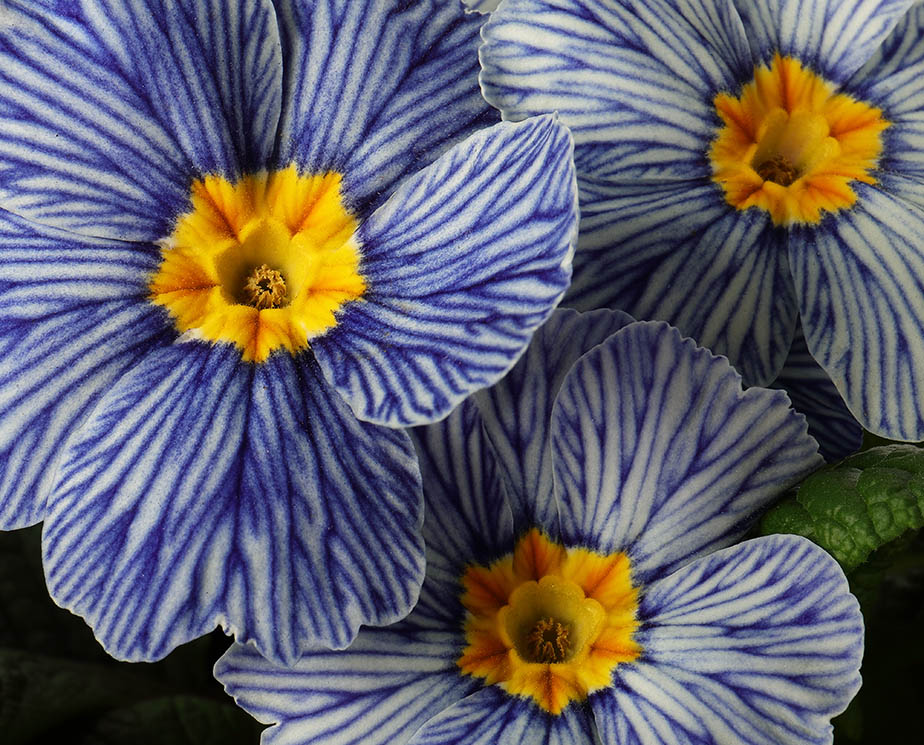
Blue-veined flowers of primrose 'Zebra Blue'.

As spring approaches, there are new stocks of plants coming into garden centres and other plant-sellers, such as supermarkets and market stalls. After winter, it’s a huge delight and an even bigger temptation to see all these fresh plants that are just waiting for us to buy them.

There are the usual bulbs – snowdrops, crocuses, irises and daffodils. And at the moment there seems to be a huge number of primulas (or primroses) everywhere, in just about any colour you might want. They glow brightly at you, flaunting their brilliance and offering themselves as a cheerful reassurance that spring must be almost here.

Like many others, I found myself wandering past these happy little plants, wondering which would be the most uplifting addition to the winter-weary borders in my own garden. Unexpectedly, I came across one that I haven’t seen before and which intrigued me much more than the gaudier varieties…a stripy-flowered primrose!
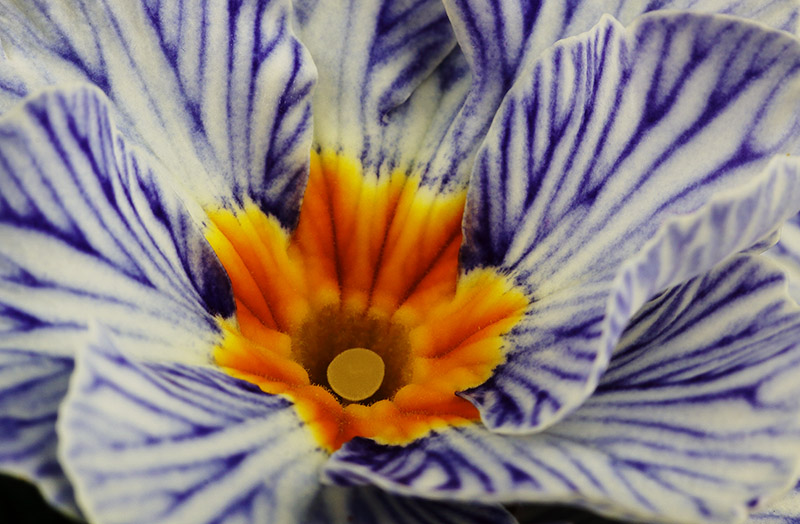
Macro photograph of Primula acaulis 'Zebra Blue'
The yellow centre is a striking contrast to the blue and white petals.

The primrose I bought turned out to be ‘Zebra Blue’. It has white petals which are veined with a wonderfully deep blue (which looks rather as if ink has been spilled onto the flowers and gradually crept along the veins). The deep orangey-yellow centres are the perfect contrast to offset the blue and make the flower very eye-catching indeed.

Most of the flowers and plants that I buy are seen as potential subjects for my photography. A flower with markings like these is an ideal source of inspiration for an afternoon spent experimenting with different compositions.

The prominent veining of the petals and the vibrant contrast of the centre of the flower makes this primrose a very bold subject. It’s easy to use the patterns produced by the veins to create a rather abstract feel. But, because some of the flowers have a more muted colouration, with much paler veining (sometimes becoming a lighter, more denim-blue), there is the option of creating a softer, more gentle image too. I have only just started exploring where this little flower may lead my photography and I reckon that I need to spend a few more hours in it’s company…what fun!
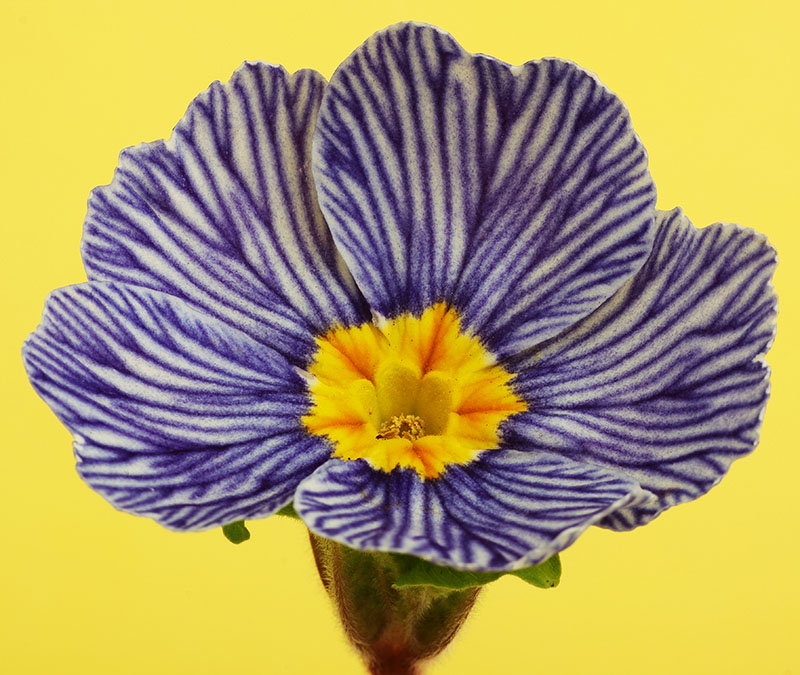
Blue-veined primrose flower against a yellow background.
I used a contrasting yellow background to give a bolder image in this photo.

Glorious Green: Ferns

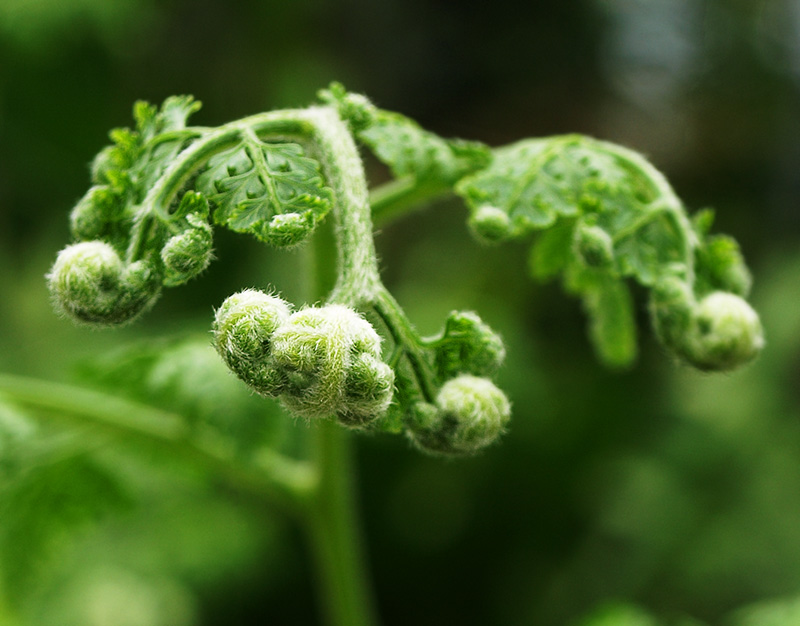
A tightly-curled young fern frond.

By this stage of winter, the idea of lush green growth is tremendously appealing. It’s easy to dream of densely-planted borders bursting with re-emerging life – new shoots, unfurling leaves, and buds that swell with the promise of flowers soon to come.

Amongst all this imagined greenery, ferns would be an excellent addition. Their finely-cut fronds would contrast well with larger, more solid leaves and would bring their delicate textures and a subtle feel of pattern to the border.

Hairy reverse of young fern-frond.
The young fronds are very hairy on the back. They look almost furry!

For photography, ferns make an excellent subject. There’s lots of pleasing detail, especially in the new foliage. The tightly-wound curls of the young fronds are especially photogenic and the outside surface of the curl (the back of the frond) can be surprisingly hairy and looks soft to touch.

(Saying that has made me realise that I didn’t actually touch them. I could have put out a finger to stroke the back of a curl, but I didn’t. Perhaps I should have. Taking photographs can absorb you so that you forget to interact with plants – or a garden – in ways that you would do, if you were walking around without a camera. So maybe I need to leave my camera in its bag for a while and explore the garden, before I start to take photographs.)

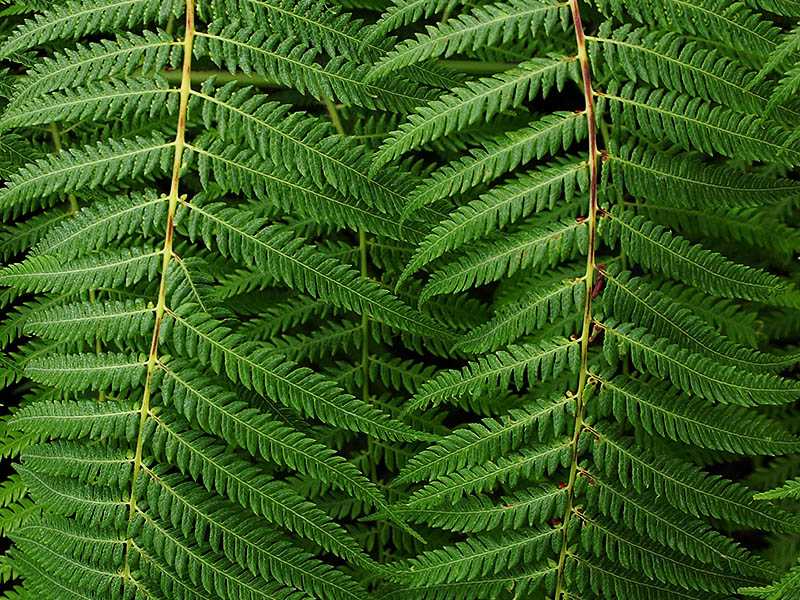
Fern leaves.
Fern leaves can add some texture and pattern to garden borders.

In my real garden (as opposed to the imaginary borders where anything will grow), it is too hot and dry for most ferns. The Male Fern (Dryopteris filix-mas) is reckoned to be able to cope with drier conditions than most, but that is if it’s in the shade. Most of our garden gets a lot of sunshine, but there is one area that is shaded by the house in the afternoon. Now I am wondering if that bit of ground might be suitable for making a bog garden and I’m imagining the other moisture-loving plants that would also be happy there. (Though there are ferns that don’t need such damp soil.)

If I do go ahead with this idea, the beautiful green growth of ferns would be a very satisfying reward. (Meanwhile, my imaginary garden is flourishing!)

Fern fronds with curled tips.
The curly tips of the fronds of this fern look unusual.

A Waiting Time…

Frosted violets

This is the time of year when everything seems to be waiting for spring. Here and there the tips of leaves are starting to show where bulbs will flower. And the flowers that have made it through the chilly months so far are starting to go over.

We don’t have many winter-flowering plants here (yet). The few that there are, give a bit of cheer and encouragement when we step outside and keep us company as we get some work done in the garden. They also give me something to photograph, although I feel that I really need to grow more winter-flowering plants to keep myself inspired. (I have recently planted a couple of Clematis cirrhosa varieties. They’re just tiny plants as yet but one does have a couple of buds…)

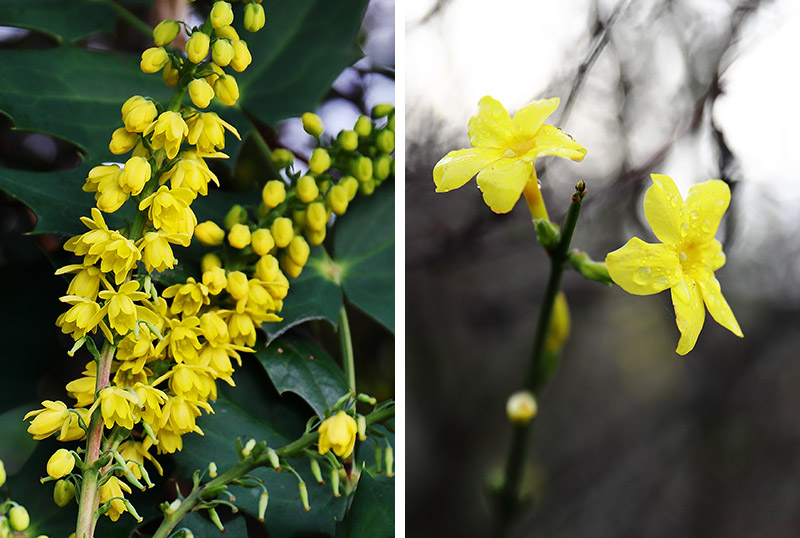
Mahonia (left) and winter jasmine (right).
Winter sunshine – a splash of yellow from a mahonia (left) and winter jasmine (right).

The flowers of Mahonia japonica, despite being past their best, still give a yellow glow from right at the back of the garden. It’s a beast of a shrub to weed around or (if feeling brave) to prune because its leaves are extremely prickly but it makes up for this with its reliable winter colour and the bold shape of its leaves. The yellow jasmine, though, has finished flowering ’til next year. It’s tiny yellow flowers disappeared suddenly during the last week, leaving what feels like a very empty space on the fence that supports it.

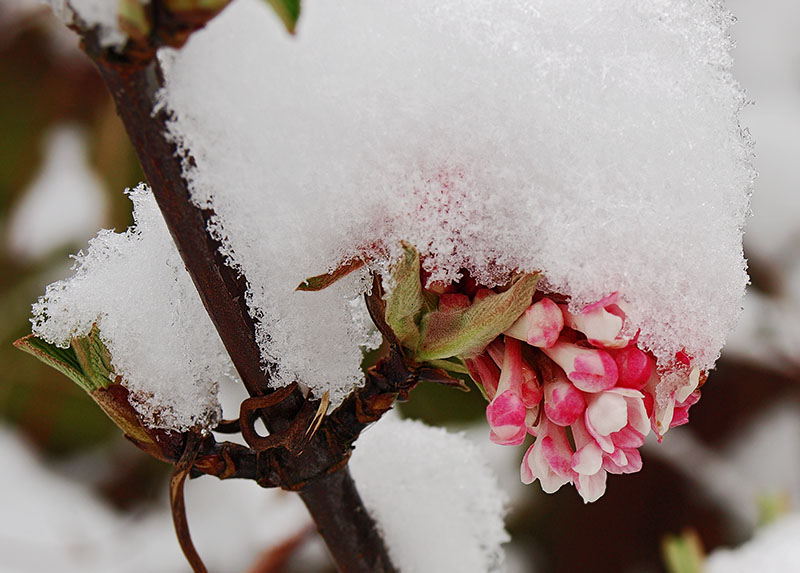
That bit of the garden feels even emptier now because the Viburnum bodnantense ‘Dawn’ that grows nearby has also finished flowering. (It’s in the photograph below, but this isn’t a recent picture – we haven’t had any snow here yet.)

Snow-covered Viburnum bodnantense flower.
Viburnum flowers can cheerfully ignore the snow.

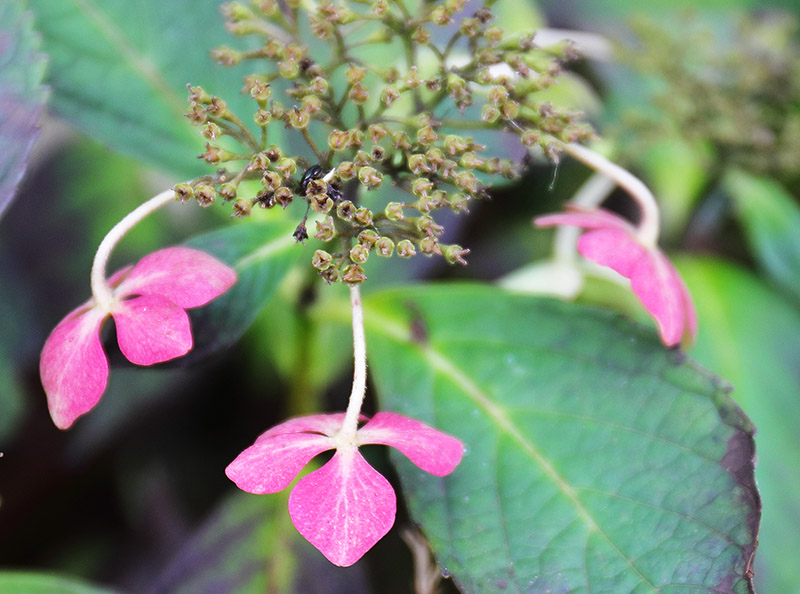
Some flowers have managed to hang on past the time they would normally be gone. The flowers of the hydrangea in the photo below managed that quite literally, but, since the frosts in the last couple of weeks, have now all turned brown. That little dash of pink was welcome while it lasted.

Hydrangea flowers in winter.
The last few pink hydrangea flowers hung on, until the frost turned them brown.

Another hanger-on was scabious. Tiny little red or pink flowers continue, just one or two per plant, wherever they have seeded themselves around the garden. They make a delightful discovery as you wander round the garden on a winter day. And they show that, despite all the dead stems and foliage around the rest of the garden, plants are still growing and thriving, no matter what the weather may feel like. Life in the garden flows on as we wait for spring.

Frosted pink Scabious
This little scabious flower is almost entirely iced-up.

Winter Jewels

Frosted Agapanthus seed-head

There have been a few frosty mornings recently. This morning’s was one of the heaviest frosts so far, the other was on Christmas Day. Both were still and silent, as if the cold was somehow transfixing not just the frosted plants, but sound and movement too.

These are the mornings that feel special in the winter garden. Camera in hand, it’s time to explore this frozen world of new creations. Old seed-heads and dead foliage are transformed into glittering sculptures that will last only until the sun erases them. It’s an ephemeral world – cold and quiet and unfamiliar.

Frosted allium seed-heads
Frost has created tiny firework bursts from these alliums

I always hope that some of the more interesting seed-heads will last long enough to become frosted. This year the weather has been kinder than most winters and there has been little in the way of strong winds or heavy rain. So the seed heads of agapanthus and alliums have kept their frail structures intact and are even holding onto quite a few of their seeds still.

It’s exciting to find out what the frost has been up to in the garden. There are all sorts of little gems waiting to inspire a close-up photograph. The cold makes it hard to linger for long, but it’s worthwhile. For the work of the frost has made it possible to photograph something delicate and transient and, once winter has gone, it will be a long time before the opportunity returns.

Hydrangea petiolaris with frost.
Hydrangea petiolaris with a light touch of frost.

It doesn’t take a lot of frost to create something to photograph. The plants in the centre of the garden, where it is more open, get a lot of frost but those towards the edges are sheltered by fences and evergreen shrubs. The climbing hydrangea in the photo above has a fairly protected position. But its dead flower-head has had enough frost to line the edges and pick out the veins of the larger petals. The tiny flowers in the centre of the head have been turned to lace – an effect that will vanish as soon as the frost melts.

Wild carrot (Daucus carota) covered with frost
Wild carrot (Daucus) was sown late to catch the frost

Sometimes there are still a few flowers left in the garden for the frost to embellish. I had sown some wild carrot seeds much later than normal, in the hope that the plants might still be around when the frosts came. So the frost turned the flowers that were left on the plants into little ice-encrusted embroideries, just waiting to be photographed up close.

Other flowers aren’t really supposed to be around when the heavy frosts arrive. The Anemone coronaria below was too eager to flower. (Last year’s flowers were much later – probably sometime in February.) The mild weather in December persuaded them to put in an early appearance but the flowers couldn’t last long once things turned more wintry. Never mind! The flower may have ‘gone over’ quickly but for just a short time, the frost has turned it into something wonderful, and allowed it to add a little magic to the garden.

Anemone coronaria, covered in frost
This Anemone coronaria flowered very early and got thoroughly frosted.

Colour for a Grey Winter’s Day

Moth Orchids (Phalaenopsis)

I’ve been saving this group of orchid photographs for this month. There’s not a lot to photograph in the garden at the moment. (But I have taken photos of the few flowers that are out there – that will be another post.)

At this time of year, it lifts the spirits to have some flowers indoors. And it’s nice to have something to aim a camera at without getting damp and chilled.

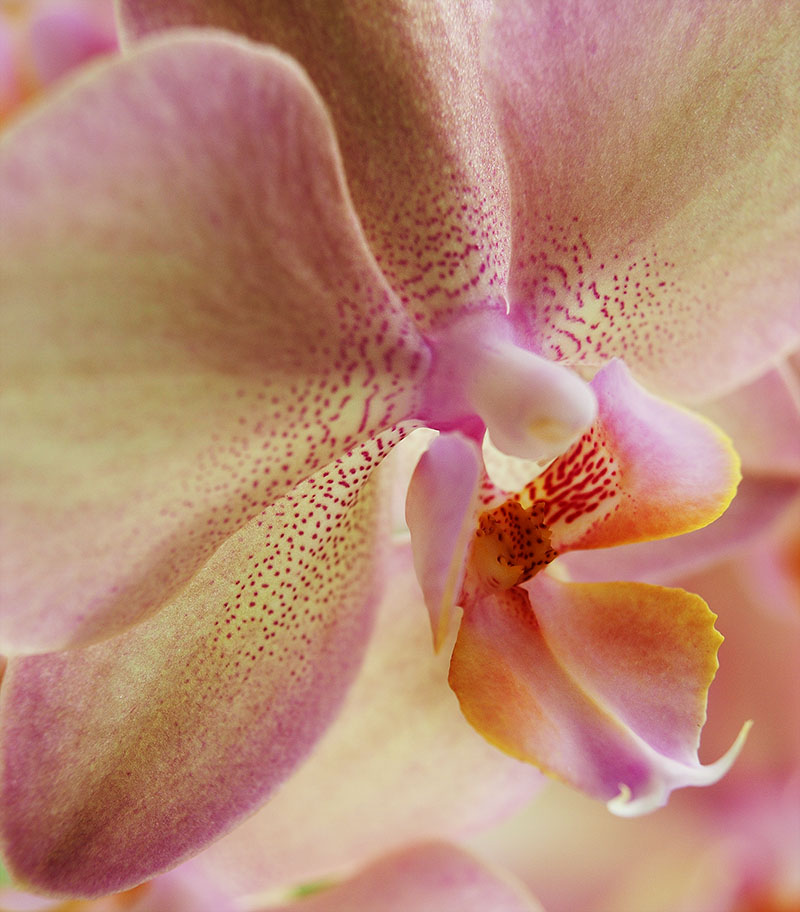
Macro photo of a spotted orchid
The dark pink spots give a delicate effect to the petals of this orchid.

These are all ‘moth’ orchids (Phalaenopsis), which are now very cheap to buy in many supermarkets. They’re very good value too, because the flowers can last for many weeks or months. (Much cheaper than buying cut flowers.) I’ve found that I can usually get the plants to flower a second time, but after that they tend not to do very well. That’s really down to my lack of knowledge about orchids. I should read up on them and look after them a bit better…

Actually, I stopped writing and had a look around on Google for some info. There’s some very detailed advice on the RHS website and having read it, I can see that I need to find a better windowsill for my plants and be more careful about the temperature. Ah, OK, so I will pay a bit more attention in future!

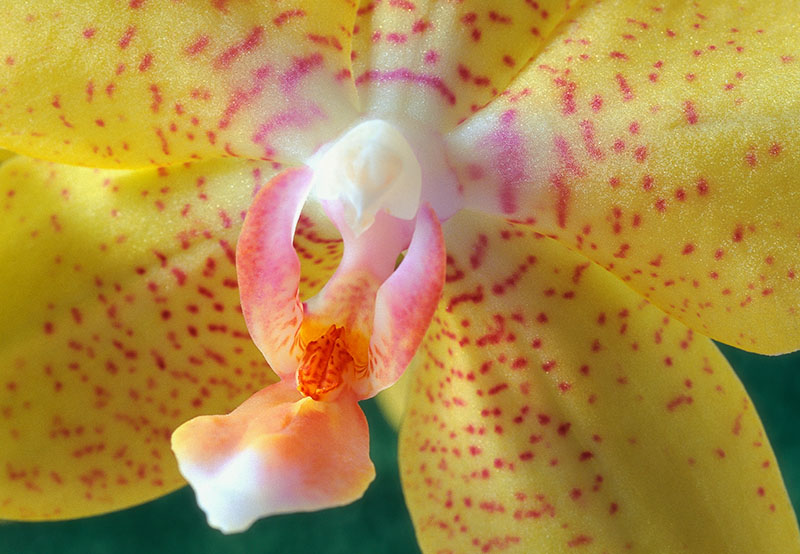
Macro photo of a yellow moth orchid
Yellow moth orchid – more spots!

As you may imagine, I tend to be attracted to the various markings on moth orchid flowers. The top photo has strikingly pink veins that look almost like stripes and most of the others have spots of varying size. These details work well in a macro photograph and provide something more for the eye to appreciate. The forward-facing lip of the flower gives a natural place to focus, especially with the spots, stripes and blushes of colour that can be found there.

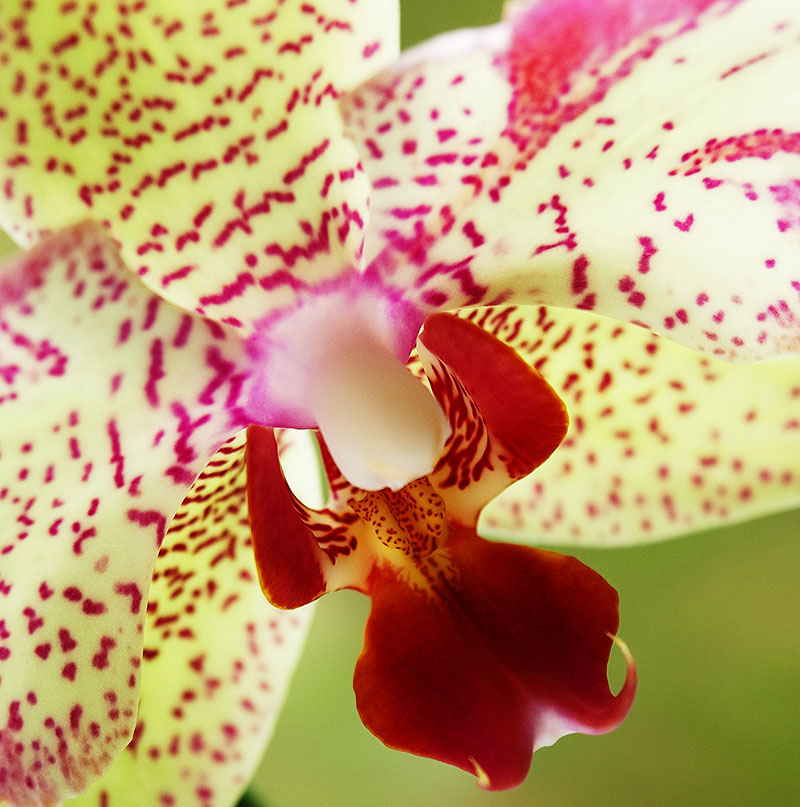
The varied colours and markings on moth orchids can make the flowers look very different from one another. This gives each plant a unique personality. The yellow orchid above, for instance, looks neat and dainty while the more greenish orchid below, with its wild spots and streaks of bright pink, looks decidedly bohemian.

Macro photo of a pale green orchid with pink spots.
The colouring of this orchid is quite an attention-grabber!

An orchid is a pleasing subject for a spot of indoor photography on a chilly winter day. All you need is a nice bright window and a large sheet of white card to reflect some of the window-light back into the shadows.

The delicate translucence of the orchid’s petals will allow the light to pass through, showing up the details of coloured veins or spotty markings and highlighting the structure of the flower. You may also find that you can see the glisten of the crystalline structure of the petal surfaces, as in the photo of the yellow orchid. The colours of the flowers are enriched by the soft window-light too, making them reminiscent of exotic silks.

I’ve spent many happy hours with just an orchid, a camera and a macro lens. The orchid is a flower that really makes it worthwhile to get up as close to it as possible – and that’s something I intend to do very frequently!

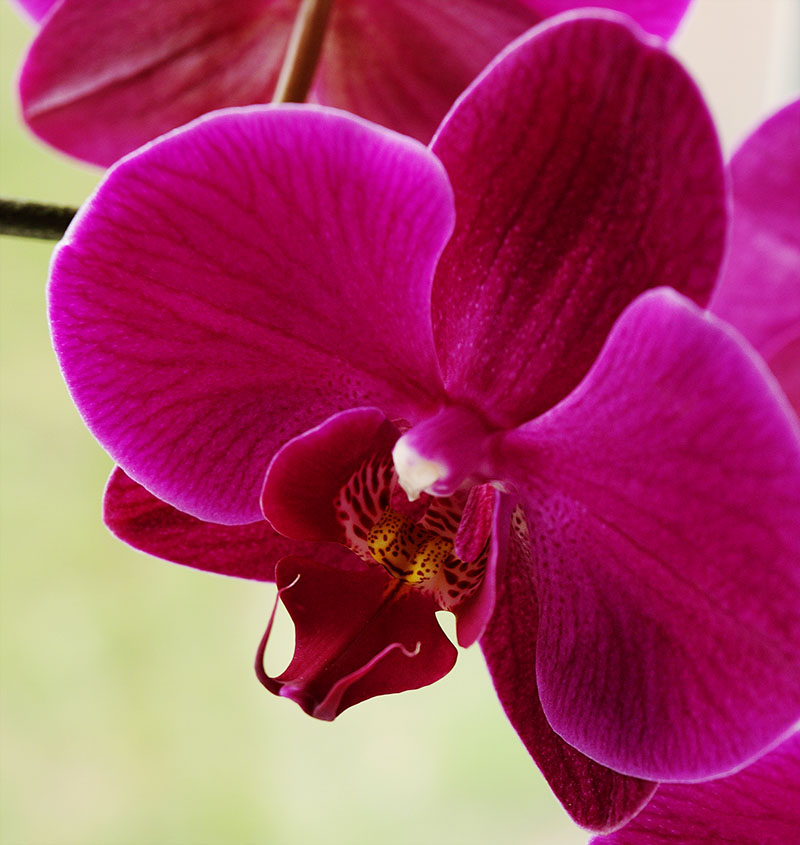
Macro photo of a dark-magenta moth orchid
This must be one of the most easily-available orchid colours.

Happy New Year! No Resolutions Here…

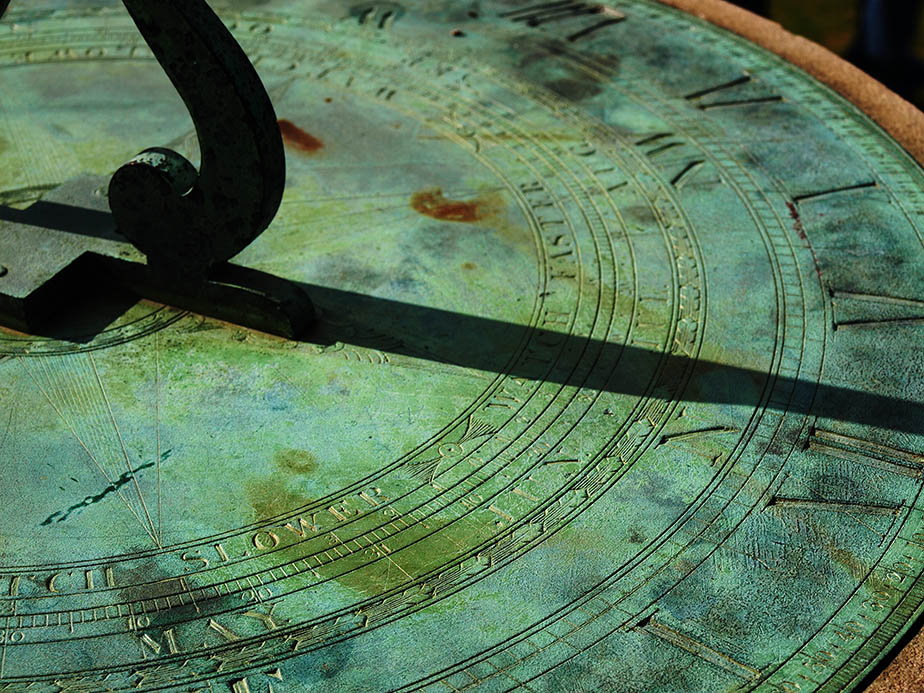
Garden Sundial

So it’s the time of year for looking both backwards and forwards…assessing, planning and – very probably – wondering where the hell the time went!

Do you make New Year’s resolutions? Or do you have a more relaxed way of working out what you want to do with the brand-new year? Is it really necessary to have one day of the year when you try to make commitments that are often unrealistically demanding? Or is it better to have an ongoing awareness of what you want to accomplish and how you may be able to do it?

You will have realized that I’m not too bothered about making resolutions at this time of year. But, as a keen gardener, it’s a useful opportunity to think about the work I want to do and the plants I want to grow. It’s a good time to plan seed-sowing and (especially if it’s too cold to work outside), to take a while to imagine how I’d like the garden to look throughout the year.

Garden-planning, for me, also means planning what I want to grow to photograph, and trying to come up with ideas for making areas of the garden more photogenic. (I think that may be a long process!)

Making a list of gardens to visit is one of the nicer ways of spending an hour or two on a grey January day. It promises both inspiration for my own garden and new subjects to photograph. Maybe I should make a resolution after all – to visit more gardens this summer. (It shouldn’t be too hard to keep that one!)

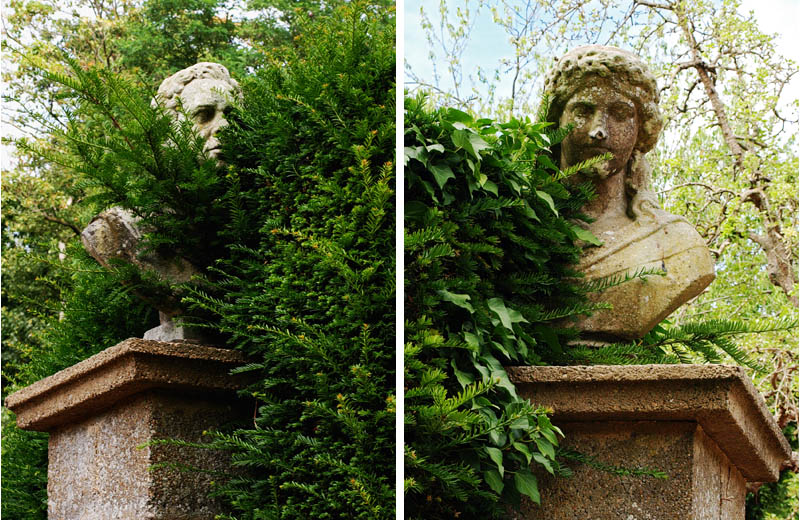
Garden Statues
Ever get the feeling that you’re being watched? These two seem to be just as interested in the visitors, as the visitors are in the garden!
Perhaps the most successful approach to the New Year is simply to decide what is most important and where our focus needs to be during the year. No make-it or break-it big declaration, but something calmer and more persevering. Encourage something to grow quietly month-by-month, and by the end of that year there may be something very pleasing to show for it.

No big display of resolutions, then. But this year I would like to concentrate on using my time for the things I really want to do. (Now my time is much more my own than it was, and I realize just how precious it is.)

That means spending time working on photography and gardening. It means continuing to learn printmaking and drawing skills. And just to enjoy time spent in our garden, visiting other people’s gardens and exploring the countryside. (Luckily Hubby enjoys these things too!) The ideal would be for me to be able to bring all of these things together as much as possible – something for me to work on steadily through 2019.

Of course, I hope to make this blog grow and flourish during the coming year. No resolution needed there! Thank you for reading and for your comments – it’s wonderful to be able to ‘chat’ and to feel a sense of community. (I’d like to be able to put a really big smiley face here!) I hope that you all have a very happy New Year.
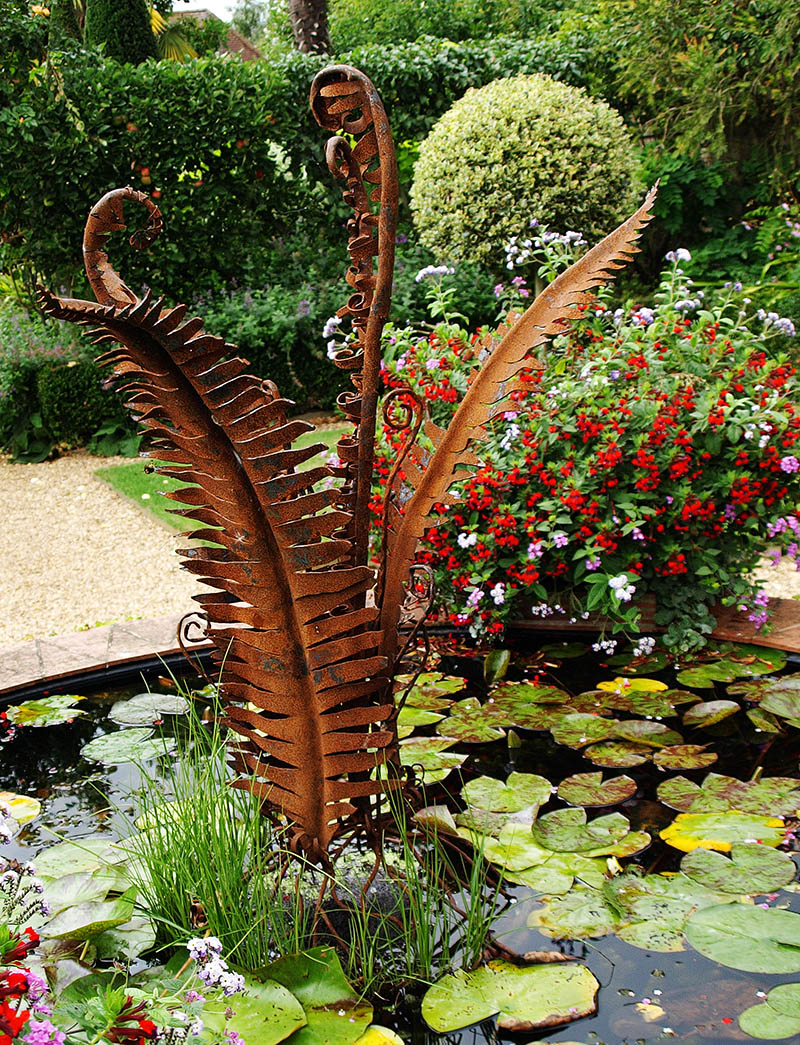
Fern sculpture
Art and gardening come together: this fern-inspired sculpture seems to grow out of the water.

Are You Dreaming of a White Christmas?

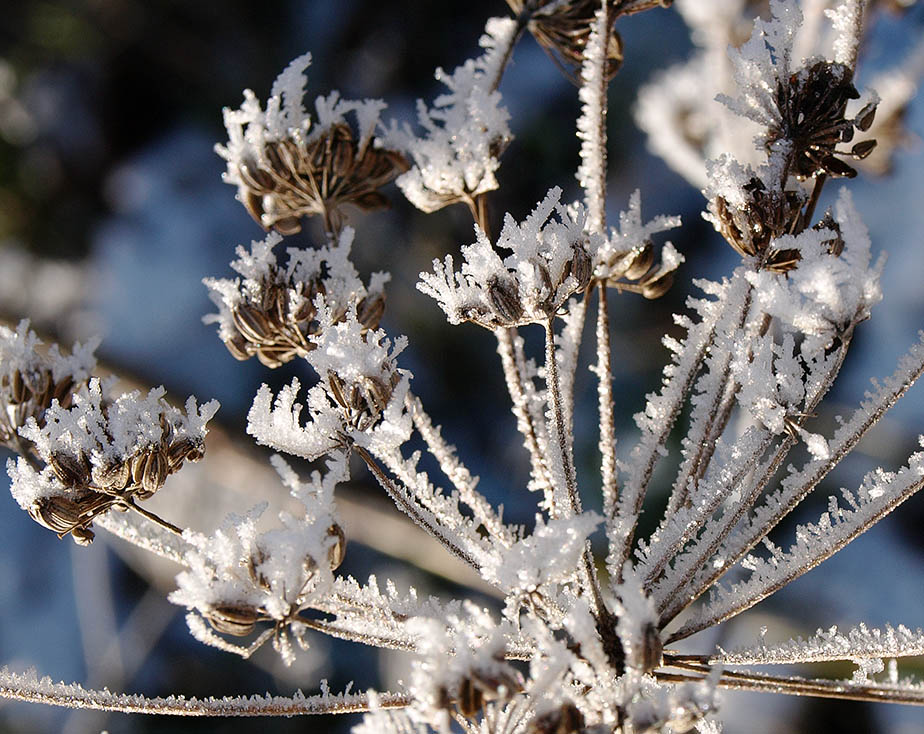
Frosted fennel seed-head

Snow can bring a bit of magic to the garden at this time of year. It covers up the dead  leaves of perennials, hides weeds and makes tiny sculptures from the seed-heads that you’ve left for the birds. And if there’s frost too, then those seed-heads become like icy Christmas decorations.

It’s rare for us to get snow at Christmas here in the east of England. In fact, in the last few days, hubby and I have been using a mild spell of weather to get work done in the garden. (It’s very pleasant if you manage to follow where the sun is as you work.)

Snow is more likely in January, when the temperature always seems to drop and you really start to notice the cold. If it snows, then there’s not much chance to get any work done in the garden. It’s a good time to grab a camera and go for a walk, looking for things to photograph.

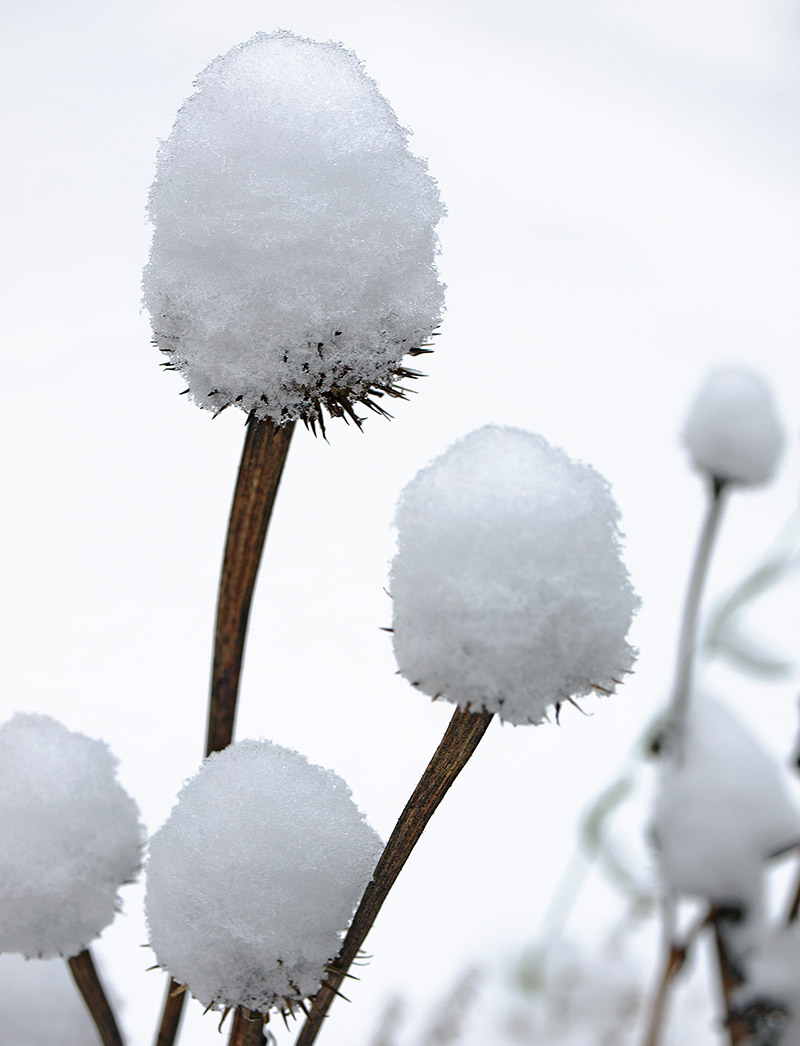
Snow-covered Echinacea seed-heads.
Guess what’s hiding under the snow! (Echinacea seed-heads.)

There are water meadows very close to our house, so this is where we usually walk. They become a great plain of white, etched with the dark shapes of trees and the even darker waters of the river. After one especially deep fall of snow, the temperature had risen enough to let the top surface of the snow melt slightly but it then re-froze as it got colder again. This made for a very satisfying walk, crunching through that top icy layer into the soft snow beneath.

Back in the garden, the plants may all turn to soft mounds of white. It can be hard to remember which is which. Everything becomes unfamiliar, clean and, for once, immaculately tidy. These are the days when I don’t look at the garden and immediately begin to think of all the jobs that are waiting to be done there. Instead I wander around with my camera, looking to see what strange forms the snow has created from the plants.

The opportunity to take photographs in the snow is quite rare here and doesn’t usually last very long. (These pictures were taken some time ago.) So if it snows this winter, I’ll have to take my chance quickly and get out into the garden to see what transformations the snow has made.

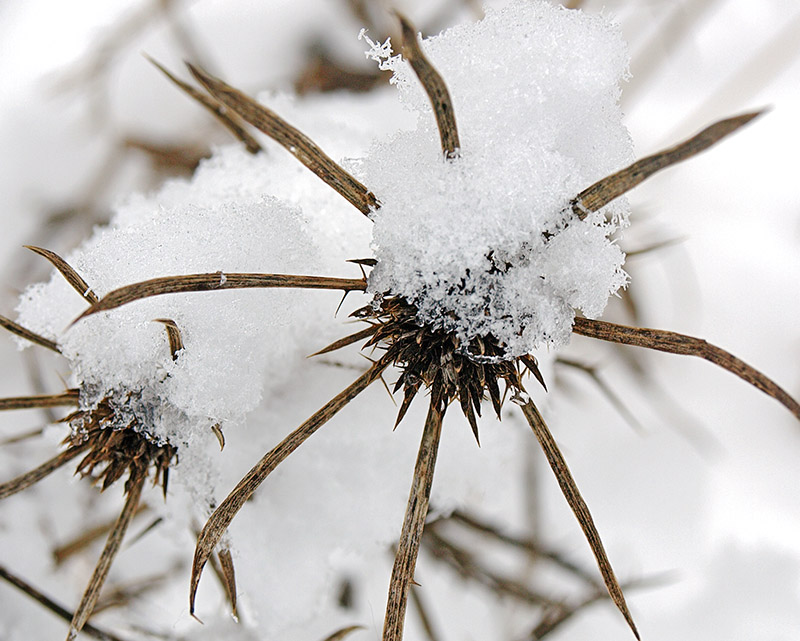
Snow-covered Eryngium seed-heads
Eryngium seed-heads – prickly little starbursts in the snow.

Snow is part of our romantic image of Christmas – all white and crisp and ideal for sledging, snowballs and making snowmen. We very conveniently forget chaos on the roads, cancelled flights at snowbound airports and horribly slippery paths. Snow is an essential part of Christmas cards, holiday TV and happy childhood memories.

I won’t do a Bing Crosby and wish that all your Christmases may be white – it may be inconvenient for your travel plans or, if you’re reading this on the other side of the world, more than a bit unlikely! But I will say ‘May your days be merry and bright!’ I hope that you have a very happy Christmas.

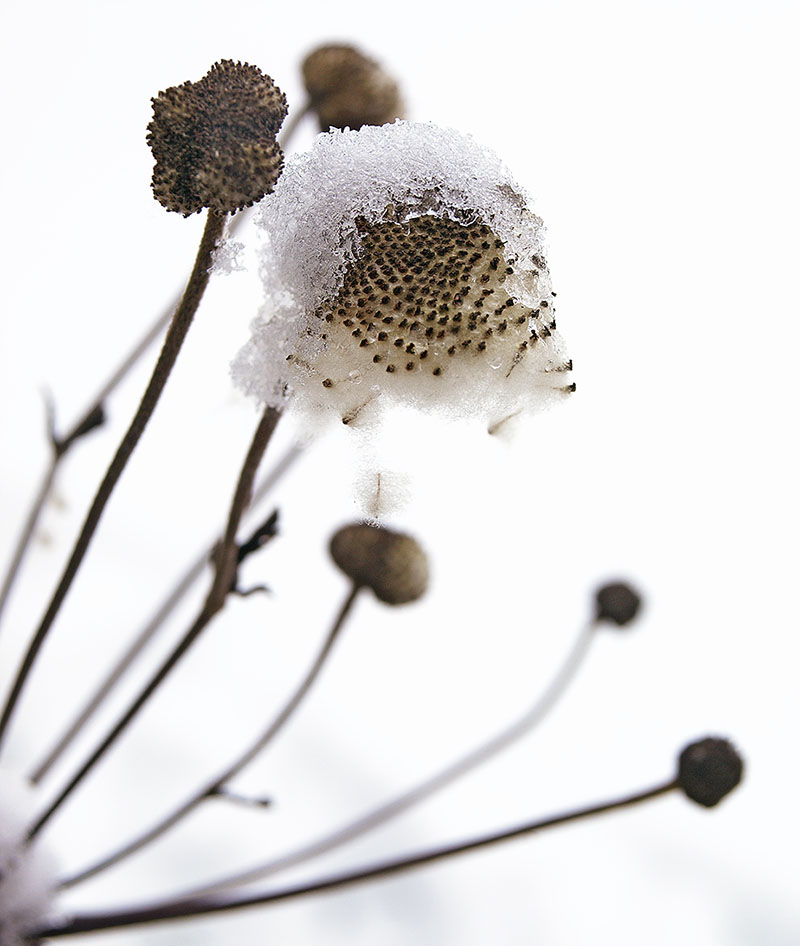
Anemone seed-head capped with snow.
The fluffy seed-head of an anemone wears a little cap of snow.

Not True Blue

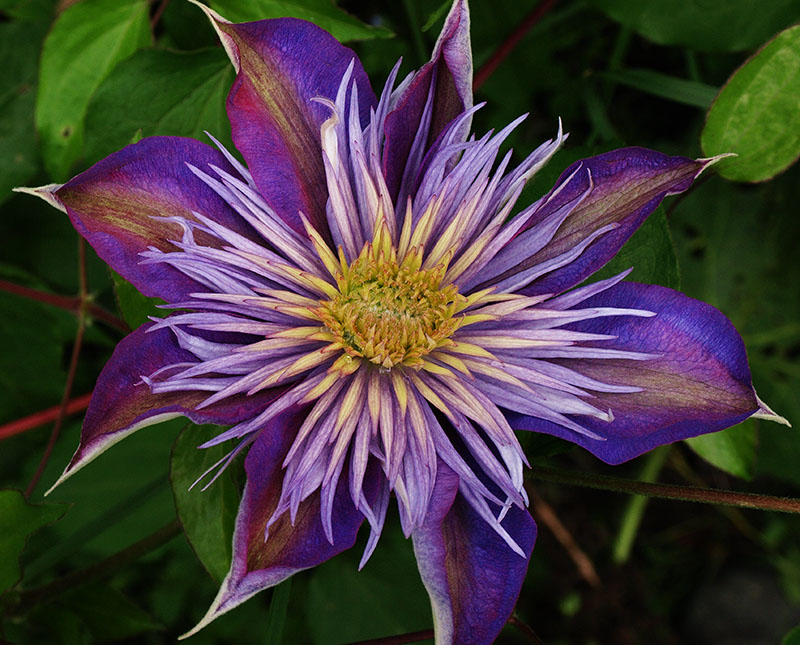
Clematis Crystal Fountain

Blue flowers are beautiful but those that are truly blue aren’t common. Those that come to mind first are delphinium, cornflower, salvia, morning glory and plumbago. Many of the flowers that we think of as blue have a hint or more of purple, mauve or lavender in their colouring.

I’ve been sitting comfortably inside while it’s been cold and sleety outside, looking through photos taken in the garden here. Working my way through them has made me aware of how often I choose to grow flowers in the purple-blue and mauve colour range.

Purple-blue clematis flower
Blue and purple blend in the petals of this clematis.

The second photo of a clematis shows a very similar colouring to the first photo. (But you’ll see that the bud in that first photo develops very differently as it matures….) Violet-purples and lavender-blues seem to be very common colours for clematis. That can make it hard to choose between them.

The way the colours in the petals bleed into one another is very delicate. It’s almost like the way watercolours blend into each other and is something that I’m keen to try and capture in a photograph.

Blue and a lilac-y pink penstemon
Blue and a lilac-y pink blend in the flowers of this penstemon.

The purply-blues, lavenders, mauves etc seem to all mix quite easily with other colours but not always with ‘true-blues’. However, the penstemon above seems to have managed this perfectly. Maybe nature can teach gardeners a thing or two about colour combinations. But, I prefer the colours in the flowers below, where the blue is a bit softer and seems to blend more gently with the lavender – perhaps there is a touch of red in the blue.

Left: Brodiaea Right: Iris
Left: Brodiaea           Right: Iris

Going much more to the mauve/pink end of the colour range, there are many flowers that look beautiful and mix with the darker purple-blues very happily.

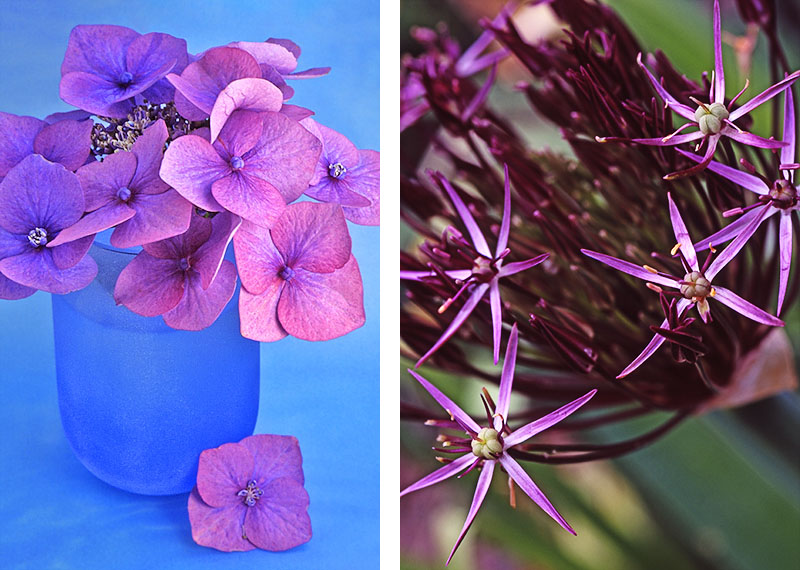
The hydrangea in the photo below grew in my previous garden in Scotland. The flowers on this shrub shaded from blue through to a mauve-pink. Evidently our soil there was not acid enough to turn the flowers completely blue, but the soft blending of the colours on the petals was lovely. (Here in Suffolk, blue hydrangeas turn pink – no chance of keeping one blue!)

The mauve-purple of the Allium ‘Cristophii’ has a lighter feel to it than the blue-purples but looks good with them. It’s an easy colour to use and the flowers are very attractive, so it’s good to see them self-seed around the garden.

Left: Hydrangea Right: Allium
Left: Hydrangea             Right: Allium

So, while I may not have many real blues in the garden here, I’m very happy that there are so many photogenic flowers in the different purple shades.

At the start, I said you’d see how that clematis bud’s colours developed…. here it is…. Yes, it is the same flower!

Clematis 'Crystal Fountain' flower
Clematis flower showing more colour as the flower matures.

Seed-heads: Textural Interest in the Garden

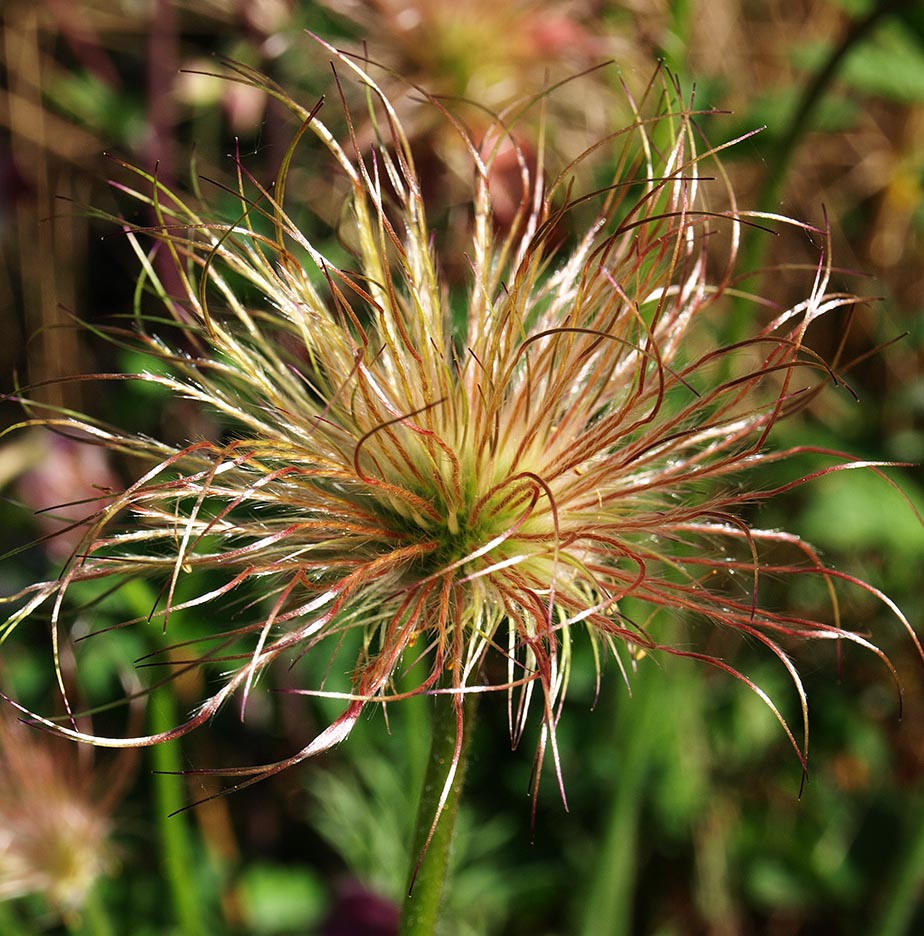
Pasque flower (Pulsatilla) seed-head

After flowers fade in the garden, there’s a certain feeling of loss, of knowing that they have disappeared for another year. But some plants have something more to give the garden – attractive seed-heads that add their own texture and interest to the planting.

For a photographer, seed-heads make a great subject. They can have very ‘architectural’, interesting shapes and their textures range from soft and fluffy to extremely prickly. There’s plenty of variety to inspire pictures with different moods. Could be something soft and gentle, or something bold and eye-catching, or perhaps an image with a more nostalgic feel.

Seed-heads have that inbuilt message that something is ending but also remind us that there will be something new – new life – in the future. And for a gardener, seed-heads can be a reason for hope, if there is a chance of new plants springing up – or dread if they’re weeds!

I love to see the Pasque flower seed-heads every year. (Top photo.) They are so soft that you want to stroke them but they can also really catch the light. The fine hairs reflect the sun and make them gleam on a sunny day. (They’re irresistible to my cats too, who find that the heads swaying on their long stems make a great toy to bat a paw at, especially those that can just about be reached through the slats of a nearby seat. Fun for all!)

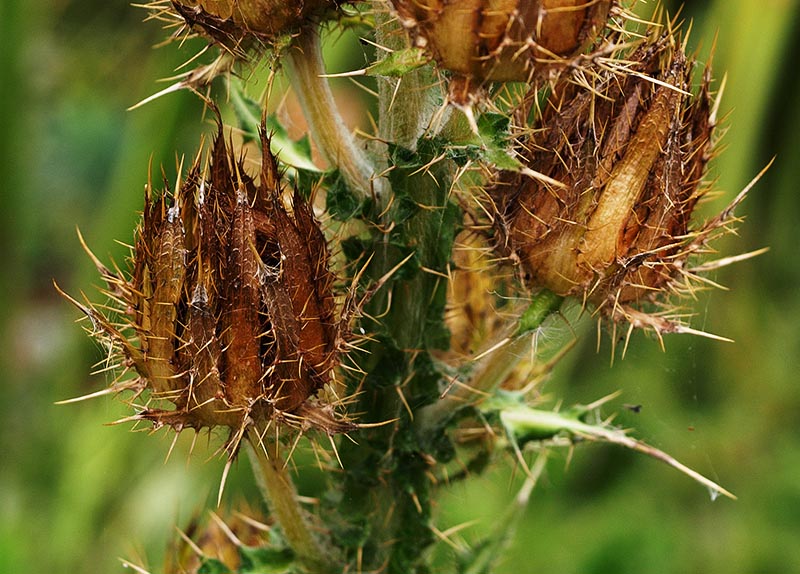
prickly seed-head
I wouldn’t like to touch this seed-head!

Other seed-heads are not at all welcoming to the touch. But they do at least look interesting in a photograph. I’m happy to say that the plant above was in someone else’s garden. I don’t know what it is, but I really wouldn’t fancy brushing against it in a border. Ow!

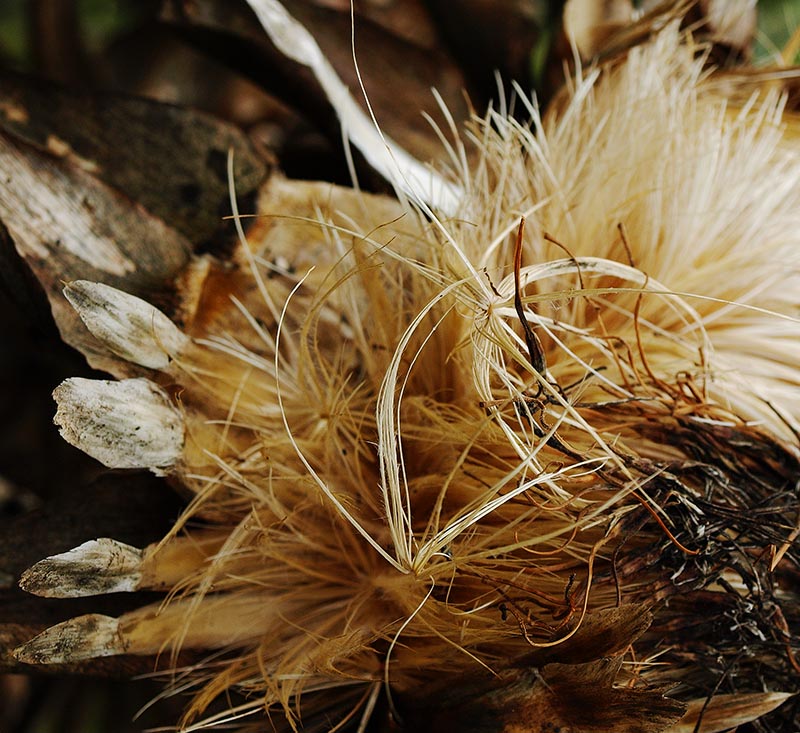
I don’t know what the seed-head in the bottom photo is either. It might be a protea. The photograph was taken in a garden that had big glasshouses, so there were a fair number of  non-hardy plants. The combination of textures and shapes and the soft browns, yellows and creams of this seed-head appealed to me. It’s very different to the seed-heads that I would find in my own garden and, like the Pasque flower, makes me feel that I want to reach out and touch it.

At this time of year, when there are few flowers left and so many garden plants are dying back for winter, seed-heads can linger. I like to leave as many as possible in my garden, so that when the frosts arrive, there will be something to photograph. A coating of frost can make a dried-out seed-head turn into something wonderful – a delicate structure with grace and sparkle. So if you like to photograph plants, it’s a good idea not to be too tidy in your garden. Leave those seed-heads standing and wait to see what magic a touch of frost or snow can bring!

I love to read your comments! Do you have any plants that you like for their seed-heads?

Seed-head
Mystery seed-head – could it be a protea?

Colourful Orchids

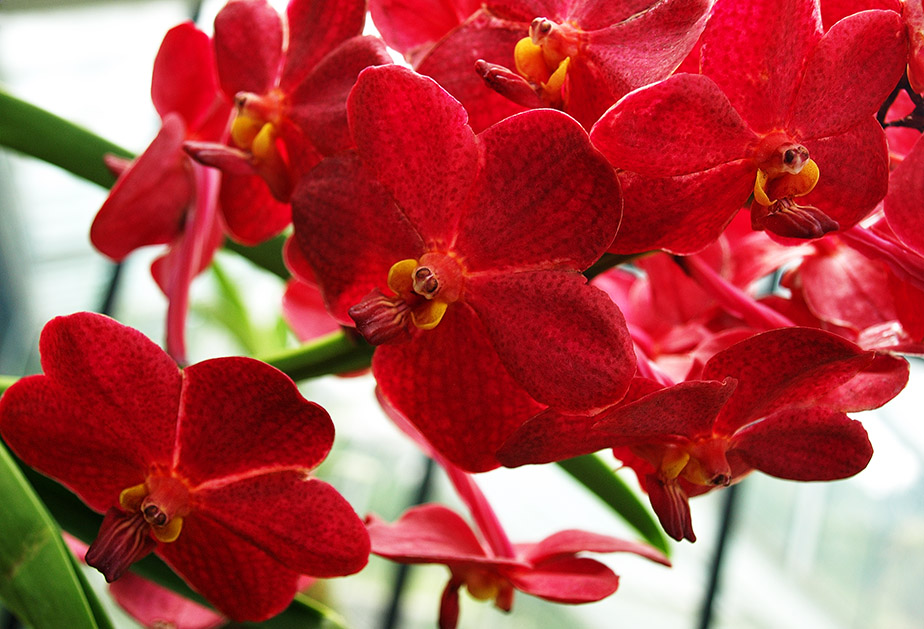
Red Vanda Orchid

It’s getting chillier every day here and we’ve had some very grey skies during the week, so I thought I’d post a bit of bright colour on the blog today.

Wherever I go, I’m always keen to take the chance to photograph flowers. Sometimes there’s something new, or a plant that would be difficult to grow at home. You never know what plants and flowers you may come across when you’re out and about with a camera. It’s pretty much a matter of luck. (And lots of garden visiting!)

It’s also a matter of luck if you find flowers that are in good condition at the time and that you can photograph without other things being in the way. There’s not a lot you can do about distracting backgrounds but experimenting with different angles and getting as close as you can will help a lot.

The weather can be a matter of luck too. If you’re photographing plants outside or in a glasshouse, you’re better to choose a day that is slightly overcast. This will soften the light and make it more diffused, allowing you to capture the colours and textures of the flowers more easily. (Whereas bright sunlight, especially at the middle of the day will easily burn out highlights and create heavy shadows that obscure details.) Low-angled sunlight near the beginning or end of the day is much gentler and the slanting light picks out details beautifully, so it’s good choice if you can time your visit for it.

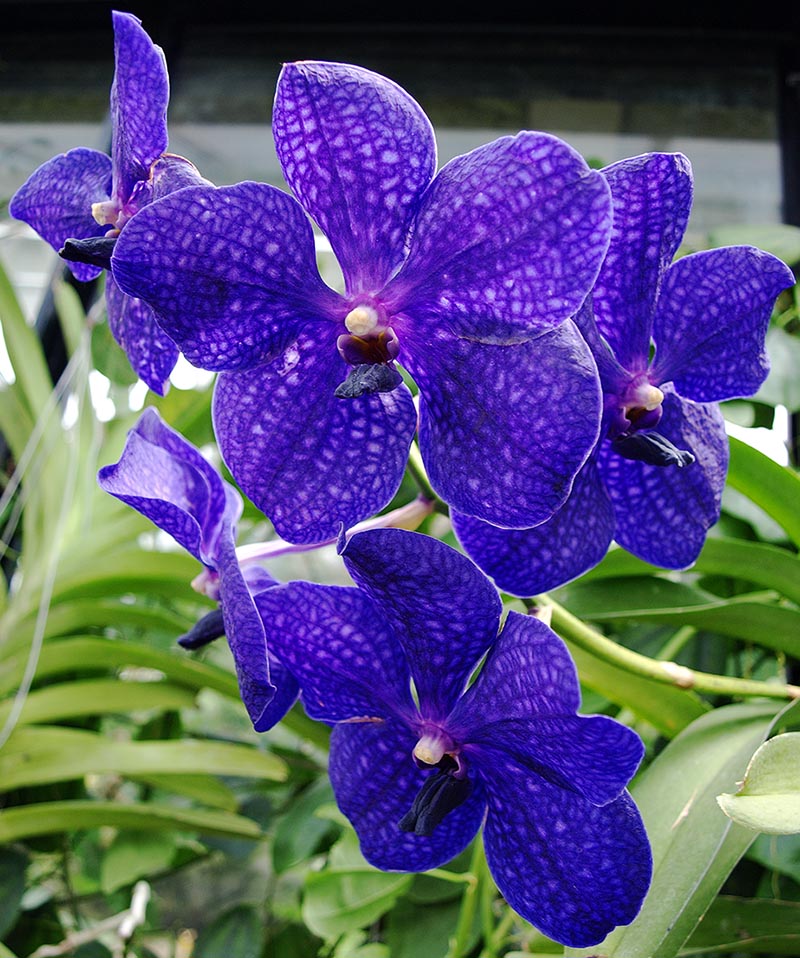
Blue Vanda Orchid
This Vanda orchid is an amazing blue.

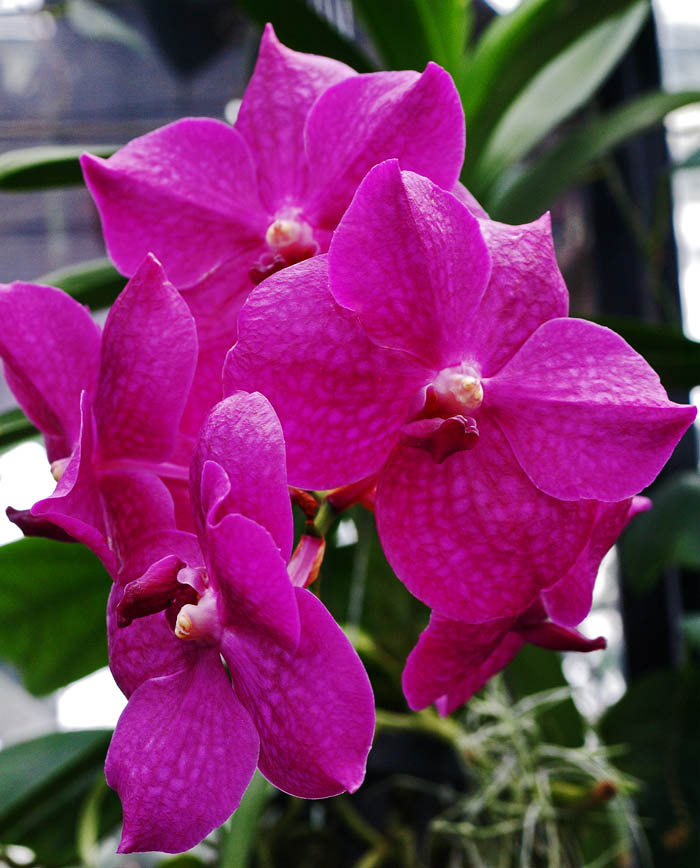
The orchids here are ‘Vanda’ orchids. I’ve never tried to grow these (just the similar-looking Phalanopsis or ‘moth’ orchids), so it’s a joy to find some that I can photograph. Their rich colours and the characteristic dotted effect on the petals add to the visual interest of the photos. And wandering around them, camera at the ready, lifts the spirits – of this photographer at any rate!

The wonderful variety of flower shapes makes the orchid family an inspiring subject for flower photographers. I find them hard to resist and will always be on the lookout for these exotic, intriguing blooms. At home I occasionally grow Phalanopsis orchids.  They are pretty easy because they seem to thrive on neglect and nowadays they can be bought cheaply at most supermarkets. At the moment I have a couple of  orchids just waiting to be photographed. They have a similar white/purple/burgundy colouring but one is a Phalanopsis and I think the other may be an Oncidium, so the flower-shape is very different. (Photographs for a future blog post….)

I hope that these orchids have brightened your day. Do you have different orchids where you live? I’d love to hear about them in the comments!

Magenta Vanda Orchid