This is a bit of a post and run today, because it has been a very busy time over the last week. It’s been frustrating not to have time to take new photographs, but hopefully I’ll be able to get back to doing what I love soon.
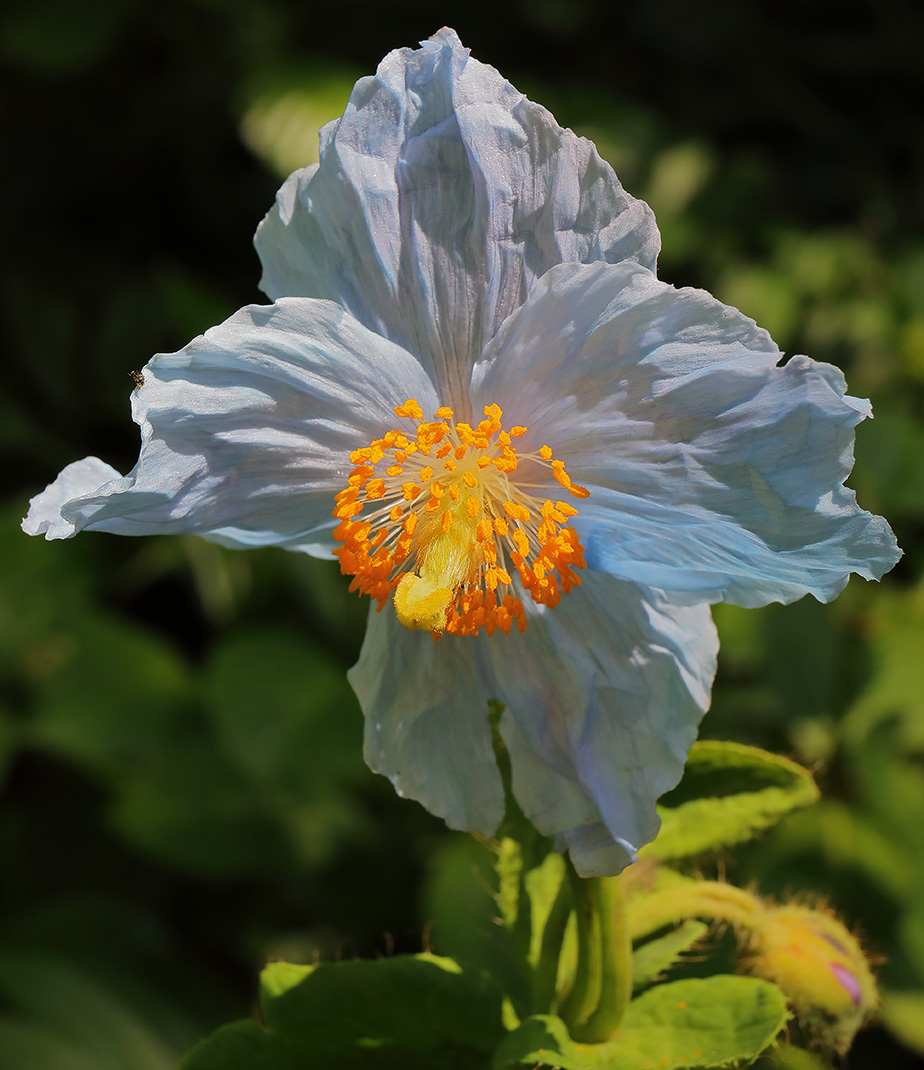
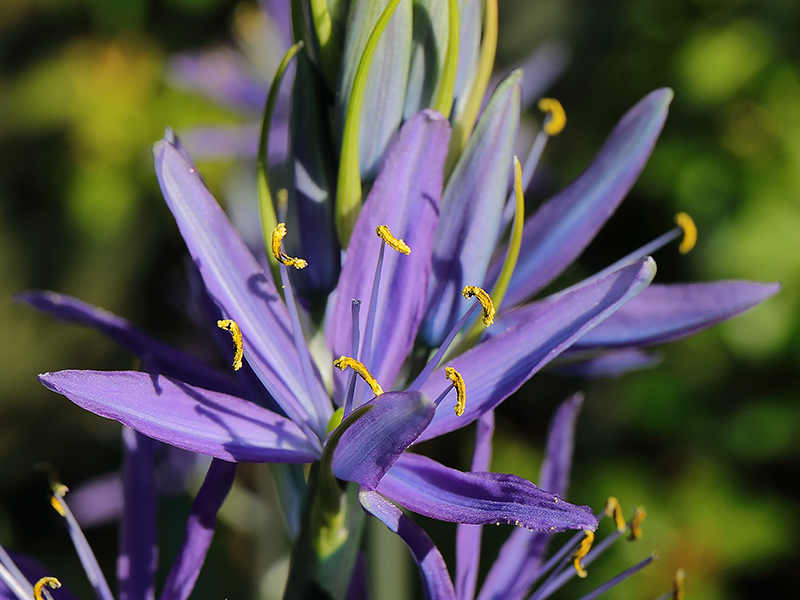
The photograph above is a flower I love to see – a Himalayan blue poppy (Meconopsis). It is frequently grown in Scotland, where the conditions suit it. (It looks wonderful near water, with trees and shrubs growing around it.)
I tried growing a couple of plants in our previous garden in Scotland, but they only lasted two or three years before dying out. At the time I thought I simply hadn’t kept them moist enough but I’ve learned since that they’re short-lived perennials. So maybe they wouldn’t have lasted a lot longer anyway.
There’s something about a plant being difficult to grow or hard to obtain that makes them all the more appealing to gardeners. I’m trying to learn to keep to plants that have a good chance in my very warm and dry garden (still a learning process). That means that I won’t be buying any blue poppies – they really wouldn’t like it here. But I can enjoy the memory of them.
The reason for being so busy this week is that we’re getting the garden ready for a contractor to come in and replace the fence around the garden. There’s far more to do than I had first realised and it seems to have taken a lot of time! Shrubs and trees have been cut back, lots of things, (including a large compost heap) have been moved and room still has to be found to store the new fence panels, posts and gravel boards…phew!
It will be a great relief to get this work done. The oldest part of the fence was blown down by gales in early spring. Since then it’s been cobbled together and propped up as best we can, so that the neighbours’ young dog can’t escape from their garden. (He managed it once, and had a lovely time playing and evading capture in our garden.) Originally the new fence was to be started mid-May – but Covid stopped it.
The job will take three weeks and there’s till plenty for me to do to create enough working space. After that I’ll be glad to get back to my photography and to planning some new planting!
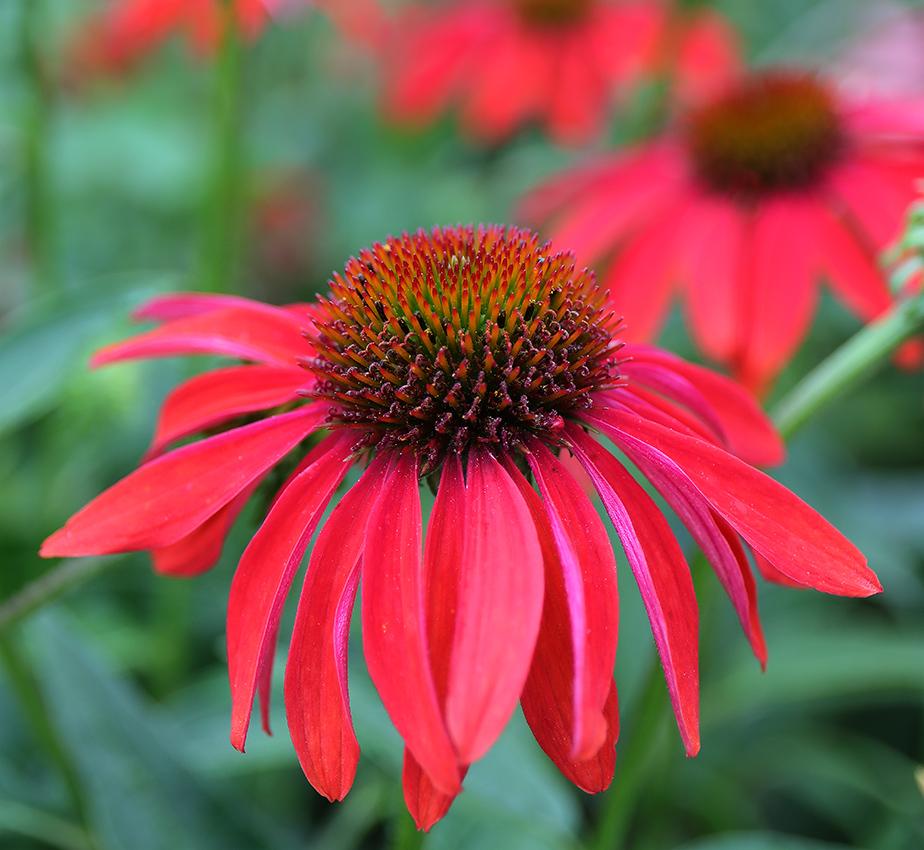
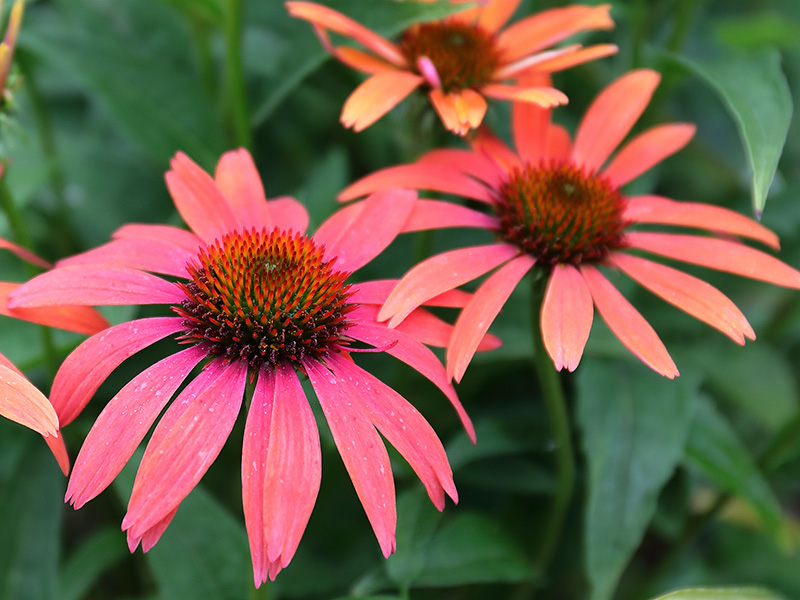
There’s a small patch of border that’s become quite a hot-spot this year. Red, orange and magenta-pink echinaceas (coneflowers), red geums, dark red scabious and the deep reddish-purple leaves of a heuchera are the start of a new planting scheme that radiates warmth.
There hasn’t been much red or orange in the garden before. Most of the other areas are planted with softer colours. These include lots of pink and mauve flowers, with plenty of lavender-blues added into the mix.
I find that these gentle pinkish shades can be difficult to use near red or orange – they can end up looking washed-out and feeble. On the other hand, a bright magenta – like rose campion (Lychnis coronaria) – works just fine and adds its own intense colour to the fieriness of the new border.
It feels good to now have an area specifically for hot colours. Last year I had some tithonia (Mexican sunflowers) in that space, and I found that I really enjoyed the intense colour. The tithonia is annual, so this year I’ve planted perennials instead.
(Although I grow a few annuals, at the moment I’m trying to concentrate on perennials so that I don’t have too much re-planting to do every year.)
The only problem with echinaceas is that they are short-lived perennials. I’ve read that the older pink varieties appear to go on from year to year because they self-seed and their offspring continue the display after the original plants have died. (It was something of a relief to discover this, because I was worried that I couldn’t keep the plants alive for long – some years they just seemed to disappear for no apparent reason.)
Some of the new echinaceas are said not to come true from seed and may die out after a few years. If that’s the case with those that I’ve planted here, then, because the colours are so gorgeous, I won’t mind buying more. (I’d like to plant yellow echinaceas too – they would be a good alternative to rudbekias because they’re much more tolerant of drought.)
In contrast to these brightly-coloured daisies, I also have an echinacea which has white flowers with centres that start off green and turn yellow. (If I remember correctly, it’s ‘Powwow White’.) It has a very different look to the hot-coloured flowers and suits a softer, more relaxing colour scheme. I photographed this particular flower when it froze last winter – you can see it here: https://annmackay.blog/2019/11/24/frozen-flowers/
Echinacea flowers in a mix of orange and magenta-pink.
These passionflower photographs are the result of an afternoon spent playing with a stem of the plant in my studio.
I photographed the flower and leaves to show their translucence. This makes the tiny veins in the petals and leaves stand out and gives a very crisp, sharp look to the photograph.
The colour changes a bit too. When seen under normal lighting (i.e. lit from the front or above), this passionflower is a soft pinky-purple. Here, though, the light from behind has bleached out the petal colours considerably and you can see more pink and red tones rather than the normal purple.
My setup for photographing flowers against a white background is fairly straightforward. I use a mini ‘shooting table’. Basically this is a sheet of translucent perspex on a metal frame. It’s bent into an ‘L’ shape (seen side-on). That gives both a background and a base for the photograph.
Because the shooting-table is translucent, you can shine studio lights through it. This gives a bright white background.
If you set the light levels so that there is a lot of light coming from behind the flower (in comparison to the light coming from the front), then you’ll get the maximum amount of detail in the veins of the petals.
To light the flowers from the front, I usually use two large studio flashes (strobes). One of these is fitted with a large, square softbox, which gives a very soft and even light. But the size of the softbox is more than a little awkward in my very small studio space!
The other light is fitted with a white (translucent) shoot-through brolly. The light from this is not as soft as that from the softbox, so it introduces a bit more shadow. This gives a bit more depth and modelling to the photograph.
If I want to have stronger shadows and a more dramatic feel to the image, I’ll use just the light with the brolly and leave out the light with the softbox. A reflector opposite the light is enough to put just a little light into the shadows.
By the way, if anyone knows the name of this particular passionflower, then please tell me! I’ve been wondering about it because it was labelled ‘Amethyst’, but Amethyst usually has a ring of purple filaments, instead of the white that this flower has. I’m intrigued and would love to know the correct name!
I feel that this flower and I have something in common at the moment – a ‘hairdo’ that’s totally out of control! (At least I suppose I can blame mine on Covid!)
But the flower has a big advantage over me…it looks good with its strangely shaggy petals sticking out at odd angles. (Even if you might imagine that someone plugged it into the mains, cartoon-style!)
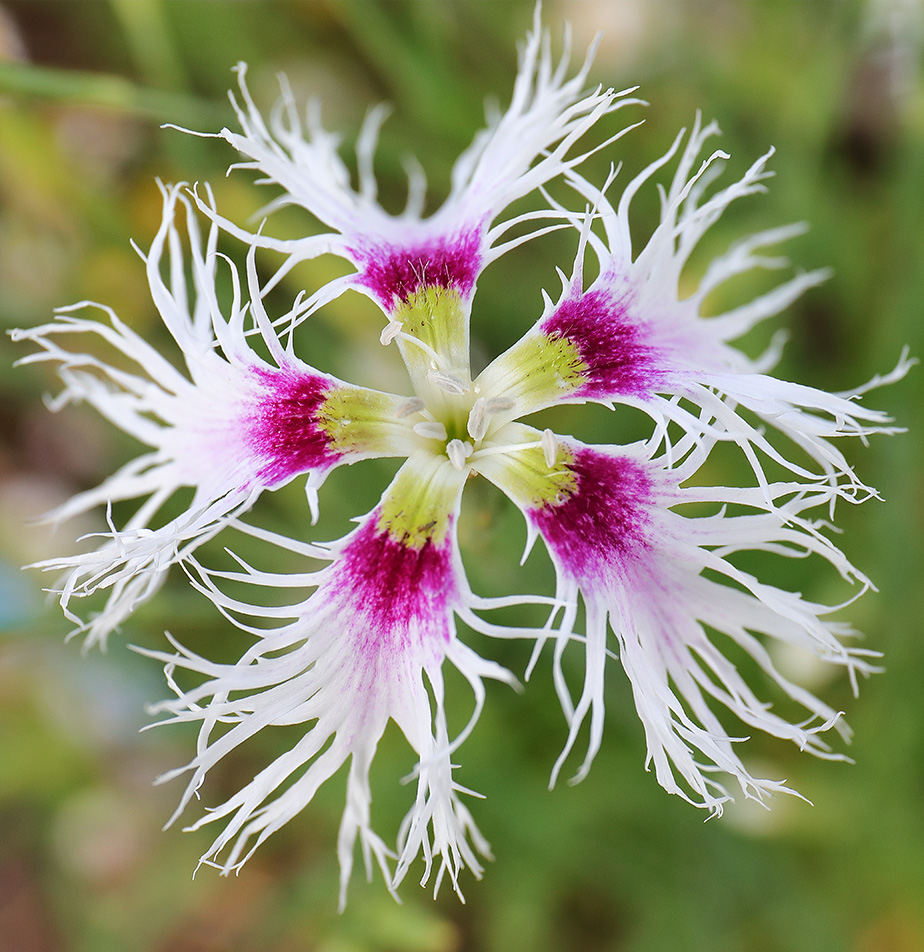
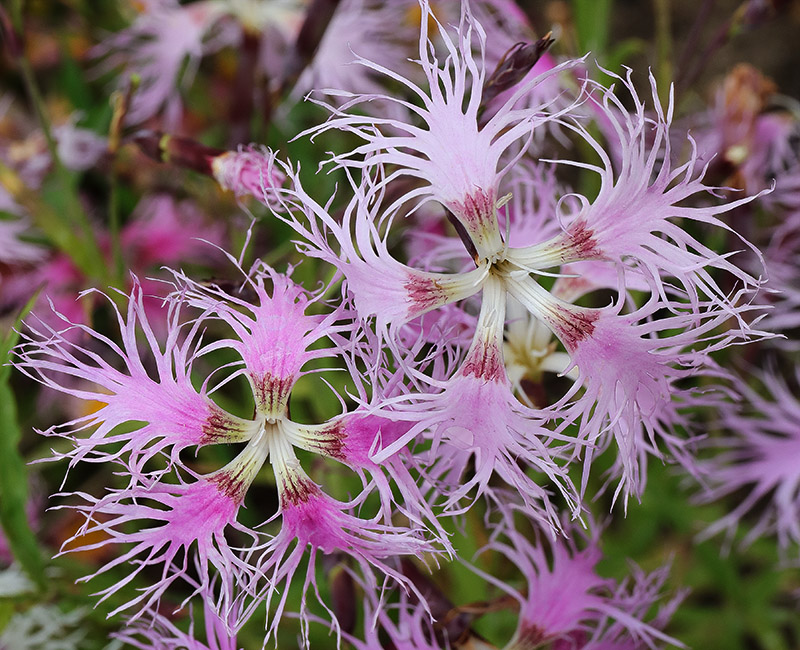
This is Dianthus ‘Rainbow Loveliness’, which I have previously photographed in the studio but not outside. The fringed petals make it an unusual and striking flower but they can make it more difficult to photograph in the garden.
The reason for this is that it can be difficult to isolate a single flower when it’s growing as part of a clump. And for this little dianthus, you do need to, if you want to be able to see the details of its complex shape. Otherwise, the fringed petals of the other flowers get in the way and create a confusing mass. (You can see what I mean in the bottom photo!)
I find that it’s useful to try propping the flower where there’s a plainer background using a thin cane and a clothes peg. And using a larger aperture to give a shallow depth of field helps too. But it is much easier for me to pick the flower and bring it into the studio where it’s easier to isolate it. (That’s one of the reasons why I tend to do a lot of my flower photographs there – and I don’t have to worry about the wind blowing the flower around either.) So I’m still planning to try to get some of the pink flowers into the studio – when they come back into flower!
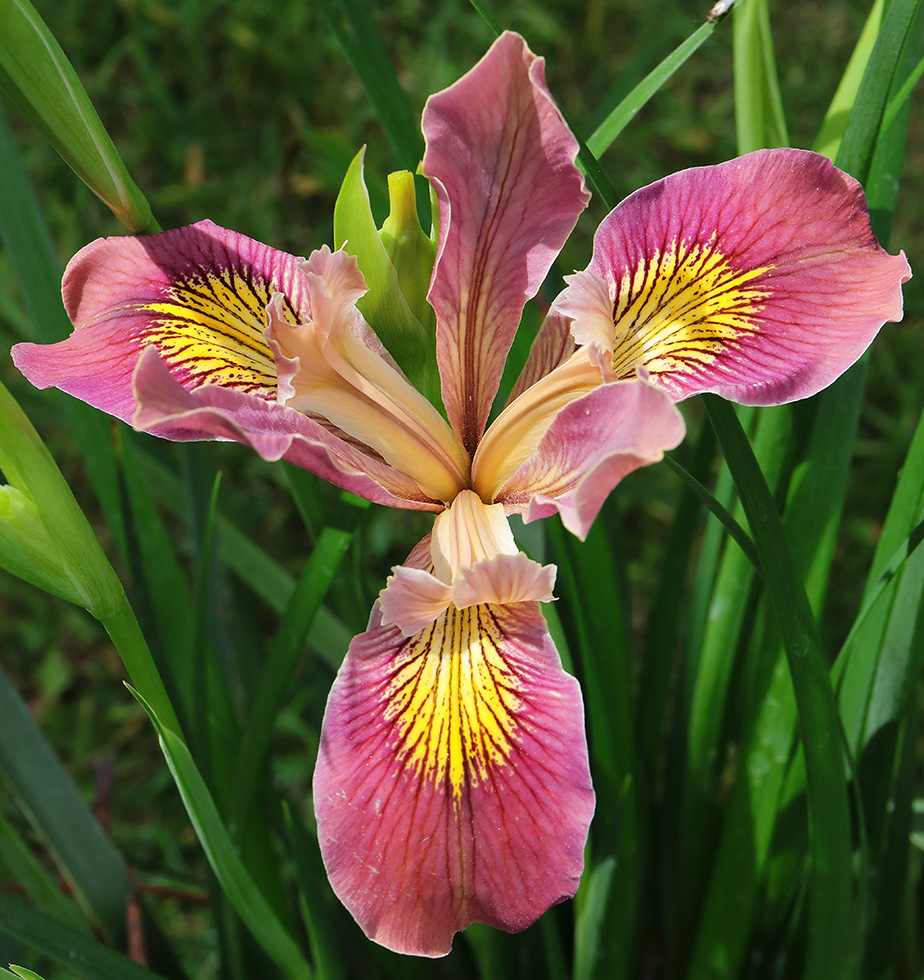
Late spring feels really special when the irises start to flower. The iris above is (I think) a Pacific Coast iris called ‘Broadleigh Rose’. It was given to me by my generous friend Judy. (Thanks Judy!) This is the first time it has flowered and I’m delighted with it.
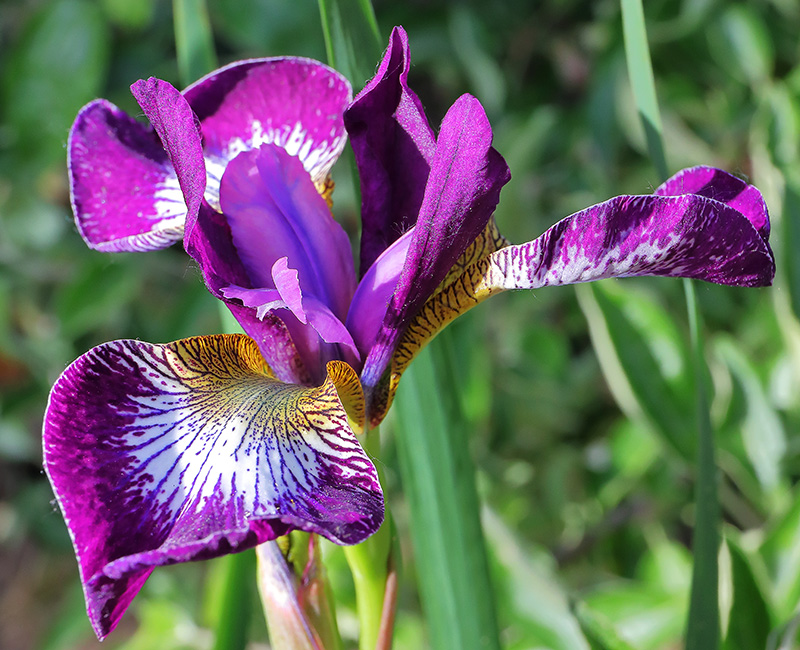
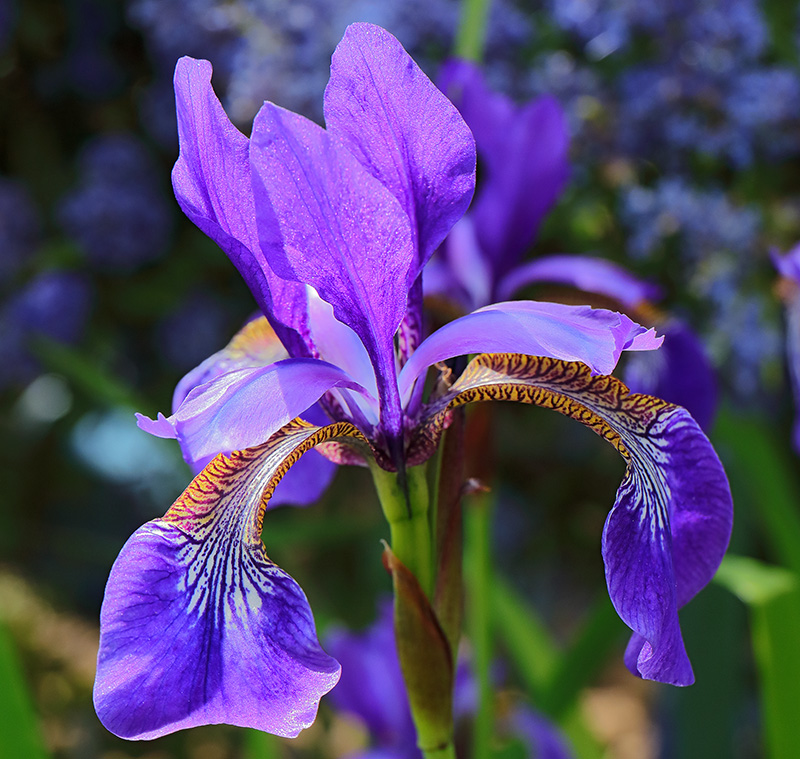
Irises are a marvellous plant for photography. They have it all – rich colours, striking markings, and a really ‘architectural’ shape. Iris sibirica is probably my favourite for photography because it combines an elegant shape with the boldest of markings.
At the moment, these irises are all living in large containers. They’re patiently waiting for me to finish preparing the border that will be their home. (That area previously had a row of huge conifers growing behind it in the neighbouring garden, so it was difficult to get anything to grow there. With the removal of the trees, I’ve had the chance to rejuvenate the area.)
Iris sibirica ‘Currier’
The new border runs most of the way along one side of the garden. There are already several well-established shrubs and some more recently planted small fruit trees along the border. But most of the rest is fairly bare, with just some planting at one end.
Eventually (!) this border will have a pond and a bog area. I’d really like to grow moisture-loving plants and this seems to be the only way that I can do it. (Unlike the garden in Scotland, where poor drainage meant we had areas that could flood.)
The pond has been dug out. (That took me a long time!) Now I need to level out the ground around it a bit, as the garden has a slight slope. This job is proving difficult because the ground has become so dried out.
But the irises are cheering me on with their vibrant colours, so hopefully it won’t be too long before they have the chance to get settled in to their new surroundings. I’m really looking forward to seeing what the border will look like next year!
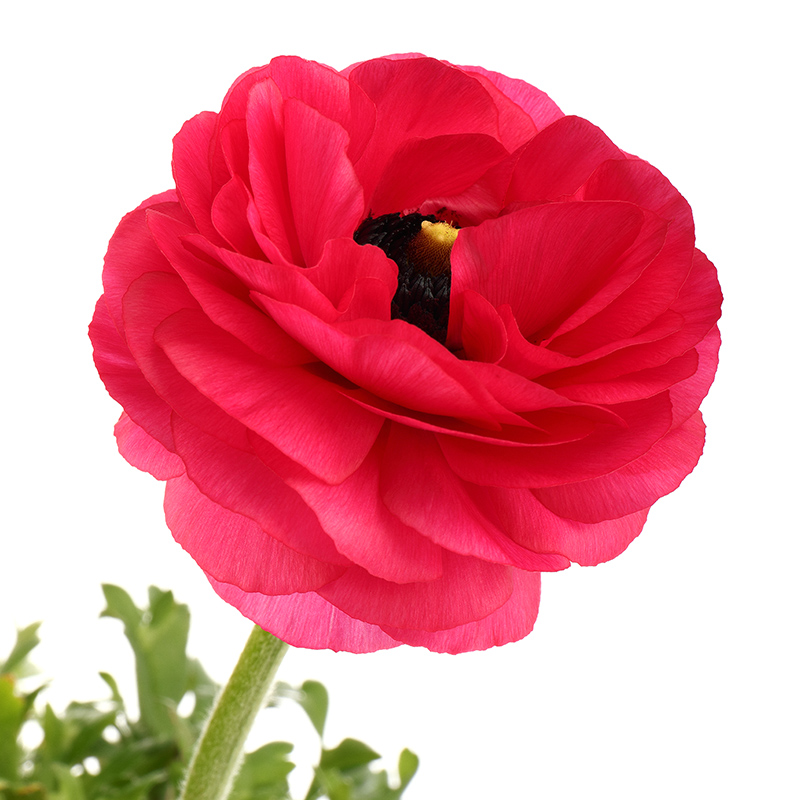
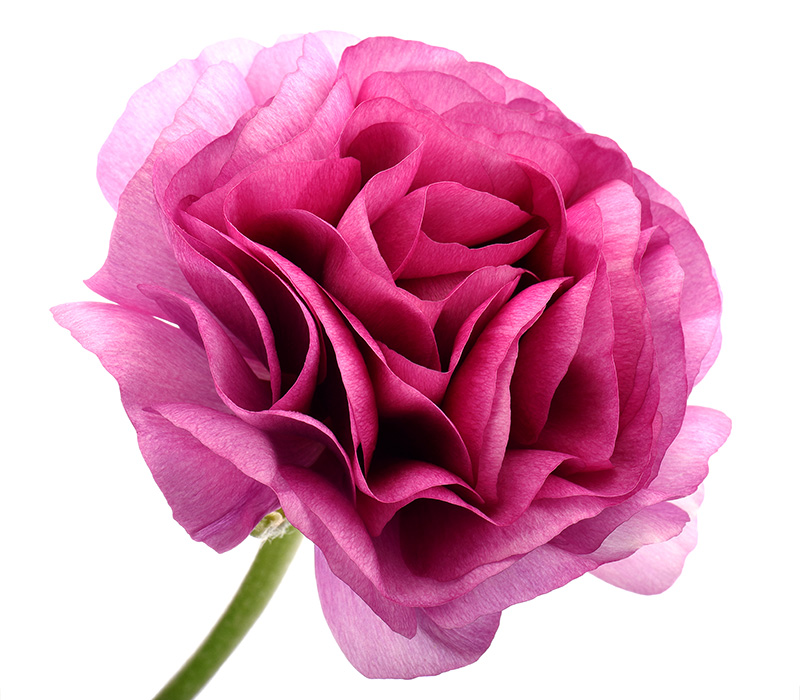
These ranunculus plants were the last plants I bought before the Covid-19 lockdown. It’s strange to think how different life was then.
The supermarket where I bought them was full of people rushing in and out on a busy weekend. Families and elderly people all going about normal life. While choosing my plants, I chatted happily with another lady who was a keen gardener…changed days!
Nurseries and garden centres have just started to open up again here but some had already begun selling over the internet and delivering locally. We were pleased to be able to buy from a tiny local nursery that we use every year. (Hubby plants annuals into tubs and baskets for the front of the house every year. I’m more into perennials.) It was a relief to know that the nursery would be able to survive.
As it has turned out, the extra time that folk now have to work in their gardens seems to have made many of these small businesses busier.
While garden centres and nurseries may cope with the effects of the pandemic, it’s a disastrous year for garden events and openings. Some however, have tried to offer an online alternative.
The Chelsea Flower Show is the biggest of these online events. For the week, the RHS had a programme of short talks by growers and designers plus a few visits to gardens that we might not normally see. It’s been interesting, but nothing like watching Chelsea on the TV as we normally do.
The BBC has managed to make some interesting programmes using footage of previous Chelsea shows alongside interviews with designers, growers and presenters all in their own gardens and nurseries. I enjoyed this much more than the RHS event – it gave more space to talk about garden design and the developments going on within gardening.
(If you’re in the UK, you should be able to watch the BBC programmes on the iPlayer. But if you’re elsewhere, you may find some of the programmes on Youtube.)
My favourite thing about blogging is the friendly community that you can become a part of. At a time when it’s impossible to visit my friends locally, the relationships I’ve formed with bloggers from all over the world are deeply valued.
So it was a welcome surprise to find that I’d been nominated for a ‘Liebster Award’ by my lovely friend Liz at Exploring Colour. (You’ll find that Liz’s blog is a wonderful mix of life-enhancing colour and fascinating articles, many tackling issues that are important to the natural world.)
Now you may be wondering just what the ‘Liebster’ (German for ‘favourite’ or ‘dearest’) Award is. It’s a means to allow readers to discover new blogs and by the recipients nominating more blogs, lots of bloggers have a chance to be found. (A sort of bloggers-helping-other-bloggers chain letter!)
Liz had eleven questions for her nominees, which I’ll answer here. The following part, where I can tell you eleven (probably random) facts about myself will be kept for next week’s post. (Along with my own questions for the bloggers I nominate.) This post might get awfully long otherwise!
Let’s get down to the questions:
1. What connection (if any) do you feel that you have with New Zealand? Not a direct one, but through my husband, Colin. Colin has a cousin named Madeline who lives there and came over to Scotland to meet everyone. I remember a family boat trip along Loch Ness (no sign of Nessie) and a huge party afterwards.
2. What place in this world do you most love? My garden – a close runner-up is Argyll, on the west coast of Scotland because it’s so beautiful.
3. Your favourite colour(s) are what? And what do you associate with the colour? Blue and purple. I think of blue skies, my hubbie’s lovely blue eyes and blue and purple flowers.
4. What connection do you feel/experience with nature? I’ve always felt a strong connection to nature. I was brought up in a house surrounded by open countryside with only one other house in view. That tends to make you aware of every living thing around you and of the weather, the seasons, the amazing skies and sunsets…there weren’t many other distractions in those days. As a keen gardener, the connection to the garden and its plants and the many little creatures that live there is extremely important to me. I believe that it is vital for us to remember that we are ourselves a part of nature.
5. Your favourite ‘active’ recreational activity…? Is walking along the country paths here. And best of all is walking around gardens that we’re visiting!
6. Your favourite ‘quiet’ hobby/interest? If you read this blog regularly, you’ll guess…gardening!
7. Is there something you enjoy ‘having a go at’ regardless of skill? Drawing – it’s something I’ve been trying to learn to do better over the last couple of years because it is so useful for printmaking.
8. What was (or is) your favourite children’s book? ‘The Starlight Barking’ by Dodie Smith. (The sequel to ‘The Hundred and One Dalmations’.)
9. Your current or past ‘occupation’ i.e. work/study/keeping busy..is what? When I lived near Edinburgh, I used to write for magazines and newspapers. That was mainly about incidents from Scottish local history, but also work for my local newspaper. I wanted to improve my photography to be able to use it to illustrate my magazine articles, so I went back to college to study HND Photography. Now the photography has taken over…
10. What’s your favourite creative activity…what do you have a passion for? Photography! My parents gave me a Kodak ‘Instamatic’ when I was eleven and that started me on a lifetime of taking photographs. Photographing flowers is my passion and a great way to blend my favourite activities.
11. Is there something you can share about a challenge you face, or have faced? The biggest challenge I’ve faced has been dealing with my mother’s dementia. I suppose we were lucky, in that it didn’t get really bad until the last couple of years of her life. Mum was almost 92 when she died, and she’d had a very full and happy life up until the time her health started to fail in her late 80s. But dementia is a dreadful way for a life to end. You lose everything – your home and interests, your relationships with family and friends, and even a large part of yourself because you forget so much of your life. Mercifully, Mum was looked after by lovely, caring people and she always remembered who I was and found my presence reassuring. (It doesn’t always go like that.)
Wow! This is a much longer post than usual! So thank you for making it this far and thank you Liz, for the questions!
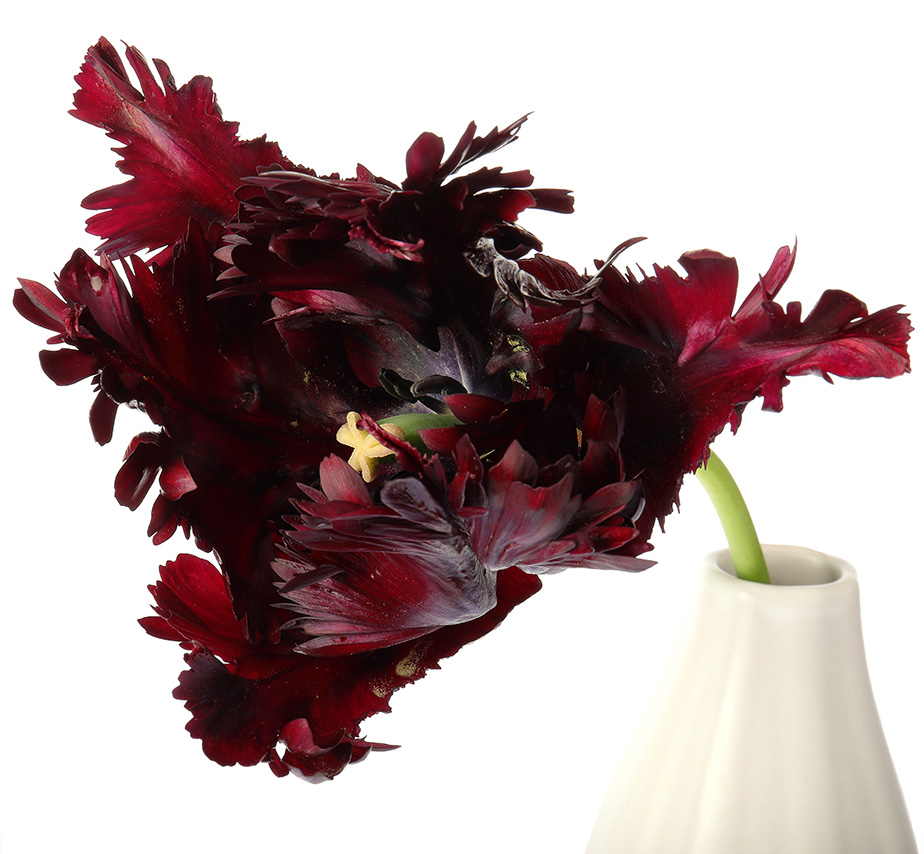
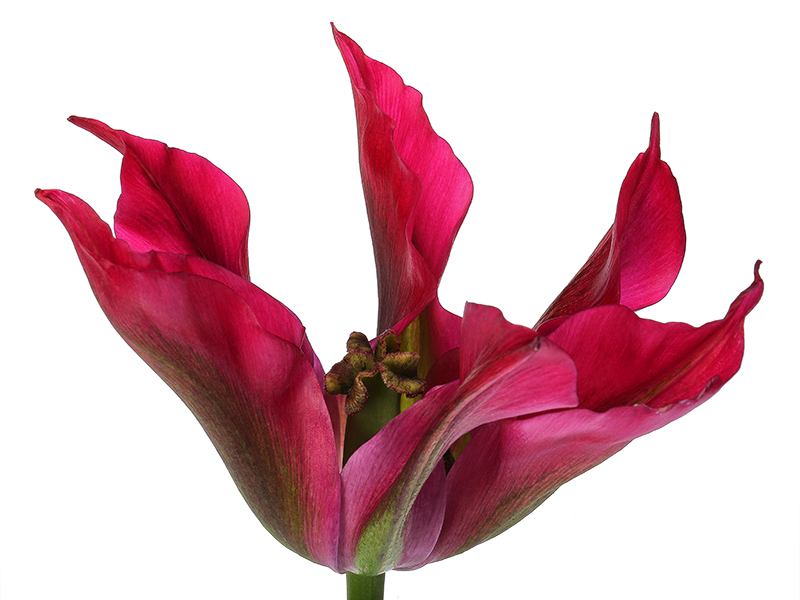
Tulips are flowers to make you smile. They come in all sorts of rich colours and extraordinary shapes, like the parrot tulip above. And they just call out to me to photograph them.
The tulip in the top photograph is ‘Black Parrot’, but, as you can see, it’s not really black at all. It’s more of a deep maroon shade – like a very dark wine. Here, newly picked and under the powerful studio lights, the reddish tones stand out. But the colour looks more purplish in the less intense light of my kitchen, especially as the flower ages.
I’m looking forward to seeing how this tulip flower will develop as it opens out fully. New shapes will be created by the unfurling petals, giving the opportunity to take a variety of different photographs.
The tulip below is very different to the first one. It’s a viridiflora – named for the green markings on the petals. The vibrant colours and sheen of the petals make me think of silk. The twisting shapes of the petals even suggest that the fabric is swaying in a breeze.
This year I’ve had several different tulips in the garden and they have done well in our warm spring weather. (There are more that are just starting to open.)
I haven’t grown many before, but now I feel encouraged to make a point of trying some new tulips every year. Then we’ll have the enjoyment of them in the borders and I’ll have plenty of lovely subjects to photograph.
Now I’m just waiting for the ‘Blue Parrot’ tulips to open – exciting!
The petals of a viridiflora tulip look like a rich, silky fabric.
Our lives may have been put on hold by Covid-19, but spring is speeding along as usual.
It seems that we wait for weeks in late winter for any sign of spring’s arrival. And then, when it gets here, it almost bowls us over with the energy and headlong change as everything in the garden rushes into growth and new life.
Spring feels wonderful but is hard to keep up with. So many jobs to do – plants, seeds, weeds – where to start? And with so many plants flowering at once, I always miss photographing some of them.
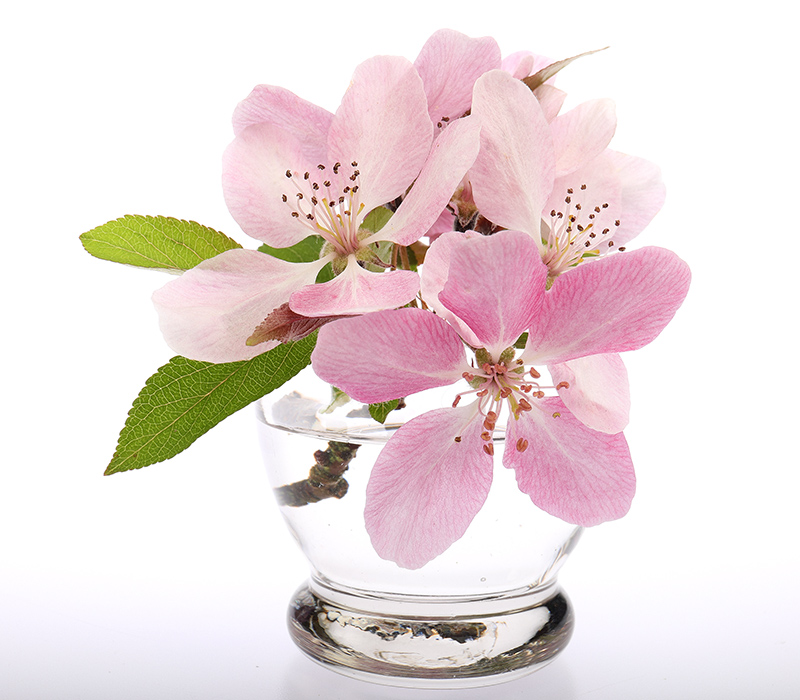
But the special flowers, like the cherry and crab apple blossom here, are worth making a special effort for. The wind had begun tearing at the delicate flowers, so I quickly cut a couple of sprays to photograph indoors. This makes it much easier to capture their details in close-up photographs, with no worries about them being blown around by the wind.
Being able to spend some time photographing these flowers was a special joy. It was a chance to appreciate their soft and transient beauty without other distractions intruding. And it was a bit of attention that the flowers thoroughly deserved. I hope you have time and the opportunity to enjoy some flowers this week.
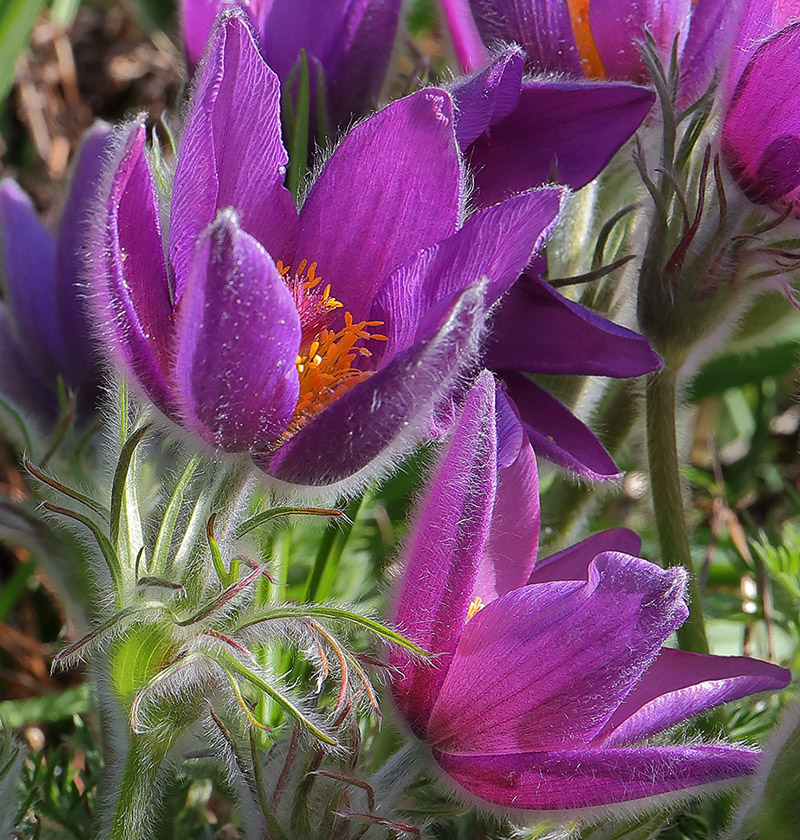
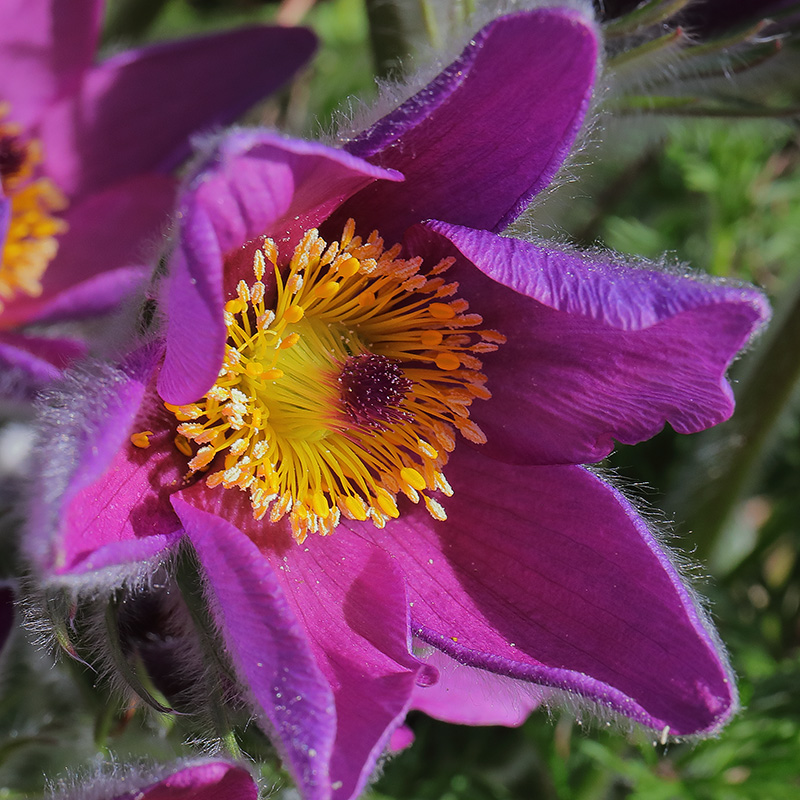
Over the past week or so, I’ve been enjoying the brilliantly-coloured flowers of Pulsatilla vulgaris (commonly known as pasqueflower) in my garden. Their rich violet-purple petals and golden stamens are a sight that has lifted my spirits.
You can see these flowers at their best on a sunny day, when they open fully, inviting bees to come and pollinate them. Soon there will be the fluffy white seed heads which glisten in the sun as their silky hairs catch the light. (You can see the seed head at the top of this post.)
I find the fluffy stems and leaves of the pasqueflower very appealing.
It feels like no time at all since the flowers started to appear but it won’t be long before they go over. This feeling is partly because I’m distracted by the spring work in the garden and sometimes get too engrossed in whatever is keeping me busy.
A nearby clump of white pasqueflowers has already finished flowering. (I removed the seed heads from this one as it’s still a young plant and I didn’t want it to put its energy into producing seeds yet.) The difference in timing intrigues me – why did the white one flower a couple of weeks earlier than the purple one? It can’t be a difference in conditions because they are only a foot apart and get the same amount of sun.
The spring flowers seem to rush into bloom very quickly and disappear quickly too. Maybe it’s the comparison with the slower changes of winter that makes this seem to be the case. It’s a good time to pause and have a good look around to see what’s in bloom and to take a few moments to appreciate the brilliance and exuberance of our spring flowers.
Spring flowers bring glorious colour to the garden.






 Ann Mackay: Inspired by Nature