We’ve just had our first little bit of rain in weeks. The garden has been desperately dry, with small cracks appearing in the ground in the worst areas. So this rain is a huge relief!
At the same time, we’ve had the sunniest May here since records began in 1929. Wonderful for sitting out in and giving us lots of flowers everywhere, but making it even harder to keep up with watering.
Many plants have suffered in the heat, but a few have coped well. One of the best has been Allium christophii, which seems quite unbothered by drought. As long as it gets lots of sunshine and has well-drained soil, it’s happy.
The allium leaves become yellowed and dead-looking by the time the flowers open. These can to be hidden by planting the bulbs with something that they can grow up through.
When the allium flowers are over, there are the lovely dry seed heads to give an interesting display for the rest of the summer. You may find seedlings if you leave the heads – or you can just cut the heads and bring them indoors to display. (Allium christophii will also multiply by bulb offsets.)
One big bonus of growing alliums is that they’re highly attractive to bees. I’m trying to increase the number of good plants for pollinators and other insects in my garden, so these really earn their place.
These alliums are well settled in my garden. I have two areas where there are spreading clumps of them and it’s a delight to see the flowers increasing every year. They’re so pretty that I won’t mind if they get a bit invasive. That just means that there will be more for me to photograph!
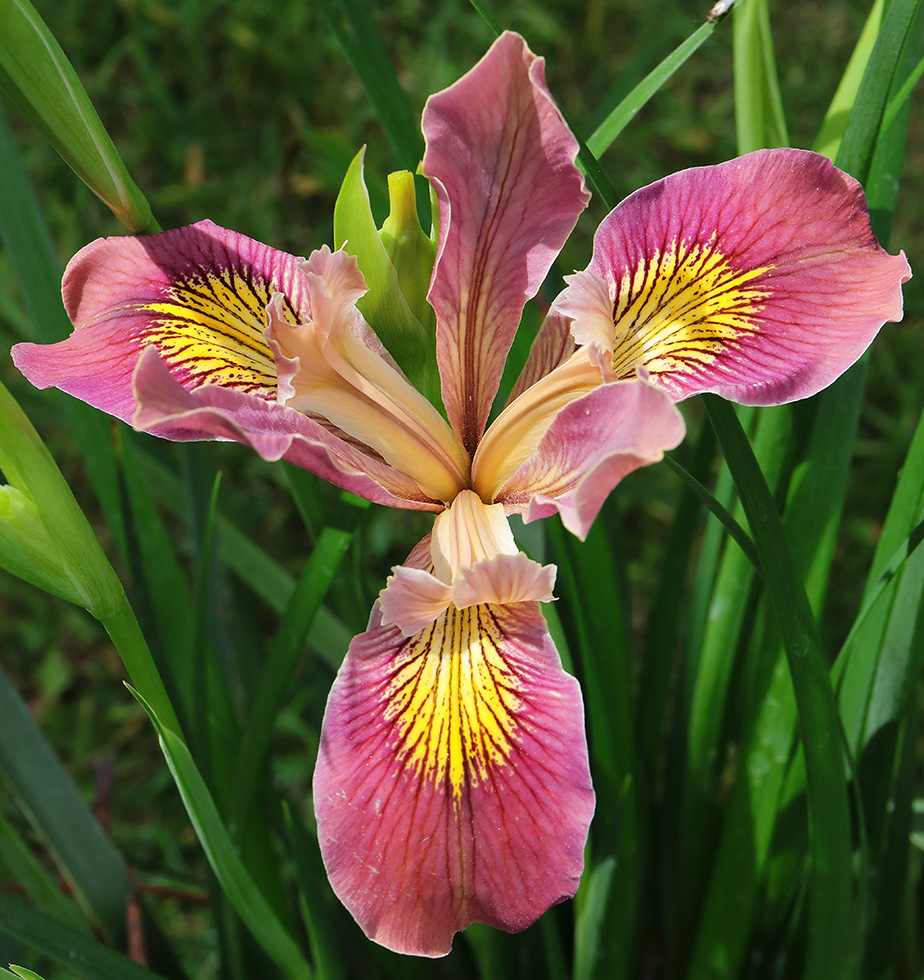
Late spring feels really special when the irises start to flower. The iris above is (I think) a Pacific Coast iris called ‘Broadleigh Rose’. It was given to me by my generous friend Judy. (Thanks Judy!) This is the first time it has flowered and I’m delighted with it.
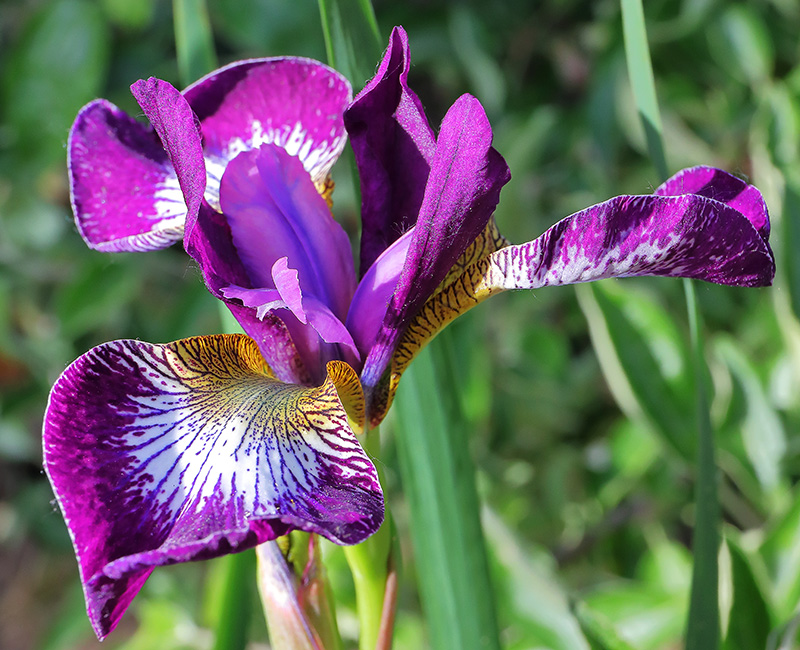
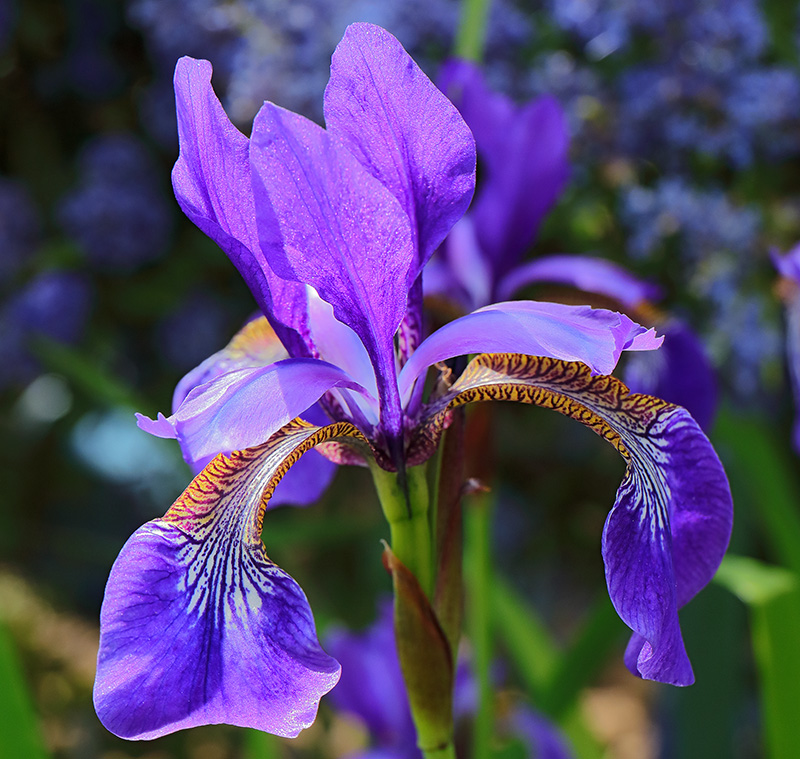
Irises are a marvellous plant for photography. They have it all – rich colours, striking markings, and a really ‘architectural’ shape. Iris sibirica is probably my favourite for photography because it combines an elegant shape with the boldest of markings.
At the moment, these irises are all living in large containers. They’re patiently waiting for me to finish preparing the border that will be their home. (That area previously had a row of huge conifers growing behind it in the neighbouring garden, so it was difficult to get anything to grow there. With the removal of the trees, I’ve had the chance to rejuvenate the area.)
Iris sibirica ‘Currier’
The new border runs most of the way along one side of the garden. There are already several well-established shrubs and some more recently planted small fruit trees along the border. But most of the rest is fairly bare, with just some planting at one end.
Eventually (!) this border will have a pond and a bog area. I’d really like to grow moisture-loving plants and this seems to be the only way that I can do it. (Unlike the garden in Scotland, where poor drainage meant we had areas that could flood.)
The pond has been dug out. (That took me a long time!) Now I need to level out the ground around it a bit, as the garden has a slight slope. This job is proving difficult because the ground has become so dried out.
But the irises are cheering me on with their vibrant colours, so hopefully it won’t be too long before they have the chance to get settled in to their new surroundings. I’m really looking forward to seeing what the border will look like next year!
While life seems to have been turned upside down and we’re all preoccupied with worries about the coronavirus, nature is quietly getting on with the business of spring. The warmer weather has brought leaves to the trees, opened colourful flowers and encouraged new growth everywhere.
It’s reassuring to get on with the small, familiar garden jobs that this time of year brings. Cutting back the stems of last year’s perennials feels both soothing and satisfying.
I have time to notice how long and curled the stems that carried the swirling butterflies of the gaura’s flowers became. Or that the shrubby sage (which has wonderfully bright magenta flowers in early summer) needs cutting back to prevent it from becoming lanky. As I trim back all these old stems, I find the new seedlings of the Canary Island geranium which have been sheltering under the old growth during the winter. Soon their large, dissected leaves will be impressively handsome.
Meanwhile, the daffodils have gone over and are being dead-headed. Now the tulips are flaunting their glorious colours as the low angle of the late sun glows through their petals.
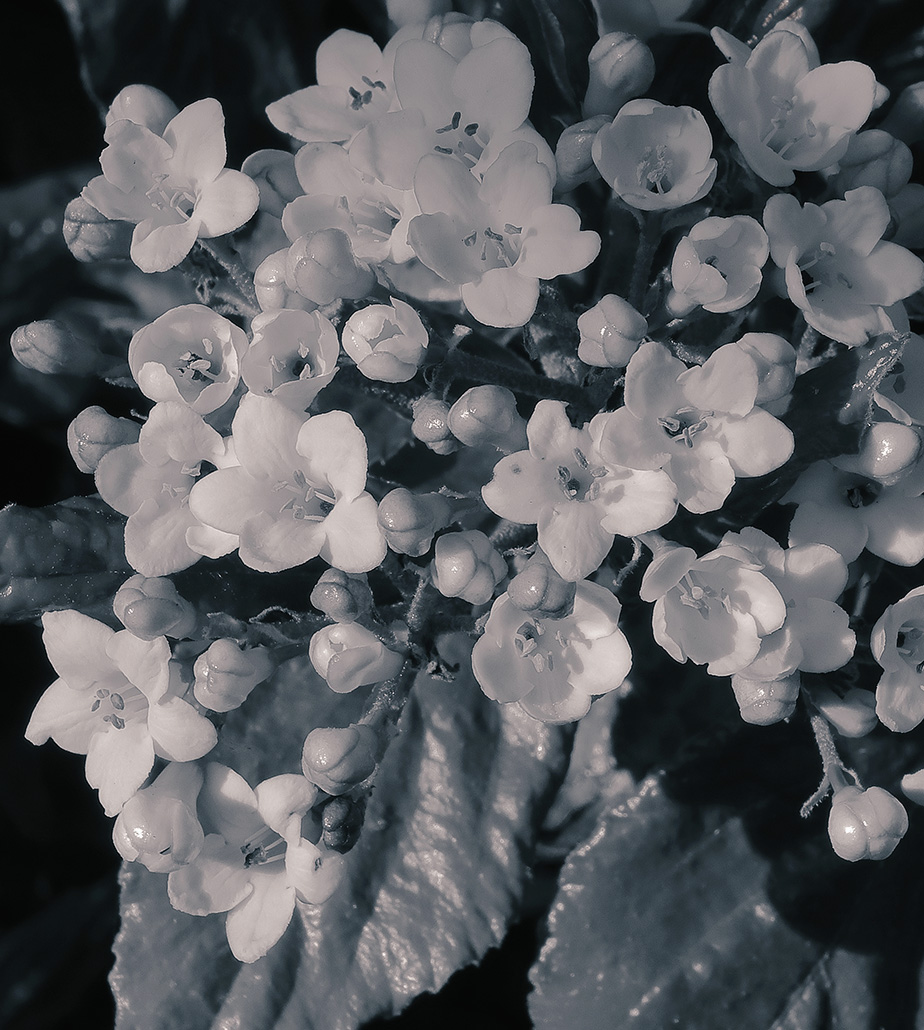
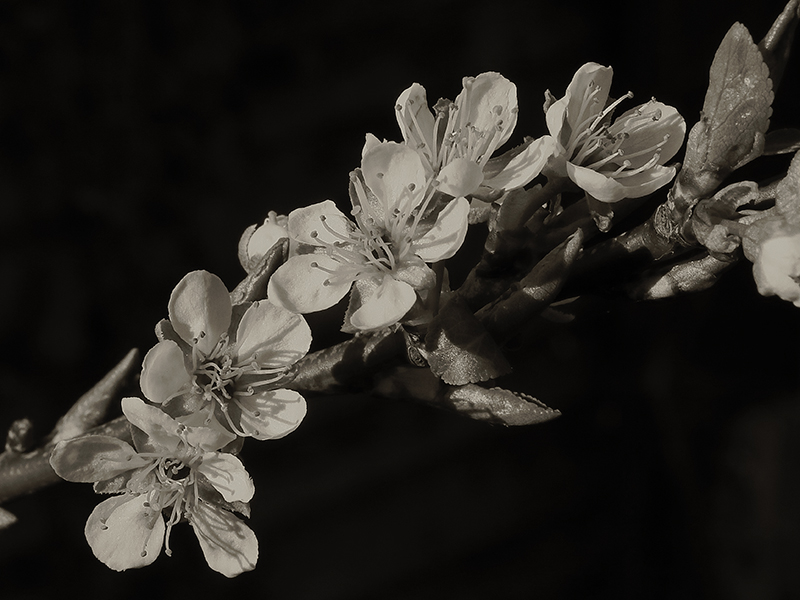
Not all of the flowers are as bold as the tulips though. There are the smaller, much more modest flowers of viburnum (top photo) and the plum tree that we planted last year (below). I’m particularly pleased to see the flowers on the plum tree – there’s lots – because last year it looked a bit sad and sorry during the drought. (Despite regular watering.) Maybe we’ll eventually get a few plums.
I’ve been entertaining myself by playing with black and white and a bit of digital toning with these photos. There’s plenty of time for a few experiments at the moment. I hope that you’re finding things to keep you happily occupied at this very strange time.
Normally I try to have something different to photograph every week, so that there’s plenty of variety in the images for this blog. But I think that’s going to be a bit difficult for a while. When there isn’t much to photograph in the garden I may buy a new plant or go on a garden visit – neither of which is possible at the moment.
However, although I cannot leave home to go visiting gardens for now, I can at least enjoy them through videos on the web. It seems a good time for me to share a quick fantasy tour of several gardens. I hope they will provide a little ‘escape’ if you’re stuck indoors.
I’ve enjoyed visiting Kew Gardens, but a day spent there can be quite tiring it you want to see absolutely everything. Their short video tour lets you see the highlights of the gardens the easy way! It includes my favourites – the Treetop Walkway (an amazing experience) and the gorgeous waterlilies in their own special glasshouse. You can find more videos from Kew at their YouTube page and I’d suggest the ‘Wakehurst in Bloom‘ video as a lovely glimpse of spring in one of their subsidiary gardens.
For many years I visited the Royal Botanic Gardens in Edinburgh on a very frequent basis. (I lived a little over 10 miles away.) So I’m pleased to be able to see spring there again and even visit their other regional gardens from the comfort of my own home.
From another botanical garden are the New York Botanical Garden’s videos. It was a treat to be able to see their fabulous orchid exhibition, which is too far away for me to be able to visit in ‘real life’. (Look out for the superbly elegant Darwin Star Orchid and the ‘predicted moth’.)
Most years I visit open garden events in the areas nearby. Sometimes the gardens are unusual or quirky and many surround interesting historic buildings. Of course, these have all been cancelled this year. I’ve been looking for videos instead and was happy to be able to explore gardens a bit further afield than usual when I found this video of gardens on the Isle of Man. Watching the video felt just like many of the open garden days that I’ve been to.
Gardens that I would normally be planning to visit at this time of year include Beth Chatto’s beautiful garden, which I’ve written about in a past post. This is one of my favourite gardens to visit, so I’ll miss it, but the video does convey what a spring visit there feels like. (I preferred to watch it with the sound music turned off though!)
I hope that you enjoy a little look around these gardens while you’re staying home. Stay safe!
It’s particularly vile outside at the moment. Right now we have high winds and sideways rain and there was even some short-lived snow earlier in the week. So it’s comforting to know that the early flowers have survived, despite the weather’s attempts to shred them.
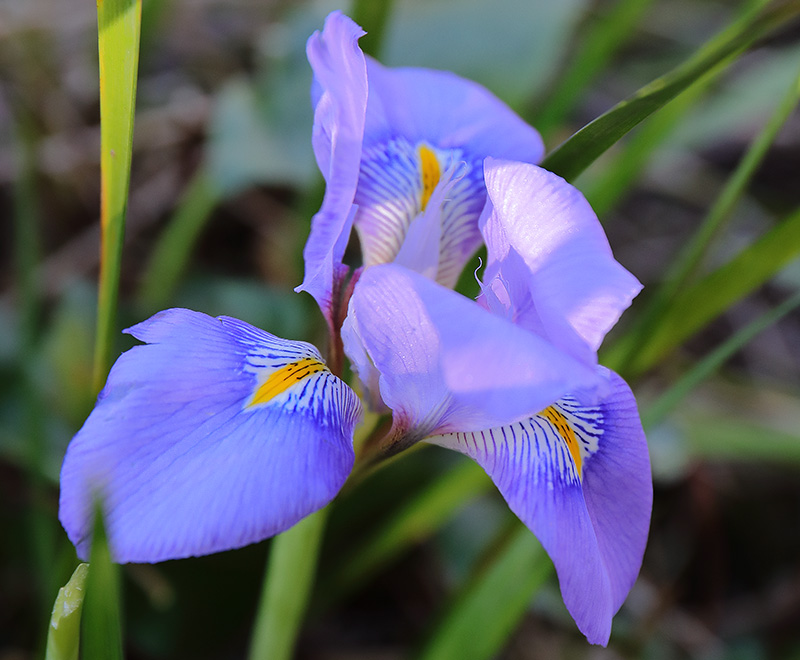
I photographed these irises a few days ago, in a dry and sunny gap in the stormy weather. (The weather forecast is my friend! I keep an eye on it to know when I must dash outside and photograph flowers before they are ruined.)
These fragile-looking flowers are iris unguicularis – had to check the spelling of that one – otherwise known as ‘Algerian winter iris’.
The plant was given to me by a generous neighbour and has slowly got itself established in a sunny border. It’s a plant that grows wild in Mediterranean countries and likes dry and sunny sites, so is well-suited to our hot and thirsty garden. (But the present heavy rain is unlikely to please it.)
There have been a good number of flowers this year, with a couple of buds still waiting to open. That is a good improvement over the previous years, when there were only three or four flowers and I thought the plant wasn’t too happy where it was. I’ve read that this iris flowers better as the clump gets older and more congested, so I’m looking forward to good displays in years to come…and a good reason to be outside on a wintry day with my camera.
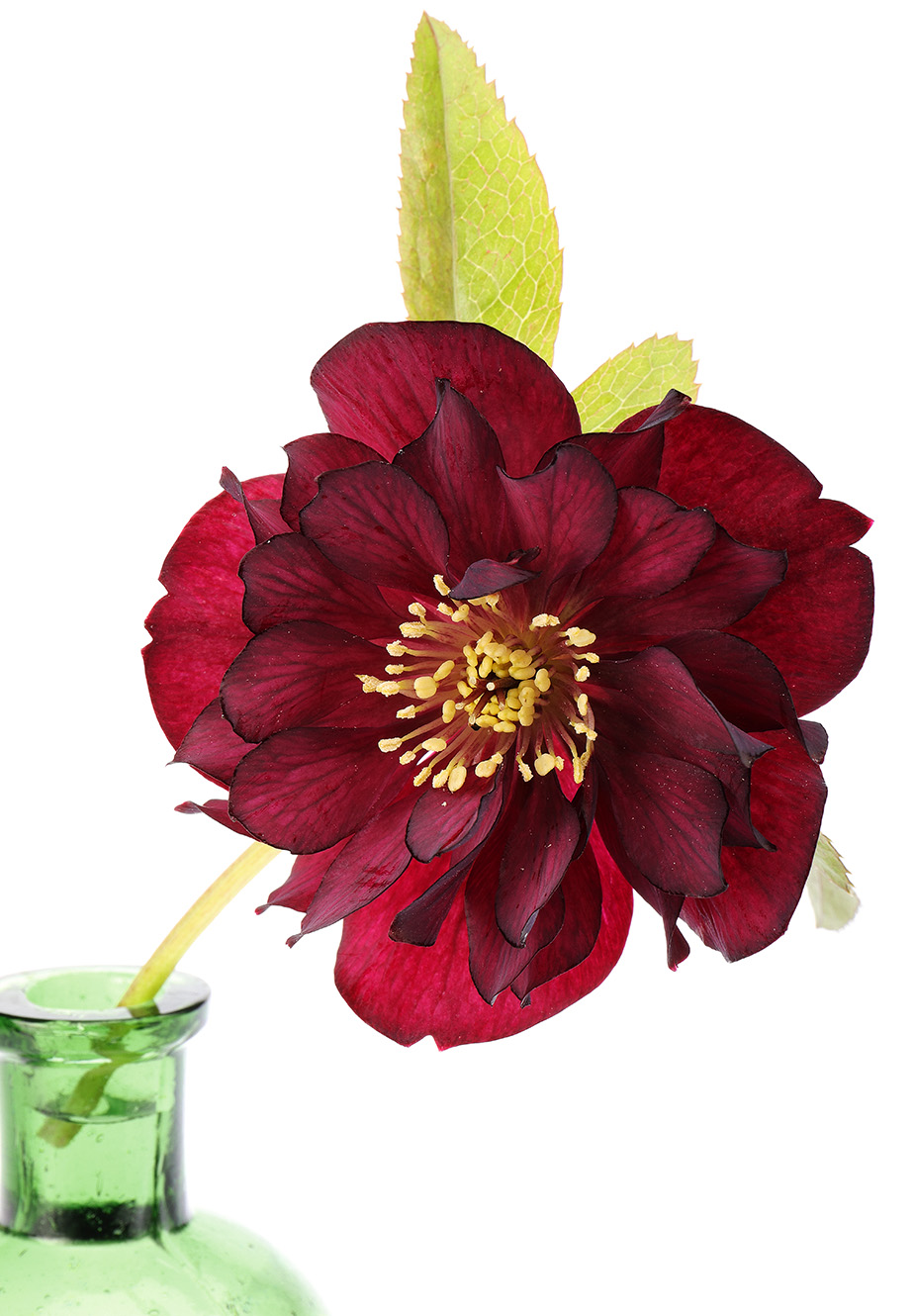
It feels like a very special treat when the hellebores start to flower. I don’t have many in my own garden yet, so I enjoy seeing them in other people’s gardens and wherever they’re offered for sale .
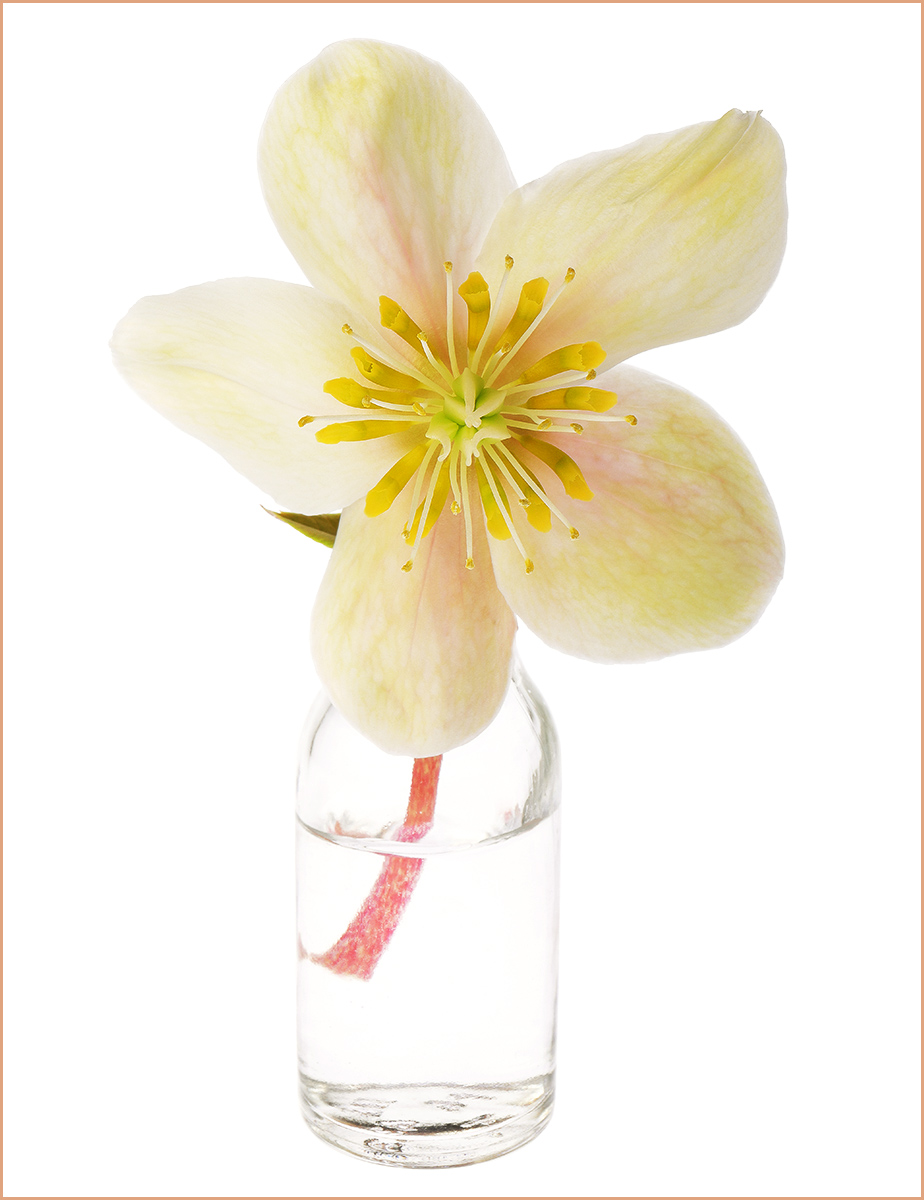
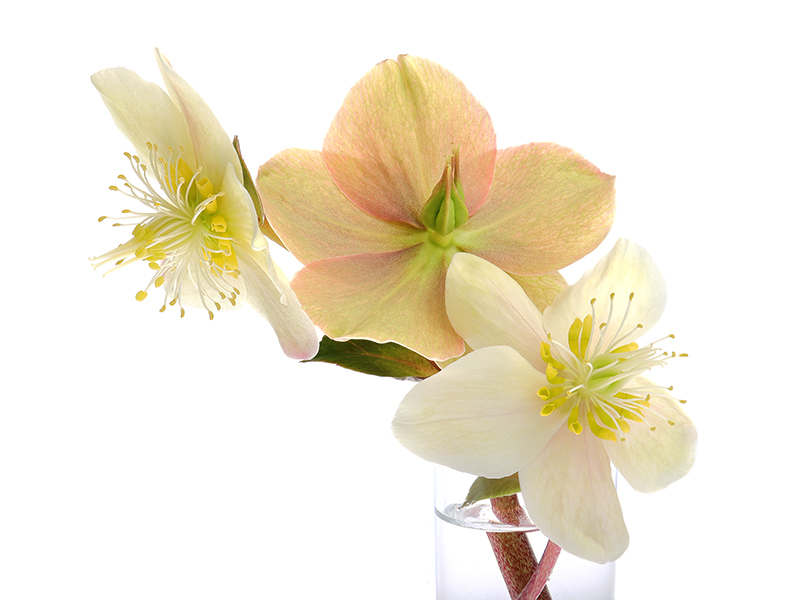
Recently I treated myself to a couple of new hellebores. According to the labels, they are ‘Shooting Star’ and ‘Cinnamon Snow’, but they are so like each other that it’s hard to be sure if they are actually different. (Plant labels can easily get mixed up in garden centres!)
As far as I can tell, the ‘Shooting Star’ is very close to white, with a touch of pink and yellowy-green to the flower as it ages. In the photo above, these tints are more pronounced because the bright studio lights make the colours of the reverse of the flower show through its slightly translucent petals.
‘Cinnamon Snow’ is a little darker, with a peachy-pink blush to its creamy flowers. It’s interesting to watch the flowers darken and develop more of a green colouring as time passes.
The flowers on these plants are a bit more upright than most hellebores, which makes their pretty faces much easier to see in the garden. (Usually I find I have to turn the flowers of hellebores upwards to see what they look like, so their beauty can go unseen if there isn’t time to stop by them for a while.)
I’m looking forward to watching these plants settle into the garden and bring a little bit of sheer loveliness to late winter.
It feels as if we aren’t yet having a proper winter here. The last few winters haven’t been as cold as we’d normally expect, but this may be the mildest since I moved here. We have had some cold weather this week and there’s been a bit of snow much further north, but it hasn’t lasted long.
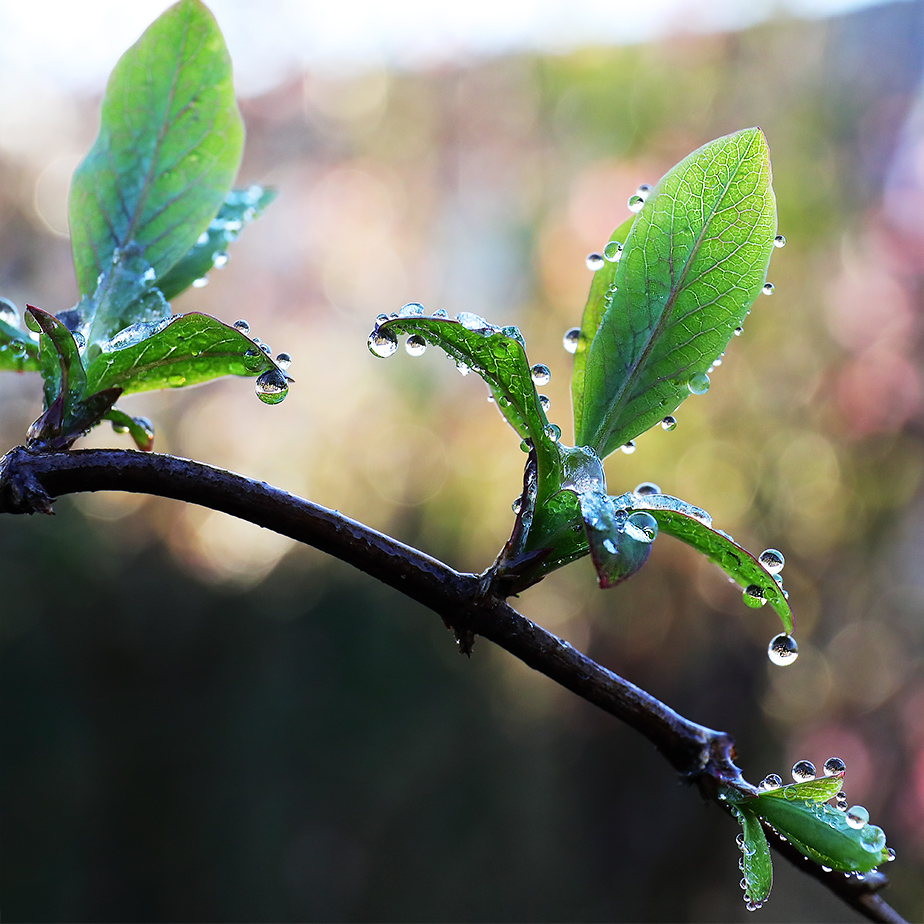
As a result, plants are further on than they should be for this stage of the winter. At this time last year, the daffodils were just showing the tips of their leaves but this year they are in bud already. The yellow crocuses are open (didn’t expect them for another week or so) and many plants are showing signs of new growth. Leaf buds are beginning to open on some of the shrubs here, especially the roses. And the honeysuckle in the photo (taken a couple of weeks ago) has hardly had time for a rest before its new leaves appeared.
But winter certainly isn’t over and we may still have more frosty mornings to come. And we could even have a snowy ‘beast from the east’, like last year. I hope that the plants don’t get far enough ahead to be likely to be damaged if they freeze – they really need to slow down and take it easy for a while! (And it IS winter, so I’d like to slow down and take it easy too…)
In part of the drab mid-January garden, lots of little yellow flowers sparkle amongst the bare branches of the dormant shrubs.
They are the flowers of winter jasmine (Jasminum nudiflorum), whose lax stems make it seem more like a climber than a shrub. In my garden it blends well with other shrubs because the long, thin stems with tiny leaves take up little space. It fills the gaps between other plants and becomes almost invisible in summer, while the other shrubs are in full leaf.
But just you wait for winter! Then the yellow starry flowers shine out against their dark background and add a touch of exuberance to brighten a cold and gloomy day.
If you leave it unpruned, the winter jasmine can spread quickly, with its flexible stems sprouting roots wherever they touch the soil. It’s easy to control the plant by pruning it after the flowers have finished, and it can be trained onto trellis or kept cut back to form a shrub. Personally, I like to have it growing in its natural, spreading form and I’m going to gather up some of the rooted stems to start new plants in other parts of the garden.
The flower you see in the photograph had been frosted and was still covered in water drops from the thaw. Although the frost destroys the jasmine flowers that are open, there are plenty of undamaged buds to provide lots more flowers – I’ll be sure to take the time to enjoy them. (And to take some more photographs!)
Bees are not the only pollinators that I’d like to encourage in the garden. Hoverflies are important for pollination and their larvae have a valuable role as predators of aphids and other garden pests. (There are always plenty of greenfly around here, so there should be plenty to keep any hoverfly babies munching!)
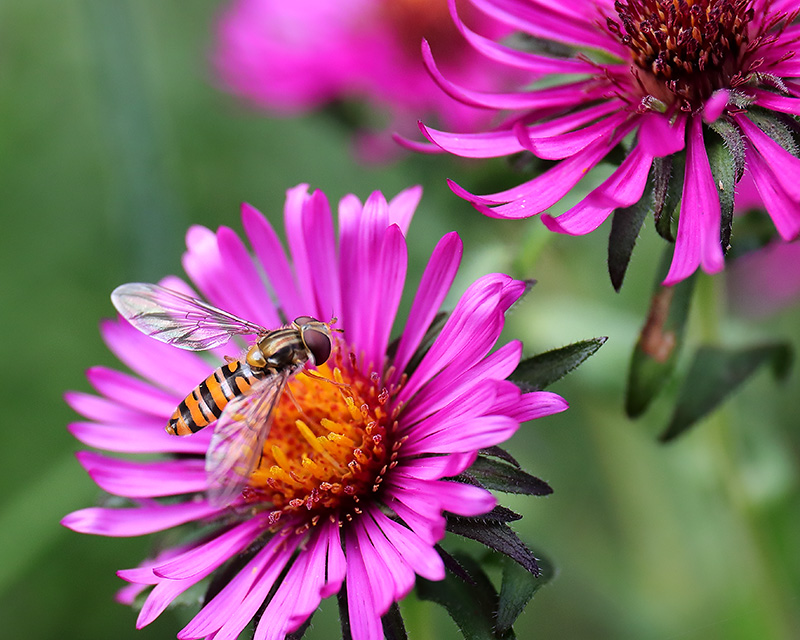
It can be easy to confuse hoverflies with bees or wasps. (They don’t sting but they mimic stinging insects so that birds are less likely to try eating them.) If you look at the photo of the honeybee below, you can see that there are differences between the common ‘marmalade hoverfly’ and the bee.
Not a hoverfly! This one is a honeybee (on a tithonia flower).
The bee here is generally a bit more furry-looking. (You can just see that there is a hairy patch on the front of the bee’s head and that its thorax is also hairy. Compare that to the thorax of the hoverfly, which is shiny and looks almost metallic in the sun.) The hoverfly has much shorter antennae and has just two wings, whereas the bee has four wings. (It’s hard to see that in the photo. You might just about be able to spot the separation at the back edge of the two wings on the nearest side of the bee.)
However, there are many other types of hoverfly (over 270 in the UK) and some look much more like bees than these. There is a difference that will help you tell which is which. Hoverflies have large eyes which cover the front and side (i.e.most) of their faces. A bee has eyes on the side of its face and they are much smaller and an oval shape.
It’s likely that some of the different ‘bees’ I thought I’d spotted in the garden were really hoverflies. Maybe I’ll learn to identify some of them… if I can move quick enough to photograph them!
Hoverfly on Cephalaria gigantea (giant scabious).
It’s very worthwhile to grow flowers that will attract these useful little beasties. They have shorter tongues than bees, so aren’t attracted to some of the deeper, bell-shaped flowers (e.g. foxgloves and penstemons) that bees like. Instead they prefer more open flowers where the nectar and pollen is easy to get at. They really like the daisy types like the aster below and umbellifers such as the fennel and wild carrot that grow in the garden here. One of the flowers that I often find them on is the scabious – as you can see from the photos.
I like watching hoverflies dart around amongst the flowers. They are fast and very agile (even flying backwards) and they add to the feeling of life and energy in the garden. I hope to see lots more of them this year – and maybe a few new ones – even if they do fool me into thinking that they may be bees or wasps!
The weather in the past week has been rainy, so not much good for gardening. But it has been ideal for a bit of ‘armchair gardening’. I’ve been thinking about the planting for a new area and imagining which plants might look good there.
Elsewhere in the garden there are a lot of deep or bright colours. I’d like to keep this new patch a bit softer and fairly informal. (Having lighter colours towards the back of the garden can give an effect of receding distance, making the garden look slightly bigger.)
This white rose has just the softest blush of pink.
Recently, I bought a white-flowered hibiscus, called ‘Red Heart’ because it has a bold red marking at the centre of its flowers. This was originally meant to go in the border alongside the new pond but, as I’ve been planting that area up, I’ve realised that there won’t be space for it.
Instead, I’m going to dig out a new border behind our main sitting-out area. (This is a tiny paved space with a wrought-iron arbour which is smothered by a grape vine at one end, and a more open seating place at the other.)
Because it’s an area for sitting around and taking it easy, I’d like to keep the planting looking relaxed and soothing. Somewhere that will help you to let all the stresses of the day ebb away. Whites, to pick up on the white hibiscus, and pale pinks are the most likely choices at the moment.
We already have a white-barked birch tree nearby, and I’m planning to move some pale pink Japanese anemones to another border behind the new area. (The anemones are beautiful thugs, so they’re getting a border of their own where they can run riot.)
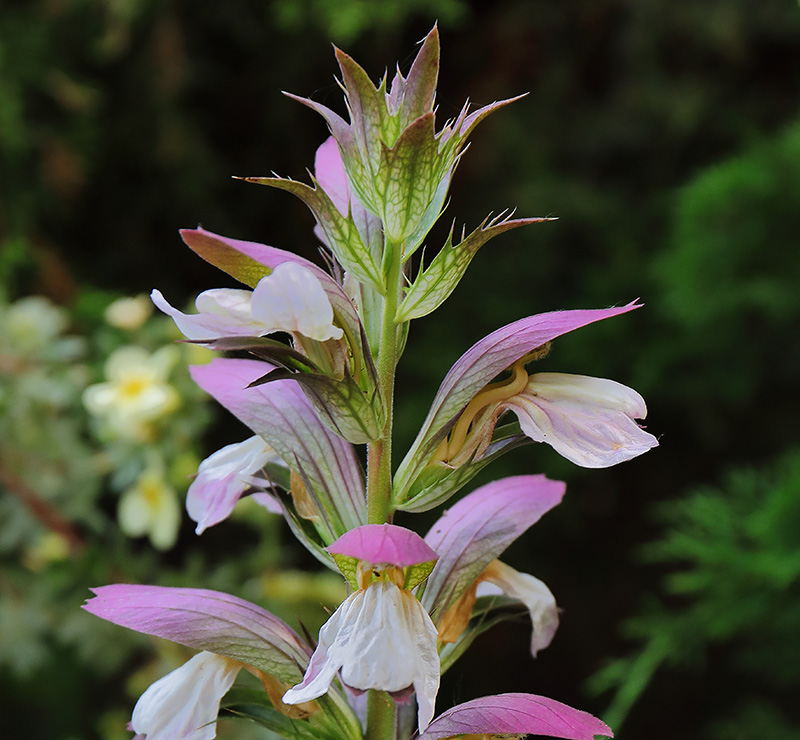
This acanthus has delicately marked veins, but it looks rather spiky.
Sidalcea, astrantia and erigeron (Mexican fleabane) grow in the garden here, so it should be easy to introduce them to the new area too. And we have lots of dark red scabious – a few of those would help to emphasise the similarly-coloured red markings on the hibiscus.
Among the plants waiting to be found homes in the garden here are several white and pink rock roses (Cistus) and they would be likely to enjoy the sun in this border. So the planned area is beginning to look very pink and white, especially if I also add a pale rose like the one in the photo. (Don’t know its name.)
And maybe there should be some acanthus too – it has similar vein-markings to the astrantia and the ‘architectural’ form of the plant would be very striking. But that spiky look might not be so relaxing to look at! (Acanthus is a plant you need to be very sure about wanting, because it’s very hard to get rid of and can grow from little pieces of left-over root.)
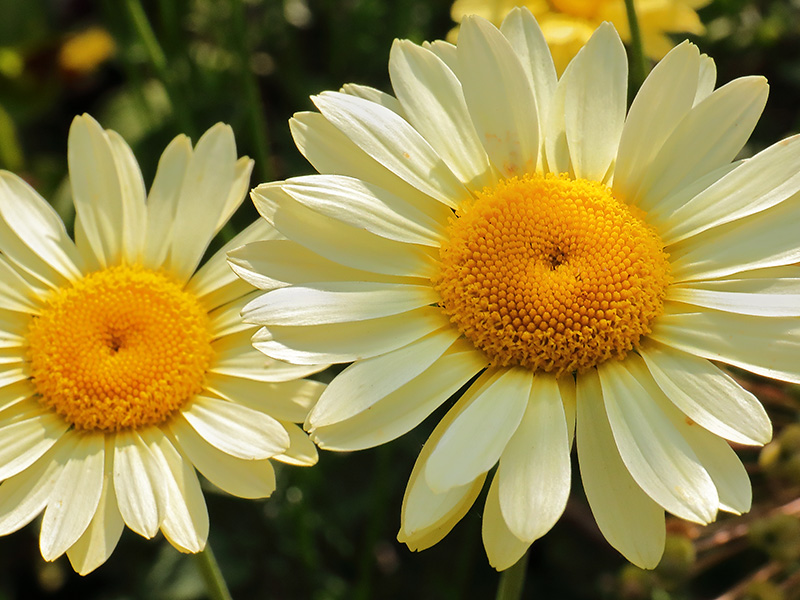
The sunny little daisies of Anthemis ‘EC Buxton’
The plan for this new area may be getting a little too pink, so some other pale colours could be added. I love the happy little daisies of the anthemis above. They’re like a sprawling splash of sunshine in the border and have a very informal look. Nigella also has that relaxed feel about it and would be delightful to see close-up. (The area behind the seating is a little higher, with a low retaining-wall because our garden is on a slight slope.)
Fantasy-gardening and planning new planting is a very pleasant way to spend wet days. But maybe the best thing about it is that it gets the enthusiasm going for starting the work. The rain is over for now and the forecast for the next week is mostly dry, so it looks like I have some digging to do…







 Ann Mackay: Inspired by Nature