In the Winter Garden

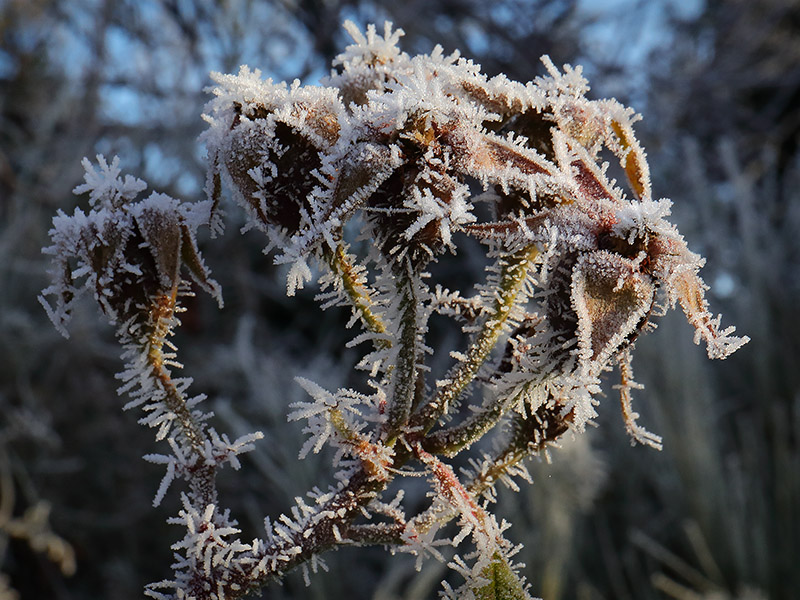
Frosted flowers of Knautia macedonica

NB: A note for WordPress Reader users – you need to click on the title of the post again to see the full photograph. (Otherwise you see just a tiny section!)

With January over, I hope that the cold will begin to ease. It feels like it’s time to get back to work in the garden, but I don’t fancy getting frosted when I do!

We haven’t had any more freezing mornings in the last week, so perhaps these will be the last of my frosty pictures for this year. I’ve been very glad to have the heavy hoar frosts around to give me something to photograph. They have made some very unremarkable parts of the garden take on a new interest.

Frosted rosehips
I’d normally have deadheaded this rose, but this year a few rosehips were left and the frost found them.

Some plants, like the Knautia macedonica (top), are generous in producing late flowers that are likely to get frosted. That makes them an obvious subject for me to photograph. But many of the other plants look much more ordinary until the frost decorates them. So plants that I might not have thought of photographing earlier in the year suddenly demand my attention.

The tiny yellow flowers of the pond plant below (Sisyrinchium californicum, aka yellow eyed grass) are long gone and have been replaced by its seed pods. The frost has turned these into odd-looking spiky growths, almost as if they’ve become some strange winter flowers reaching towards the frozen pond.

Frosted pond plant
Pond plant Sisyrinchium californicum takes on a different appearance when covered in hoar frost.

Sometimes there are non-plant things for me to photograph on a frosty day, like the spider’s web below. I can’t help wondering if the spider has survived the very cold spell – maybe it’s hiding in a warmer spot under some leaves somewhere. At any rate, I’m sure that any spiders and other creatures in the garden will be much happier when it warms up a bit.

However, since I began writing this, I’ve noticed that the latest weather forecast has promised us some very chilly nights. So I may have to be patient and wait a while yet for the warmer weather. (But roll on spring!)

Frosted Spider Web
Chilly weather for spiders!

In a Shady Corner: Frosted Hydrangea Flowers

Frosted hydrangea flowers

NB: A note for WordPress Reader users – you need to click on the title of the post again to see the full photograph. (Otherwise you see just a tiny section!)

A climbing hydrangea (Hydrangea anomala subsp. petiolaris) grows in a cool and rather dark spot in our garden. It is beside our main seating area, under a laurel that has grown into a large tree.

The laurel’s shade is a very welcome protection from the hot sun in summertime, both for us and for the hydrangea. Without that bit of shade, the hydrangea would struggle to cope with the way heat can build up here.

The RHS describes this plant as ‘best grown in partial shade in a moist but well-drained soil’. Unfortunately, the soil here is rarely moist in summer. (Winter is a different matter!) This was something I did not realise when I planted it many years ago. Nor did I make much allowance for how dry the tree roots must make the area. Nevertheless, the climber has survived, though growing slowly.

From May to July the hydrangea’s white flowers add a cool note to my favourite place to sit. I get to enjoy their grace and airiness from close quarters. By winter any remaining flowers have turned brown and leathery, but a light dusting of frost makes them graceful again.

You can see the summer flowers of Hydrangea petiolaris in this post.

Frosted hydrangea flowers
Frosted hydrangea flowers in a shady corner of my garden.

Winter Roses

Frosted rose 'Blue Rhapsody'

NB: A note for WordPress Reader users – you need to click on the title of the post again to see the full photograph. (Otherwise you see just a tiny section!)

We had a few days of frost and snow towards the end of December. This created lots of opportunities for winter photographs, so you can imagine how pleased I was to see it. (Finding something to photograph for the blog can get difficult at this time of year!)

The warm autumn and mild early winter had encouraged the roses ‘Rhapsody in Blue’ (above) and ‘Zepherine Drouhin’ (below) to produce a few very late blooms. I love to photograph frosty and frozen flowers because they’re like little icy sculptures. Sadly the frost brought these particular flowers to an end. Freezing damaged the cells of the petals too much for them to survive once the frost melted.

Most of my frosty pictures are photos of seed heads and leaves, so it makes a change to be able to photograph frosted flowers. Because there are only a few winter-flowering plants in my garden, I’d like to plant more flowers that will appear during this time. That would mean that I have more to enjoy in the garden in winter and more to photograph – that’s always a pleasure!

Frosted rose 'Zepherine Drouhin'

Wishing You a Happy Christmas

NB: A note for WordPress Reader users – you need to click on the title of the post again to see the full photograph. (Otherwise you see just a tiny section!)

Christmas already! It feels as if it has sneaked up on me very quickly again this year. As usual, I’ve been on the lookout for a photograph of a suitably frosty ‘decoration’ from the garden for this post.

Luckily, our recent frost and snow, which lasted for several days, was a great opportunity to spend time in the garden with my camera. There are always some seed heads left in the garden and these look good when they’re heavily coated with frost. The seed head you see here is on a bronze fennel. It’s the same plant that I used for the photo of a seed head with water drops (from melted frost) in this post. (The photographs in that post were taken in a previous winter.)

Whether or not you celebrate Christmas, I wish you a time of happiness, and a time to get together with the people you love. I hope that it will be a chance to enjoy being with family and friends. Merry Christmas everyone! 🙂

It’s Cold Out There!

Frosted Salvia (flowering sage)

NB: A note for WordPress Reader users – you need to click on the title of the post again to see the full photograph. (Otherwise you see just a tiny section!)

We are definitely in the cold, dark depths of winter here, brrr! I think the drawn-out and very mild autumn had lulled me into a false sense of security and/or warmth because the freezing temperatures feel like quite a shock. But grey clouds are said to have silver linings, and frosty mornings mean opportunities for photography.

I initially wrote that frosty mornings have a sparkle, but that’s not necessarily true. If there is sun, as in the top picture of a pink-flowered salvia, it makes the image much more appealing. The tiny flowers are just enough to give a translucent gleam of crimson.

Frosted Astrantia flowers
Astrantia flowers are usually long gone by winter.

The two following images, were, by contrast, in deep shade. They have a much colder and more subtle feel, lacking the drama of strong colour and sun. At the same time, there is more detail in the frost than if the flower was beginning to warm in the weak sunshine. (Any bit of sun soon softens and melts the frost, so in brighter areas I have to work much more quickly.)

Astrantia (above) wouldn’t normally be in flower at this time of year and this late flower was a surprise. The Japanese anemone (below) would normally have finished flowering some time ago too (usually October). Maybe the late flowers were a result of the warmer than normal autumn. In any case, they were a chance to take frosty flower photographs that I wouldn’t normally get.

Frosted Anemone
This anemone flowered very late and paid a very chilly price!

Sadly, the frozen flowers will be destroyed by the frost. They’ll be like limp brown rags when they eventually thaw. I can’t complain though, because in these cooler, shady areas, the frost has lasted several days without lifting, giving me plenty of time to photograph these flowers.

The winter-flowering clematis that I posted photographs of recently has frozen too. Although I would expect the opened flowers to be badly damaged by the frost, I hope that the still-unopened buds will survive. With luck and milder temperatures soon, there may be more of these pink bells to come. I certainly hope so!

Frosted clematis flowers
The winter-flowering clematis is now a frozen clematis!

Winter Scent: Viburnum Bodnantense ‘Dawn’

Snow on flowers of Viburnum bodnantense Dawn

NB: A note for WordPress Reader users – you need to click on the title of the post again to see the full photograph. (Otherwise you see just a tiny section!)

Last week I photographed a winter-flowering clematis growing up a shrub that flowers at the same time. This week I thought I’d show you what the flowers of that shrub (Viburnum bodnantense ‘Dawn’) look like.

As you can see, the flowers are small and not exactly spectacular. They do however, look very pretty on the bare branches of the shrub and provide some good colour on a winter’s day. After frost or snow some of the older flowers will be browned and dying, but the newly-opened flowers and buds keep going and can last over a long period.

One of the main reasons I planted this viburnum wasn’t for the flowers, but for the scent. I’d come across it in a park in winter and had been entranced by its sweet fragrance. For the first years with my own one, I’d been disappointed by an apparent lack of scent. (But I don’t have a particularly strong sense of smell, so I thought I could be at fault.) I wondered whether individual shrubs could vary in the amount of scent they produced.

This year I was very pleased to find that my viburnum does indeed produce scent. At the moment it has far more flowers than ever before, so their sweetness has been noticeable in the air. Getting up close to the viburnum while I photographed the clematis in its branches was a very pleasant experience. There are some delightful benefits to spending time in a cold winter garden!

Winter Clematis: Lansdowne Gem

Clematis cirrhosa 'Lansdowne Gem'

NB: A note for WordPress Reader users – you need to click on the title of the post again to see the full photograph. (Otherwise you see just a tiny section!)

The weather has made the garden feel distinctly unappealing for most of this week. It has been grey and damp and dark far too early in the day for me to spend much time outside. But I did make a point of going out to look at the flowers of Clematis cirrhosa ‘Lansdowne Gem’.

Unlike the other clematis in the garden, this one flowers during winter. The flowers are a deep wine-red, but in order to see the colour you need to be standing underneath the bell-like flowers. (The outside of the flower is a drab greyish-white.) I’ve chosen to grow this clematis up through the winter-flowering Viburnum bodnantense ‘Dawn’ which has pink flowers at the same time.

The flowers are not all a solid red. Some are quite speckled, especially around the edges of the petals. I was intrigued to notice that one flower was especially spotty (below), making it look very like the flowers of the related variety ‘Freckles’. And seeing how pretty it is, I’m now tempted to look for somewhere that I could grow ‘Freckles’ too.

Having flowers in the garden in winter is something of a treat. It’s also great for any bees that are around at this time. That makes me very interested in growing other winter-flowering clematis.

These clematis come from Mediterranean areas and go dormant in summer. That means they are more likely to survive drought in my hot Suffolk garden than the summer-flowering types. (I’ve lost a few of those through planting them in unsuitably dry places!) These clematis are not so hardy, though, so I’m hoping we won’t get a ‘Beast from the East’ this year.

Clematis cirrhosa 'Lansdowne Gem'

LEFT: The clematis flowers trail through this shrub’s branches like rows of bells.

RIGHT: One of the flowers of ‘Landsdowne Gem’ was spotty rather than the usual almost solid red.

Waiting in Hope

Hesperantha flowers

NB: A note for WordPress Reader users – you need to click on the title of the post again to see the full photograph. (Otherwise you see just a tiny section!)

Will I see a flower or two on my hesperanthas before winter comes? I must admit that it’s just a small hope by now, because I haven’t even noticed any buds. (But I’ve been busy elsewhere in the garden so I could have missed those.)

Hesperanthas flower a bit later in my garden than they’re said to – often October into November here. So if they flower they add a splash of colour before the frosts. Last year I had lots of red in a border and this white one in a pot. Nothing this year.

This year has been so extremely hot and dry that I think these plants have really suffered. I did try to keep them watered, but with so many plants gasping for more moisture, it was hard to keep up. These plants like moist or damp soils, so I may try relocating them to the bog garden that I’m building near the pond. Winter may be a problem there though. We do get long rainy spells at that time of year and I worry that the ‘bog’ area may get too waterlogged. I guess I will just have to try it and see. If it works, I may get some flowers like these next year… 🙂

Autumn Elegance

Japanese anemone 'Honorine Jobert'

NB: A note for WordPress Reader users – you need to click on the title of the post again to see the full photograph. (Otherwise you see just a tiny section!)

This white Japanese anemone (‘Honorine Jobert’) has just finished flowering in the last week. I’m impressed that the flowers have lasted so well, despite it getting very little extra watering in summer.

Many of the other plants in the garden appeared to finish flowering earlier than usual due to the stress of the hotter than usual weather and lack of rainfall. (Some plants, like the red echinacea have loved the sunshine and produced masses of flowers.)

The pink Japanese anemones here (‘Hadspen Abundance’ and ‘September Charm’, which always flowers much earlier than September) have struggled this year. Both have produced far fewer flowers than usual and much less leaf growth too. Perhaps drought and heat will help to keep these thuggish plants in check in future!

It’s a relief to see that this anemone hasn’t spread as much as the pink ones. So far it hasn’t caused any problems by crowding the plants around it. (But it has only been in the ground for around three years. Maybe it will start a takeover bid when it has had more time to get thoroughly established. I will have to wait and see.) Originally I had thought of keeping this plant and a second one in pots to limit their spread but eventually decided that they would be better off in the ground.

Japanese anemones may be inclined to swamp their neighbours, but so far ‘Honorine Jobert’ has been much better behaved than her pink cousins. Even if that does happen, I will have to forgive the plant because the white flowers with their touch of glowing yellow are delightful, especially when the other flowers are fading away.

(Almost) Silent Sunday: Passionflower

Passionflower (Passiflora caerulea)

NB: A note for WordPress Reader users – you need to click on the title of the post again to see the full photograph. (Otherwise you see just a tiny section!)

I’m having a little break this week because a very dear friend who lives a long way away has come to stay. Lots of fun and friendship here, but not much attention for the garden for a little while. Back to normal next week! 🙂