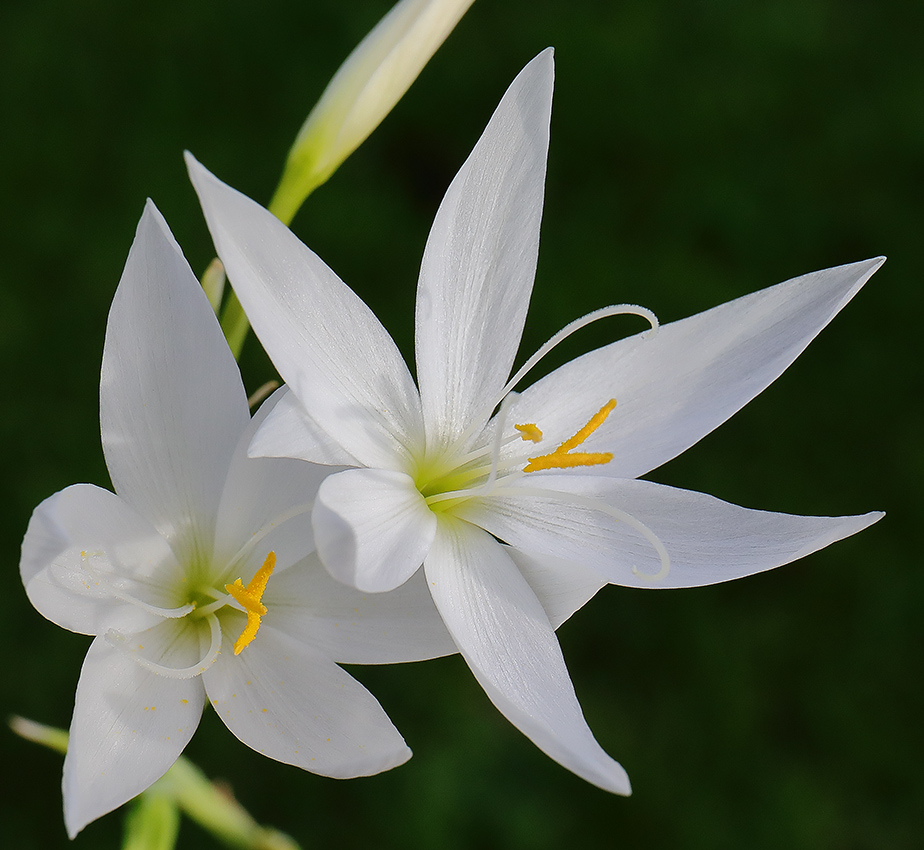
Brief Glories

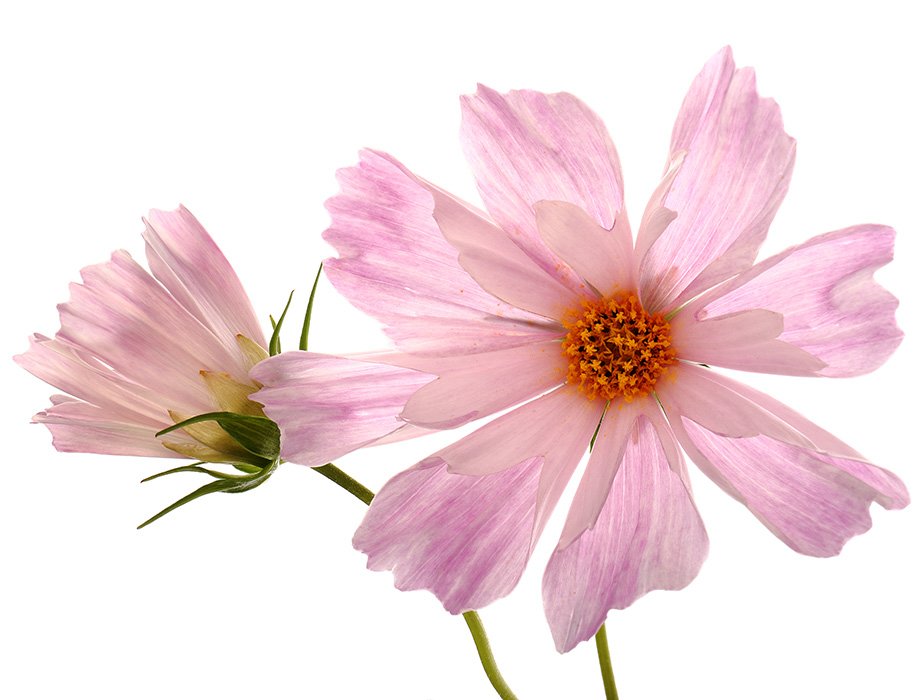
Flowers of Cosmos 'Seashells'

NB: A note for WordPress Reader users – you need to click on the title of the post again to see the full photograph. (Otherwise you see just a tiny section!)

My title isn’t entirely true! Annuals, like the cosmos in this post, can flower for months. But here I’m thinking of the difference between annuals and perennials.

Most of my garden is made up of perennials because I rely on them coming back year after year and gradually spreading. I wouldn’t have time to grow much from seed every year, so I need plants that are long-lived and can pretty much do their own thing once they are planted.

That makes lots of sense for building up the planting of the garden. But annuals have the advantage of providing me with something new to photograph. These – such as the zinnias, cosmos and nigella I’ve grown in past years – add some variety to the images I can create. This year I’ve missed having that variety because I didn’t grow any annuals at all.

There are sometimes a few annuals and biennials that reappear from self-sown seed. The love-in-a-mist (nigella) manages to spread itself around, as do evening primroses, wild carrot (daucus) and borage (which gets everywhere if it gets a chance). This year I’ve noticed that there is a small self-sown cosmos in a border. I’ve never had them do this before, so it’s an unexpected surprise and I’ll have to wait to see what the flower will be. (Probably a pink and white ‘Candy Stripe’, since they were the most recent. You can see them here.)

Waiting for that little cosmos bud to open is making me feel that I must make time to sow some annuals next year. I’ve missed the added interest and excitement that growing something new and unfamiliar from seed brings. Hmm, now I need to look at some seed catalogues… 🙂

Flower of Cosmos 'Seashells'
Flower of Cosmos ‘Seashells’

Absent Friends

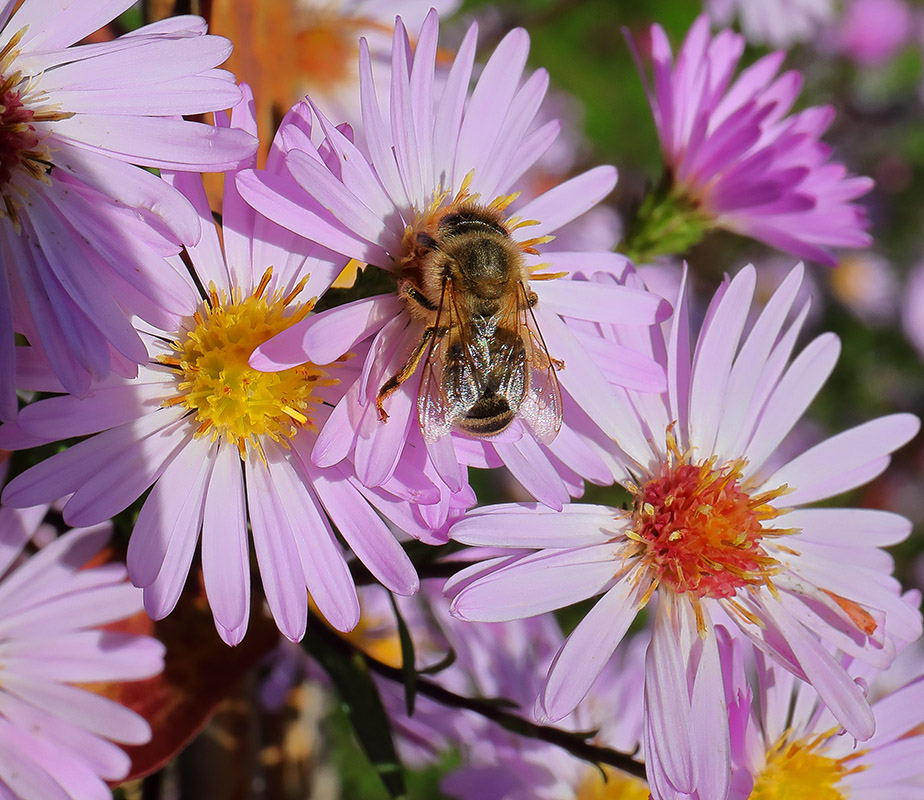
Bee on aster

NB: A note for WordPress Reader users – you need to click on the title of the post again to see the full photograph. (Otherwise you see just a tiny section!)

A look through my photo files shows me that I have taken very few images of bees this year and none at all of butterflies. That may be partly due to me being busy finishing off the pond, rather than paying so much attention to the flower borders. But the relative absence of these garden friends has been very noticeable over the last few months.

Spring wasn’t so bad. There were Buff-tailed bumblebees and Common carder bees keeping busy in the spring flowers as usual. A little later, lots of honeybees made the most of the flowers of the Ceanothus bush. It fairly buzzed at times! But when the temperatures began to climb, there certainly appeared to be less activity in the garden.

Red Admiral, Peacock and Comma butterflies
Butterflies clockwise from top left: Red Admiral, Peacock, Comma

Keeping myself out of the heat probably means that I was less aware of any bees that were around. Normally, though, I would see quite a lot of them – hoverflies too. I’m more sure about the drop in butterfly numbers here. There are warm, sheltered spots in the garden that frequently attract butterflies but this year there were rarely any there.

I’ve read that this year’s ‘Big Butterfly Count’ had lower numbers recorded, despite an expected increase because of the warm weather. It is feared that environmental changes and habitat loss account for the drop. For many bees, though, the heat of this summer is suggested to have been a disadvantage. A study by US scientists has found that the larger, heavier bodied bees (including bumblebees) declined as temperatures increased, while smaller bees increased in numbers.

Does this explain why I’ve seen fewer bumblebees this year? I don’t know. All I can really do is to try to provide as much as I can in the way of useful plants and habitats in the hope that it will help both bees and butterflies.

Common Carder Bee on Sedum

Low-Growing Beauties: Herbaceous Clematis

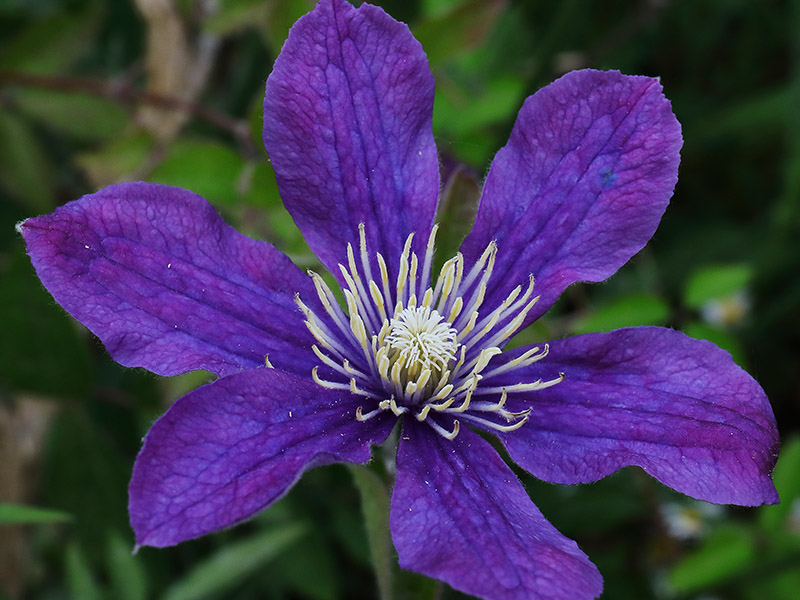
Clematis Sapphire Indigo

NB: A note for WordPress Reader users – you need to click on the title of the post again to see the full photograph. (Otherwise you see just a tiny section!)

Tall, climbing clematis are amongst my favourite plants. I love the different flower forms, as well as their wonderfully rich colours and the velvety look of their petals. But I can struggle to keep them going here, in the dry and baking soil of my East-Anglian garden.

The short-growing herbaceous varieties of clematis may be a dependable alternative here. I have two at the moment: ‘Sapphire Indigo’ ( just opening in the top photograph) and the popular ‘Arabella’ below. They have been in the garden for a number of years and have managed to come through the drought and unusually high temperatures of this summer without any extra watering. Both are still in flower now, at the beginning of October and have been in flower on and off from June. (They would probably be more constantly in flower if they had more moisture.)

Clematis Arabella
Clematis Arabella

Reading up on these clematis tells me that they don’t suffer from clematis wilt and that they are long-lived. They have no tendrils to help them climb and are only 30 to 60 cm tall, so are good where they can grow through another plant for some support. I have ‘Arabella’ growing through a shrubby sage that gets to over 60 cm and provides a useful home where the clematis can lean against its twiggy framework.

The only problem that I’ve found so far is that slugs and snails like snacking on the flowers. So I’ll need to find something gritty or prickly (we have a holly and mahonia bushes, so perhaps some of their leaves) to sprinkle around the stems in the hope of keeping these marauders away.

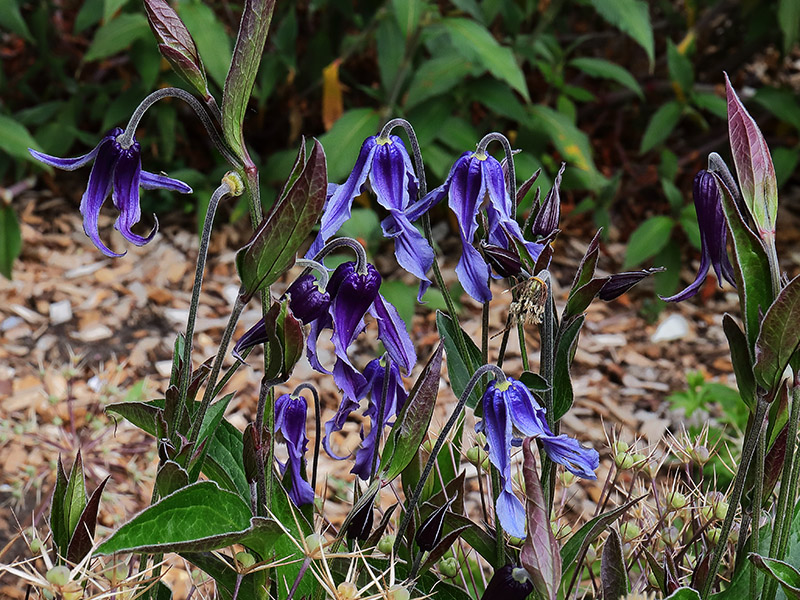
The flowers on these two plants start off with a lot of purple in their colour when they first open and then gradually become more blue as they age. (You can see the newly-opened flowers of ‘Arabella’ here.) My last photograph is another purply-blue short-growing clematis, probably a clematis integrifolia. This one was photographed on a visit to Fullers Mill Garden and is one that I would like to try here. These lovely purple-blues are my favourites, but I’m sure I’ll be tempted by pink and white varieties too. For now though, I’m going back outside with my camera to take some more pictures of ‘Sapphire Indigo’…

Clematis integrifolia

Glowing Embers

helenium flowers

NB: A note for WordPress Reader users – you need to click on the title of the post again to see the full photograph. (Otherwise you see just a tiny section!)

Here we’ve gone from unusually high temperatures to autumnal chills in a very short time. I’m still wondering how the summer disappeared so quickly. (And hoping for some more gentle sunshine that we can enjoy rather than be baked by.)

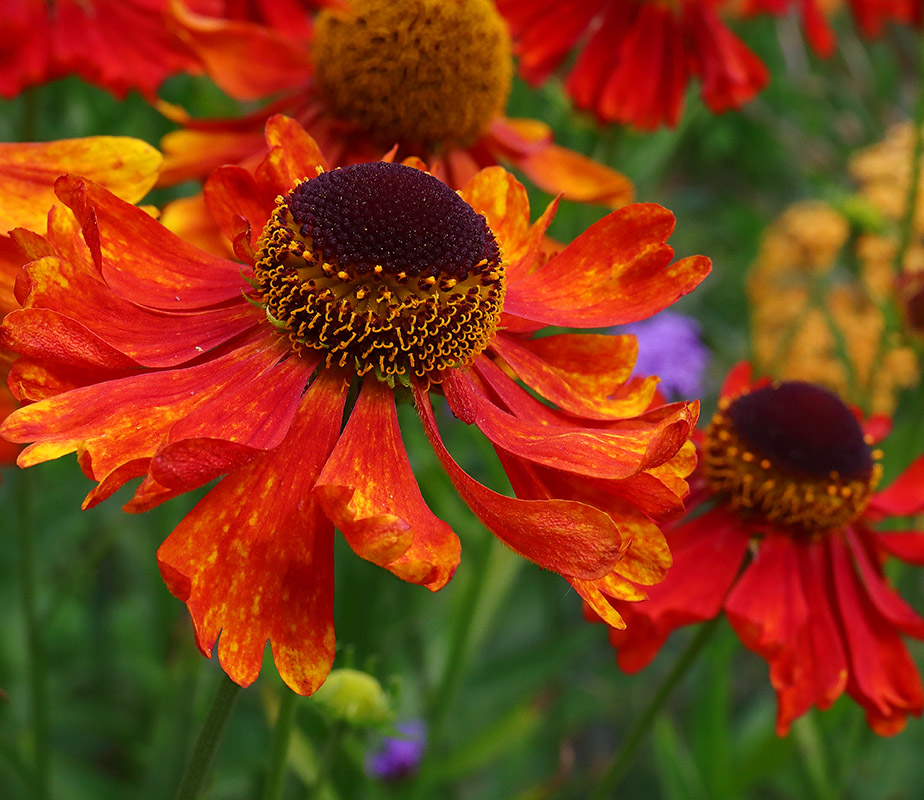
Late summer flowers have become a memory too. These heleniums (aka sneezeweed) are in colours that remind me of that summer heat. They are fiery and glowing and demanded to be gazed at and photographed.

The heleniums in the top image were in a garden I visited. I wouldn’t plant this particular helenium in my own garden because I’m not keen on its combination of colours. However, the flowers made a good picture anyway, so I was pleased to be able to photograph them.

The flowers in the bottom photograph were in my own garden. (Unfortunately the plant didn’t come back this spring – but I think it would have struggled to survive this dry summer, even if it had.) The colour here is much redder than the other plant and makes me think of the hot embers of a fire. Maybe I’ll try to grow it again in the future.

helenium flowers

It’s all in the Detail

zinnia flower

NB: A note for WordPress Reader users – you need to click on the title of the post again to see the full photograph. (Otherwise you see just a tiny section!)

The detail of plant structure has always fascinated me. When you think of the different forms of flowers and plants it’s mind-boggling. Just in the plants you might see in the UK (never mind all those in countries over the rest of the world) there’s an amazing variety, especially in our gardens.

In my own garden, I can, for instance, see the flower of a daisy near a passionflower. Or a rose and the lavender growing by it – such a range of shapes, textures and colours. These differences make for a more appealing garden and they make photography more interesting too.

The individual details of flowers entice me to capture them in a photograph. Here, with these zinnias, it’s the tiny yellow ‘disc florets’ that have opened in a ring around the flower centre (the ‘eye’). If you look at the photo below, you can see, tucked deep among the curving red bracts (‘paleae’ or chaff) there are more yellow disc florets waiting their turn to open. Each red palea is like a tiny flag, with a fine tip and a jagged-looking edge. They add an attractive texture and contrast to the other parts of the flower head.

centre of zinnia flower
The ‘eye’ of the zinnia flower head, showing the ring of disc florets and the red paleae in the centre.

As the zinnia matures, the shape of the centre of the flower head becomes more conical due to the growing seeds within. (As you can see in the top image.) The ring of open disc florets advances towards the tip of the cone as the older disc florets finish and the new ones open. This gives a different look from the flatter head of the immature zinnia and new photographic possibilities.

The photograph below shows a variation I hadn’t expected. This flower head has developed fasciation due to abnormal behaviour of the growing tip (perhaps because of damage, disease, genetics or environmental factors). As a result, there are two conjoined flower heads instead of the normal single. It just shows that you never know what you’ll find when you take a wander around a garden!

Zinnia with fasciation

Pink Profusion – or Not!

Anemone huphensis 'Hadspen Abundance'

NB: A note for WordPress Reader users – you need to click on the title of the post again to see the full photograph. (Otherwise you see just a tiny section!)

There are fewer flowers left in our garden than usual this autumn. That’s partly because I didn’t plant any annuals this year. But the main reason is because of the effects of heat and drought on the plants here.

There are still a number of Japanese anemones – even though they too have suffered from the lack of rain. Usually the anemone clumps would be bigger and would have more flowers. Many of the flowers are smaller, presumably because the plants have been able to take fewer nutrients out of the dry soil. So this year this anemone hasn’t been able to live up to its name – ‘Hadspen Abundance’.

In case you’re thinking that these anemones look OK, I need to tell you that the photographs are from last year. I haven’t got much left to photograph in the garden now, so let’s hope they’re a bit more abundant next year!

Japanese anemone 'Hadspen Abundance'
Anemone hupehensis ‘Hadspen Abundance’

(Almost) Silent Sunday: Arisaema

Arisaema flower

NB: A note for WordPress Reader users – you need to click on the title of the post again to see the full photograph. (Otherwise you see just a tiny section!)

It may look slightly sinister as it lurks in the shade, but this plant isn’t carnivorous. The deep flowers are this shape to make sure that they are pollinated by insects. The insects aren’t on its menu!

Lilies: Deadly Beauty

NB: A note for WordPress Reader users – you need to click on the title of the post again to see the full photograph. (Otherwise you see just a tiny section!)

You may wonder why I’ve gone for such a dramatic-sounding title, especially as lilies don’t pose us a threat. But if you own a cat (or it owns you), you’ll probably know what my reason is. Lilies, especially their beautiful, golden-yellow pollen, are a deadly threat to cats.

If a cat gets lily pollen on its fur, perhaps while brushing past the flowers, and then licks it off, the cat can suffer severe kidney damage which can be fatal. (The other parts of the lily plant are also highly toxic, but less likely to be ingested by a cat…unless it has a habit of nibbling plants.)

Lilium regale – the regal lily – is tall and beautiful.

When I had my first two cats, I had no idea about the damage lilies could do them and I did actually have some lilies growing in a large tub. They were Lilium regale, which is tall, so the cats didn’t get close to the flowers. Even so, the thought of what might have happened if some of the pollen had fallen on them makes me shudder!

Other members of the lily family are equally toxic to cats. Daylilies (Hemerocallis), Lily of the Valley (Convallaria) and Peace Lilies (Spathiphyllum) can all cause damage that needs to be treated by a vet immediately to try to save the cat’s life.

We have two cats here, so I don’t grow any lilies in the garden now. But if I see them growing in gardens I visit, I love to photograph them. The lilies you see here were growing in Fullers Mill Gardens. (Just a few of their lovely collection.)

Leopard Lily (Lilium pardalinum)

Cool Thoughts: Frosty Memories

Snow on anemone seed head

NB: A note for WordPress Reader users – you need to click on the title of the post again to see the full photograph. (Otherwise you see just a tiny section!)

I’d like to thank Tanja Britton for the idea for this post…we felt that some of my frosty photographs may bring a suggestion of coolness to these over-hot summer days. (The temperatures are still higher than normal in the UK and, I believe, in many areas elsewhere.)

Snow is infrequent in our winter in Suffolk now, so the Japanese anemone seedhead, with its tiny cap of snow, (top photo) is a rare image for me. Frost is much more usual in our winters, so I leave seedheads to see if they will become interesting subjects to photograph. The frost can make something magical out of the most ordinary plant remains, as you can see from the photo below. The honesty seedheads were long past their best and getting very scruffy, but with a bit of frost and some sunshine, they’re suddenly delicate and attractive.

frosted honesty seed pods
The remains of honesty seedheads look much better after the frost.

Bronze fennel tries to take over my garden by spreading its seedlings everywhere but I resist the temptation to clear away the seedheads and I leave it intact for the frost. This plant never disappoints me when it’s frosted, and it can become most decorative, especially when the sun adds some sparkle.

frosted fennel seed head
A frosted fennel seedhead looks decorative in the sun.

If the frost is early, it can catch plants that are still in flower. The echinacea below was a new plant and had come into flower much later than normal. It was an unexpected sight one morning, to see it completely frozen through by the first frost. (It hasn’t happened to any of the echinacea flowers since.)

Echinacea purpurea – frozen through by an early frost!

A few flowers, such as the yellow winter jasmine, the pink-flowered shrub Viburnum bodnantense ‘Dawn’ and this winter-flowering iris (below) have flowers through much of the winter. They look especially appealing with a touch of frost (although that shortens the life of the individual flowers).

winter-flowering iris
Iris unguicularis – a winter-flowering iris that frequently has frosted flowers.

I’m glad that the roses in my garden right now haven’t got any frost on them though! Zepherine Drouhin sometimes has a few flowers left just as the frosts are starting, so I always look to see if they’re in good enough condition for a photograph. Of course, when the frost melts, the flowers are left looking wilted and they won’t survive the damage the frost has done to the petals. But a photograph preserves the memory of them.

Rose 'Zepherine Drouhin', covered in frost.
Rose ‘Zepherine Drouhin’

Cool Whites

Hydrangea petiolaris

NB: A note for WordPress Reader users – you need to click on the title of the post again to see the full photograph. (Otherwise you see just a tiny section!)

To me, white flowers with green foliage have a lovely fresh and cool look…something that would be welcome in all the recent hot weather. (Fortunately the temperatures have dropped a bit, but it’s still hotter than normal.)

The climbing Hydrangea petiolaris in the top picture has recently finished flowering. During June and early July its airy white flowers looked graceful alongside our shady seating area. It’s going to get too big for its space, so I ought to prune it back now the flowers are over. However, I like to leave some of the flowers to dry out so that I can photograph them in the frost. It’s hard to imagine frost right now, but it does look deliciously cool, as you can see below.

Frosted climbing hydrangea
Frosty flowers of climbing hydrangea, photographed in winter 2019.

We have just a few white flowers in our garden. It’s still a little early for the white Japanese anemones. These struggle a bit in the heat and do need watering to keep them going, so I’m not expecting great results from them this year. And I haven’t grown any of the white cosmos this year, so I’m rather missing it.

The white geranium below was originally planted years ago but has now managed to spread itself around the garden by self-seeding. It’s very welcome, so I hope it will continue it’s journey around the garden. Most of my geraniums form spreading clumps but this one seems so far to be much more compact. That’s great, because it means that it doesn’t cause much disruption to other plants and can fit itself into gaps quite easily.

white hardy geranium flowers
A white geranium (name unknown) that seeds itself around.

A plant that I’ve only started to notice recently is Gillenia trifoliata. The plant below was growing at Fullers Mill Garden, and being able to see it close up – rather than in a photo or on TV – made me realise how pretty and delicate the effect of the tiny white flowers is. If I can find space I’d like to grow it, but there’s already a list of plants I’d like to find room for…

Gillenia trifoliata flowers
Gillenia trifoliata (Bowman’s root)

The Gillenia makes me think of the flowers of Gaura lindheimeri, which are just starting to come out in my garden and will last into the late autumn. Gaura is great here because it doesn’t take up a lot of room and the flowers weave themselves through and around the other plants. I’m looking forward to seeing their flowers dancing in the borders like little white butterflies very soon.

Flower of Gaura lindheimeri
The flowers of Gaura lindheimeri are just beginning to open.