Snake’s Heads and Crowns of Leaves: Fritillaries

Three snake's head fritillary flowers.

Snake’s head  fritillaries and crown imperial fritillaries are strange-sounding names for very unusual plants. For a photographer, the flowers make an enticing subject and I was lucky enough to be able to take some pictures of them in my friend Judy’s beautiful garden. (Thanks, Judy – I had a lovely time!)

The snake’s head fritillary (Fritillaria meleagris) gets its name from the shape of the unopened flower bud – long and pointy at the tip – a bit like a viper’s head. It has other folk-names, according to Richard Mabey’s ‘Flora Britannica’ (a fascinating book, worth dipping into if you happen to get the chance). These include crowcups, leper’s bells, sulky ladies, and frawcups (possibly derived from a place-name).

These fritillaries were recorded to be growing in gardens in the UK in 1578 but not recorded in the wild until 1736. Some say that this suggests they may not be native to the UK but, even so, they used to be seen in their thousands growing in damp meadows.  Sadly, as agriculture developed over time and land was drained and ‘improved’, they lost these habitats. There are still a few places where they can be found growing wild and, thankfully, they’re popular with gardeners, so they are still able to create a magical sight every spring.
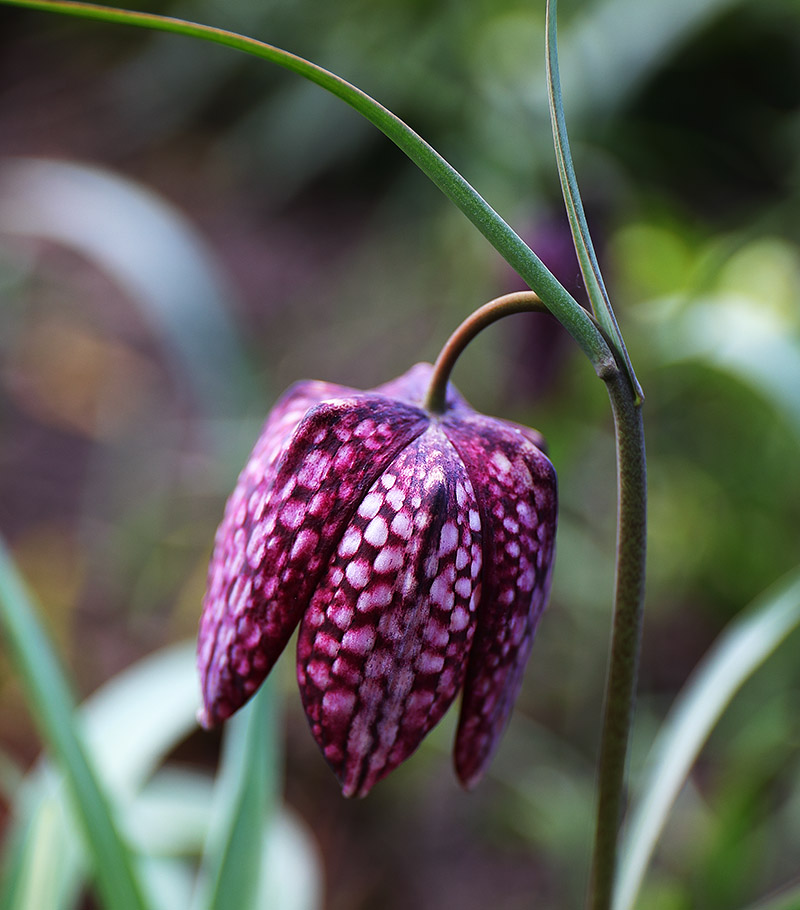
Close-up of Fritillaria meleagris flower.
The markings on this fritillary look as if someone painted them on!

The tiny chequered markings on the snake’s head flowers are irresistible. They make me want to get as close as I can to photograph the flower, in an attempt to show how much they look as if they’ve been carefully painted on by hand. The graceful shape of the flower, with those almost umbrella-like ribs at the top adds to the attraction. (Doesn’t it look just as if the petals are fabric, stretching over the ribs that are holding it in shape? Umbrellas for the ‘wee folk’!) The way the bell of the flower hangs from its curving stem, with one or two long and slender leaves soaring up from it, completes a very elegant flower.
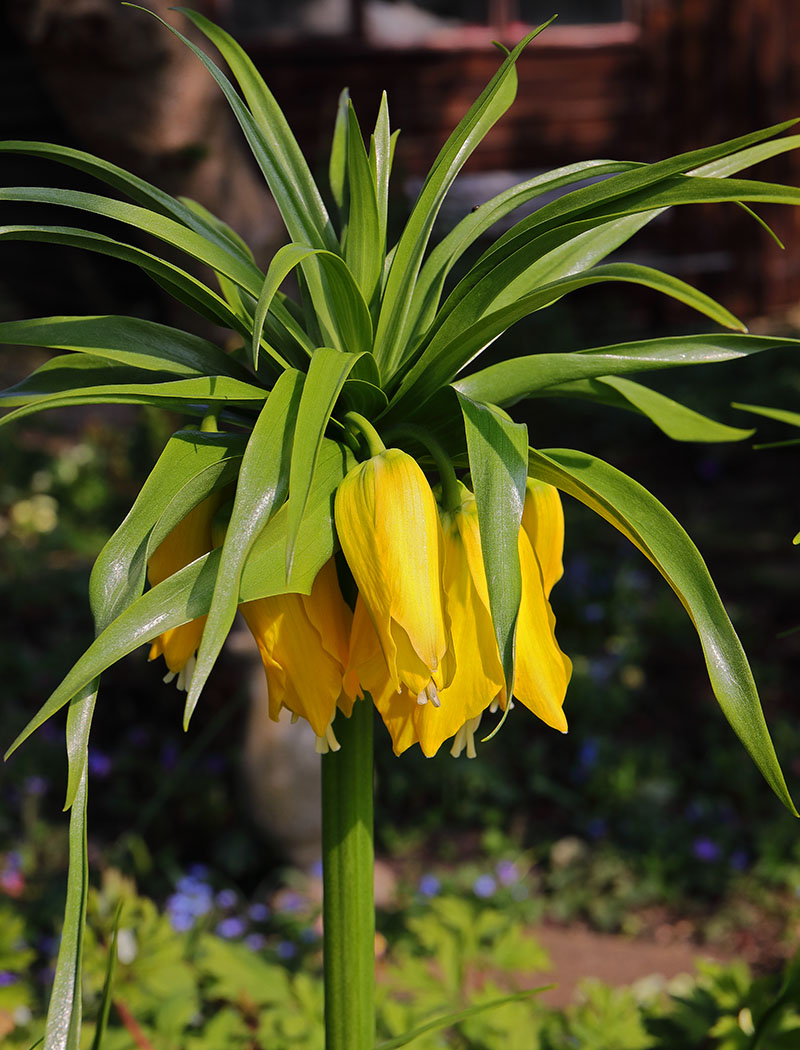
Yellow 'Crown Imperial' flowers. (Fritillaria imperialis.)
The crown imperial has an extraordinary top-knot of leaves!

The crown imperial fritillary is very different from its serpent-like sister. A dramatically long stem holds the bold cluster of flowers up high. Instead of the one or two leaves rising above the flowers, there is a generous top-knot of leaves, giving a very distinctive appearance. This ‘crown’ of arching leaves is said to have given the plant its name, due to its resemblance to the shape of an imperial crown. However, a competing claim suggests that the name derives from the plant having been grown in the Imperial Botanic Garden in Vienna after the plant was brought there from Persia in 1576.

Like the snake’s head fritillary, I wanted to be able to get close enough to the flower of the orange crown imperial to show the markings on its petals. (The veins on the petals of the yellow version are barely visible by comparison.) These darker veins create a strong pattern of lines that make the flower even more pleasing to photograph. These flowers are such star performers when you come to take their photograph, that I think I will need to try growing some fritillaries in my own garden.
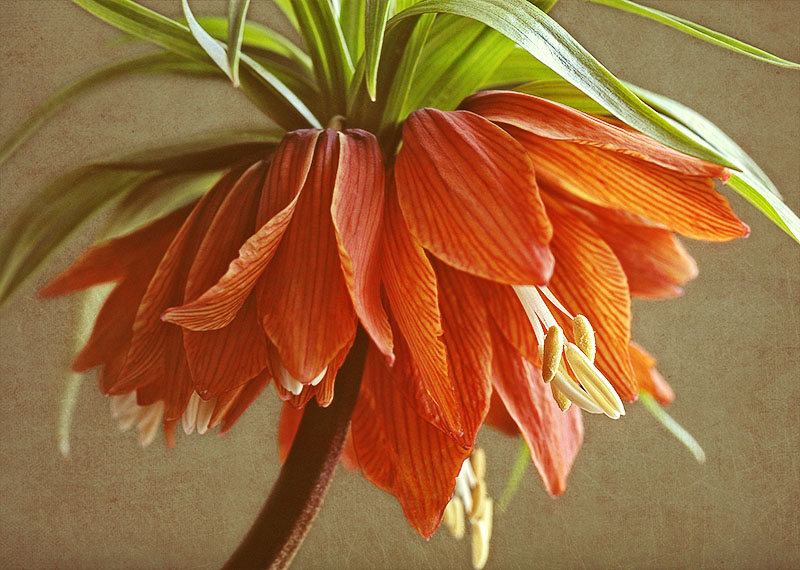
Orange 'Crown Imperial' fritillaries. (Fritillaria imperialis.)
The prominent veins of these orange crown imperial flowers make them all the more striking.

Tulips: Glowing with Glorious Colour.

Purple and white striped tulip.

As March comes to an end, gardens are filled with plants coming back to life. New flowers are opening every day, providing an exciting array of  possible photographs. You can imagine, I’m sure, what a happy and busy time of year this is for me!

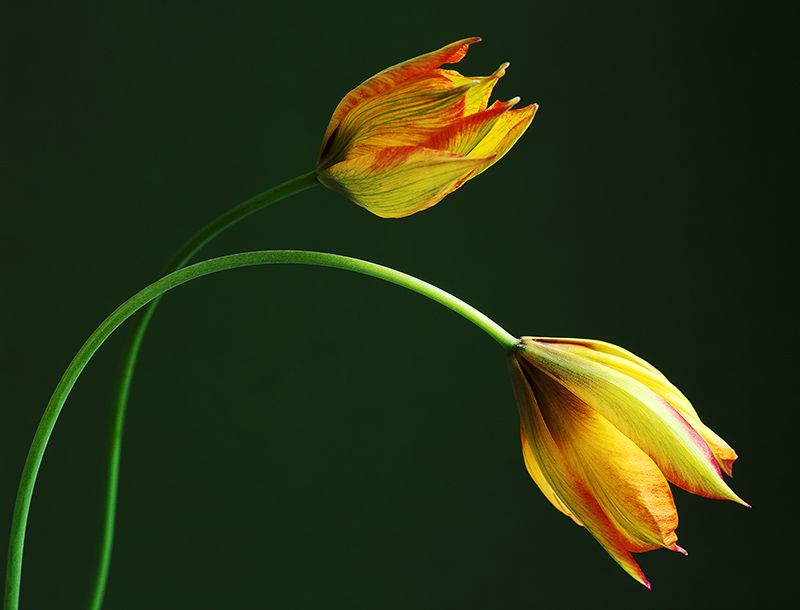
Among my favourite spring flowers to photograph are tulips.  The variety of colours and the amazing markings that some of the flowers have make them an obvious subject for a picture. When you also take into account the different flower shapes and the sinuous way that the tulip stems bend, then you have all sorts of possibilities for different images, whether bold, graceful, or full-on pretty.

Striped flowers of tulipa orphanidea 'Flava'
Tulip orphanidea ‘Flava’ has delicate coloured veins on its petals.

Tulips with coloured markings – the ‘feathered’ stripes, as in the top photo, or the more delicate veining of  ‘orphanidea’ (above), can be especially lovely. These are the flowers that I look out for because they add a lot of extra interest to the photograph.

But the single-hued flowers are great too. These tulips, with their brilliant, saturated, colours and simple shapes help the photographer to make very bold, eye-catching images.

For next year, I’m planning to create a small bed for cut flowers that can be used for photography and tulips will be an essential addition to it. And for now, there are tulips in the garden that haven’t opened yet…I’m waiting!

Tulip 'Prinses Irene'
There’s a flame-like glow from this tulip flower.

Flower Photography for a Rainy Day

Purple and white pansy.

The weather has been quite wild here over the last week – very windy and wet too. (A huge change from the spring-like sunshine of late February.) So there has been no chance for anything staying still enough to take photographs outdoors.

Luckily, I have some plants in pots that have been sitting in the conservatory while they’re waiting for the ground to dry out enough for them to be planted in the garden. (There’s been a lovely scent from the primulas and, I think, the tiny pansies in there – I’ll miss it when the plants do go outside.)

I took this pansy into my little studio space and set up my lights and a white background. It was only after I’d taken a few photos that I realised I had company…the unfortunate plant had become home to some greenfly. It’s amazing how much more you can see in a close-up photograph compared to just looking straight at something. Now I have some nice sharp shots of greenfly, but somehow I don’t think they’ll be very useful to me! It didn’t take long to dust the wee devils off with a soft artists’ paintbrush. (Usually it’s cat hairs that I have to brush off – they can be practically invisible until you look at the photo magnified on the PC monitor.)

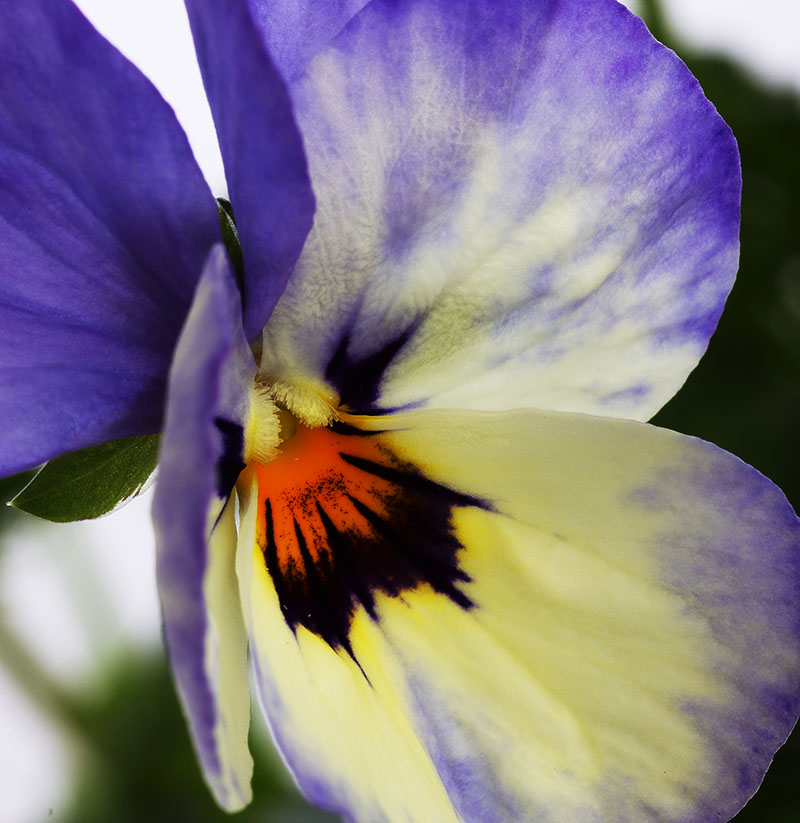
Centre of a violet.
The yellow and black centre of this small pansy makes me think of a bee.

You can see pansies planted all over the place at this time of year in the UK. They’re cheap to buy and easily available everywhere, so they do get pretty much taken for granted. But I do love the colours, especially the way they blend into each other, giving a soft, almost watercolour effect.

Having the plant indoors made it easy to keep the flowers still while they were being photographed. When you’re working outdoors, movement in the slightest breeze is a big problem with macro photography.  The area of focus is so shallow that it takes very little to take your flower out of focus and, if you’re not watching carefully, it can be easy to miss the fact that the flower has moved.

Spending an afternoon indoors, taking photographs with plenty of light and being able to keep warm and dry felt like quite a luxury. However, there a flowers out in the garden that are still waiting for their chance to be photographed…so I’m hoping for some better weather next week!

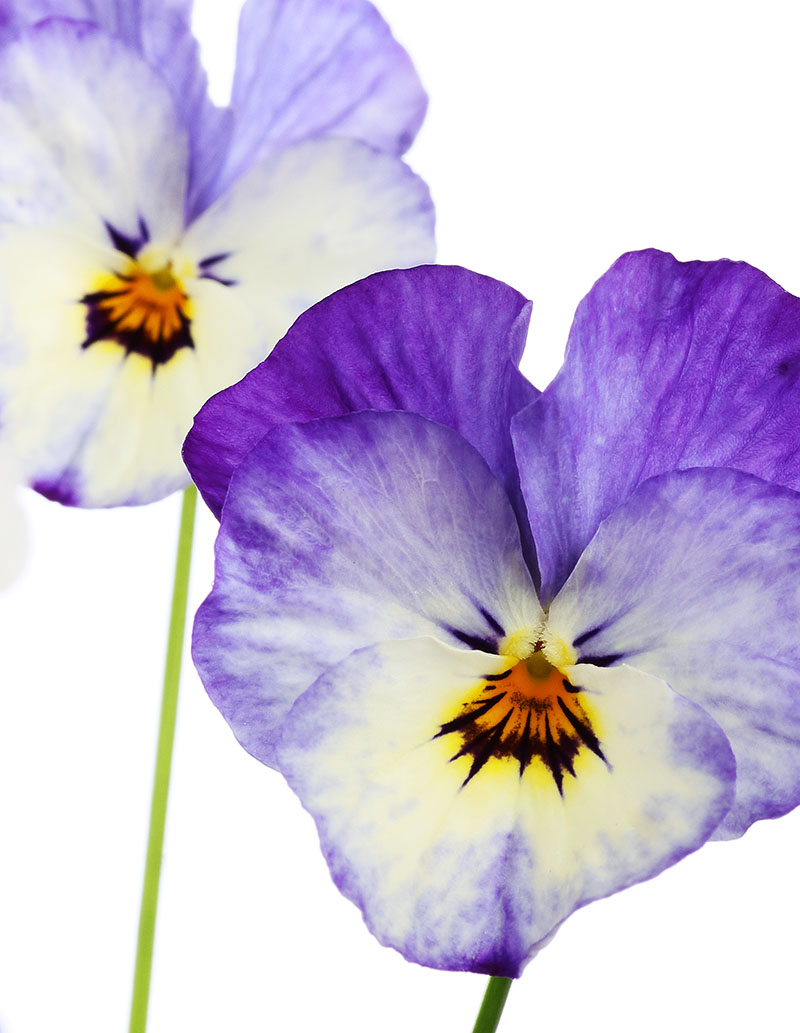
High-key photograph of violets.
Playing with a high-key effect with these little pansies…

The Early Flower Catches The Photographer

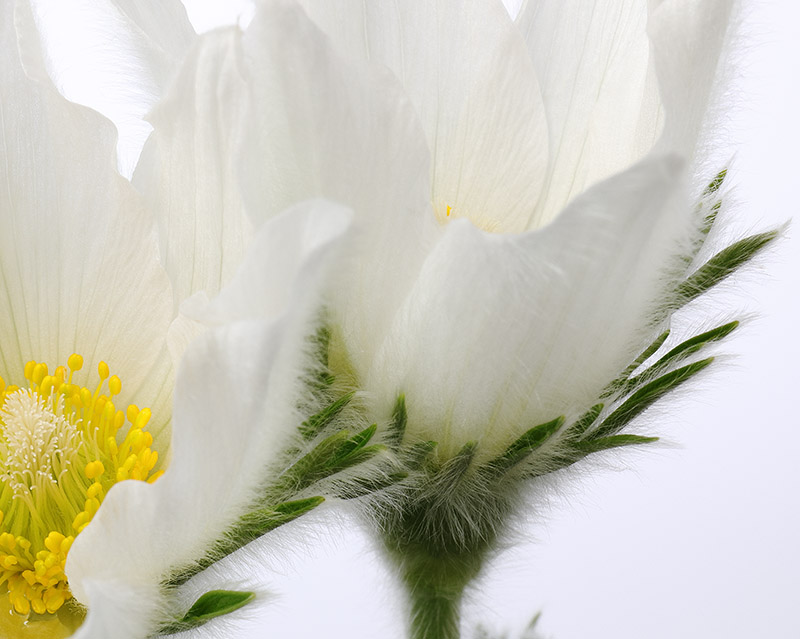
White Pulsatilla vulgaris (Pasque Flower)

Last week, I wrote about finding all the new stocks of plants coming into garden centres very tempting. So you may not be surprised to learn that I bought a few of them. (If you’ve been reading this blog for a little while, you will probably know me well enough by now to expect it!)

I tell myself  that I have a great excuse, because I need something to photograph and there isn’t a lot available in the garden yet. And buying plants instead of cut flowers means I can grow them in the garden for the following years. Neat reasoning, eh? All the same, I’m glad that there are several plant nurseries nearby, so that I can buy reasonably-priced small plants rather than spending a fortune on larger plants elsewhere.

It’s interesting to see just how far advanced these plants that have been grown in large, heated glasshouses are, in comparison to garden plants. I have pinky-purple pasque flowers growing in the garden but they won’t be in flower for weeks yet. (Probably April or May.)

Hairy flowers of Pulsatilla vulgaris (pasque flower).
You can see how hairy these pasque flowers are!

Pasque flowers like it in the garden here. The well-drained soil and open, sunny site suits them. It’s actually a native plant in the UK and East Anglia (which includes Suffolk, where I live) is one of the areas that it grows in. Sadly though, it’s rare as a wild plant now and you’re much more likely to see it growing in gardens. However, as a ‘local’ plant, they’re both drought-tolerant and wonderful for bees.

The flowers themselves are delightful to photograph – fresh, pretty and entirely charming. And then there’s the bonus of the rest of the plant being photogenic too. That’s because it’s so very hairy (and soft enough that you want to stroke it). All the soft little hairs that cover the finely-cut leaves, flower buds, and even the outside of the petals, help to give the plant a silvery appearance when they are caught in sunshine. Later the seed-heads become very ornamental, like some sort of silky, wildly fluffy pompoms. (My cats think they’re great fun for having a swift bat at with a paw!)

The pasque flower that I bought will no doubt be joined by others. (I have to wait for them to flower at the nursery, so that I can see what colour they are.) And I’m sure that a few hours will be spent photographing them…happy times!

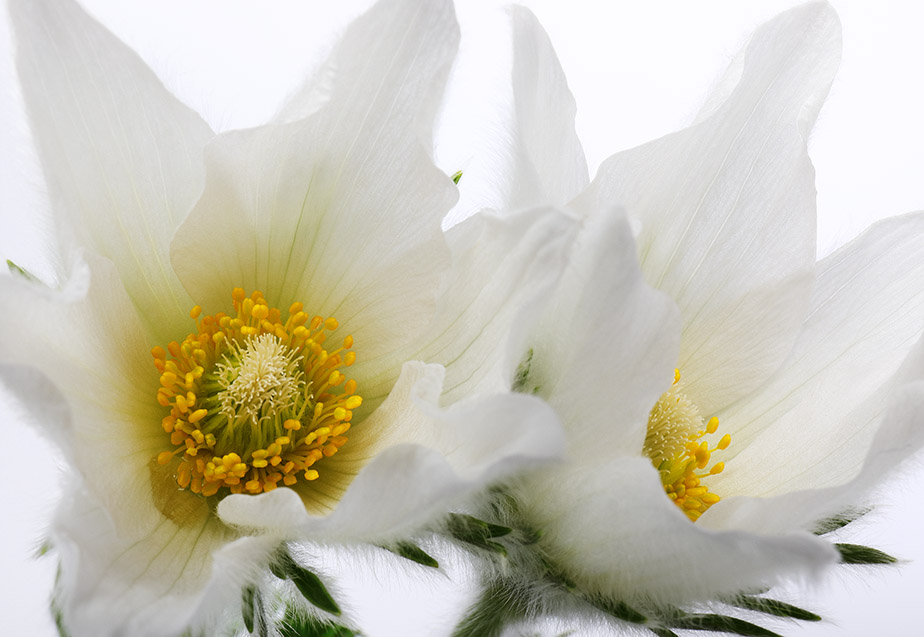
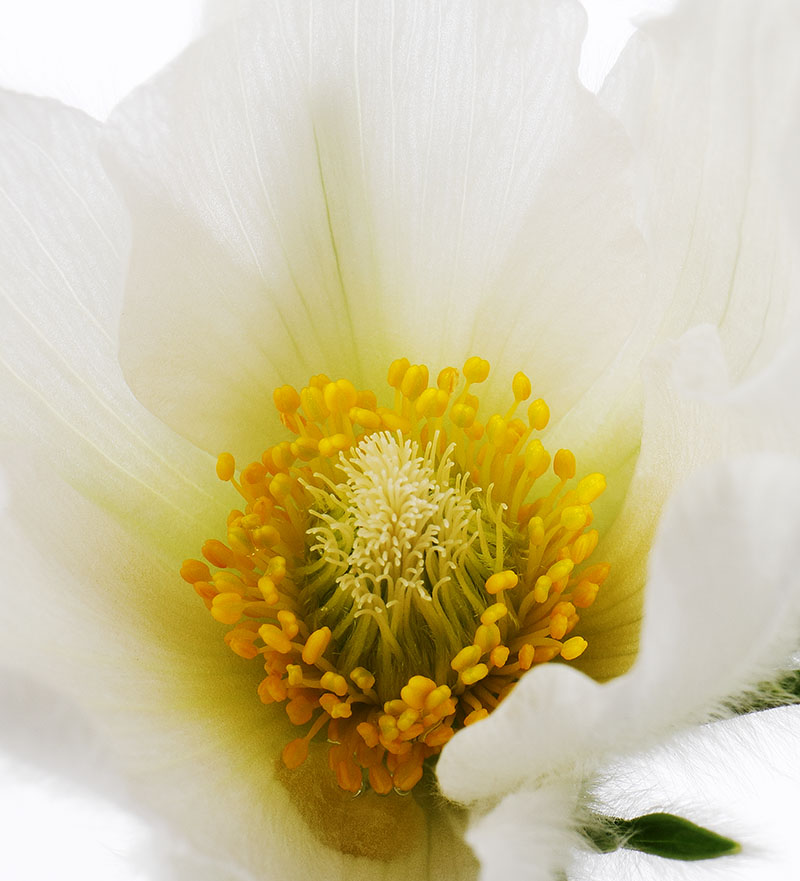
Flower of Pulsatilla vulgaris (pasque flower).
Delicate white and rich yellow make this a very attractive spring flower.

A Waiting Time…

Frosted violets

This is the time of year when everything seems to be waiting for spring. Here and there the tips of leaves are starting to show where bulbs will flower. And the flowers that have made it through the chilly months so far are starting to go over.

We don’t have many winter-flowering plants here (yet). The few that there are, give a bit of cheer and encouragement when we step outside and keep us company as we get some work done in the garden. They also give me something to photograph, although I feel that I really need to grow more winter-flowering plants to keep myself inspired. (I have recently planted a couple of Clematis cirrhosa varieties. They’re just tiny plants as yet but one does have a couple of buds…)

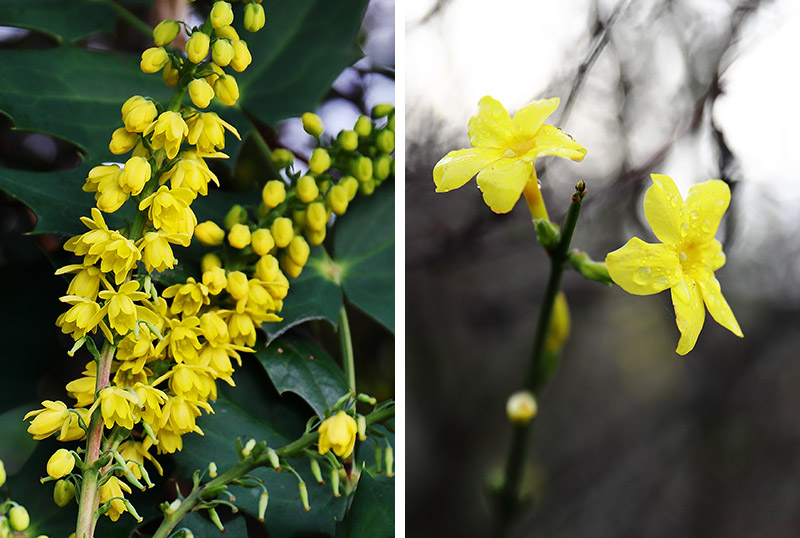
Mahonia (left) and winter jasmine (right).
Winter sunshine – a splash of yellow from a mahonia (left) and winter jasmine (right).

The flowers of Mahonia japonica, despite being past their best, still give a yellow glow from right at the back of the garden. It’s a beast of a shrub to weed around or (if feeling brave) to prune because its leaves are extremely prickly but it makes up for this with its reliable winter colour and the bold shape of its leaves. The yellow jasmine, though, has finished flowering ’til next year. It’s tiny yellow flowers disappeared suddenly during the last week, leaving what feels like a very empty space on the fence that supports it.

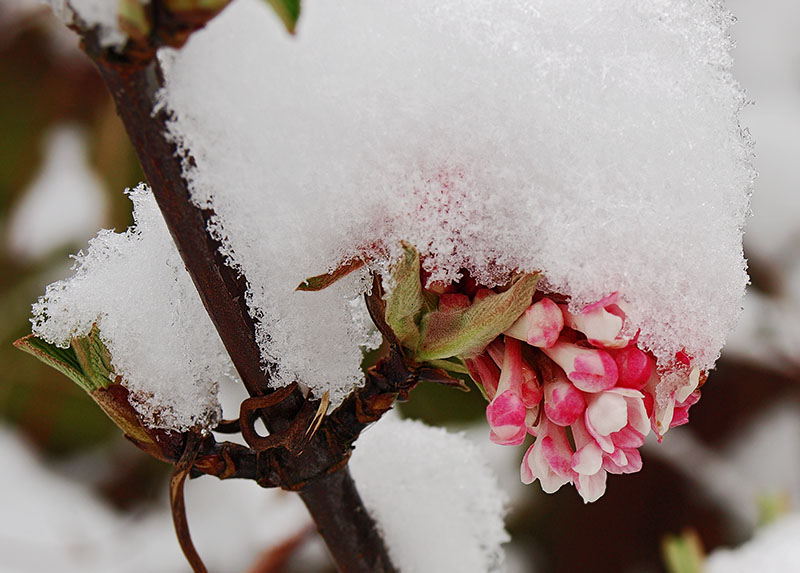
That bit of the garden feels even emptier now because the Viburnum bodnantense ‘Dawn’ that grows nearby has also finished flowering. (It’s in the photograph below, but this isn’t a recent picture – we haven’t had any snow here yet.)

Snow-covered Viburnum bodnantense flower.
Viburnum flowers can cheerfully ignore the snow.

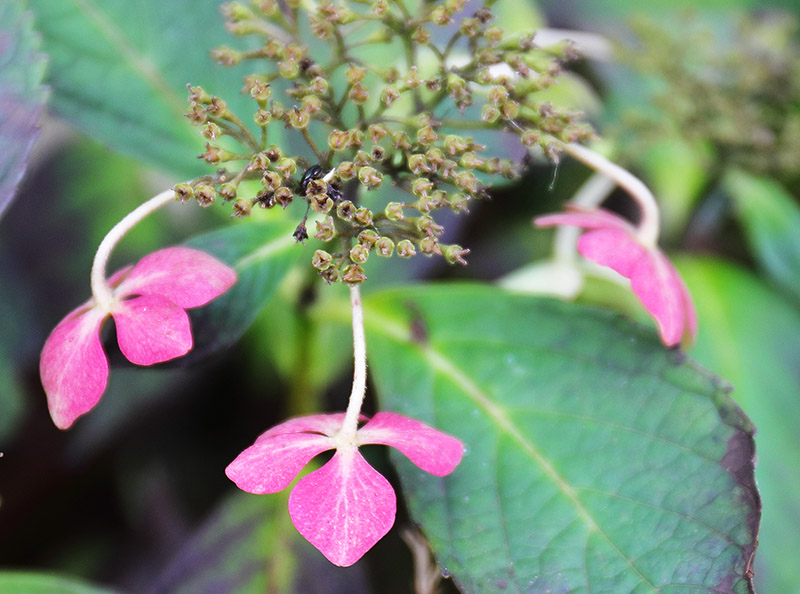
Some flowers have managed to hang on past the time they would normally be gone. The flowers of the hydrangea in the photo below managed that quite literally, but, since the frosts in the last couple of weeks, have now all turned brown. That little dash of pink was welcome while it lasted.

Hydrangea flowers in winter.
The last few pink hydrangea flowers hung on, until the frost turned them brown.

Another hanger-on was scabious. Tiny little red or pink flowers continue, just one or two per plant, wherever they have seeded themselves around the garden. They make a delightful discovery as you wander round the garden on a winter day. And they show that, despite all the dead stems and foliage around the rest of the garden, plants are still growing and thriving, no matter what the weather may feel like. Life in the garden flows on as we wait for spring.
Frosted pink Scabious
This little scabious flower is almost entirely iced-up.

Winter Jewels

Frosted Agapanthus seed-head

There have been a few frosty mornings recently. This morning’s was one of the heaviest frosts so far, the other was on Christmas Day. Both were still and silent, as if the cold was somehow transfixing not just the frosted plants, but sound and movement too.

These are the mornings that feel special in the winter garden. Camera in hand, it’s time to explore this frozen world of new creations. Old seed-heads and dead foliage are transformed into glittering sculptures that will last only until the sun erases them. It’s an ephemeral world – cold and quiet and unfamiliar.
Frosted allium seed-heads
Frost has created tiny firework bursts from these alliums

I always hope that some of the more interesting seed-heads will last long enough to become frosted. This year the weather has been kinder than most winters and there has been little in the way of strong winds or heavy rain. So the seed heads of agapanthus and alliums have kept their frail structures intact and are even holding onto quite a few of their seeds still.

It’s exciting to find out what the frost has been up to in the garden. There are all sorts of little gems waiting to inspire a close-up photograph. The cold makes it hard to linger for long, but it’s worthwhile. For the work of the frost has made it possible to photograph something delicate and transient and, once winter has gone, it will be a long time before the opportunity returns.
Hydrangea petiolaris with frost.
Hydrangea petiolaris with a light touch of frost.

It doesn’t take a lot of frost to create something to photograph. The plants in the centre of the garden, where it is more open, get a lot of frost but those towards the edges are sheltered by fences and evergreen shrubs. The climbing hydrangea in the photo above has a fairly protected position. But its dead flower-head has had enough frost to line the edges and pick out the veins of the larger petals. The tiny flowers in the centre of the head have been turned to lace – an effect that will vanish as soon as the frost melts.

Wild carrot (Daucus carota) covered with frost
Wild carrot (Daucus) was sown late to catch the frost

Sometimes there are still a few flowers left in the garden for the frost to embellish. I had sown some wild carrot seeds much later than normal, in the hope that the plants might still be around when the frosts came. So the frost turned the flowers that were left on the plants into little ice-encrusted embroideries, just waiting to be photographed up close.

Other flowers aren’t really supposed to be around when the heavy frosts arrive. The Anemone coronaria below was too eager to flower. (Last year’s flowers were much later – probably sometime in February.) The mild weather in December persuaded them to put in an early appearance but the flowers couldn’t last long once things turned more wintry. Never mind! The flower may have ‘gone over’ quickly but for just a short time, the frost has turned it into something wonderful, and allowed it to add a little magic to the garden.

Anemone coronaria, covered in frost
This Anemone coronaria flowered very early and got thoroughly frosted.

Colour for a Grey Winter’s Day

Moth Orchids (Phalaenopsis)

I’ve been saving this group of orchid photographs for this month. There’s not a lot to photograph in the garden at the moment. (But I have taken photos of the few flowers that are out there – that will be another post.)

At this time of year, it lifts the spirits to have some flowers indoors. And it’s nice to have something to aim a camera at without getting damp and chilled.

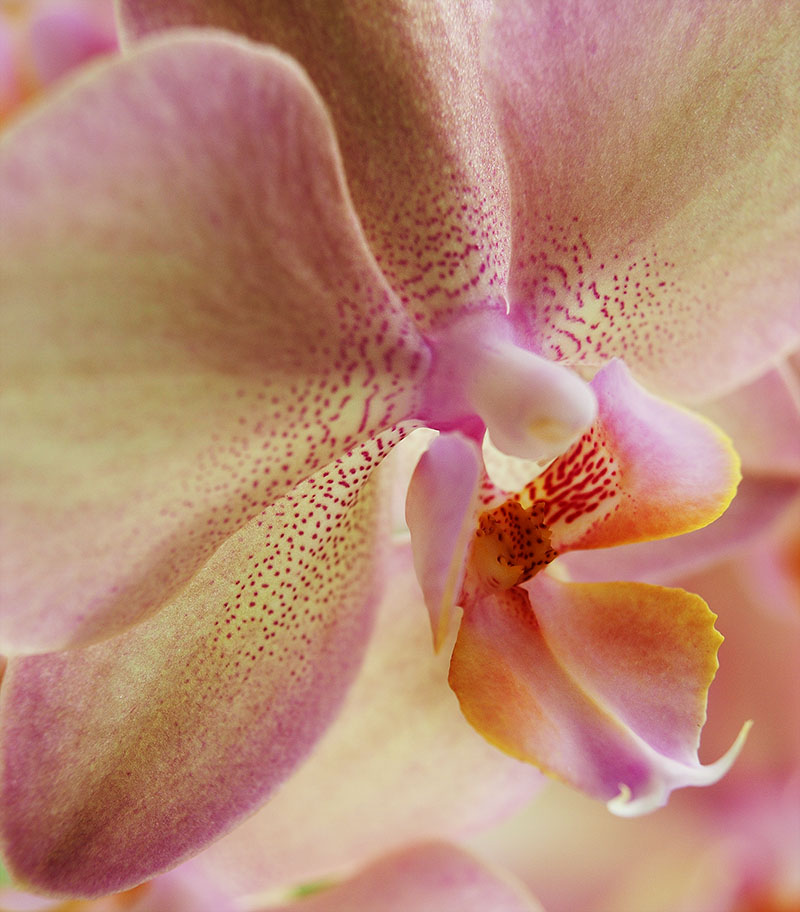
Macro photo of a spotted orchid
The dark pink spots give a delicate effect to the petals of this orchid.

These are all ‘moth’ orchids (Phalaenopsis), which are now very cheap to buy in many supermarkets. They’re very good value too, because the flowers can last for many weeks or months. (Much cheaper than buying cut flowers.) I’ve found that I can usually get the plants to flower a second time, but after that they tend not to do very well. That’s really down to my lack of knowledge about orchids. I should read up on them and look after them a bit better…

Actually, I stopped writing and had a look around on Google for some info. There’s some very detailed advice on the RHS website and having read it, I can see that I need to find a better windowsill for my plants and be more careful about the temperature. Ah, OK, so I will pay a bit more attention in future!

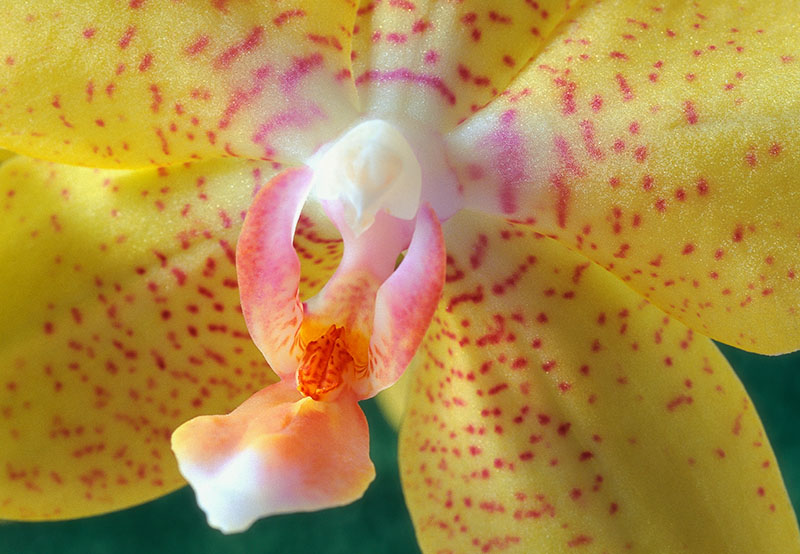
Macro photo of a yellow moth orchid
Yellow moth orchid – more spots!

As you may imagine, I tend to be attracted to the various markings on moth orchid flowers. The top photo has strikingly pink veins that look almost like stripes and most of the others have spots of varying size. These details work well in a macro photograph and provide something more for the eye to appreciate. The forward-facing lip of the flower gives a natural place to focus, especially with the spots, stripes and blushes of colour that can be found there.

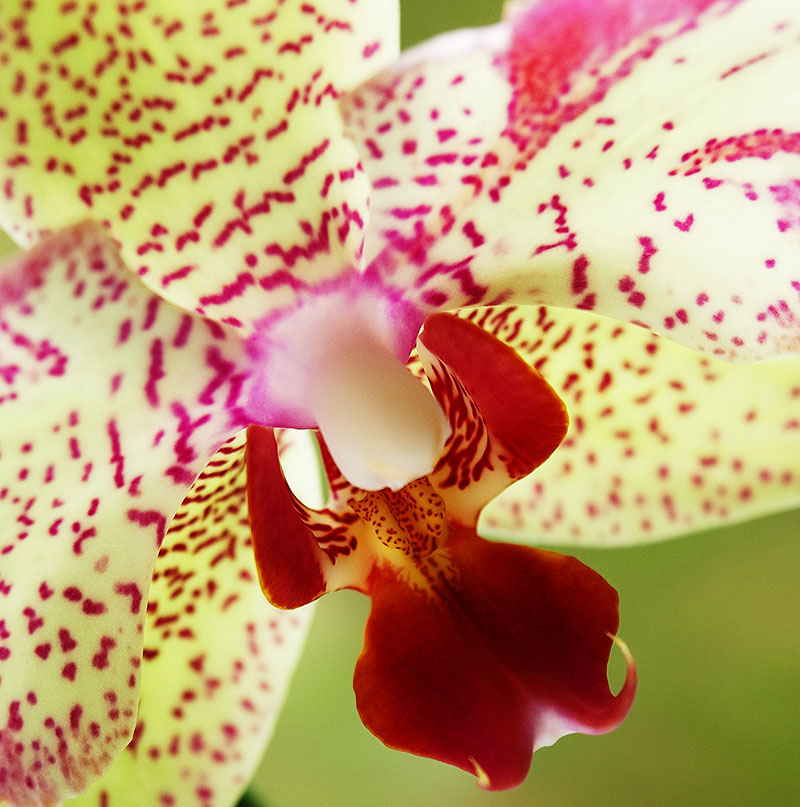
The varied colours and markings on moth orchids can make the flowers look very different from one another. This gives each plant a unique personality. The yellow orchid above, for instance, looks neat and dainty while the more greenish orchid below, with its wild spots and streaks of bright pink, looks decidedly bohemian.

Macro photo of a pale green orchid with pink spots.
The colouring of this orchid is quite an attention-grabber!

An orchid is a pleasing subject for a spot of indoor photography on a chilly winter day. All you need is a nice bright window and a large sheet of white card to reflect some of the window-light back into the shadows.

The delicate translucence of the orchid’s petals will allow the light to pass through, showing up the details of coloured veins or spotty markings and highlighting the structure of the flower. You may also find that you can see the glisten of the crystalline structure of the petal surfaces, as in the photo of the yellow orchid. The colours of the flowers are enriched by the soft window-light too, making them reminiscent of exotic silks.

I’ve spent many happy hours with just an orchid, a camera and a macro lens. The orchid is a flower that really makes it worthwhile to get up as close to it as possible – and that’s something I intend to do very frequently!

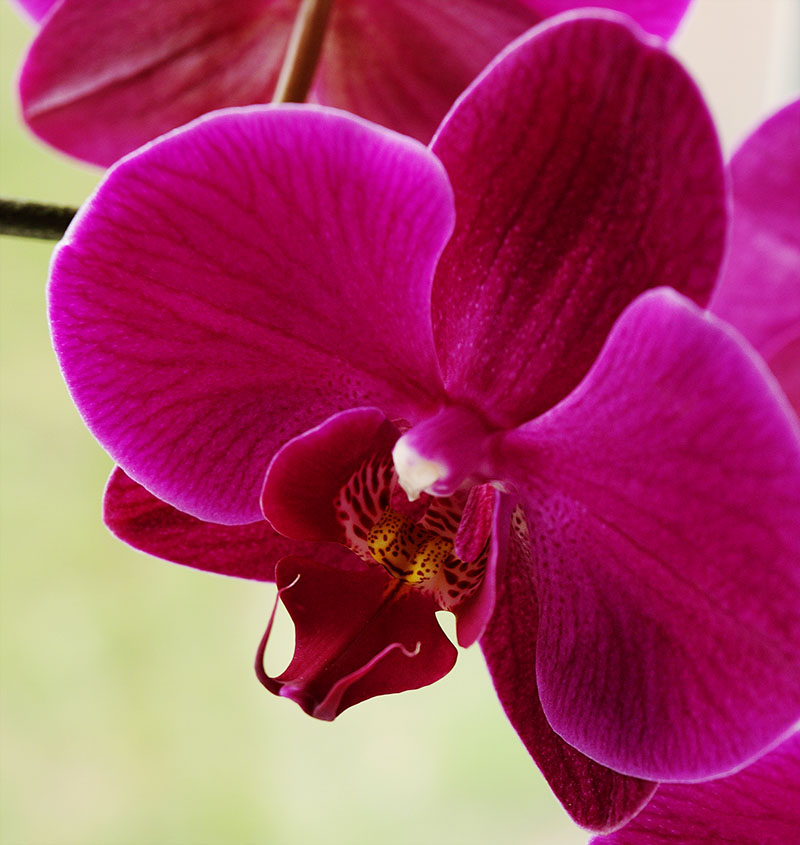
Macro photo of a dark-magenta moth orchid
This must be one of the most easily-available orchid colours.

Hydrangeas: Delicate and Colourful.

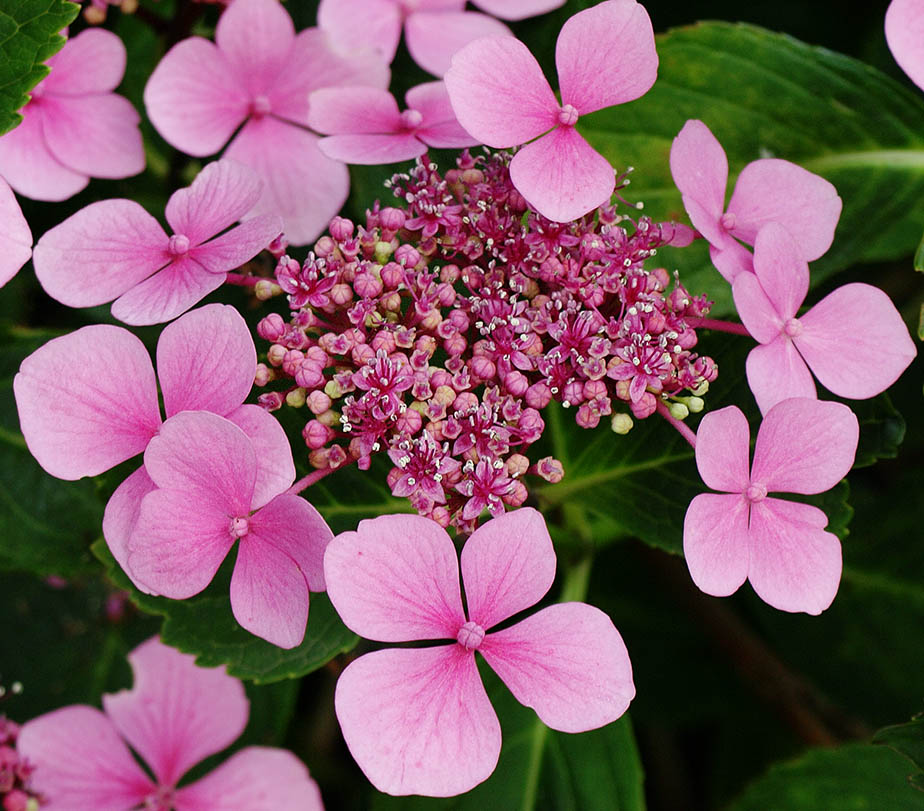
A pink 'lacecap' hydrangea.

Hydrangeas make me wish that I could just wave a magic wand and change my garden soil…moister and more acidic would do fine.

Then I would be able to grow blue hydrangeas, or, failing that, a nice purply-blue shade like the hydrangea in our old garden in Scotland. It was Hydrangea macrophylla ‘Mariesii’ (a lacecap) and had flowers that ranged from a good blue to a more lilac/pink shade. Many of the flowers graduated from blue at the centre of the petal to pretty much pink at the outside. It was really delightful and lovely to photograph.

The hydrangea in the top photograph is growing here in our Suffolk garden. It’s very pretty but there’s no chance of any blue in its flowers. Unlike our Scottish garden, which had a fairly acidic soil, the soil here is alkaline. So our hydrangeas will never be blue. (Oh we could try…with acid-based compost, rainwater, and added aluminium sulphate or organic materials such as coffee grounds and eggshells, but that’s doing things the hard way. Much better to go with the conditions you have.)

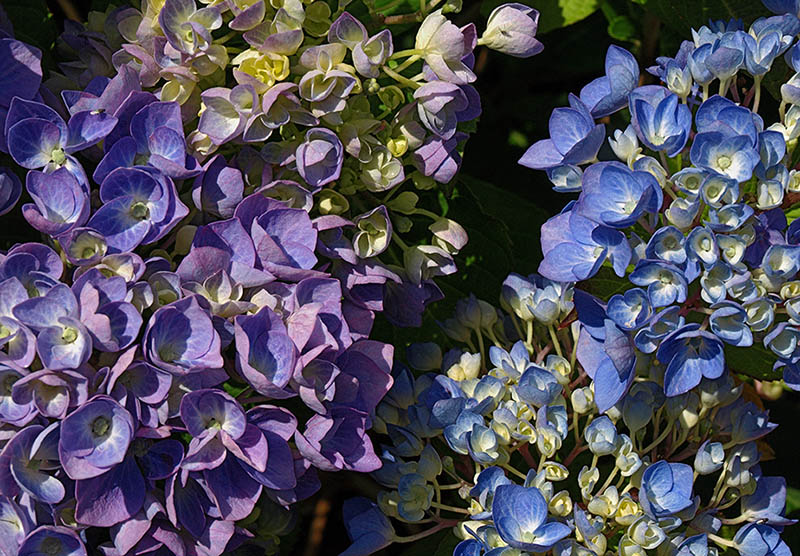
Purple and blue hydrangeas.
I wish I could grow hydrangeas with these colours here!

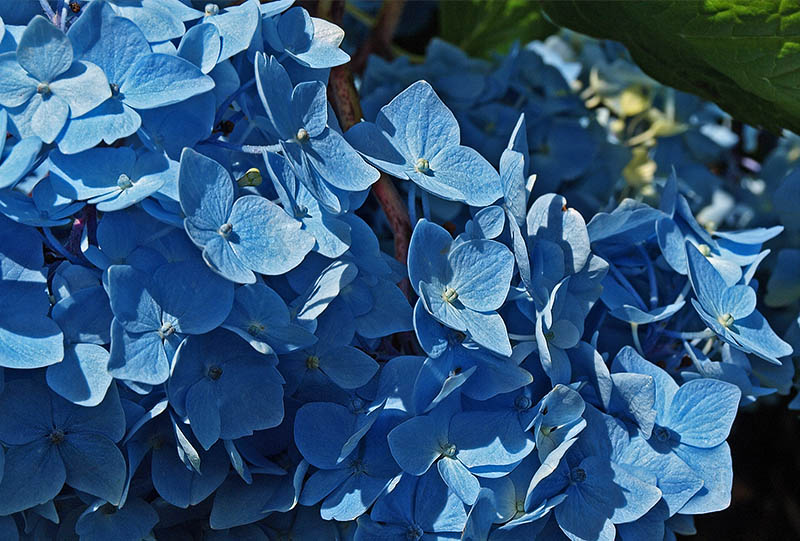
So I can only dream about having hydrangeas with flowers in wonderful shades of purple and blue like in the photo above. Or even a stunning blue like the hydrangea below. (Well, winter is a good time for indulging in fantasy gardening, sitting by a warm fire with your favourite books and seed catalogues.)

Visiting other people’s gardens does at least give me a chance to photograph hydrangeas of different types and colours. Finding a plant that you really love is one of the great joys of garden-visiting. And usually means that there’s a growing wishlist of plants to hunt for in the nurseries and garden centres.

Blue Hydrangea
What a fantastic blue!

I find that the flowers of the lacecap hydrangeas are much easier to photograph than the mophead types. The mopheads can be an unruly mass of flowers that don’t cooperate when it comes to creating structure within the photograph. The arrangement of the lacecaps, with their tiny ‘true’ flowers at the centre of a ring of bigger sterile flowers, means that it is easy to find an attractive angle for a photograph.

As well as the pink lacecap, we have the climbing Hydrangea petiolaris here. It’s growing along a shady fence and I’m a bit worried that it might actually be holding the fence up now! Replacing the fence panels in the future, without damaging the plant, might be really difficult, so I should try propagating some cuttings as insurance. The flowers of this climber are very like the lacecap flowers – again they make a good photograph. (I have just photographed a frost-covered flower that had lingered on the plant. That’s for another ‘frosty flowers’ blog post very soon.)

Pastel-coloured 'mophead' hydrangea.
This ‘mophead’ hydrangea has very delicate colours.

Looking at the colours of the flowers here has me dreaming of summer gardens and making plans for my own. Our soil here is rather too dry for hydrangeas to be happy. The plants we already have needed to be watered frequently while they were young and the pink lacecap can still wilt a bit on a really hot day. It may be possible to create a more suitable space for hydrangeas in one of the areas that we’re re-developing in the garden. Somewhere with a bit of shade, maybe. But there will need to be lots and lots of good compost added to the ground to help it retain moisture…that will not be a quick job!

While I work to improve the soil in the garden here, I may just have to wait before planting any more hydrangeas. Meanwhile I hope I’ll be able to enjoy more of them in the gardens I visit. It’s exciting to see plants that I’ve not seen before, such as the oakleaf hydrangea below. (These seem to be less common than the mopheads and lacecaps here in the UK.) And I hope I’ll be able to take some more photographs too. (That’s my kind of plant-hunting!)

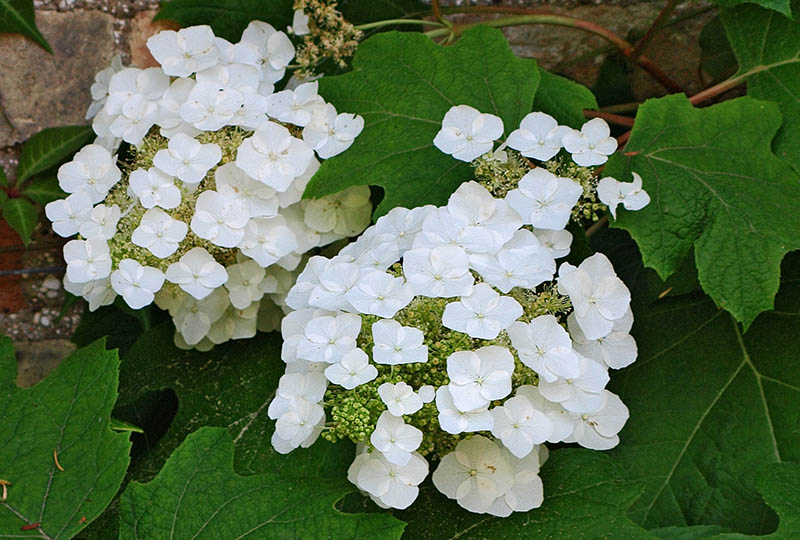
White oakleaf hydrangea
The large, rough leaves are a great foil for the white flowers of this ‘oakleaf’ hydrangea.

Summer Memories

pink hollyhock

I’ve been transferring my photo files over to a new PC, so it has given a chance to look through images that haven’t been seen for a while. Among them was this set of hollyhock pictures which were taken on a long-ago summer evening.

We hadn’t been living here in Suffolk for long and still felt relatively new in the area. It was a warm evening with the sun still shining over the water meadows that run along one side of the town, so Hubby suggested that we should go for a walk. We decided to wander along the river and by some of the old cottages along its bank.

One of the cottages had a little bit of garden at the side that had been taken over by hollyhocks – they looked as if they had just seeded themselves wherever they fancied. The tall spires were spilling out of the garden and dotted along the side of the path. Luckily I had taken my camera…….

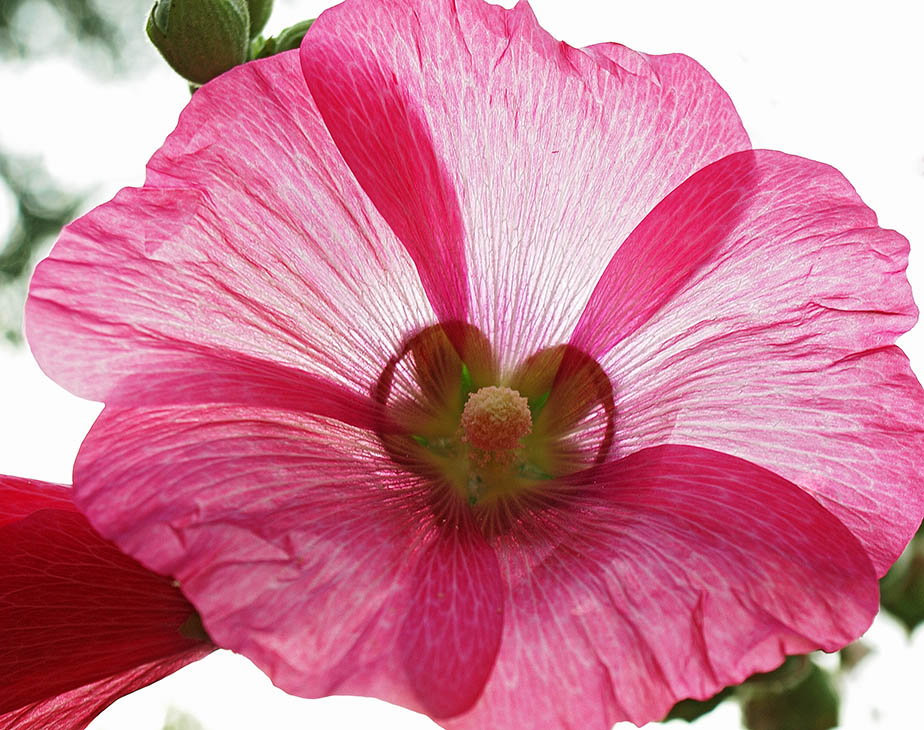
A pink hollyhock flower
Pale veins stand out against the bright pink of this hollyhock.

For some reason, there was never the chance to photograph hollyhocks while I lived in Scotland. Some gardeners must grow them there but I don’t remember seeing them in Scottish gardens. (Maybe because they seem too tall and vulnerable for the rougher weather there – the winds can get quite fierce.) Here, though, they are everywhere. They’re a real ‘English cottage garden’ plant and an essential part of summer.

We now have a few in our own garden and they seem to be replacing themselves with their own seedlings. This means I never know what colours may come up – usually pink but there have been other colours – yellow and a deep, dark purply-red.

cream hollyhock
The dark centre is a strong contrast to the translucent petals.

The hollyhocks were a treat to photograph. Their petals were so thin and delicate that it was easy to capture the evening sun passing through them. The light made them vibrant. It showed up the marking of the veins on their petals and the jewel-like colours, especially those with the dark ‘halo’ in the centre.

Looking at the photographs now, they bring back happy memories of summertime and an evening spent exploring our new home town. They’re a reminder, too, that it won’t be so long before next summer is on the way!

A reddish-pink hollyhock flower
Brings back memories of a warm summer evening….

Seed-heads: Textural Interest in the Garden

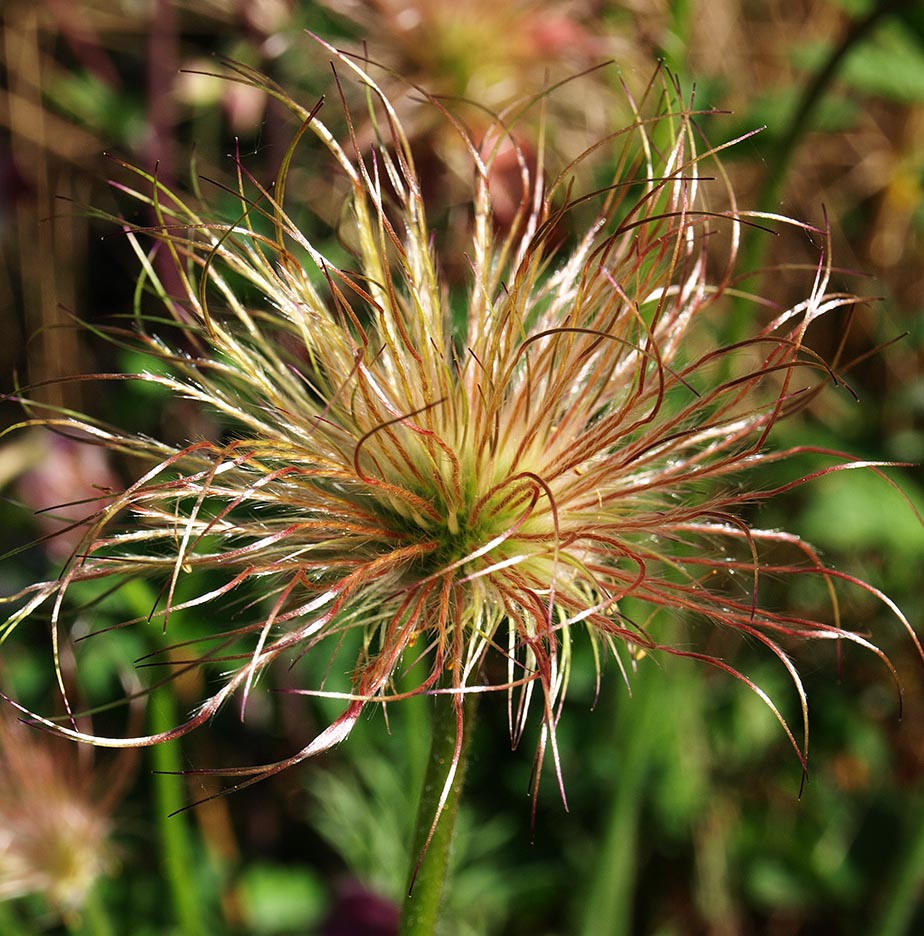
Pasque flower (Pulsatilla) seed-head

After flowers fade in the garden, there’s a certain feeling of loss, of knowing that they have disappeared for another year. But some plants have something more to give the garden – attractive seed-heads that add their own texture and interest to the planting.

For a photographer, seed-heads make a great subject. They can have very ‘architectural’, interesting shapes and their textures range from soft and fluffy to extremely prickly. There’s plenty of variety to inspire pictures with different moods. Could be something soft and gentle, or something bold and eye-catching, or perhaps an image with a more nostalgic feel.

Seed-heads have that inbuilt message that something is ending but also remind us that there will be something new – new life – in the future. And for a gardener, seed-heads can be a reason for hope, if there is a chance of new plants springing up – or dread if they’re weeds!

I love to see the Pasque flower seed-heads every year. (Top photo.) They are so soft that you want to stroke them but they can also really catch the light. The fine hairs reflect the sun and make them gleam on a sunny day. (They’re irresistible to my cats too, who find that the heads swaying on their long stems make a great toy to bat a paw at, especially those that can just about be reached through the slats of a nearby seat. Fun for all!)

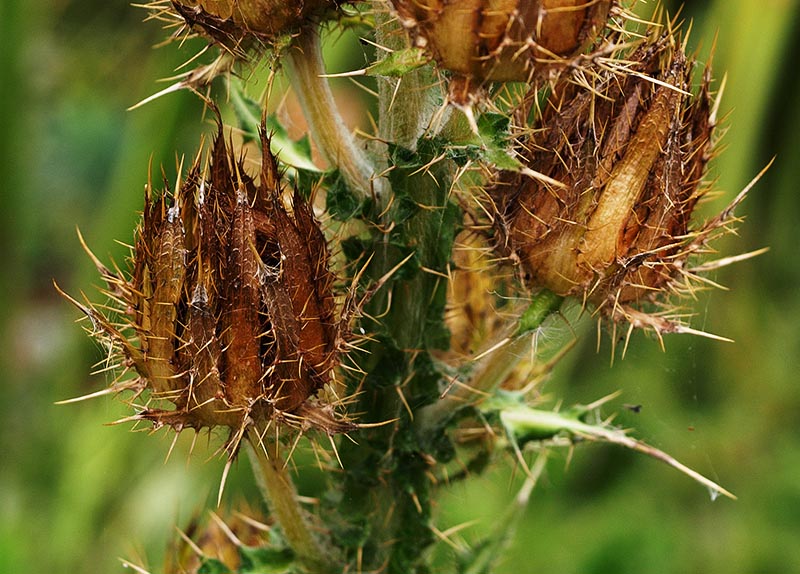
prickly seed-head
I wouldn’t like to touch this seed-head!

Other seed-heads are not at all welcoming to the touch. But they do at least look interesting in a photograph. I’m happy to say that the plant above was in someone else’s garden. I don’t know what it is, but I really wouldn’t fancy brushing against it in a border. Ow!

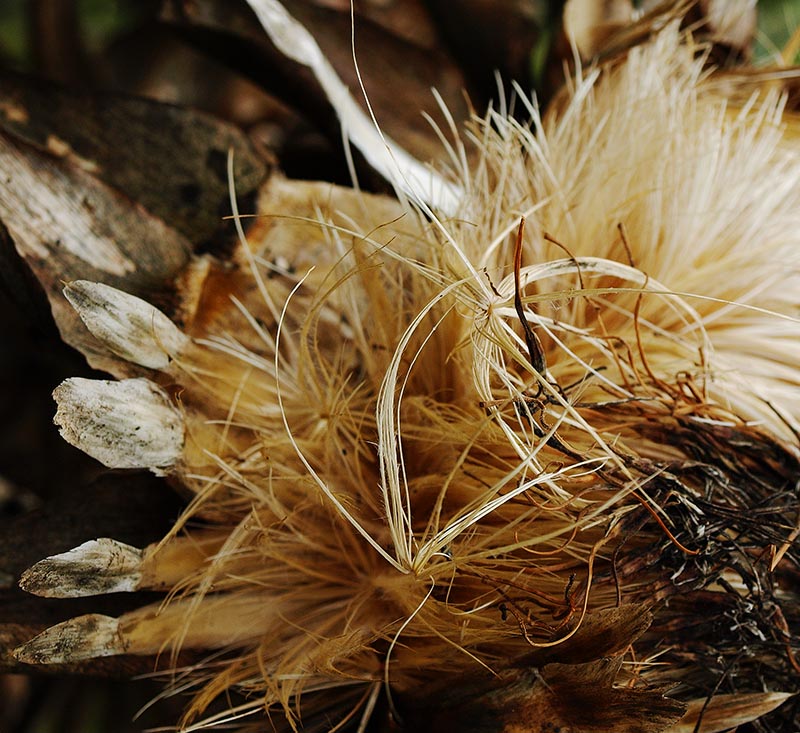
I don’t know what the seed-head in the bottom photo is either. It might be a protea. The photograph was taken in a garden that had big glasshouses, so there were a fair number of  non-hardy plants. The combination of textures and shapes and the soft browns, yellows and creams of this seed-head appealed to me. It’s very different to the seed-heads that I would find in my own garden and, like the Pasque flower, makes me feel that I want to reach out and touch it.

At this time of year, when there are few flowers left and so many garden plants are dying back for winter, seed-heads can linger. I like to leave as many as possible in my garden, so that when the frosts arrive, there will be something to photograph. A coating of frost can make a dried-out seed-head turn into something wonderful – a delicate structure with grace and sparkle. So if you like to photograph plants, it’s a good idea not to be too tidy in your garden. Leave those seed-heads standing and wait to see what magic a touch of frost or snow can bring!

I love to read your comments! Do you have any plants that you like for their seed-heads?

Seed-head
Mystery seed-head – could it be a protea?