Springing Slowly…

Plum Blossom

NB: A note for WordPress Reader users – you need to click on the title of the post again to see the full photograph. (Otherwise you see just a tiny section!)

At last it is starting to feel like spring here. A few sunny days have persuaded the first leaves to begin to unfurl. Around the garden flowers are in bud and very gradually opening.

Daffodils have been appearing and going over, some are yet to open. (And I’m smiling to see the return of a few that I thought I may have lost.) Tulips are now showing traces of colour on their still tightly-closed buds and there are forget-me-nots sprinkled through the borders.

Everything is much slower than it was last year, though. Then, the early spring was especially warm and the garden felt full of flowers by the beginning of April. There was a mass of blossom on our few fruit trees – and lots of fruit to follow! This year the cherry and the apple trees look as if it will be a while yet before they’re ready to flower.

However, it’s good to see that life is returning to the garden now. Our young pear tree has just started to open its flowers as I’m writing this. (This year I hope to photograph that blossom before it disappears – I didn’t manage it last year.)

Earliest of the fruit to blossom is a small plum tree – you can see this in both photos. This tree has never yet managed to produce a plum, but it’s early flowers may mean that it manages to keep its place in our smallish garden. (I’m not making any promises to it though!)

Plum Blossom
Plum blossom – a welcome sight at last!

Flowers of the Wind…and Rain!

White anemone flower (Anemone blanda)

NB: A note for WordPress Reader users – you need to click on the title of the post again to see the full photograph. (Otherwise you see just a tiny section!)

Spring is still taking its time to get established here, but there are signs of new growth and flowers are gradually appearing. These are Anemone blanda, commonly known as the windflower or winter windflower.

Winter windflower seems an appropriate name for a flower blooming now, because our weather has been unusually wet and sometimes windy too. Conditions here are decidedly un-springlike at the moment. Despite this, these small flowers are quietly establishing themselves in amongst the bigger perennial plants that haven’t yet come into growth. Whenever the sun comes out they open their flowers fully and bring a gleam of light to the still somewhat wintry garden.

There are only a few of the white windflowers in the garden so far. We also have the blue windflowers which have begun to spread, so I’m hoping that the white ones will too. These brave little flowers will always be a welcome sight as winter loses its chilly hold on us and we get ready for spring to arrive in full bloom.

White anemone flowers (Anemone blanda)

Waiting for Sunshine

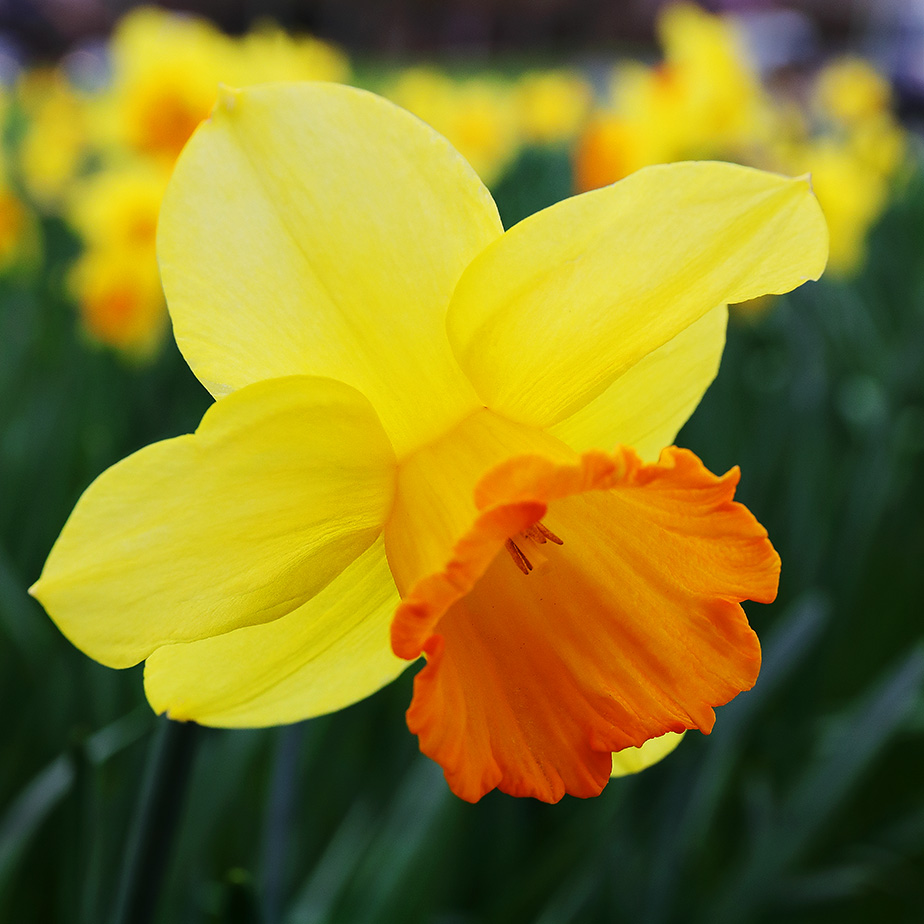
Yellow and orange daffodil

NB: A note for WordPress Reader users – you need to click on the title of the post again to see the full photograph. (Otherwise you see just a tiny section!)

It has been very wet here over the last couple of weeks. That’s actually a very good thing because this part of England (East Anglia) has still been in ‘drought status’, even after the winter. Suffolk doesn’t get a lot of rain, so the rain we’re getting now should help keep everything growing for a good while. (And, I hope, top up the region’s reservoirs too.)

But after so much grey weather, I’m starting to long for sunshine. And flowers! It feels as if spring has been slower in arriving this year. At the end of March last year our fruit trees had come into flower. By the start of April we had a wonderfully frothy display of apple, plum and cherry blossom. That outburst of flowering seems a long way off still.

Happily, there are some flowers appearing. Daffodils have recently opened their gleaming yellow flowers both in the garden and on the green at the front of the houses here. Those on the green are particularly cheerful, with warm orange coronas surrounded by the brightest of yellow petals. En masse, they are an impressive and cheering sight. Up close (as above) they are simply delightful.

Hot Spot: Ranunculus

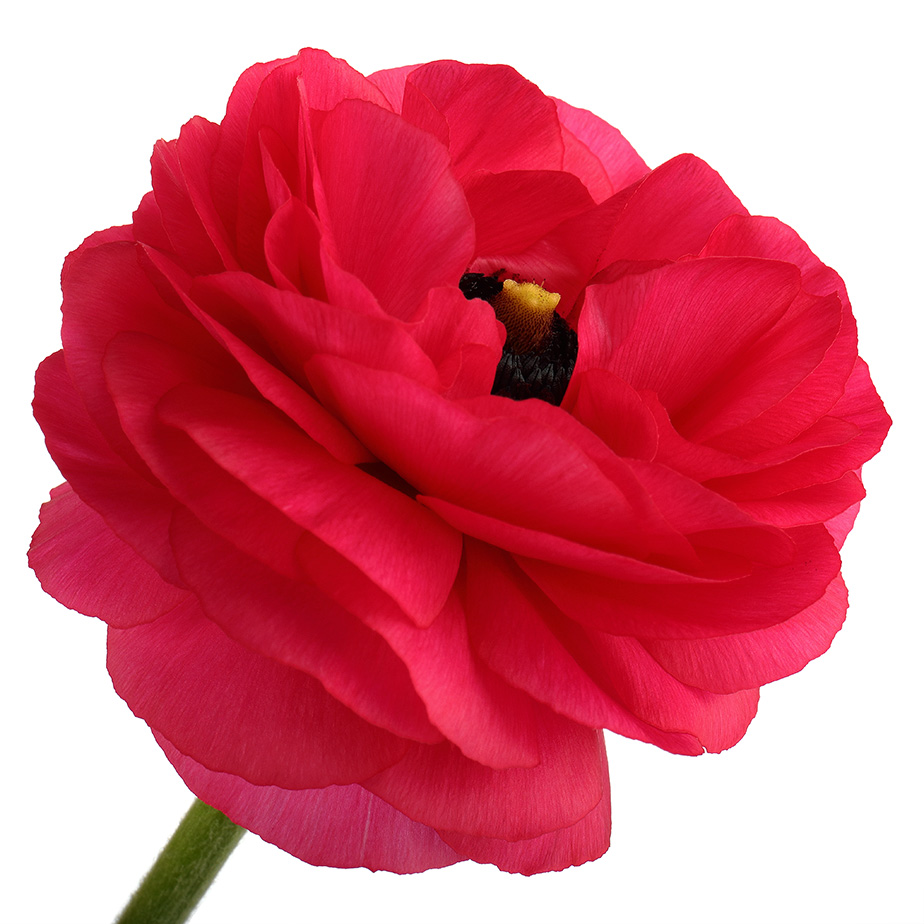
Red ranunculus flower

NB: A note for WordPress Reader users – you need to click on the title of the post again to see the full photograph. (Otherwise you see just a tiny section!)

Red always demands attention and there’s nothing subtle about the way this ranunculus flaunts its frill of glowing petals. It makes me think of the over-the-top style of dress that a Hollywood star might wear for an awards ceremony.

Well, maybe that’s my imagination getting a bit carried away, but Ranunculus asiaticus (or ‘Persian buttercup’) certainly has a glamourous look. The flowers provide a stunningly beautiful and richly-coloured display. (And of course, they’re irresistible to this photographer!)

Like the primulas from my last post, these are currently in stock in garden centres. Here in the UK they’re often treated as bedding plants because they aren’t hardy and it’s difficult to save the tubers for re-planting a second year. Plants bought now can be put outside once there is no risk of frost and will give colour in spring and early summer. Or they can be grown from tubers planted in late spring, to then flower in autumn.

I haven’t yet bought any ranunculus this year (the photo is one from a couple of years ago) but I know that I’ll buy them again in the future. They’re too lovely to miss out on. And it would be fun to try to photograph the rest of the colours that they come in…a project for next spring perhaps?

Sweet pinks: Primulas

Pink primula flower head

NB: A note for WordPress Reader users – you need to click on the title of the post again to see the full photograph. (Otherwise you see just a tiny section!)

The colours of these primulas make me think of children’s sweets (candies if you’re in the US). Radiantly bright, they’re just the thing to make the still-cold days of late winter and early spring feel better.

Polyanthus primroses (AKA ‘English primroses’) like these have been bred to have a great range of brilliant colours. Garden centres have row upon row of them in gleaming reds, pinks, oranges, yellows, blues and purples. There are even striped flowers like this ‘Zebra Blue’.

Jolly as they are, it can be difficult to make these plants look at home in the more restrained borders of my garden. Gradually I’ve been trying for a more natural look to some areas, so the colours of highly-bred primroses can look too brash and artificial.

Rather than trying to find a place where they might look right in a border, I potted these up and parked them by our front door. They looked good in their pots but sadly they eventually suffered having their roots eaten by vine weevils! (Vine weevil grubs eat the roots of some plants that are grown in containers. Plants growing in the soil are much safer.)

It’s a couple of years since I lost these plants. I’ll probably try again with something that will fit the look of the garden better and can be planted in the ground. (Such as the UK’s pretty yellow native primrose, Primula vulgaris.) And then there’s the rich colours of the dainty ‘candelabra’ primulas which would be happy in the bog garden that I’m making…tempting!

Pink primula flower head

Looking Up: Hellebore ‘Rosali’

Hellebore 'Rosali' flowers

NB: A note for WordPress Reader users – you need to click on the title of the post again to see the full photograph. (Otherwise you see just a tiny section!)

Unlike the hellebores in my recent posts, the pretty pink-blushed flowers on this plant are upright and easy to see. Recent hellebore breeding has created a number of plants that have out ward-facing rather than downward-facing flowers and these flowers are bigger too, so make a very eye-catching sight.

‘Rosali’ is a recent purchase – I couldn’t walk past it in the garden centre! (So it may be a good thing that I don’t go to garden centres too often…) ‘She’ will join a small group of hellebores just outside the back windows of the house and where there is a change in level with a retaining wall. (That makes the other hellebores easier to see.) The area also gets a bit of shade in the afternoon, so hopefully won’t be too hot in summer.

This hellebore is one of the HGC ‘Ice N’ Roses’ collection (Helleborus glandorfensis), a new species which has been bred as a cross between a Snow Rose and a Lenten Rose (Helleborus ericsmithii and Helleborus x hybrida). This new species of hellebore is tall (at 45cm). It’s also said to be robust and long-lived. I certainly hope it is, because it will always be welcome in the garden as a joyful start to the gardening year.

Hellebore 'Rosali' flowers
Flowers of Hellebore HGC Ice N’ Roses ‘Rosali’

Sweet Spots

Pink hellebore flower

NB: A note for WordPress Reader users – you need to click on the title of the post again to see the full photograph. (Otherwise you see just a tiny section!)

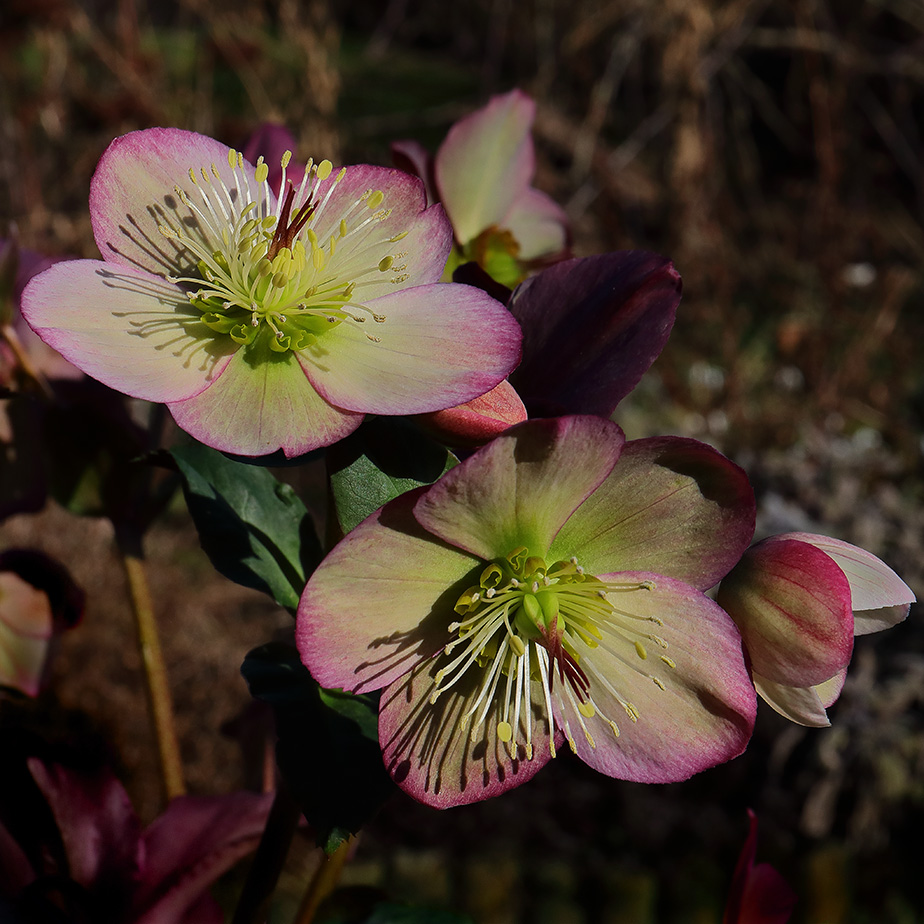
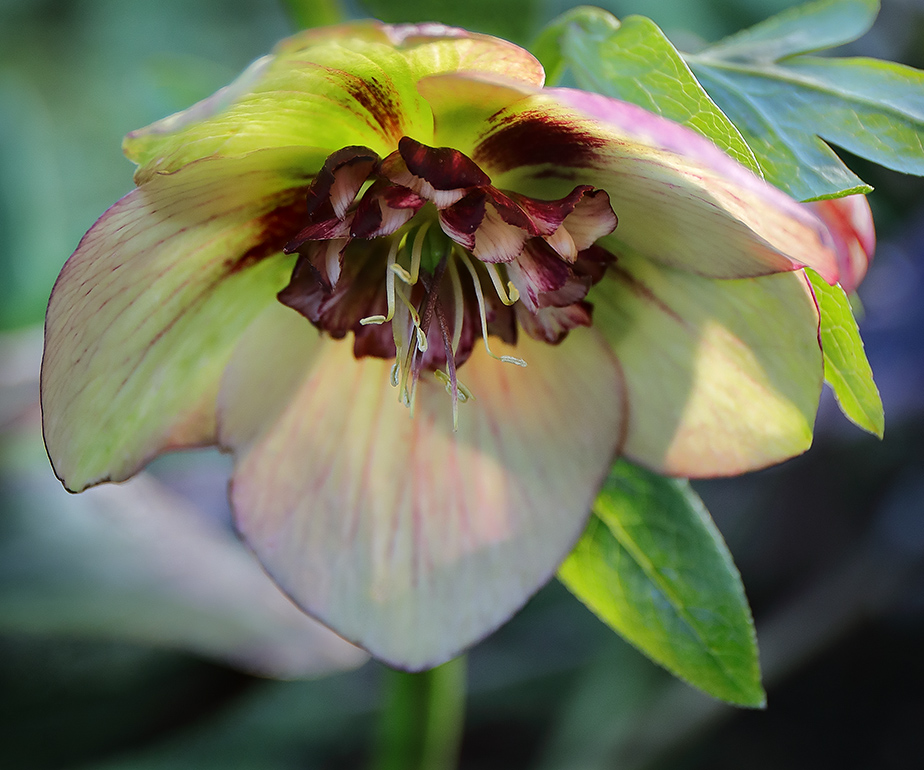
Part of the charm of hellebores comes from the variety of markings and colourings on the petals. The two flowers photographed here came from a friend’s garden. At first glance they look like they might be the same flower, but take a closer look and you can see small differences.

The top flower has larger, more diffuse spots that merge with the dark veining of the petals. You can see that the hellebore at the bottom has smaller specks of crimson that don’t obscure the petal’s veins as much. Tiny differences, but they add a lot to the appeal of a group of hellebores growing together.

A very similar hellebore is this little spotty one from my own garden. As the flowers on my plant get older, they become a lot paler than the flowers here. (EDIT: I’ve added a photo of the stages of this hellebore in my garden, so that you can see what I mean. The flower on the left side is darker when newly opened but will become a bit lighter as it develops.)

Pink-spotted hellebore flowers.
Three stages of a flower – you can see how much darker the newly-opened flower on the left is.

It will be interesting to see if any seedlings develop from it and the other hellebores growing nearby because they’re all quite different from each other. Maybe I’ll eventually have a family of related plants that have interesting variations like the hellebores in these photos.

Pink hellebore flower
From a friend’s garden: a pretty pink hellebore flushed with tiny crimson spots.

Shy Beauties

Hellebore flower

NB: A note for WordPress Reader users – you need to click on the title of the post again to see the full photograph. (Otherwise you see just a tiny section!)

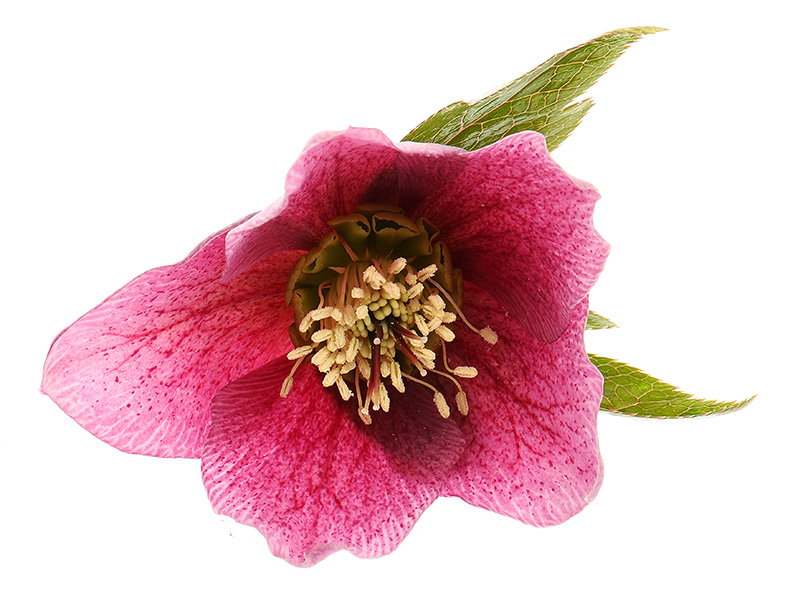
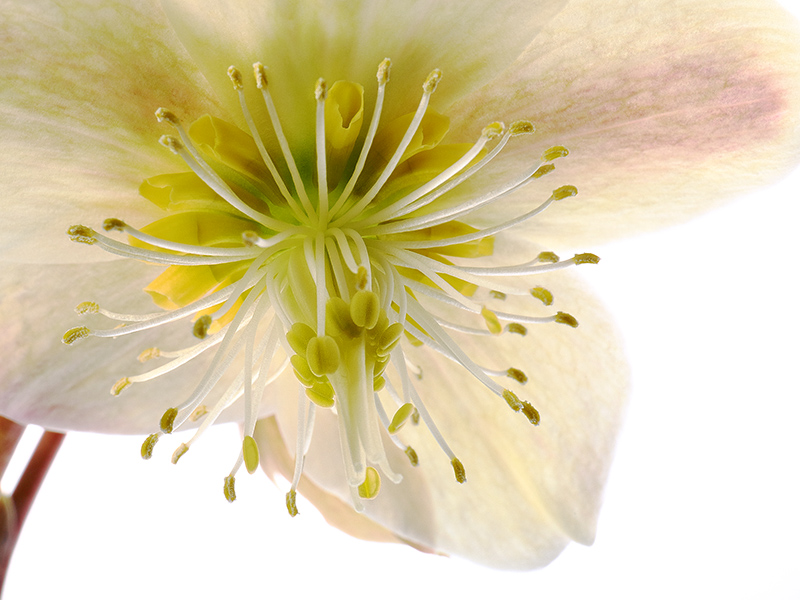
It’s almost time to photograph the hellebores as they start to come into flower. While I’m waiting for them to be ready, I thought I’d show you a couple of flowers from previous years.

I’ve photographed the hellebore above quite a lot because it’s one of my favourites. But it’s not getting any easier. That’s because it’s a shy little flower, like most hellebores, and keeps its flowers facing earthwards. To photograph them I have to get down really close to the ground – and then get back up again!

Hellebores are lovely flowers, so getting into awkward positions to photograph them is worthwhile. There is good news though, in that there are newer varieties that have more upward-facing flowers. I’ve just treated myself to a new plant (but not photographed it yet) that has taller stems and much more upright flowers. This makes them far easier to see. (You’ll see photos of that one soon.)

For the bottom photo I made life easier for myself by taking the flower indoors to photograph. Simply placing it higher than the camera let me look into its little face and capture its portrait. 🙂

Hellebore flower

Looking Forward

Iris reticulata and yellow crocuses

NB: A note for WordPress Reader users – you need to click on the title of the post again to see the full photograph. (Otherwise you see just a tiny section!)

It feels like an in-between time in the garden at the moment. Spring isn’t here yet, but winter has become less harsh and it’s grip is not as cold as it was a week or so ago. Some mornings there may be traces of frost on the grass, but the heavier frosts that have iced the garden plants are absent. Now is a time of waiting for the new season to arrive.

There are some signs of the approach of spring already. The leaves of daffodils are well above the ground and their flower buds are slowly swelling. Hellebores are getting ready to bloom. A few crocuses have bravely opened their yellow flowers – the same crocuses as in the photo. (These are Crocus chrysanthus var. fuscotinctus, growing with Iris reticulata ‘Cantab’ and Iris reticulata ‘Harmony’ behind. I grew them together in a pot a couple of years ago to make a welcome by my front door.)

The cold weeks of January have made me impatient for the start of spring. I want to see plants bring life and excitement back to my garden, to feel the sun warm me, to hear the first bees buzz past. For me, the start of spring is a time of hope and of building anticipation as I gradually see plants reappear, like familiar and much-loved friends. While I’m waiting, the photographs from previous years are a reminder of the joys to come.

In the Winter Garden

Frosted flowers of Knautia macedonica

NB: A note for WordPress Reader users – you need to click on the title of the post again to see the full photograph. (Otherwise you see just a tiny section!)

With January over, I hope that the cold will begin to ease. It feels like it’s time to get back to work in the garden, but I don’t fancy getting frosted when I do!

We haven’t had any more freezing mornings in the last week, so perhaps these will be the last of my frosty pictures for this year. I’ve been very glad to have the heavy hoar frosts around to give me something to photograph. They have made some very unremarkable parts of the garden take on a new interest.

Frosted rosehips
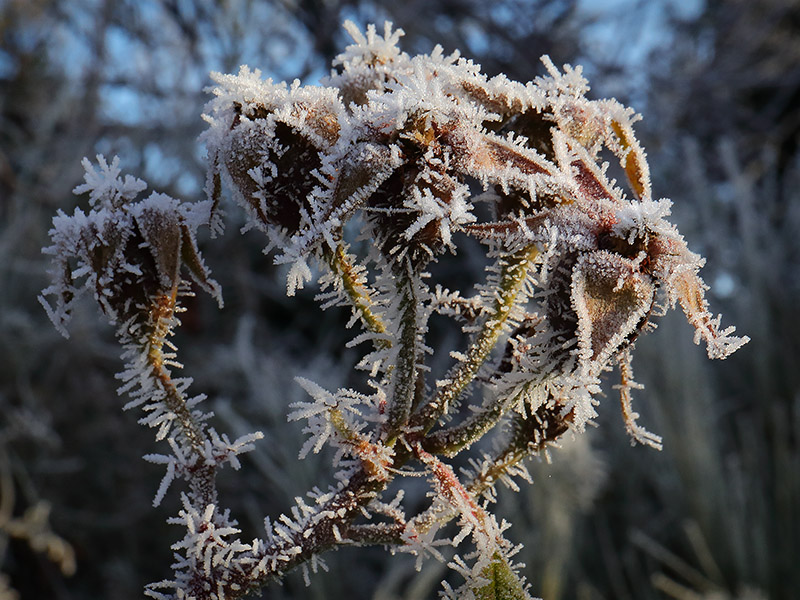
I’d normally have deadheaded this rose, but this year a few rosehips were left and the frost found them.

Some plants, like the Knautia macedonica (top), are generous in producing late flowers that are likely to get frosted. That makes them an obvious subject for me to photograph. But many of the other plants look much more ordinary until the frost decorates them. So plants that I might not have thought of photographing earlier in the year suddenly demand my attention.

The tiny yellow flowers of the pond plant below (Sisyrinchium californicum, aka yellow eyed grass) are long gone and have been replaced by its seed pods. The frost has turned these into odd-looking spiky growths, almost as if they’ve become some strange winter flowers reaching towards the frozen pond.

Frosted pond plant
Pond plant Sisyrinchium californicum takes on a different appearance when covered in hoar frost.

Sometimes there are non-plant things for me to photograph on a frosty day, like the spider’s web below. I can’t help wondering if the spider has survived the very cold spell – maybe it’s hiding in a warmer spot under some leaves somewhere. At any rate, I’m sure that any spiders and other creatures in the garden will be much happier when it warms up a bit.

However, since I began writing this, I’ve noticed that the latest weather forecast has promised us some very chilly nights. So I may have to be patient and wait a while yet for the warmer weather. (But roll on spring!)

Frosted Spider Web
Chilly weather for spiders!