It’s particularly vile outside at the moment. Right now we have high winds and sideways rain and there was even some short-lived snow earlier in the week. So it’s comforting to know that the early flowers have survived, despite the weather’s attempts to shred them.
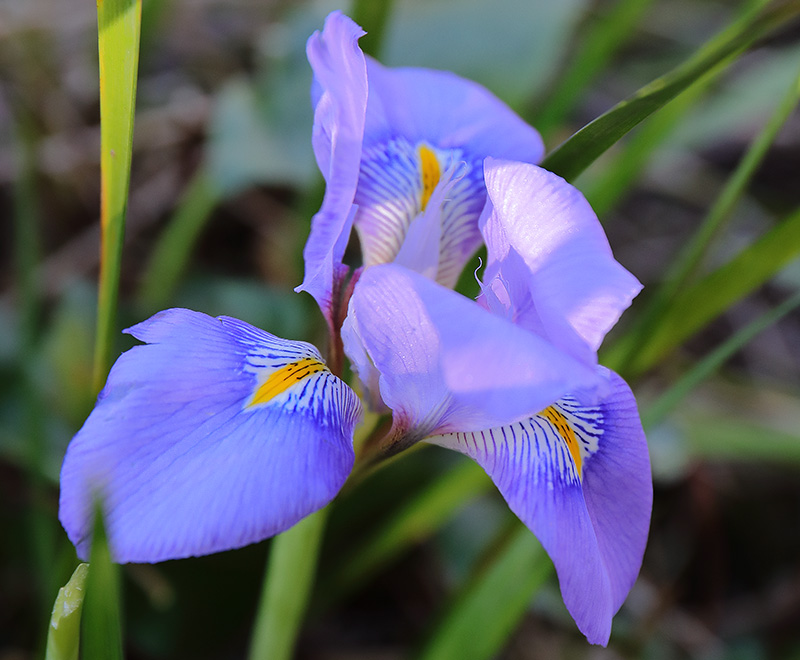
I photographed these irises a few days ago, in a dry and sunny gap in the stormy weather. (The weather forecast is my friend! I keep an eye on it to know when I must dash outside and photograph flowers before they are ruined.)
These fragile-looking flowers are iris unguicularis – had to check the spelling of that one – otherwise known as ‘Algerian winter iris’.
The plant was given to me by a generous neighbour and has slowly got itself established in a sunny border. It’s a plant that grows wild in Mediterranean countries and likes dry and sunny sites, so is well-suited to our hot and thirsty garden. (But the present heavy rain is unlikely to please it.)
There have been a good number of flowers this year, with a couple of buds still waiting to open. That is a good improvement over the previous years, when there were only three or four flowers and I thought the plant wasn’t too happy where it was. I’ve read that this iris flowers better as the clump gets older and more congested, so I’m looking forward to good displays in years to come…and a good reason to be outside on a wintry day with my camera.
In part of the drab mid-January garden, lots of little yellow flowers sparkle amongst the bare branches of the dormant shrubs.
They are the flowers of winter jasmine (Jasminum nudiflorum), whose lax stems make it seem more like a climber than a shrub. In my garden it blends well with other shrubs because the long, thin stems with tiny leaves take up little space. It fills the gaps between other plants and becomes almost invisible in summer, while the other shrubs are in full leaf.
But just you wait for winter! Then the yellow starry flowers shine out against their dark background and add a touch of exuberance to brighten a cold and gloomy day.
If you leave it unpruned, the winter jasmine can spread quickly, with its flexible stems sprouting roots wherever they touch the soil. It’s easy to control the plant by pruning it after the flowers have finished, and it can be trained onto trellis or kept cut back to form a shrub. Personally, I like to have it growing in its natural, spreading form and I’m going to gather up some of the rooted stems to start new plants in other parts of the garden.
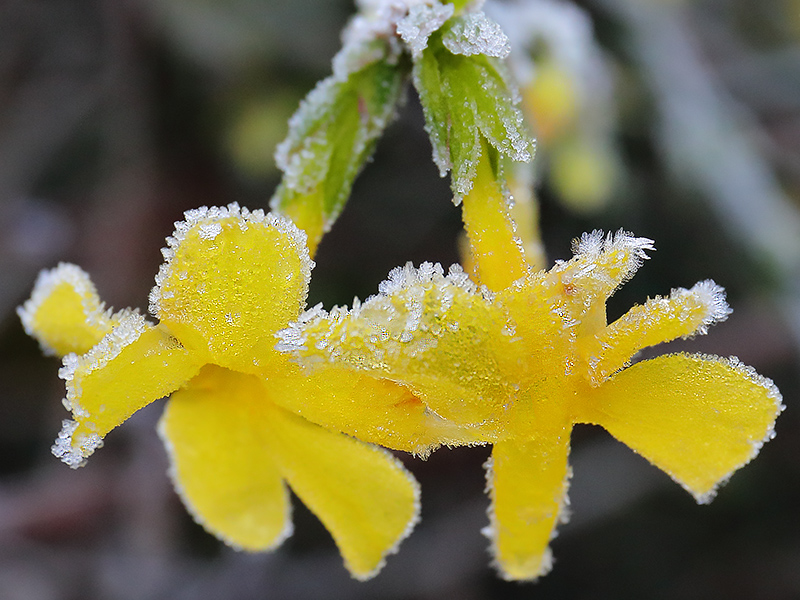
The flower you see in the photograph had been frosted and was still covered in water drops from the thaw. Although the frost destroys the jasmine flowers that are open, there are plenty of undamaged buds to provide lots more flowers – I’ll be sure to take the time to enjoy them. (And to take some more photographs!)
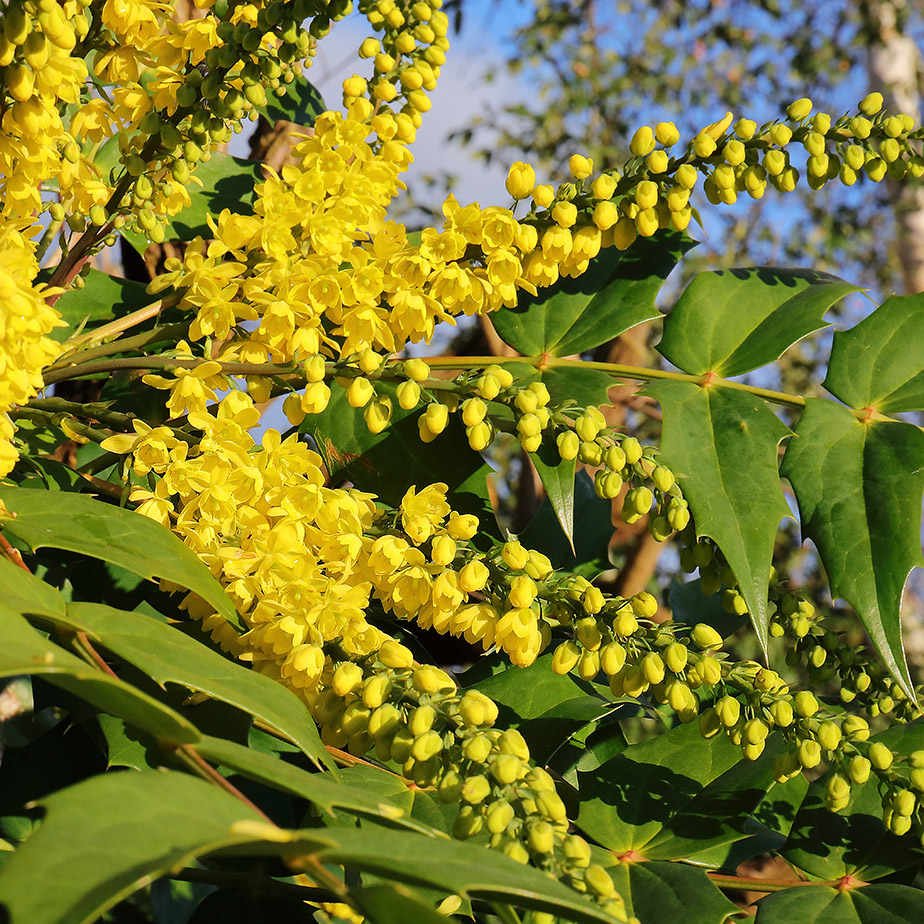
When everything outside is looking wintry and dreary, the mahonia bush right at the back of our garden boldly flaunts its gleaming yellow flowers. Give it a bit of sunshine, and those flowers are reminiscent of a yellow highlighter pen – practically fluorescent!
The mahonia provides a touch of brilliance and an attention-grabbing focal point to the garden at a time when it’s really needed. The little flowers are like a patch of concentrated sunshine. (I think it must be mahonia x media ‘Charity’.)
So I shall use these cheerful winter flowers to wish you a very bright and joyful New Year. May 2020 bring you health and happiness!
Because it’s almost Christmas, I thought I’d post some slightly sparkly frost photographs. They go to show that nature can be festive when she likes!
Last Christmas, I woke up to a frosty morning and was able to get outside and spend a bit of time taking photographs of a softly shimmering world.
This year we had a cold period much earlier in the month and I took these photographs then. I don’t think I’ll be outside taking photos this year because the forecast is not promising any frost or snow. (I’ll have a lazy morning inside!)
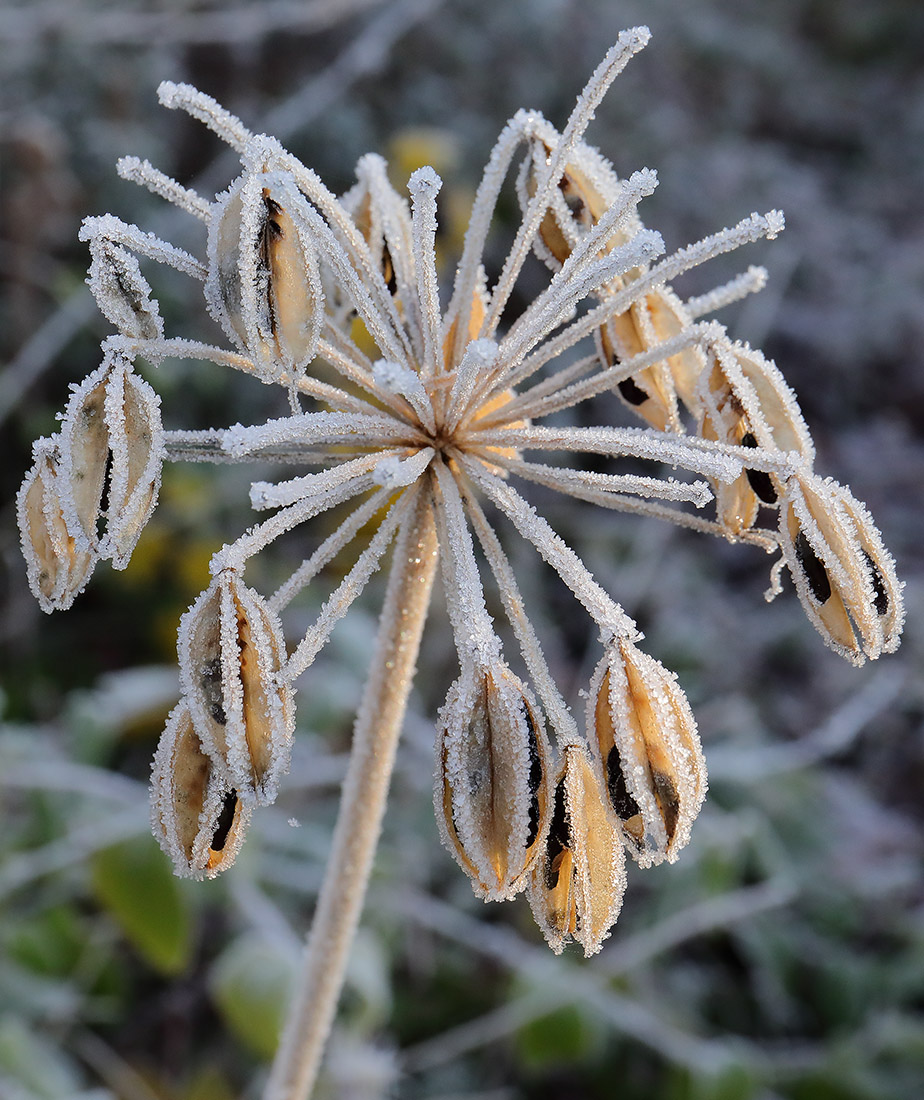
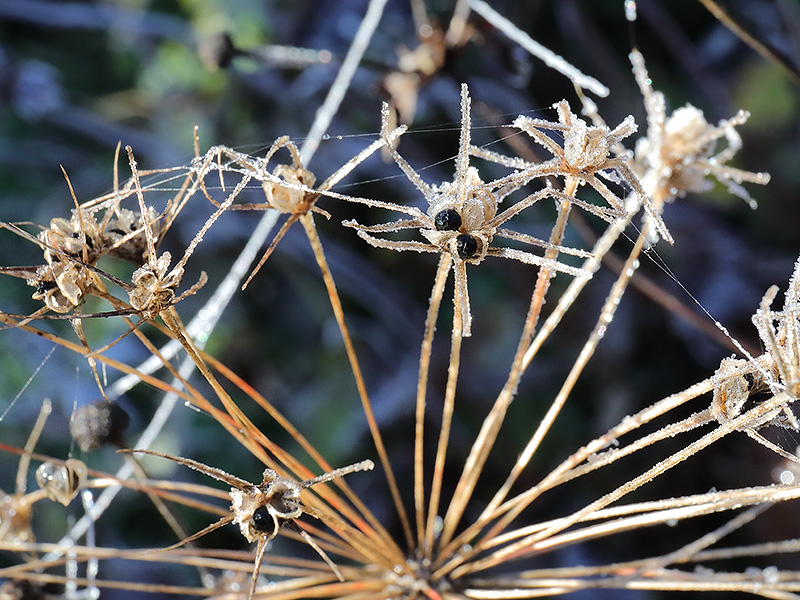
Fennel seed head
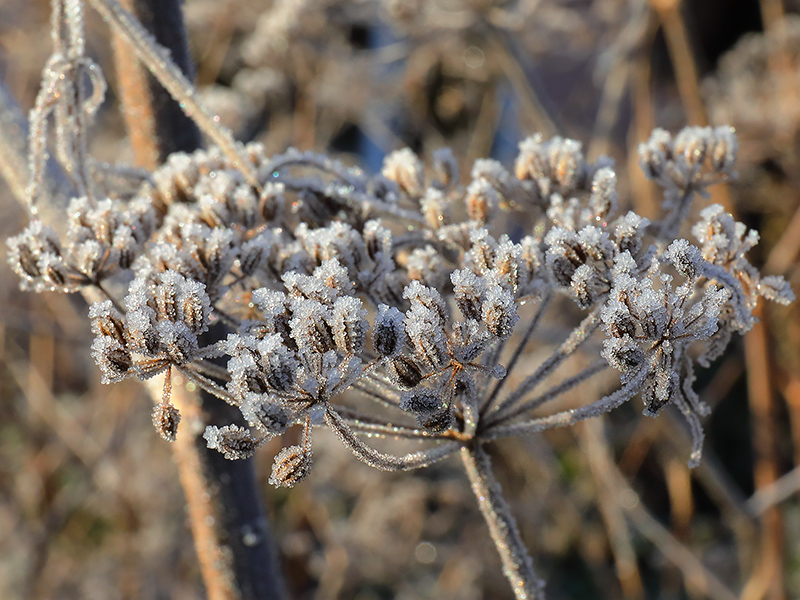
Seed heads are among the most promising of garden subjects to photograph when they are decorated with ice crystals. For this reason, I don’t cut plants back at the end of autumn. (And, more importantly, really, it gives a better habitat for wildlife and a supply of seeds as food for birds.)
There are several seed heads that I particularly want to stay intact until the frost arrives – agapanthus, fennel, allium and daucus (wild carrot) – because they have the most interesting structures and look at their best when frosted.
Allium seed head
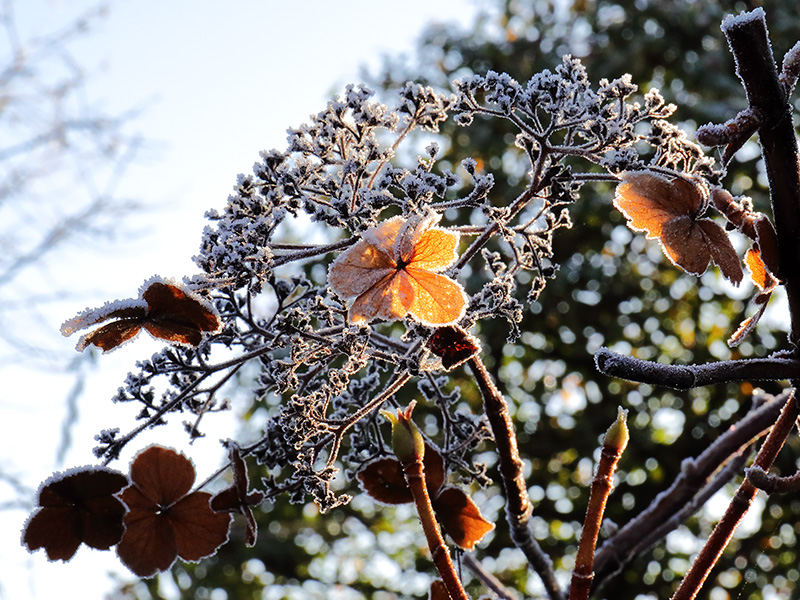
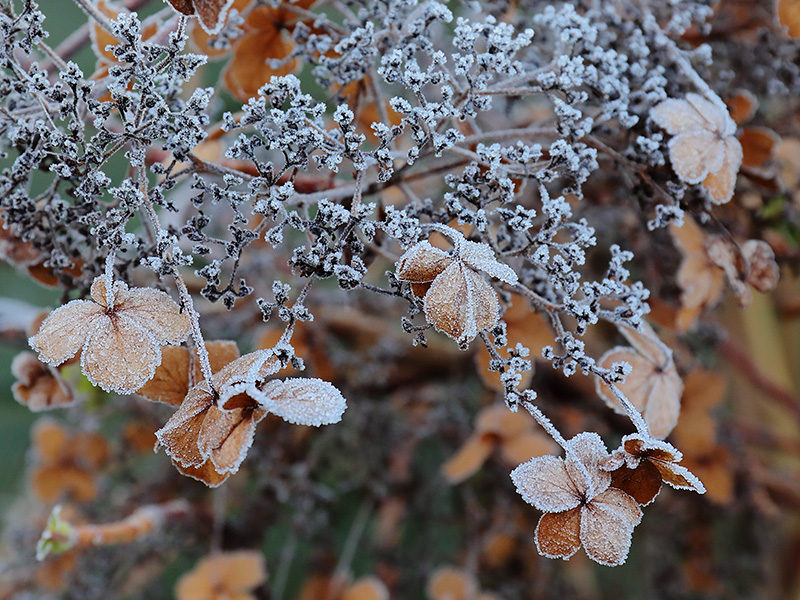
The arrival of frost is one of the times I most enjoy garden photography. With luck, there will be a moment when the sun comes out. Then the frost will glitter and shine, making the garden come alive with exciting new images to photograph. Plants that may have looked quite ordinary before (like the hydrangea below) suddenly acquire a radiance that makes them irresistible to me and my camera.
I wish you a joyful Christmas, full of fun and sparkle!
Sometimes things don’t go to plan with my flower photography. This year I wanted to photograph the range of different colours (including white, pink and lilac) of the Dianthus ‘Rainbow Loveliness’ given to me by a friend.
However, rain and the fact that the plants were grown from seed this year, so not yet large enough to have a lot of flowers, made it difficult.
By the time the young plants were ready to flower, the drought of summer had passed and it had become rather wet and windy. This meant that the delicately fringed flowers were easily damaged. I would walk past them and think, ‘Must take some photos’, but by the time I came back to them, the rain would have got to the flowers and would have left the petals trailing limply.
In the end, I managed to take photographs of just the one bicoloured flower. For close-up photography like this, the flowers really need to be in excellent condition. Sadly, my timing wasn’t good enough to catch the others when they were fresh and undamaged.
Not to worry! Next year the plants will be bigger and able to flower more profusely. They should also be able to flower earlier in the summer, when the weather is likely to be drier and kinder to fragile flowers. Then I should have a chance of of photographing more of these strange but pretty dianthus (‘pinks’), whose petals look like swirling strands of seaweed floating in an invisible sea.
The frost has been back again, giving us some chilly but sparkling mornings. I’ve been grateful to see it because we’ve reached the stage of the year when there are few flowers or plants left to photograph.
Stalking around the garden, camera in hand, I’m usually on the lookout for images that are only made possible because of the frost: veins on a leaf picked out in white, petal edges encrusted as if they’ve been dipped in sugar, or tiny crystals of ice building up on frozen plant surfaces.
Tiny, frozen winter jasmine flowers with ice crystals building up on them.
The shady areas of the garden retain the most frost, and that shade can give a slightly blue tint to the white, which creates an even colder appearance. The lack of light makes it hard to get much depth of field in the photographs, even at fairly high ISO values. (I could use my tripod, but it’s much too cold to stand around for long and my feet feel warmer if I keep moving around.)
As the sunlight gradually starts to seep into the garden, I look for places where the frost has begun to sparkle in the sun. There won’t be much time before the frost begins to disappear as it warms up. This means I have to work quickly to capture the images that have attracted my eye.
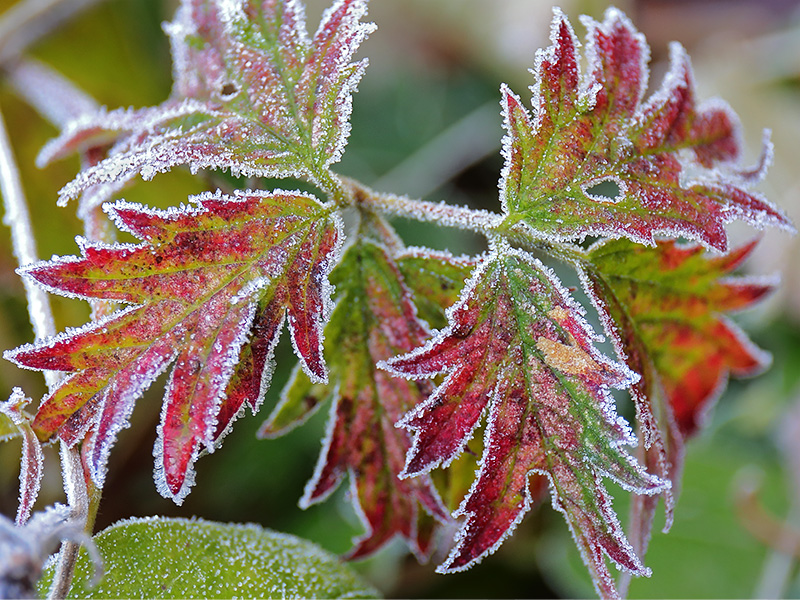
This climbing hydrangea is in one of the coldest parts of the garden, shaded by the fence and a tree.
Eventually I’m either too cold to stay out any longer or the frost has started to melt and drip off the wet plants. So it’s time to head indoors, first wrapping my camera in a large plastic bag to protect it from getting covered in condensation in the warmer air. (Outside, it’s all to easy to let the viewfinder get steamed up by my own breath – a frustrating interruption to taking the photographs!)
Once indoors, it’s time for a well-earned mug of coffee and a chance to get warm again while looking to see what new photographs I have. Frosty mornings can be productive and very satisfying!
The frost on this fig leaf will soon be gone, now that the sun has reached it.
It doesn’t get very cold in this part of Suffolk in Autumn, so the leaves tend to get blown away before they have a chance to develop much colour. (Yet a few miles away, where it gets chillier, there have been great clouds of yellow leaves.)
However, in the last couple of weeks, the night-time temperature has got cold enough to encourage a bit of colour here and there. You have to look quite hard for it, but it can be found.
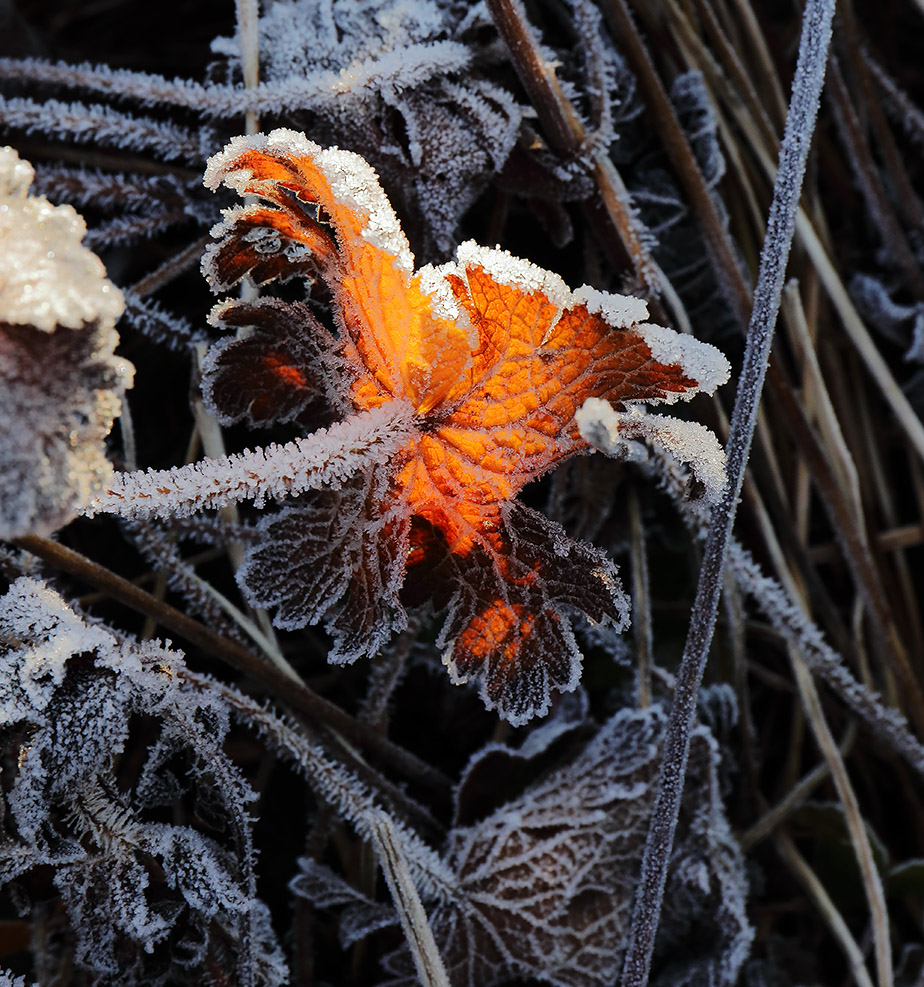
Blackberry leaves become a mix of heat and frost.
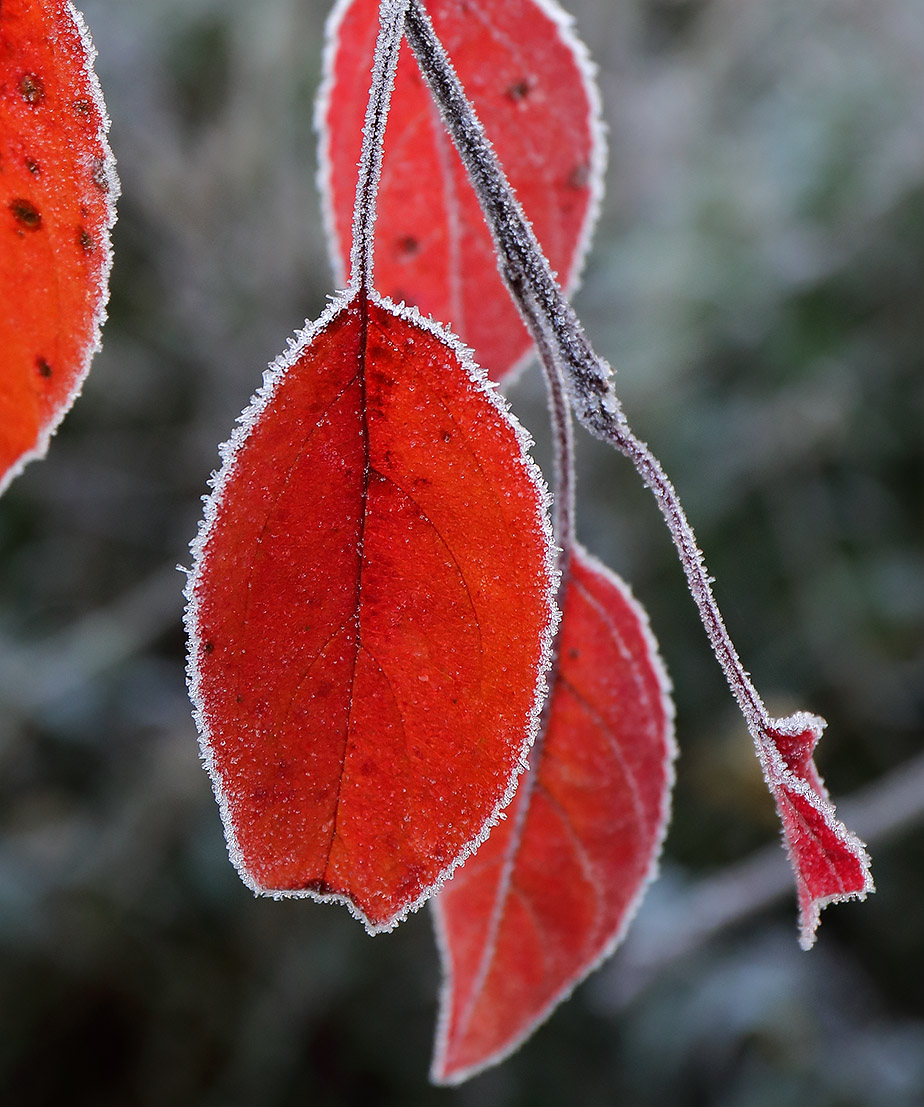
Our recent frost helped to make the last of the leaves more interesting to photograph, providing a crisp, icy contrast to the warm tones of the leaves. It was a good time to be out early to take some pictures.
While I was wandering around with my camera, I noticed soft noises that at first sounded as if there were birds hopping around nearby.
But when I looked up, I realised that I was hearing the leaves falling in the neighbours’ garden. It gets the sun before ours does, and as the frost melted, the leaf-stalks were losing their last grip on the trees and shrubs and dropping softly to the ground. Somehow, the tiny sounds made the morning feel even more hushed and peaceful.
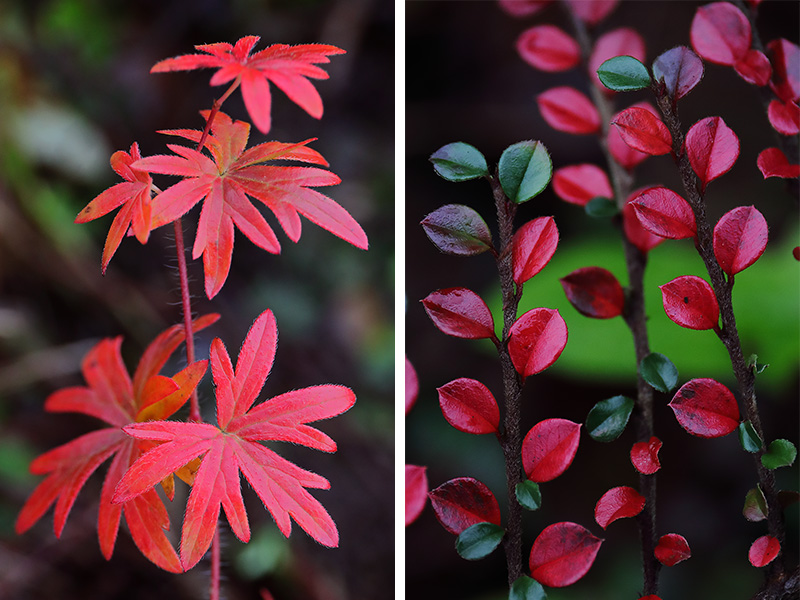
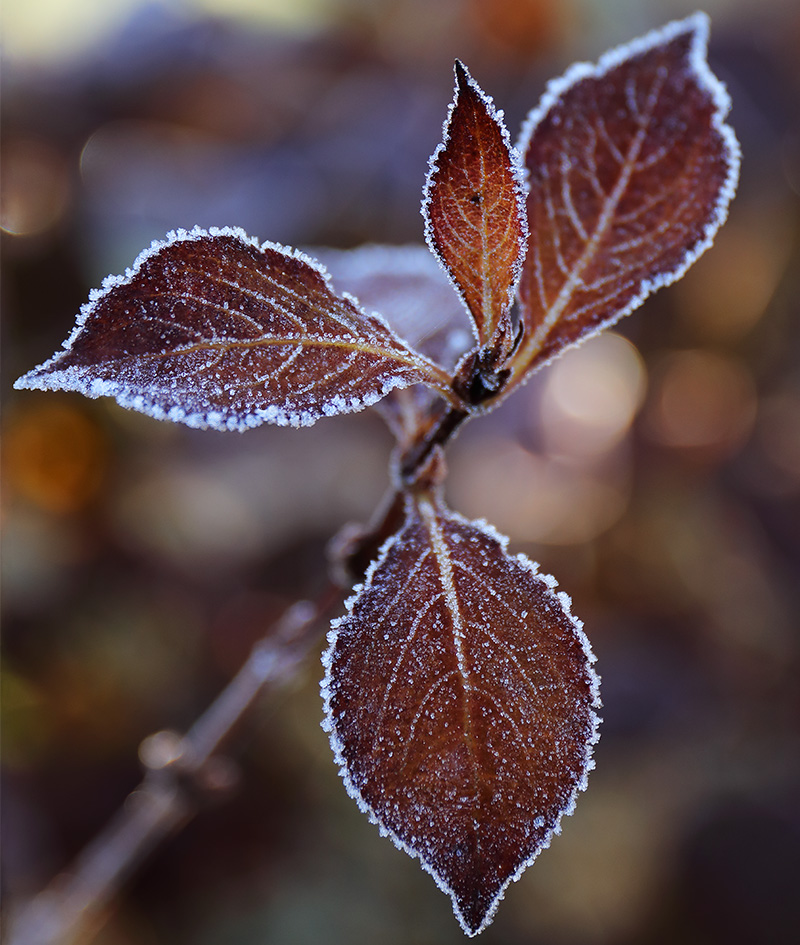
The frost has melted, but being wet makes these geranium and cotoneaster leaves all the more red.
The leaves will soon be gone and everything will seem bare and wintry. But, just for this last little while, these few are rich and glowing with beautiful warm tones – a sight to seek out and enjoy.
By the time you read this, we will have had another frosty morning here. More of the leaves will have fallen and I will have been out taking more photographs.
Autumn has slightly lightened and warmed the tones of these weigela leaves.
On Monday we had the first frost of the year. Up until then, the weather had been mild and wet, so it felt as if it had come suddenly. There were still a few flowers in the garden, lasting much later than you might expect. And, of course, they were caught by the frost.
As you may imagine, this meant that I had a busy morning padding about the frozen garden with camera in hand.
Now that the plants are beginning to die back for winter, there’s not much left to photograph, so the intricate effects of frost give an opportunity that’s too good to miss. I took as many photographs as I could before the sun melted it all away. (And there will be more in later posts…)
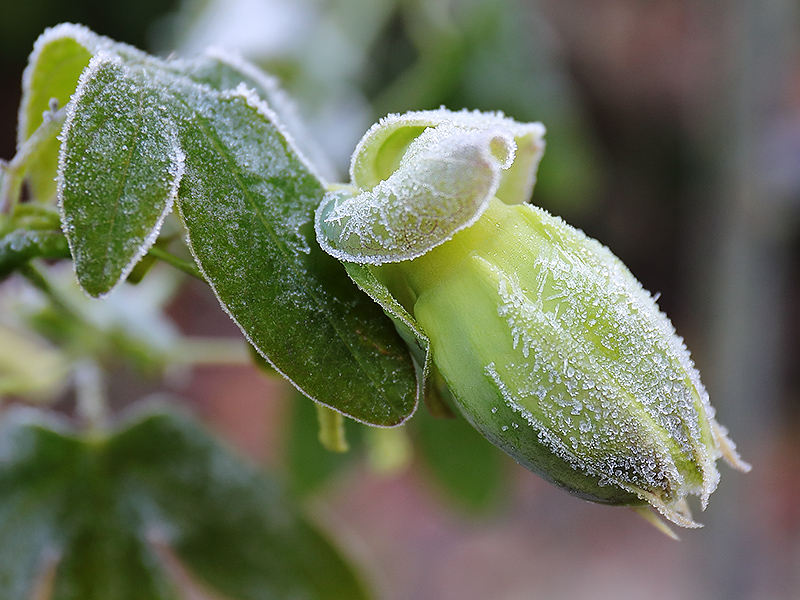
A passionflower bud, caught by the frost.
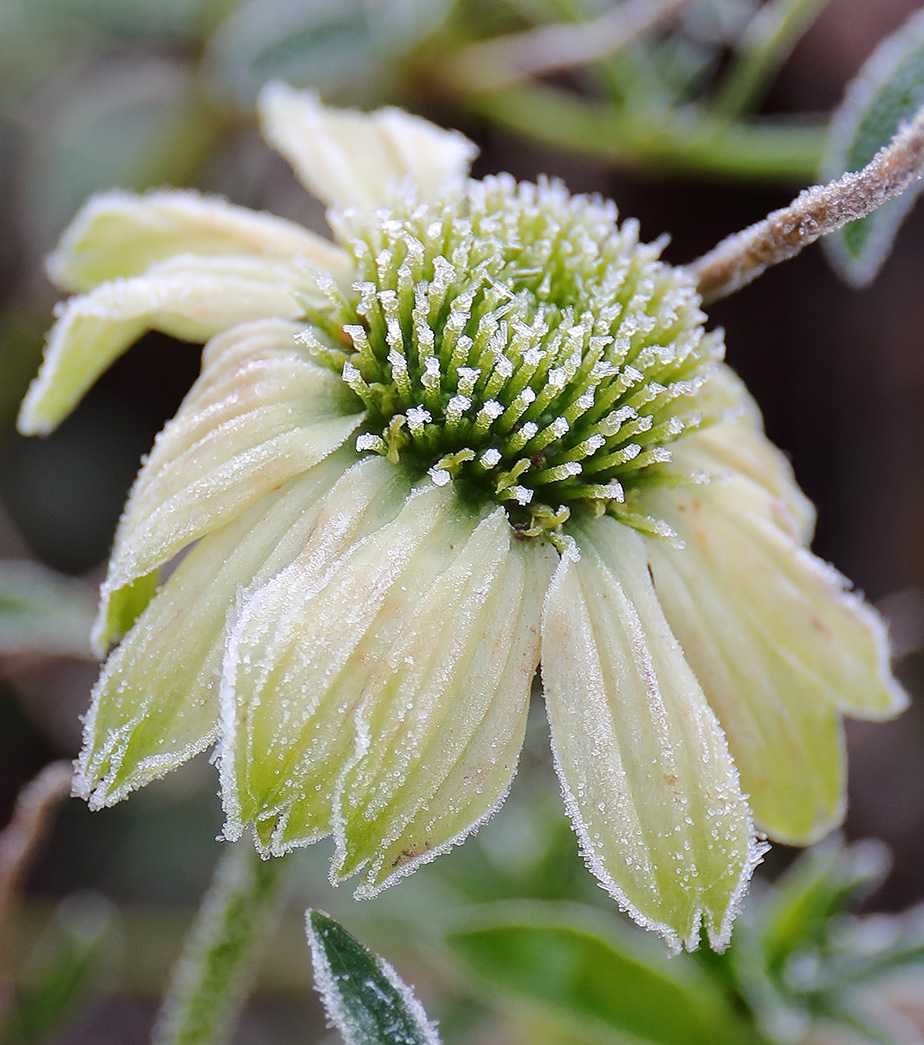
The echinacea flower (PowWow White) was frozen through, and this has enhanced the green tinge to the ends of the petals. The emerging flowers start off pale green, with a vivid green cone, gradually maturing to a white flower with a golden-yellow cone.
This colour-change makes for more photographic potential. The plant is a new addition to the garden and I’m looking forward to following its progress with my camera during the next year.
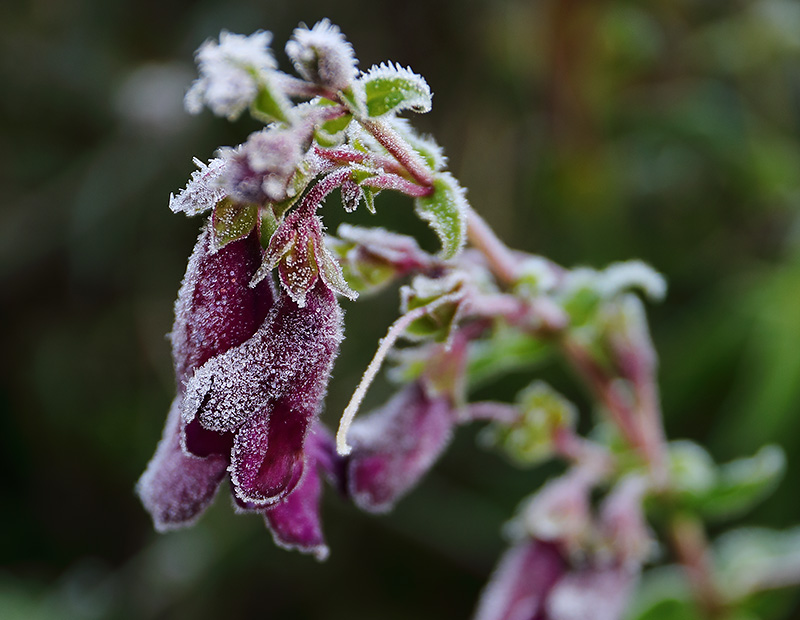
Frosted penstemon ‘Raven’ – hope it can cope with the cold!
The passionflower is ‘Constance Elliot’, which I wrote about here. It was planted just last year and has flowered well during the late summer. The bud seems to have escaped any serious damage from the frost and the plant’s leaves are still firm and healthy-looking, so I reckon it hasn’t come to any harm. Even so, as it gets colder, I’ll protect the base of the plant with either mulch or frost-fleece.
If the winter gets really cold, I may also put fleece around the penstemons. I’ve lost a few of these in cold winters, but some varieties have gone on for years – especially ‘Garnet’, which seems to be hardier than most. (Pictured is ‘Raven’, which came through last year’s fairly mild winter easily. I hope it turns out to be thoroughly hardy too.)
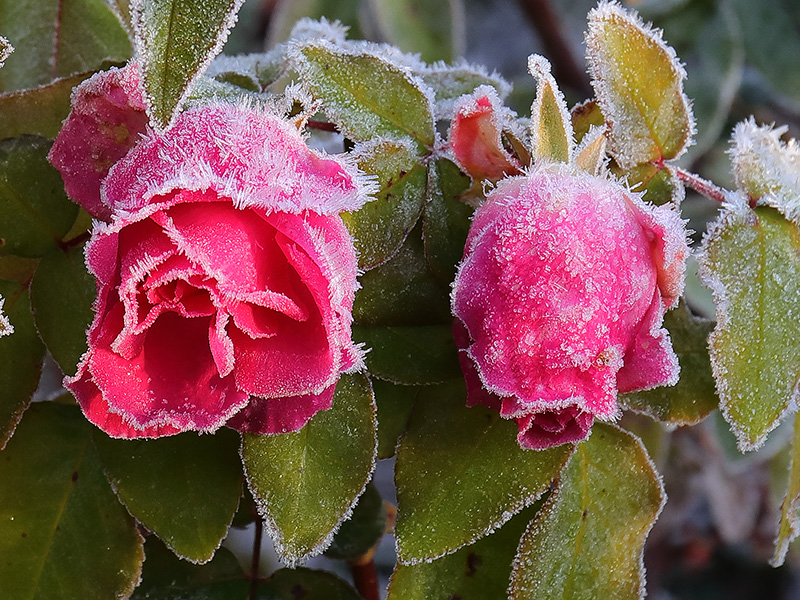
The rose below is a tough old girl who doesn’t let anything bother her…’Zephirine Drouhin’, a rose that is both delightfully scented and thornless. This is probably my favourite plant in the whole garden. I’m glad that she doesn’t mind the frost!
Rose ‘Zepherine Drouhin’, covered in frost now, but her flowers will perfume the air again next summer.
The weather in the past week has been rainy, so not much good for gardening. But it has been ideal for a bit of ‘armchair gardening’. I’ve been thinking about the planting for a new area and imagining which plants might look good there.
Elsewhere in the garden there are a lot of deep or bright colours. I’d like to keep this new patch a bit softer and fairly informal. (Having lighter colours towards the back of the garden can give an effect of receding distance, making the garden look slightly bigger.)
This white rose has just the softest blush of pink.
Recently, I bought a white-flowered hibiscus, called ‘Red Heart’ because it has a bold red marking at the centre of its flowers. This was originally meant to go in the border alongside the new pond but, as I’ve been planting that area up, I’ve realised that there won’t be space for it.
Instead, I’m going to dig out a new border behind our main sitting-out area. (This is a tiny paved space with a wrought-iron arbour which is smothered by a grape vine at one end, and a more open seating place at the other.)
Because it’s an area for sitting around and taking it easy, I’d like to keep the planting looking relaxed and soothing. Somewhere that will help you to let all the stresses of the day ebb away. Whites, to pick up on the white hibiscus, and pale pinks are the most likely choices at the moment.
We already have a white-barked birch tree nearby, and I’m planning to move some pale pink Japanese anemones to another border behind the new area. (The anemones are beautiful thugs, so they’re getting a border of their own where they can run riot.)
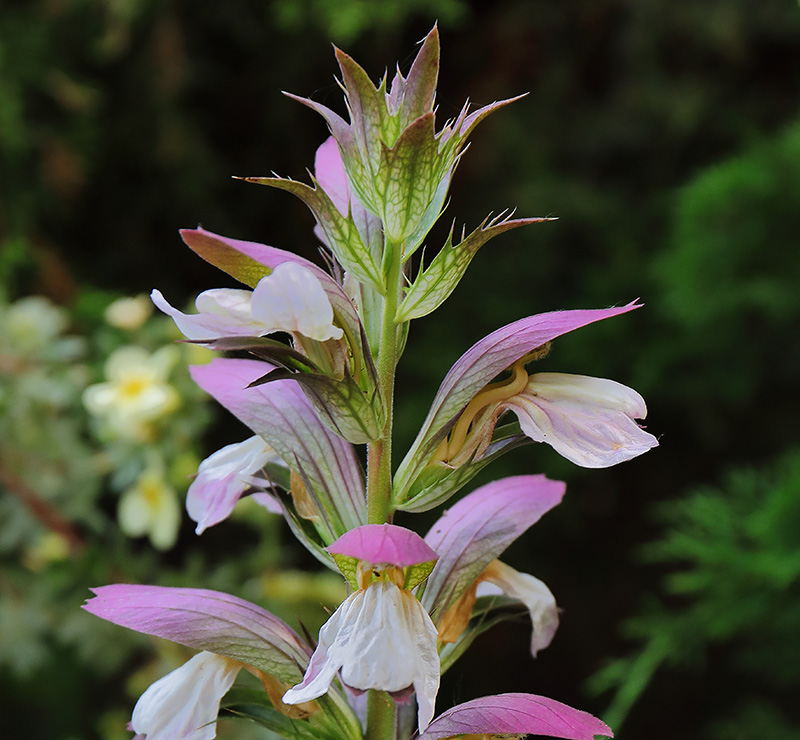
This acanthus has delicately marked veins, but it looks rather spiky.
Sidalcea, astrantia and erigeron (Mexican fleabane) grow in the garden here, so it should be easy to introduce them to the new area too. And we have lots of dark red scabious – a few of those would help to emphasise the similarly-coloured red markings on the hibiscus.
Among the plants waiting to be found homes in the garden here are several white and pink rock roses (Cistus) and they would be likely to enjoy the sun in this border. So the planned area is beginning to look very pink and white, especially if I also add a pale rose like the one in the photo. (Don’t know its name.)
And maybe there should be some acanthus too – it has similar vein-markings to the astrantia and the ‘architectural’ form of the plant would be very striking. But that spiky look might not be so relaxing to look at! (Acanthus is a plant you need to be very sure about wanting, because it’s very hard to get rid of and can grow from little pieces of left-over root.)
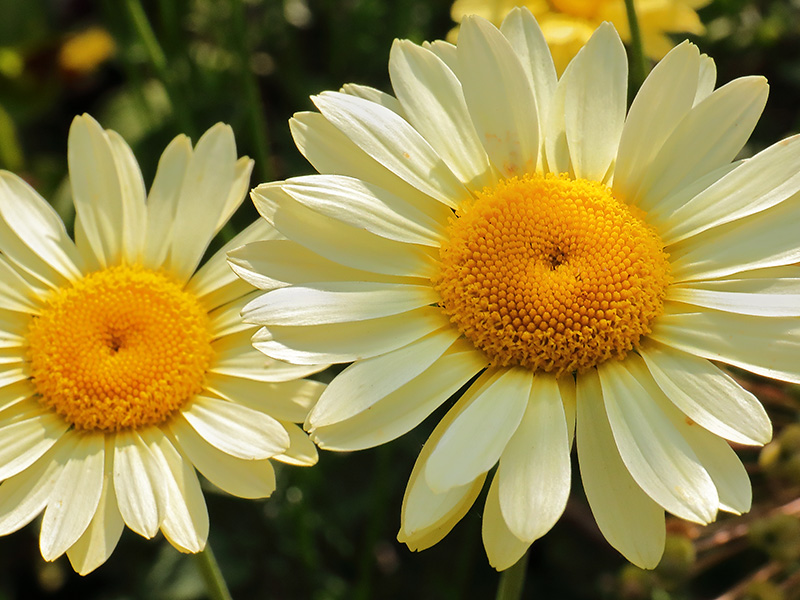
The sunny little daisies of Anthemis ‘EC Buxton’
The plan for this new area may be getting a little too pink, so some other pale colours could be added. I love the happy little daisies of the anthemis above. They’re like a sprawling splash of sunshine in the border and have a very informal look. Nigella also has that relaxed feel about it and would be delightful to see close-up. (The area behind the seating is a little higher, with a low retaining-wall because our garden is on a slight slope.)
Fantasy-gardening and planning new planting is a very pleasant way to spend wet days. But maybe the best thing about it is that it gets the enthusiasm going for starting the work. The rain is over for now and the forecast for the next week is mostly dry, so it looks like I have some digging to do…
November has brought chilly winds and the threat of frost. It’s not quite winter yet but the garden flowers are disappearing fast. Soon the main colour will be the yellow of the autumn leaves.
But for a few days yet, there is a little bit of colour here and there. Just enough to enjoy while I finish planting the spring bulbs.
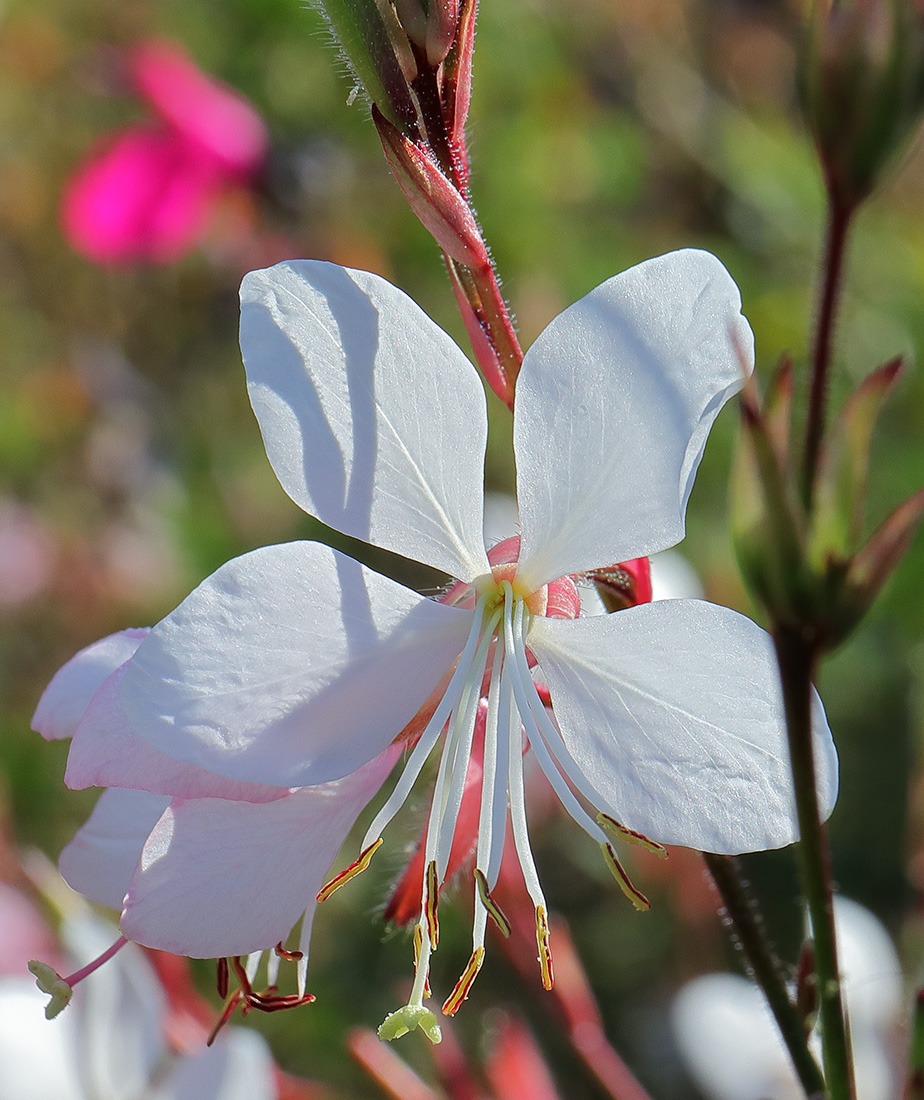
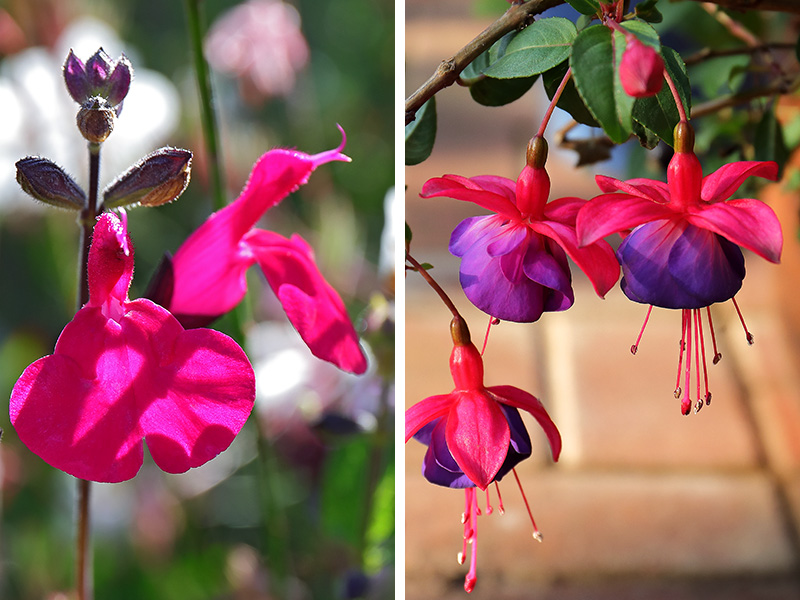
Some plants have flowered for a surprisingly long period. The gaura (above) has been in flower for months, as has the pink-flowered salvia below.
Salvia and fuchsia flowers brighten the garden until the end of autumn.
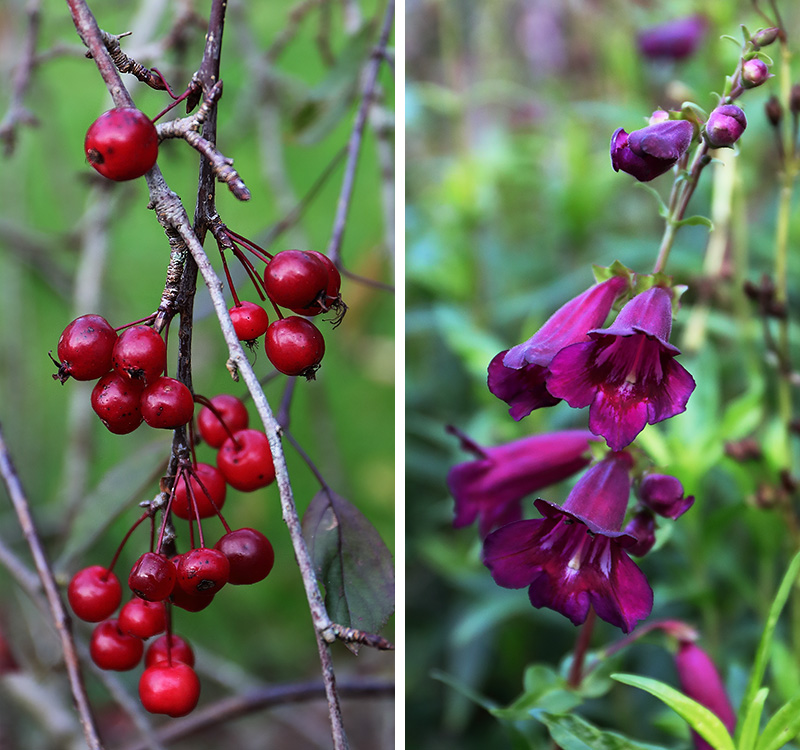
The deep purple penstemon ‘Raven’ is another plant that has fully earned its place in the garden by flowering for a long time. A weeping crab apple called ‘Royal Beauty’ grows nearby, and the rich red of its tiny fruits picks up on the slight touch of red at the mouth of the penstemon flowers.
The fuchsia is one of several plants that are in pots at the front of our house. I think this one is ‘Army Nurse’, but I can’t be sure because we have several that are very similar to each other. It’s one of the hardy fuchsias and I’m planning to plant it (and some others) out in a border in the back garden. They’ll be visible from the house and give a splash of glowing colour right through the autumn.
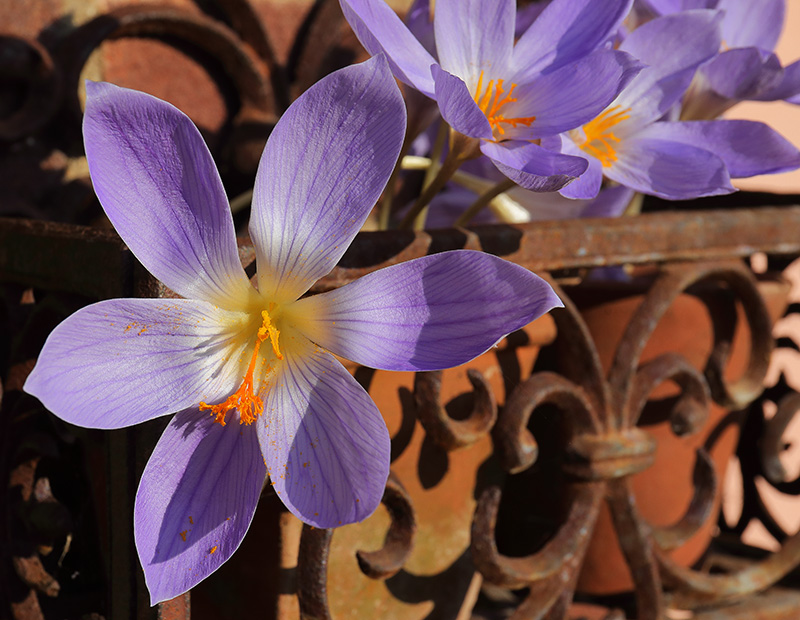
My last flower is the autumn crocus. The bulbs are growing in small clay pots sitting in a wrought-iron holder on the wall. (This keeps them well out of the way of my cats – autumn crocuses are very toxic plants so I didn’t want to take any risks with them.) These flowers should have been over by now but I planted them late, so here they are at last!
Now I must remember that I still have to finish planting some spring bulbs…then I’ll be hoping to find something more to photograph. Maybe some of the late colour will hang around for long enough to get frosted. Not very kind to the plant but makes a great picture!
Crocus speciosus (autumn crocus) opening in the sun.








 Ann Mackay: Inspired by Nature