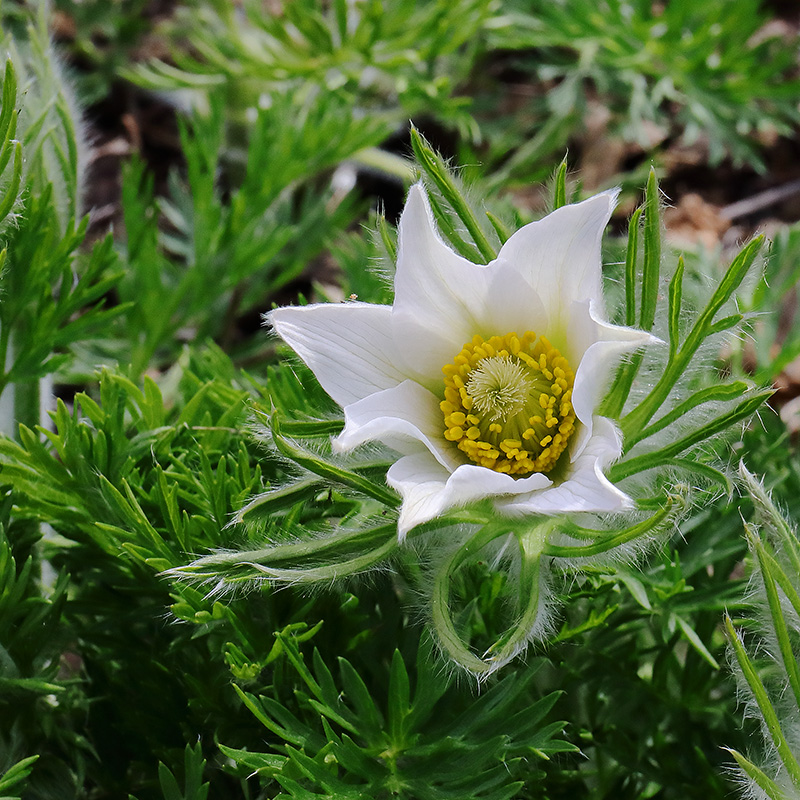
NB: A note for WordPress Reader users – you need to click on the title of the post again to come out of the reader and go to the post itself. This allows you to see the whole of the top photograph. (Otherwise you may see just a tiny section!)
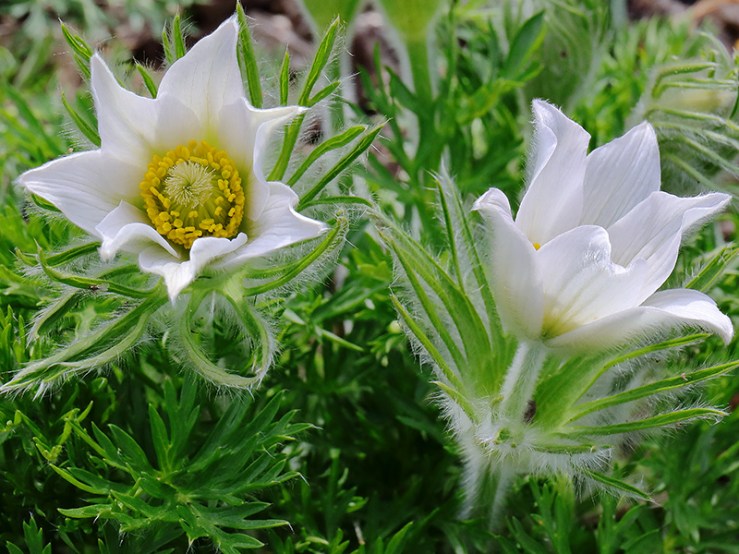
These pasqueflowers (Pulsatilla vulgaris ‘Alba’) are at their best…freshly-opened and unmarked. Their white flowers have a gleaming purity that makes them stand out against the lush greens of young foliage. When I saw them, it felt as if they were just waiting for me to photograph them.
Every spring I photograph the purple pasqueflowers that grow in my garden but I often fail to photograph the white ones quickly enough. (I have just a couple of small plants, so, as yet, not many flowers.) At this time of year I’m always kept busy by the work the garden needs, and by the time I spot some of these graceful flowers, they’re often just going past their best.
The white pasqueflowers seem to deteriorate more quickly than the purple ones and it doesn’t take much to mar their beauty. Browning petal tips as they age and begin to dry out would mean that I have left it too late to do the flowers justice. But this spring I have caught these at just the right time. (However, I haven’t photographed any purple pasqueflowers yet, so I’d better get out there with my camera!) Spring is a time when there are new flowers appearing rapidly, but wind and rain, and even strong sunshine, can make their beauty quite fleeting.

 Ann Mackay: Inspired by Nature
These really are gorgeous; I love white flowers, and I’d enjoy seeing these. When you post about them, I always make the connection to Easter’s paschal candle, and remember that this is their season, too.
You’re right about white flowers being hard to find without imperfections, but you got to these in time. There are a couple of native species in the U.S.; the one I’m most familiar with (thanks to the Prairie Ecologist) blooms in Nebraska. It’s scientific name apparently is Anemone patens, although it’s also referred to as Pulsatilla patens or P. nuttalliana.
LikeLiked by 1 person
I looked up that pasqueflower…it’s a beauty, especially the colouring. Pulsatilla vulgaris is native here, but a rare sight in the wild now, although I did see a wonderful picture of them growing on a stretch of grassland. (So they can be seen in the wild if you know where to look. 🙂 )
LikeLiked by 1 person
I love Pasque flowers, your white ones are lovely. They seed around obligingly too
LikeLiked by 2 people
I love them too, and it’s great to be able to grow something that’s a UK native too. So far I’ve found that the purple ones have done better, but I think that was down to having a more suitable site, with less shading or competition from nearby plants.
LikeLike
You’re clearly happy to have photographed pristine white specimens.
I immediately recognized the first part of pasqueflower as a word for Easter (Old French Pasques, Spanish Pascua), which roughly coincides with the time when this flower blooms (I say roughly, because Easter moves around from year to year). I discovered there’s more to it than that. According to the American Heritage Dictionary, the pasque in the flower’s French name was originally passe, meaning ‘pass, change.’ And change it people eventually did, thanks to the association with Easter.
The resemblance to an anemone hasn’t changed, even if the genus name changed from Anemone to Pulsatilla.
LikeLiked by 1 person
Yes, this year the flowers have even timed themselves right for Easter 🙂
LikeLike
🤩🤩🤩🙌🏼😍
LikeLiked by 1 person
Thank you! 🙂
LikeLiked by 1 person