NB: A note for WordPress Reader users – you need to click on the title of the post again to come out of the reader and go to the post itself. This allows you to see the whole of the top photograph. (Otherwise you may see just a tiny section!)
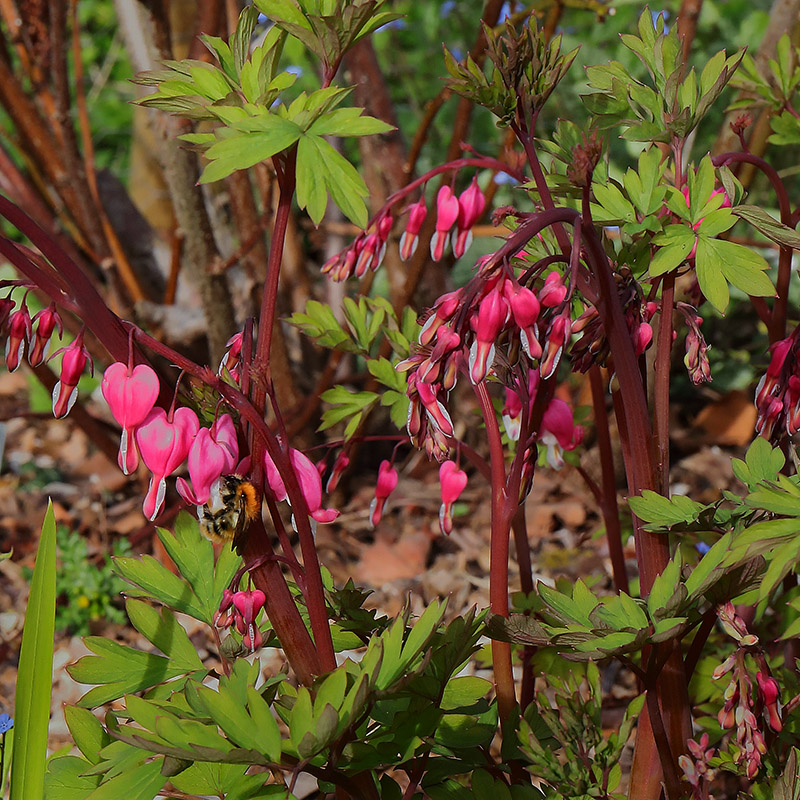
A visit to Fullers Mill a couple of weeks ago allowed me to discover that they have an attractive collection of ‘bleeding hearts’ flowers, both Dicentra formosa cultivars and the Lamprocapnos spectabilis that you see above. (In the past, both of these were in the same genus, but scientists decided that Dicentra spectabilis really wasn’t a Dicentra after all, and called it Lamprocapnos. This new, tongue-twisty name was not the best news for us gardeners, and I’m using copy and paste to make sure I spell it right.)
As you can see from the photos below, they certainly look like they are very closely related. But the Dicentra has smaller leaves that emerge straight from the ground, whereas the Lamprocapnos has leaves on long stems that also hold the flowers. The flower stems of Dicentras do not have any leaves. So much for that, I doubt that the bee enjoying the Lamprocapnos cares!
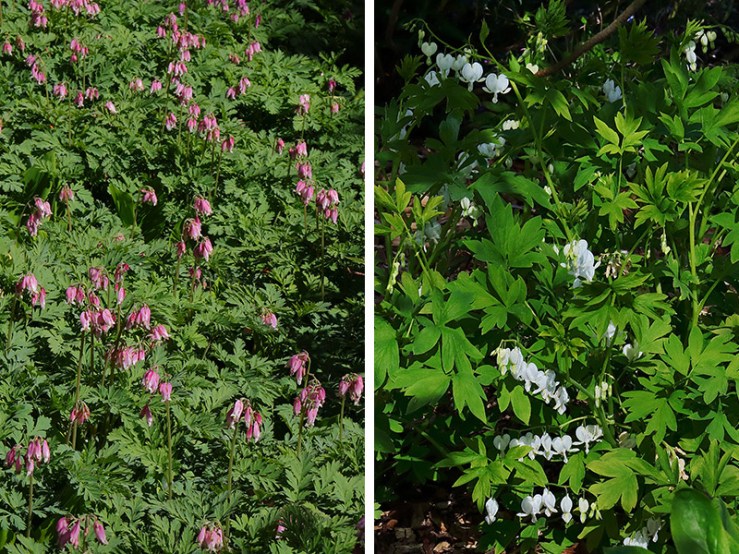
Right; white ‘Asian bleeding hearts’ (Lamprocapnos spectabilis ‘Alba’)
The photo below, from a post a couple of years ago, shows a close up of Dicentra flowers and it’s easy to see why the very similar Lamprocapnos flowers were thought to be the same genus for so long. The plant here is one from my own garden, Dicentra formosa ‘Aurora’. It’s really too hot for it here but it’s surviving. It may do a bit better if I transfer it to a place with more shade.
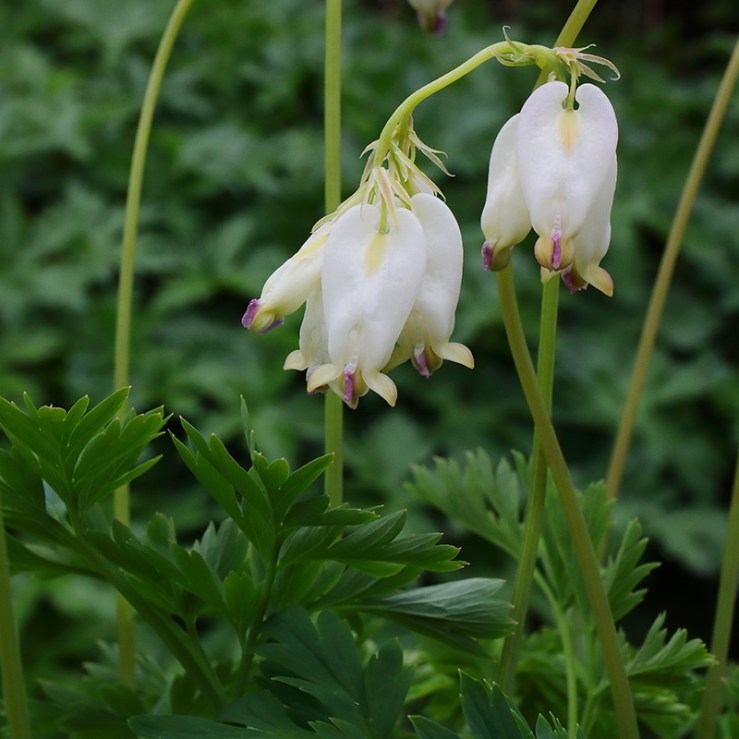
When I still lived in Scotland, I grew Dicentra formosa ‘Langtrees’ in the garden. It’s a lovely white flowered cultivar, very similar to ‘Aurora’, but with much more grey/blue leaves. I found it at Fullers Mill too, looking great in the moist soil and with some shade from nearby trees. My plant in Scotland spread a long way over time, but used to die down in hot summers, making an awkward gap in the border. Sadly, I don’t think it would manage to spread very far in this garden.
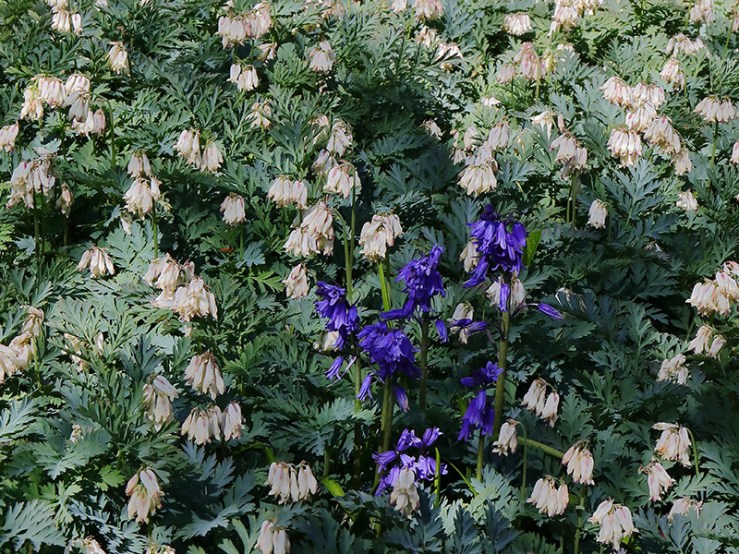
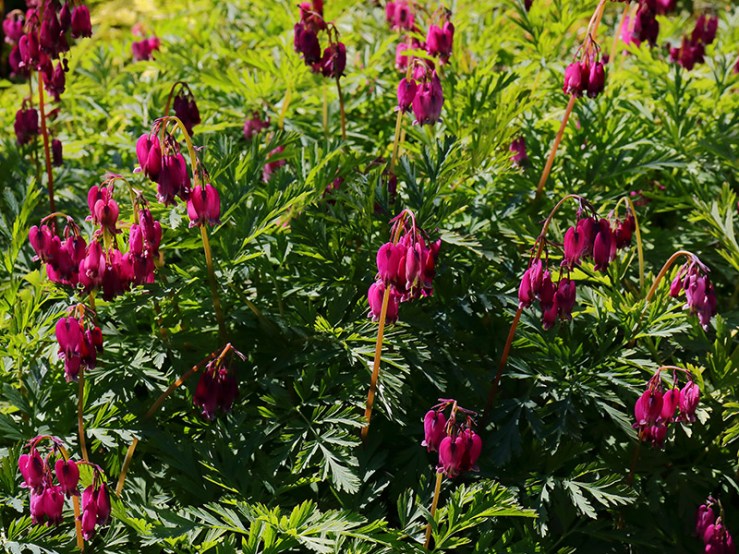
If I had better, cooler conditions for growing Dicentra, the plant below is one that I’d be very tempted by. I don’t know its name, but there are several red and dark pink cultivars available, including ‘Bacchanal’, Cox’s Dark Red’ and ‘Filigree’. Ah, now, if only my garden was a bit cooler, these lovely flowers and delicate leaves would be sure to make my heart happy!

 Ann Mackay: Inspired by Nature
We certainly want you to end up with a happy heart in regard to your bleeding hearts, whether they be Lamprocapnos or Dicentra. According to AI: “Lamprocapnos is derived from Greek, meaning ‘shining’ or ‘bright’ (lampros) and ‘smoke’ (kapnos). This name, applied to the Bleeding Heart plant, refers to its unique, glowing, heart-shaped flowers, which were reclassified from the Dicentra genus due to genetic analysis.”
LikeLiked by 1 person
Hehe, Steve, my heart is usually happy in a garden. 🙂 The ‘bright’ part of the name makes sense to me, but the ‘smoke’ part isn’t a description that I would have chosen…plant names are odd at times!
LikeLike
From those odd plant names can we infer oddness in the people who made up those names?
LikeLiked by 1 person
Maybe…😆
LikeLike
I love ‘Langtrees’ it has such lovely foliage. I am also fond of ‘Valentine’ which was introduced after Bernard’s time. That’ Aurora’ is gorgeous, I haven’t seen it before.
LikeLiked by 1 person
The foliage of ‘Langtrees’ was what made me grow it and I would try it again in an area shaded by the neighbours’ garage, to see if it would be OK there. ‘Aurora’ is very similar, but the foliage is greener. At the moment, Fullers Mill is providing me with lots off opportunities to add variety to my photography…the choice of plants in my own garden is very limited!
LikeLike
All of these colors are appealing, and that blue and white combination is especially nice, however accidental it might be. I will admit that my favorite among these is Lamprocapnos spectabilis ‘Alba.’ It looks to me like what a bleeding heart is ‘supposed’ to look like. Here’s a confession: to me, the flowers of the Dicentra ‘Aurora’ look as though they’ve been afflicted by a virus that’s misshapen them. Of course, I’m not anything close to a sophisticated gardener!
LikeLiked by 1 person
I like the white Lamprocapnos a lot…it has an elegance that outshines the coloured versions for me. But poor old ‘Aurora’, LOL!
LikeLiked by 1 person