Calm White

Flower of Pulsatilla vulgaris (pasque flower) in white.

NB: A note for WordPress Reader users – you need to click on the title of the post again to see the full photograph. (Otherwise you see just a tiny section!)

Spring here can be full of colour. There are the reds and pinks of hellebores, and of tulips later on. Of course there are the yellows of daffodils that mean spring to most of us. And above all, I love the blues of anemones, hyacinths and grape hyacinths.

Some white can be a welcome change. White flowers have an air of freshness and for me at least, a more natural, less ‘bred’ look than many other garden flowers. The simplicity of the colour can lend a calm feeling to the area they’re planted in. Less distracting or attention-grabbing than the more colourful spring blooms.

The pasqueflower (Pulsatilla vulgaris) photographed here is growing near one end of the pond I’ve been building. I’m hoping that it will give a softer and slightly wilder feel to the area around the pond in spring. (Pulsatilla vulgaris is actually native to the UK.)

That wilder feel that I’d like won’t carry on through the the rest of the year. Because nearby there are clumps of echinaceas in an intense red and a (fortunately subtler) orange that will demand attention during late summer. The echinaceas are happy there so I won’t move them. They’re short-lived plants, so when they need to be replaced, it will be a bit further away.

For now, though, I’m enjoying the delicate look of these delightfully fluffy white flowers.

Flower of Pulsatilla vulgaris (pasque flower) in white.

Transient Pleasures: Crocuses

Pale purple crocus

NB: A note for WordPress Reader users – you need to click on the title of the post again to see the full photograph. (Otherwise you see just a tiny section!)

In spring things start to move quickly in the garden. The first shoots soon become the first leaves of re-emerging plants. Flowers arrive, dazzle us with their vibrant colours, and disappear again. There’s always something new coming along to replace the flowers that have gone before.

The busyness of spring means that I often miss photographing some of the flowers in the garden. Every year I tell myself that I’ll try to get them all, but that doesn’t happen. There are usually too many things demanding attention at the same time (a new pond this year), so some things just don’t get photographed.

These crocuses are an example of my ‘misses’. The pictures here are from last year. This year I was too slow with them. I certainly noticed the crocuses when first the yellow, and then the purple and the purple and white flowers opened wide in the sun. And I did take time to enjoy the sight of them. But somehow I was always too busy to have my camera in hand whenever I was near them. By the time I’d thought of it, they’d started to go over. Shame. But I’m glad that I did make the effort to take photographs soon enough last year.

This spring the crocuses seem to have gone over more quickly than usual due to the very warm weather we’ve had. One minute their flowers were gleaming in the sunshine and the next there were what looked like shreds of tattered silk on the ground. The crocus flowers arrived suddenly and departed just as suddenly. Next year I need to remind myself that they may not be around for long and to take photographs as soon as I have the chance.

Purple-striped crocus 'Pickwick'

Oh! You Pretty Things

Pink hellebore flower

NB: A note for WordPress Reader users – you need to click on the title of the post again to see the full photograph. (Otherwise you see just a tiny section!)

The hellebores here were given to me from my neighbour’s garden. She knows that I photograph flowers, so she knew I would be delighted with them. A lovely gift, and one that kept me happy for a long while.

The top photograph is of a flower floating in a bowl of hellebores. I found that I preferred photographing the hellebore close-up, rather than trying to photograph the whole bowl of flowers. I think that’s partly due to the limitations of my bowl (not the most attractive) and partly because I find it much harder to create a pleasing composition from so many very varied flower heads.

It’s a lot more satisfying to me to arrange a smaller group of flower heads, especially if they are somehow related. That makes it easier to concentrate on the details of the flowers – even more so if I choose to photograph just a single flower.

I love seeing hellebores appear in early spring. They have a very exotic look which is not what I would really expect in a UK garden that is still shivering in chilly breezes. Both single and double flowers are utterly enchanting, but the doubles are just a bit more elaborate. I actually think the singles suit my garden better because of the fairly naturalistic planting here. However, I’m happy to create a slightly more formal looking area that should suit a few of the doubles – if I get a chance to buy some!

You may have noticed that I pinched my title from the David Bowie song. If you’d like to hear a very different version by Lisa Hannigan, it’s here. Enjoy!

White hellebore flowers

Hellebore Time!

White and pink hellebore flower

NB: A note for WordPress Reader users – you need to click on the title of the post again to see the full photograph. (Otherwise you see just a tiny section!)

This is a time of year that I really look forward to. The garden is beginning to waken from winter and the first flowers of the year are starting to open. These early flowers are an invitation to come outside and have a look around to see what new delights have appeared.

Amongst these, the hellebores are the flowers that demand attention first. After the tiny winter flowers of mahonia, Viburnum bodnantense and winter jasmine, their big, showy blooms bring an exotic feel to borders that have been starved of colour for a few months.

White and pink hellebore flowers

I find the variations in hellebore flowers fascinating. There are so many different flowers and new ones being bred all the time – all with beautiful colours and markings on the petals.

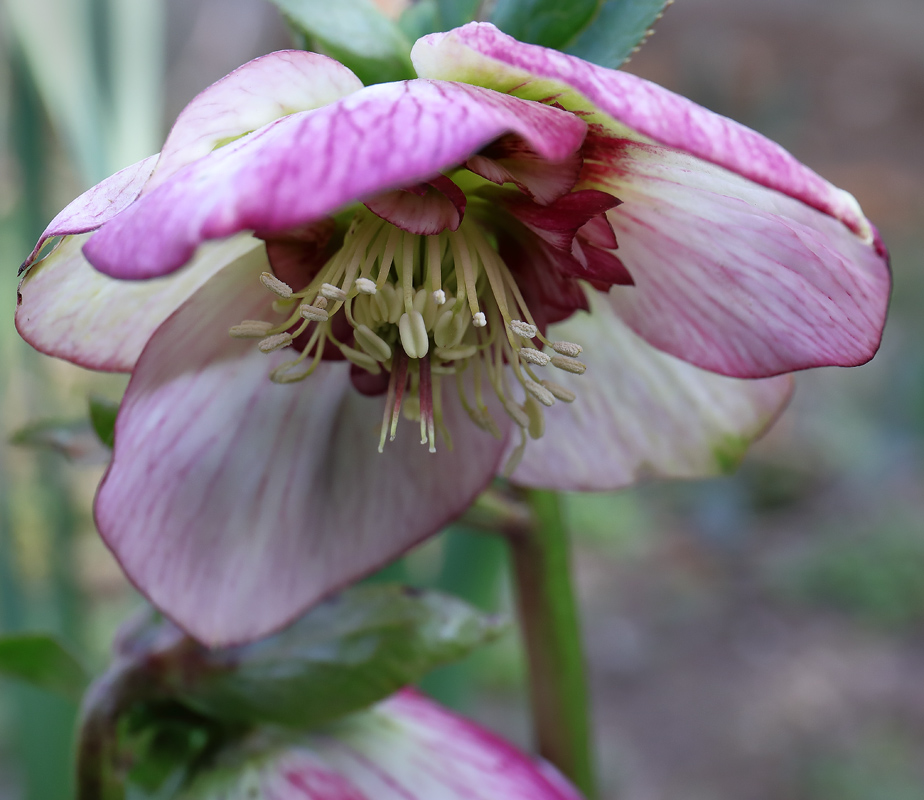
The flower forms can vary too. On this one the nectaries are very large and a deep red. (The nectaries are the tube-like shapes, arranged in a ring at the base of the petals. In fact, these nectaries are reckoned to have evolved from the hellebore’s original petals, while what we think of as the petals are actually sepals. The sepals last for far longer than petals can, meaning that hellebores have very long-lasting flowers.)

These are such pretty flowers (and good for early bees) that I would love to have lots more. Unfortunately, they can be quite expensive to buy, but occasionally I’m lucky enough to find one at a price that’s easier to afford. For the pleasure they give, they’re worth it!

White and pink hellebore flower

Tiny Beauty: Spring Vetchling

Lathyrus vernus (spring pea) flowers

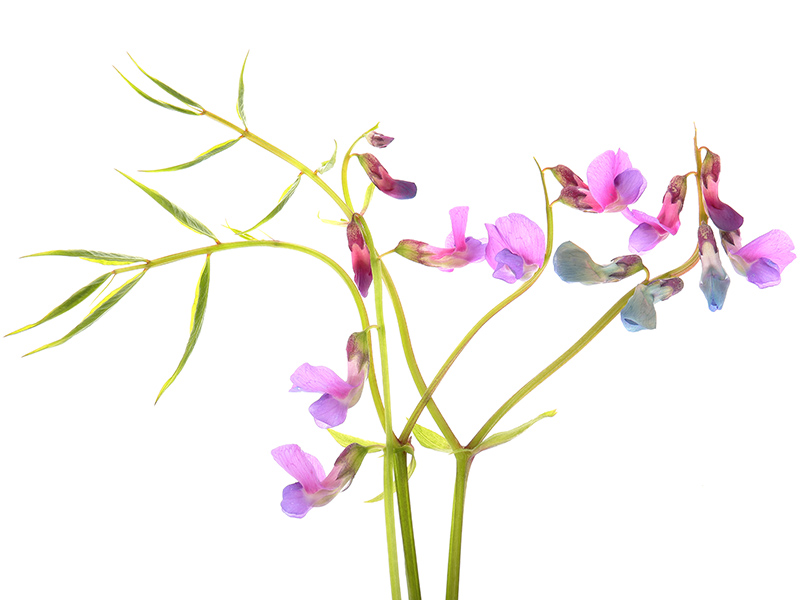
The spring vetchling or spring pea (Lathyrus vernus) is one of those plants that needs to be seen up close to appreciate its loveliness.

It’s a relative of the sweet pea, but is far smaller and looks much more delicate. It doesn’t climb, but instead produces a rounded clump of leaves and flowers around 18 inches high and wide. The flowers are just 3/4 inch long.

Several different cultivars of Lathyrus vernus have been bred to give different flower colours. You can find plants with flowers in pink and white, plain pale pink, white or blue. The plant in my photographs is the original species.

These flowers start out purplish pink, but gradually age to a pale blue. This gives a range of different shades of colour which adds to the appeal for photography. In those areas where background flowers are out of focus, the colours have a softness that reminds me of watercolour paint (top photo).

While writing this, I have popped back into my studio and had a quick look at the flowers in their vase. I was delighted to discover that the flowers have continued to change colour even after picking. The remaining flowers are now almost all blue, so I should be able to take some quite different photographs of them. (In that case, next week’s post will probably be blue spring flowers.)

The spring pea’s flowers are amongst my favourites at this time of year. For me, the smallest flowers can be the prettiest.

Lathyrus vernus (spring pea) flowers

Frothy Pinks: Cherry Blossom

Cherry blossom

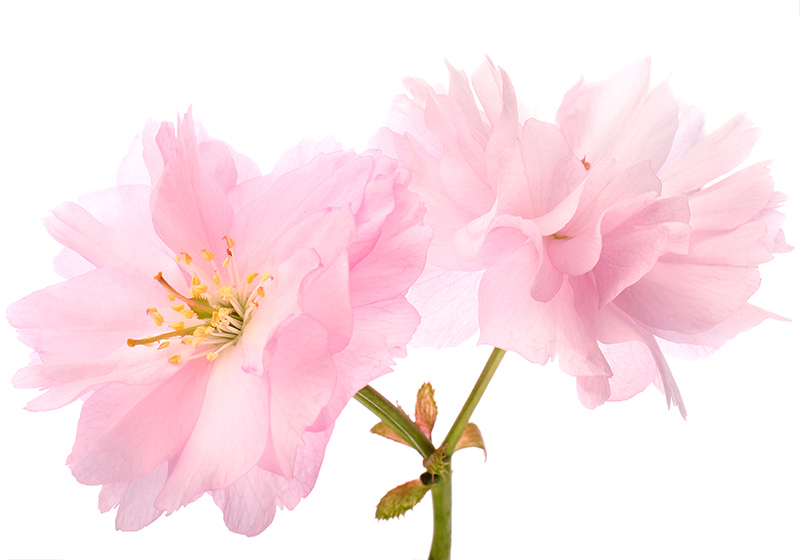
After last week’s pink tulips, here’s more pretty pinks – but even frothier! (Or should that be fluffier – not sure, but this cherry blossom can out-pink anything else.)

The blossom on our cherry tree is late this year because April has been so cold. Not all of the buds have opened yet but it should be a very good show when they are. The tree must be a good few years old, so is a good size and is always completely covered in these soft pink flowers.

The tree is Prunus ‘Kanzan’, one of the most frequently-seen ornamental cherries here. Sadly, our tree may not be here for many more years. They’re known to have a short life-expectancy. (I’ve seen differing estimates of 15-20 years and up to 40 years.) Ours was a mature tree when we moved here 16 years ago. In addition, it now has splits in the bark, which may be due to the effects of winter weather or may be an indication of disease. It has obviously suffered from canker at some time before we moved in, but this hasn’t stopped it from being laden with flowers in spring.

For now, we’ll enjoy whatever time the tree has left. At the same time, we will probably have to think about what we might want to plant in its place in the future. It should probably be something that doesn’t get too big, given that it’s so close to our boundary with our neighbours. We wouldn’t want it to protrude into their driveway! And it needs to be robust and healthy because it is the most exposed area of the front garden.

It feels a bit sad to to know that it may not be long before we have to remove this old cherry tree. We moved in to this house at a time when it was in full, glorious flower and it felt like a warm welcome to our new home. But the tree, like its flowers, is an ephemeral thing – to be enjoyed in the moment. (And afterwards I will still have photographs of its blossom as a reminder of it.)

Cherry blossom

Something Sweet: Pink Tulips

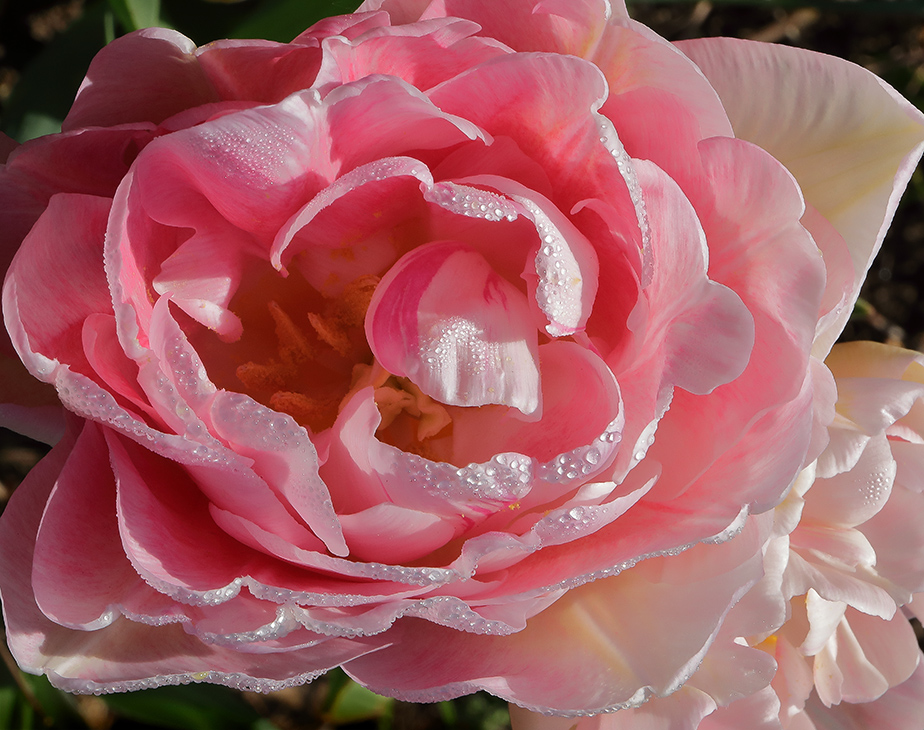
Tulip 'Angelique'

Tulips are a sign that spring is well underway. Winter is forgotten and plans are being made for summer.

However, tulips are something that I don’t have much experience of in the garden. I think that’s because I became frustrated by the fact that so many varieties don’t come back again. I’d plant tulips that flowered beautifully the first year (and perhaps remember to photograph them) but then the next year I’d wonder what I’d done wrong when they failed to reappear.

Recently I’ve allowed myself to fall in love with them again. They are one of the prettiest and most feminine of flowers at this time of year and I love to photograph them too. So now I am happy to grow a few every year, to give myself something new to photograph and to enjoy while they’re here.

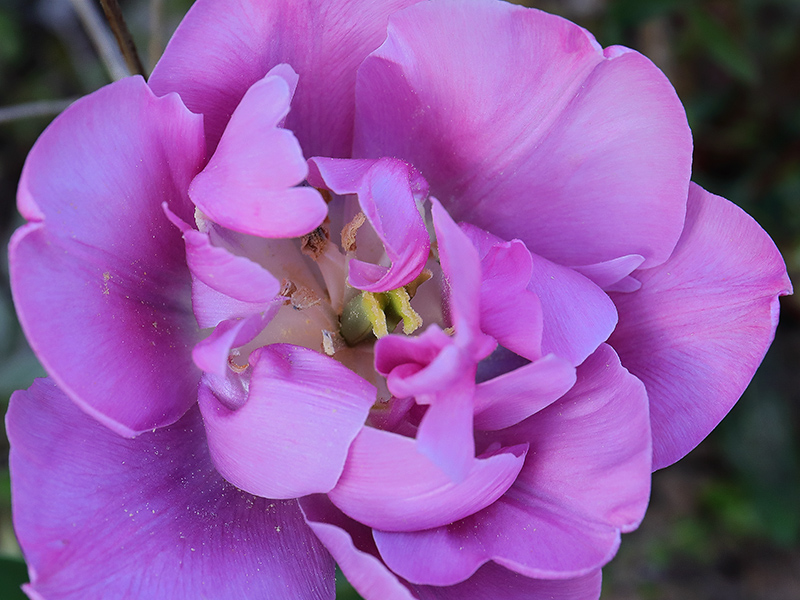
Some tulips, like the one below, have only flowered once before disappearing. So I was delighted when the tulip in the top picture not only came back this year but has produced even more flowers. It’s ‘Angelique’ and is certainly a vision of sweetness in the early morning sun.

I didn’t buy any bulbs last autumn but this year I’ll make a point of buying some tulips that I haven’t tried before. Then there will be something new and delightful to look forward to next spring.

Tulip 'Angelique'

Daughter of the Wind: Anemone Blanda

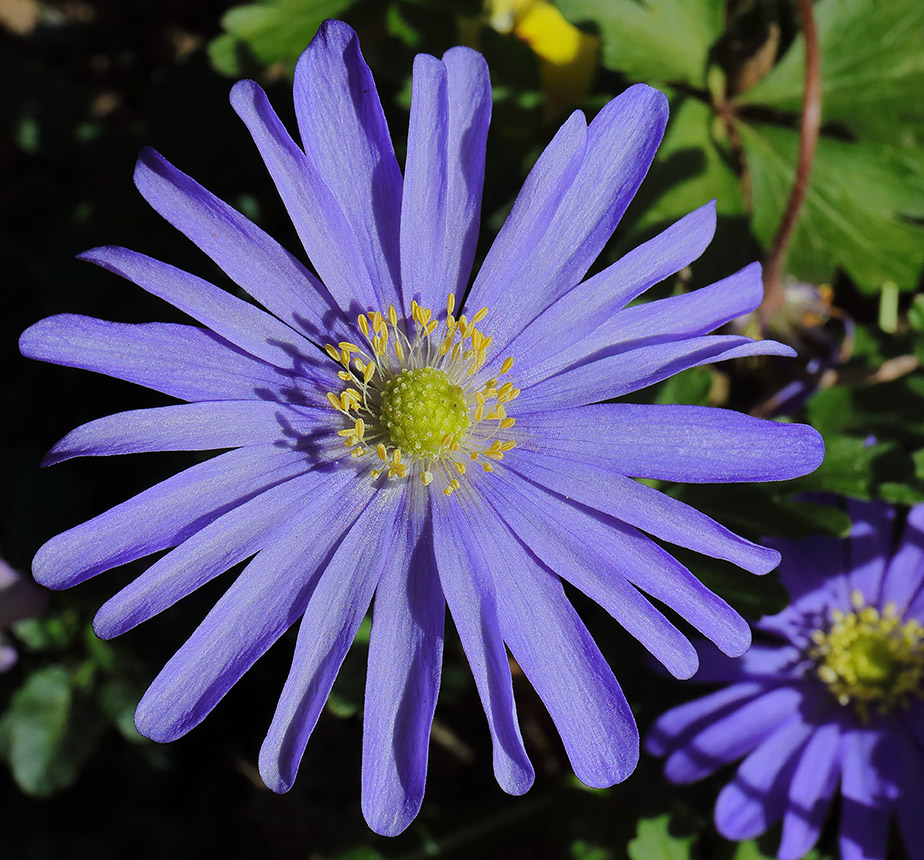
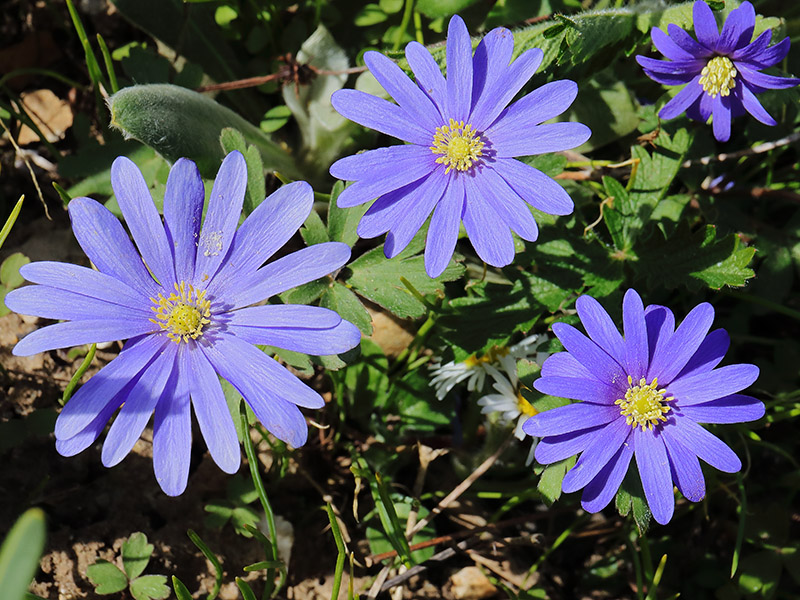
Close-up of a violet-blue Anemone blanda flower.

The common names for Anemone blanda are ‘Grecian windflower’ or ‘winter windflower’. ‘Why windflower?’, I wondered, as I dived into a little internet search. The reason for the name is unclear. Some suggest that it’s because it symbolises their fragility in the wind, while others say it’s because the flowers are opened by the wind.

Whatever the reason behind the name, it probably comes from a Greek word which translates as ‘daughter of the wind’. That translation appeals to me greatly. I can imagine it as the name for a graceful old-fashioned sailing ship or a sleek modern racing yacht. I suppose I’m not the only one to come up with that idea!

But sailing ships are taking us far from garden flowers. This daisy-like flower is currently flowering in odd corners of my garden, mostly where I’d forgotten planting it. (Actually, I think that its rhizomes sometimes get picked up and transferred with other plants as I divide and move them elsewhere. So eventually they could end up anywhere in the garden.)

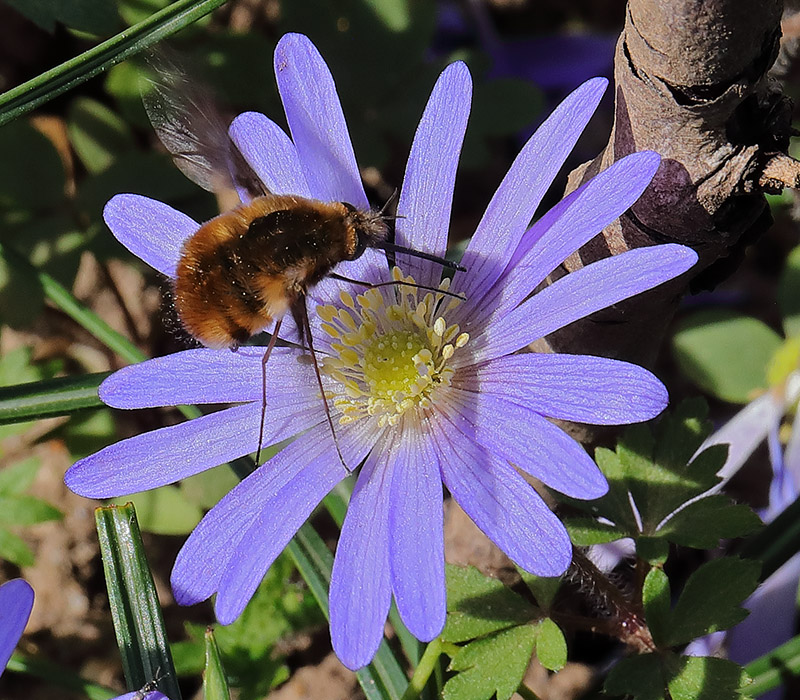
A bee-fly enjoying an Anemone blanda flower

The anemone above has a visitor. It’s not a bee, though, but a bee-fly. Although it may look like a bee, you can see the difference in the long proboscis (tongue, used for feeding on nectar) and the long and very fragile-looking legs. Although the proboscis may look sharp and a bit scary, bee-flies don’t sting or bite. They just try to look as if they might!

Bee-flies aren’t good news for the nearby ground-nesting bumblebees, because bee-fly larvae eat the bumblebee larvae. Luckily it doesn’t seem to affect the overall number of bumblebees. (Just shows how much murder and mayhem is going on among the beasties that live in our gardens!)

I hope that some of the bumblebees will find these anemones too. Apparently bees prefer to work among a large patch of the same flowers, rather than going to lone individuals. This must be a great reason/excuse for growing more of all the early spring flowers, especially these delightful beauties. (Given time, they will spread, but I reckon I’d like to give them some help.)

Please note that I won’t be able to reply to comments until after Tuesday because of internet connection problems. But I’ll be back to chat to you after that!

Blue Anemone blanda flowers

Fluffy Flowers for Easter: Pasqueflowers

Pulsatilla vulgaris (pasqueflower)

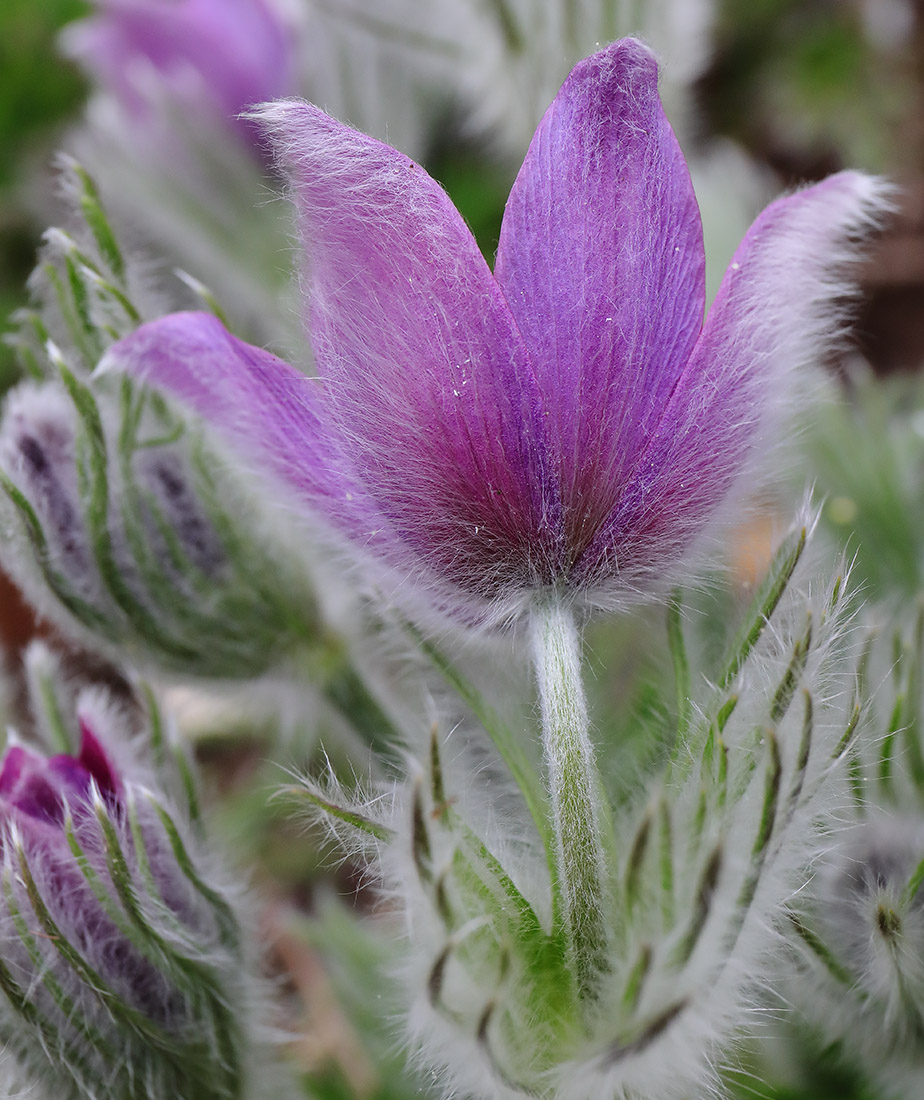
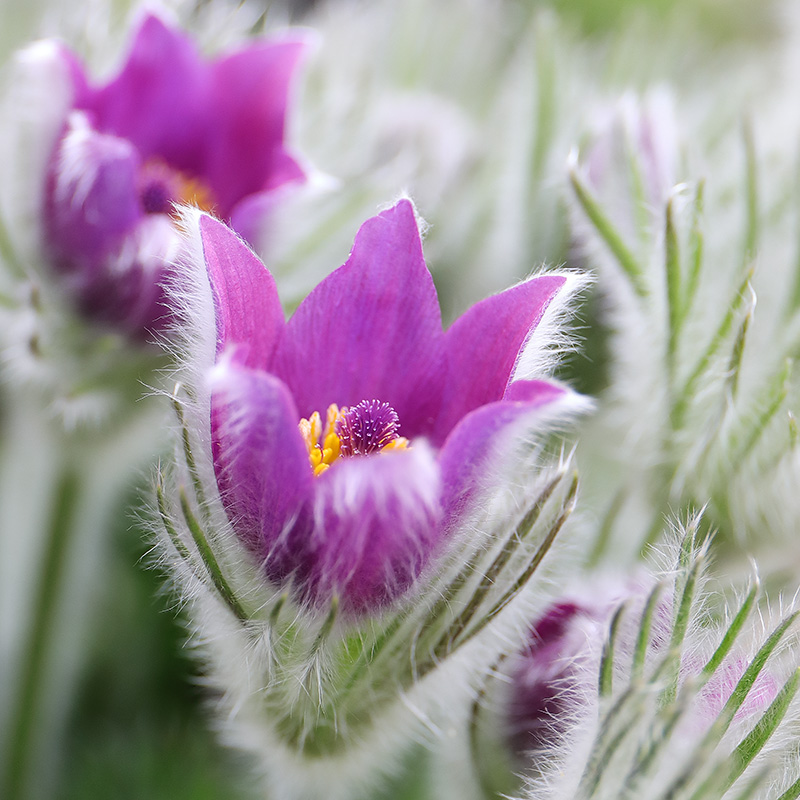
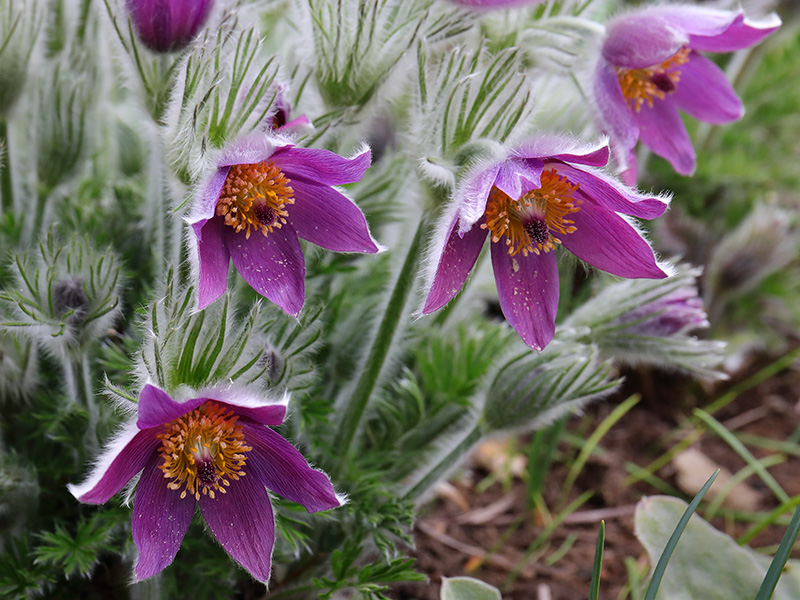
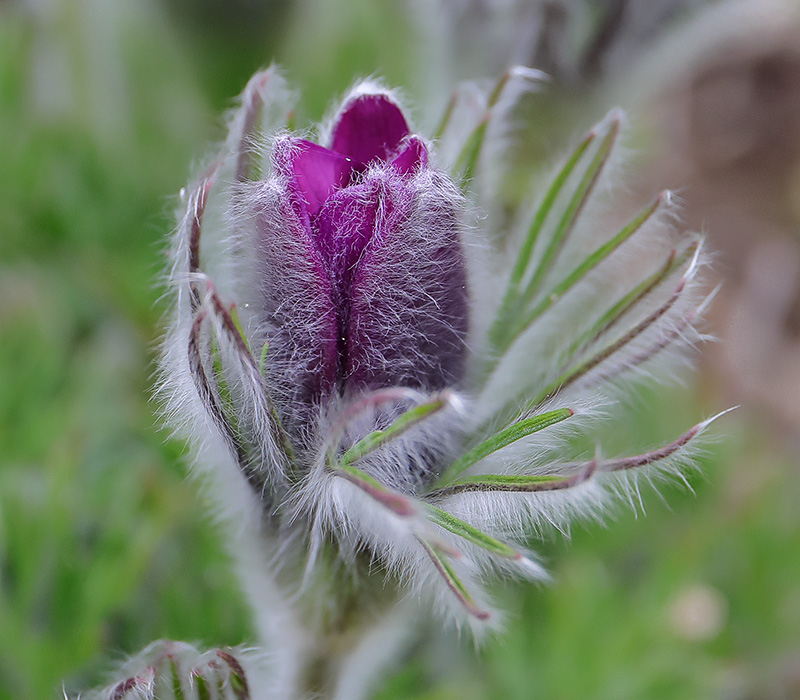
The pasqueflowers (Pulsatilla vulgaris) are flowering slightly earlier than last year. That means they’re here in time for Easter, so they’re living up to their name. (The pasque part of the name comes from ‘paschal’, meaning ‘of or related to Easter’.)

The clumps are a bit bigger than last year, so there are more flowers too. Those fluffy, cup-shaped flowers are a most welcome sight. They seem to have settled into the garden here very well and they’re probably the most reliable of our spring flowers.

Pulsatilla vulgaris (pasqueflower)

But they don’t just look good – they feel nice too. Those fine hairs on the outside of the petals, buds and leaves are just as soft as they appear. I know this for certain, having spent a few minutes stroking them just to check! It’s not often that I think about how a plant feels as opposed to how it looks, but with these, the urge to touch is strong.

Although a native wildflower in the UK, the pasqueflower is rarely seen in the wild. It has become a well-loved garden flower, with nurseries and garden centres stocking plants with purple, white (‘Alba’) or deep red (‘Rubra’) flowers.

Pulsatilla vulgaris (pasqueflower)

I was hoping that I might have the opportunity to buy one or two more pasqueflower plants today. We were able to visit a garden centre for the first time in many months. (Probably since the end of last August.) It was a treat to be able to do this again and we did make sure to buy some plants. (But no pasqueflowers this time.)

Now that a few weeks have passed since having our first Covid jabs, we have enough protection to be able to explore the world again. Plant nurseries will be also able to open soon, so I’m feeling excited about being able to visit my favourites again. There’s a fair bit of border space that’s just waiting for some new plants to fill it!

If you celebrate it, I wish you a very happy Easter. And for everyone, I hope you enjoy your weekend.

A pasqueflower bud.

A Sweet Gift

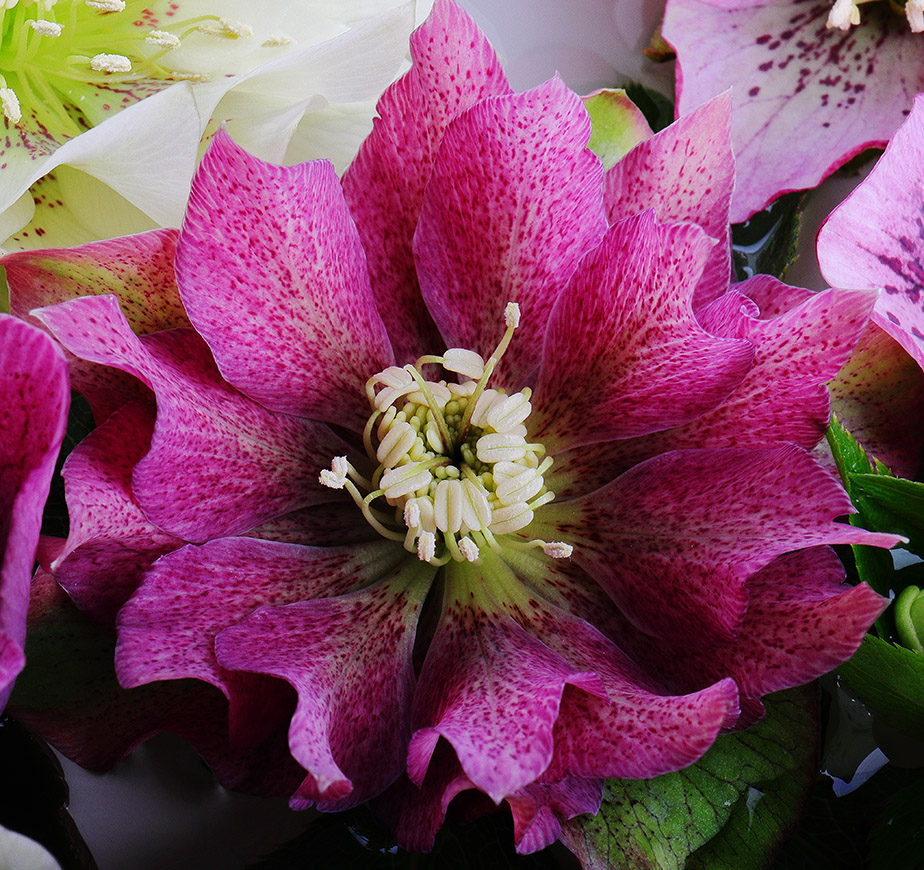
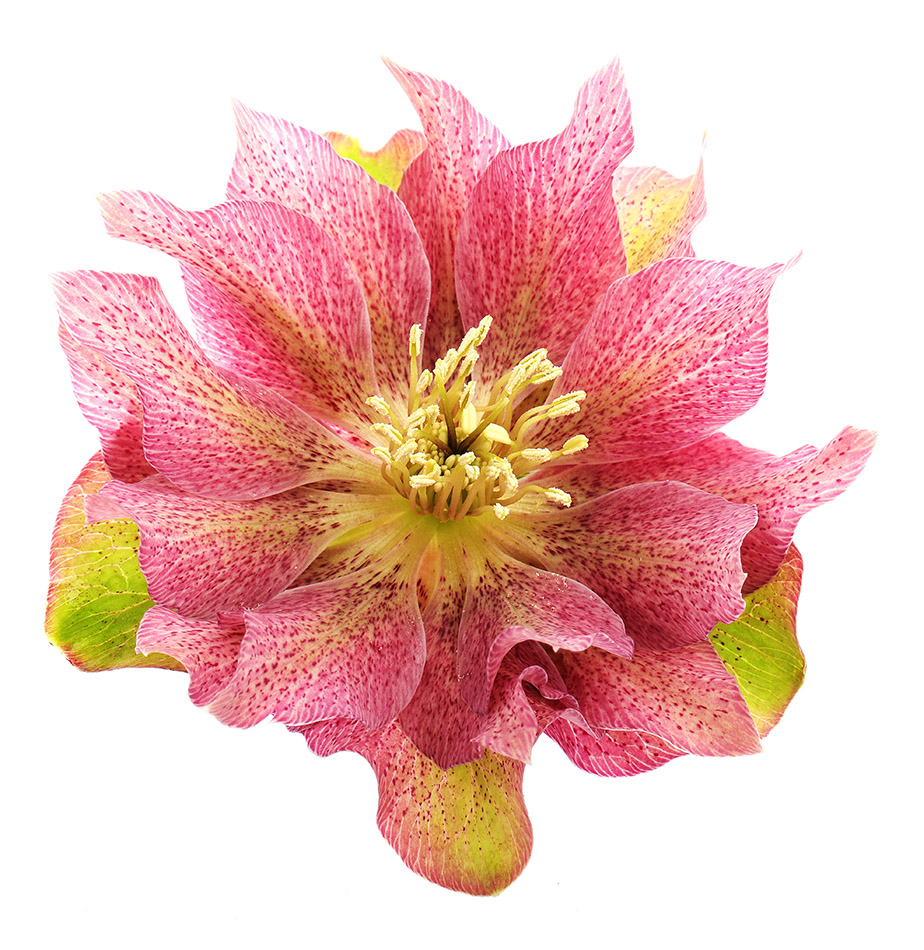
A pink double hellebore flower

Recently my neighbour brought me some beautiful hellebore heads from her garden. She’d been cutting some to display in a bowl and said she felt like sharing the bounty. As you can imagine, I was delighted.

You won’t be at all surprised to know that I photographed them. To start with I tried photographing them in the bowl I floated the heads in. However, I soon realised that the markings on the petals of the individual flowers would show much better if I photographed them on their own.

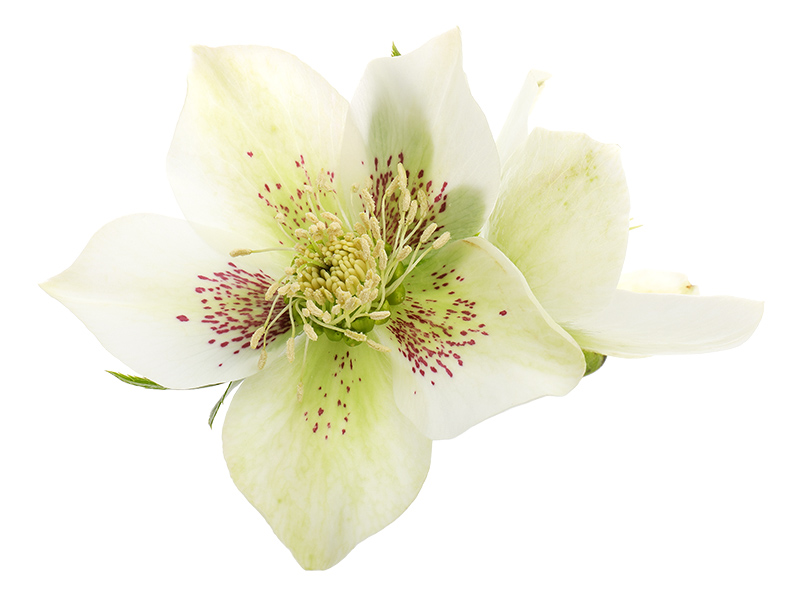
Pink-speckled white hellebore flowers

To photograph the flower heads, I used my studio lighting and my ‘light-table’. This table is simply a piece of curved white plastic on a frame. It’s translucent, so that I can shine light through it. And that means the light can pass through the flowers too.

This is probably my favourite way to photograph flowers. It shows up every detail of markings and colour changes in the flowers, making it a great way to show the pretty freckles and streaks on these hellebores.

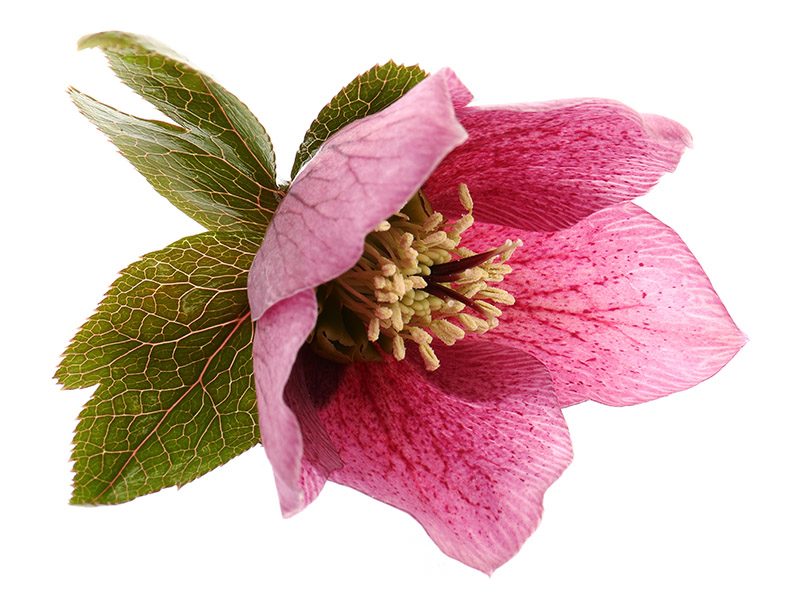
A pink hellebore flower

Using the light table also shows the veining in the leaves well. I was surprised to see how much pink there is in the leaf-veins in the photo above. The light coming through the leaves has really brought out the colour. (And it makes the colour of the flower gleam too.)

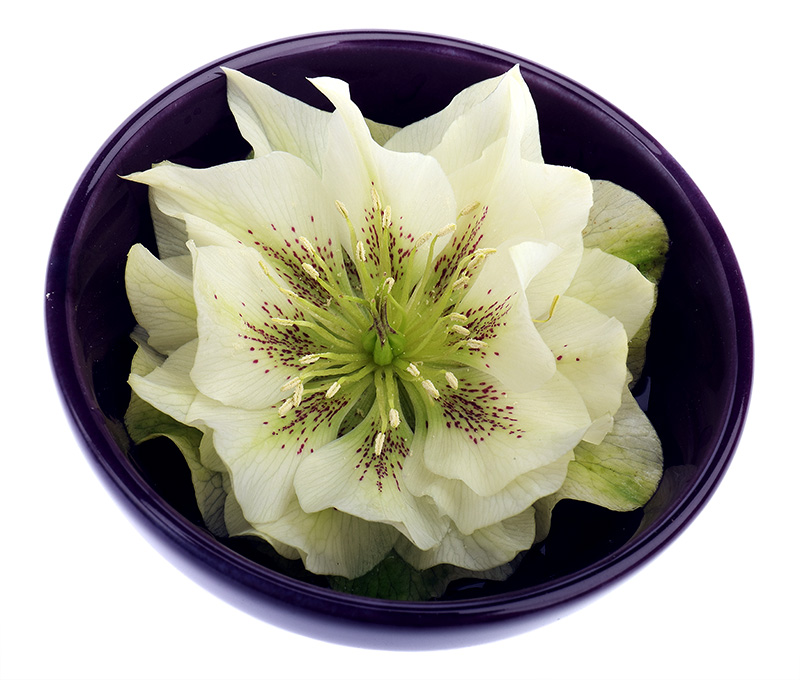
Just to see the difference, I decided to photograph the next hellebore in a tiny coloured bowl. Although I like the way the dark purple of the bowl goes with the deep purply-pink markings on the flower’s petals, I prefer the other images. This has made me think that I will probably use the light-table more often to create images that show the translucence of the flowers. (Especially when someone brings me such a lovely gift!)

Cream-coloured hellebore flower