Looking for Inspiration: The Bog Garden at East Bergholt Place

NB: A note for WordPress Reader users – you need to click on the title of the post again to come out of the reader and go to the post itself. This allows you to see the whole of the top photograph. (Otherwise you may see just a tiny section!)

Last year I created a small bog garden here to make it easier to grow moisture-loving plants. For inspiration beforehand, I went to see a bog garden at East Bergholt Place. This is a large garden and arboretum which also has a plant centre (‘The Place for Plants’). Although my own bog garden is tiny – just five foot in diameter – I reckoned that being able to see what was growing happily in a large and well-established bog garden would be useful.

This garden is only about 16 miles away from our home, but the conditions are very different. The soil in it is naturally moist, due to there being a high water table and there is plenty of shade from large trees. (While walking around I noticed how damp the ground was underfoot. And being in the shade made it an excellent place to spend a very hot afternoon.)

The bog garden sits along the banks of a narrow, stone-edged stream that runs down from the area of a large formal pond. The damp soil here supports very lush growth which hides much of the watercourse.

A very small part of East Bergholt’s bog garden. You can just see the stone edges of the stream.

The structure of the bog garden at East Bergholt is obviously entirely different to my own one. Mine is entirely artificial, created by using an old tent groundsheet to trap moisture. (I first made holes in the groundsheet with a garden fork and then added a layer of stones and gravel to provide some drainage.) But I’m hoping that many of the plants that grow well at East Bergholt will be fine for my bog garden too.

I made the bog garden with the intention of providing suitable conditions for astilbes and Siberian irises. Other plants in it now include ragged robin (Lychnis flos cuculi, AKA Silene flos-cuculi), purple loosestrife (Lythrum salicaria) and a red hesperantha that had been struggling in too-dry soil elsewhere. (It is much happier now!)

Left: primulas, hostas and irises along the damp edges of the stream. Right: a view over the formal pond uphill from the bog garden.

It was reassuring to see the astilbes and Siberian irises growing well in the very damp soil at East Bergholt. There were lots of candelabra primulas,which were in full flower on our visit in mid-May last year. From the photographs, you’ll see that there were also ferns and hostas and I spotted the blue flowers of camassia and the pretty leaves of Alchemilla mollis too.

There is one thing that is worrying me a little about having made a bog garden: what will happen if we get a lot of rain over a long period? There are drainage holes in the groundsheet I used to line it, but they may not allow water to escape quickly enough if there is too much. The danger then is that roots may rot. But that is something I will just have to look out for – and my fingers will certainly be crossed!

Although the bog garden at East Bergholt was the focus of my attention, we did take the time to see the rest of the garden and arboretum. There is a formal garden area beside the house with lawns surrounded by topiary and hedges, but I preferred the arboretum, with its beautiful trees and flowering shrubs. The wilder area of the ‘lower garden’, with naturalistic planting and a large, totally informal pond was delightful too. I’ll be happy to visit this garden again!

Candelabra primulas were the star of the show in May.

(Almost) Silent Sunday: Looking Back

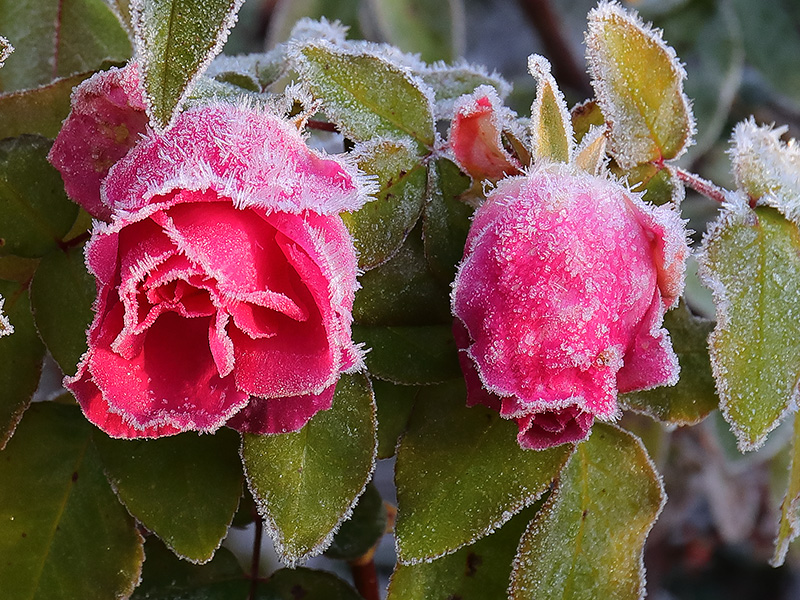
Rose 'Zepherine Drouhin', covered in frost.

NB: A note for WordPress Reader users – you need to click on the title of the post again to see the full photograph. (Otherwise you see just a tiny section!)

I have Covid (for the first time), so I’m using it as an excuse to take it easy this week and just re-posting a photograph from 2019. Sometimes I get lucky and there’s something still in flower when the first frosts arrive. This is the rose ‘Zepherine Drouhin’.

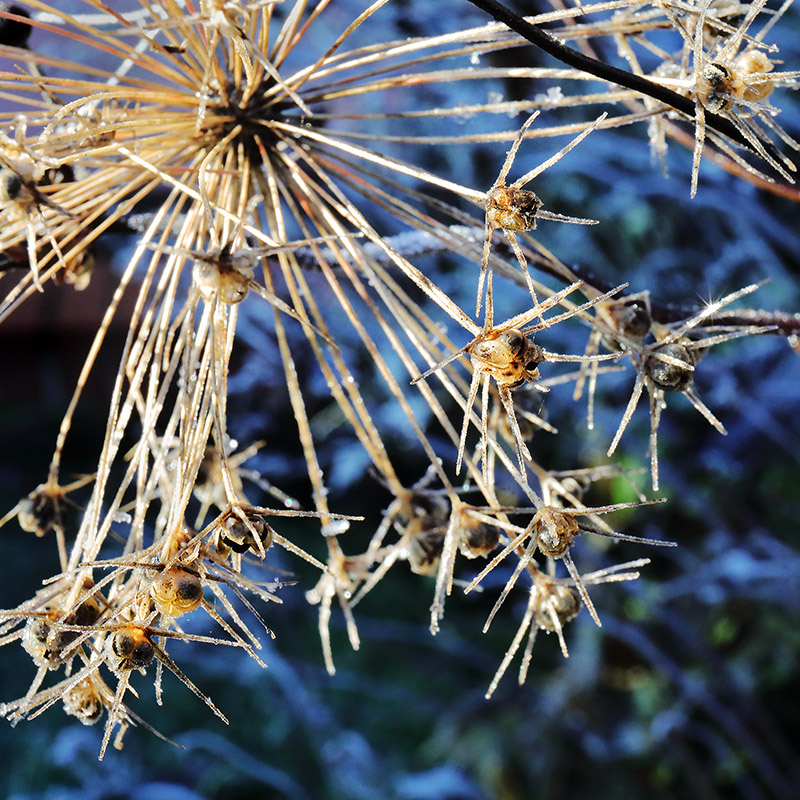
Ghosts: Frosted Allium Seed Heads

Frosted Allium christophii seed head

NB: A note for WordPress Reader users – you need to click on the title of the post again to see the full photograph. (Otherwise you see just a tiny section!)

The Allium christophii seed heads pictured here are held motionless in the thinnest coating of frost. On a freezing winter morning the tiny seed pods, and the remains of the flowers behind them, gleam softly in the early sun.

It has just occurred to me that it’s unusual for a seed head to retain the remains of the flower like this. The petals have lost their colour and their edges have curled inwards. They’ve shrunk a little as they’ve dried too, but those petals are still there. Now they are little icy stars.

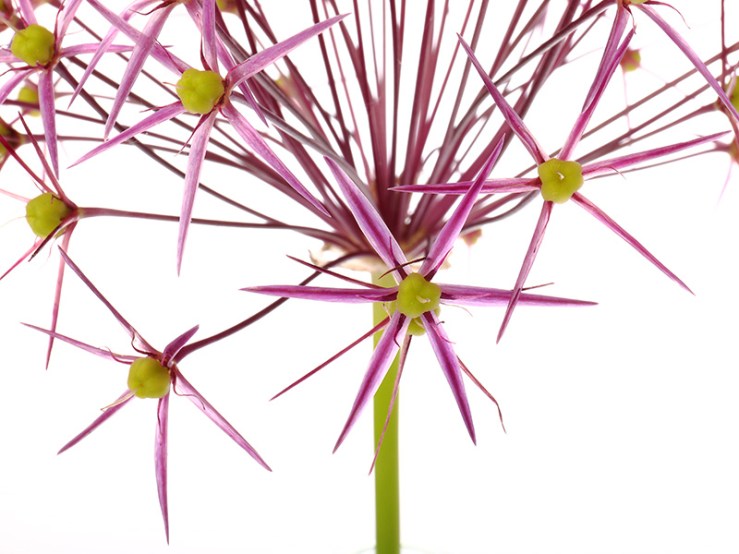
You can see what those stars looked like while the flower was still alive:

Allium christophii flower head

The living flowers are lilac, with a delicate metallic sheen. Already the green seed pods are forming in the centre of each individual floret. If you look closely you’ll see that there’s also an inner ring of filaments. (These are the lower part of the stamens, which would have held the anthers.) Their tapered, almost spiky, appearance makes them look like another set of much smaller petals.

Now my imagination is playing with the idea of having the ‘ghosts’ of the year’s flowers sprinkled throughout the garden. For company, the alliums would have hydrangeas (as in last week’s post) and perhaps, if there were any late flowers, astrantias. (But in both of these plants, what look like petals are not. The hydrangea has minute flowers surrounded by showy sepals and the astrantia has large bracts around a tiny pincushion-like arrangement of true flowers. Perhaps that is why they keep their flowery appearance for longer.)

Hmm, I wonder if a slightly spooky winter garden would be fun… 🙂

Frosted Allium christophii seed head

Frost and After

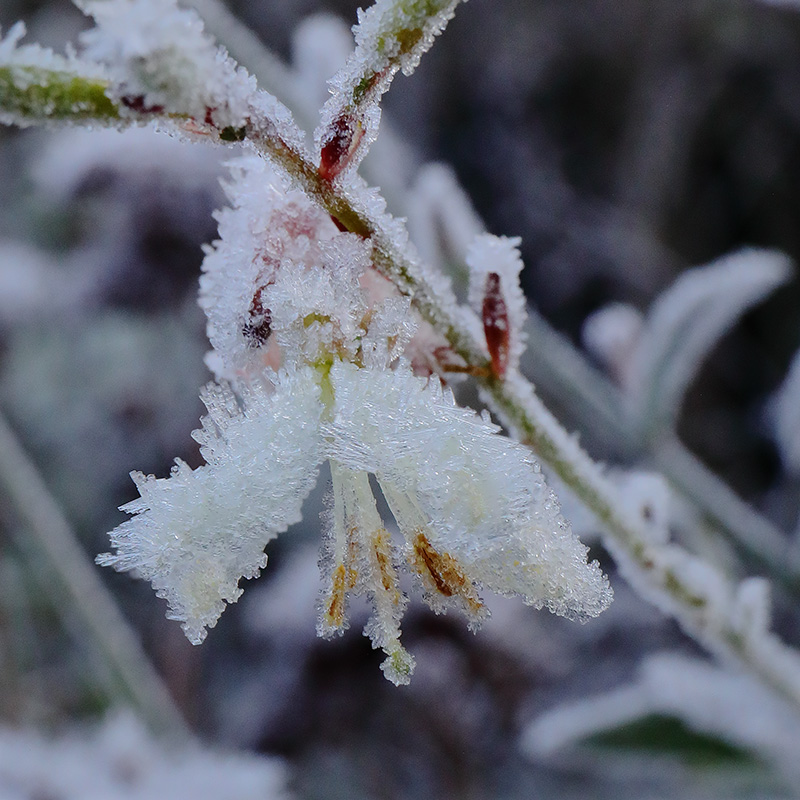
frosted gaura flower

NB: A note for WordPress Reader users – you need to click on the title of the post again to come out of the reader and go to the post itself. This allows you to see the whole of the top photograph. (Otherwise you may see just a tiny section!)

Last year’s hoar frost made icy little sculptures out of many of my garden plants. The one you see here is Gaura lindheimeri. (Now known as Oenothera lindheimeri, but I still call it by it’s old name. There are too many plant name-changes to keep up with these days!) This plant carries on flowering until late in the year, so frequently ends up covered in frost.

The area where the gaura is growing stays in the shade for much of the day in winter, so the frost lasts here for a long time. That gives me plenty of opportunities for taking photographs, but means that the sun doesn’t reach the frost to make it sparkle. So photography here is a bit of a compromise. Perhaps I should consider the effect of sun on frost when planting!

Eventually the frost will go, changing the look of the flower again. This time the petals are likely to be left translucent and looking very fragile indeed. (They usually wilt quickly after being frosted.) The drops of melted frost give an interesting texture to the flower – you can see right through the petals to the drops that are actually on the other side. ❄

Gaura with melted frost drops

Another (Almost) Silent Sunday

NB: A note for WordPress Reader users – you need to click on the title of the post again to come out of the reader and go to the post itself. This allows you to see the whole of the top photograph. (Otherwise you may see just a tiny section!)

It’s a re-post of an image from near the start of my blog (in 2018) for this week. We’re just getting back to normal here after having our new heating system installed and it’s good to be warm again. With a bit of luck I’ll be back to my garden and photography in the next few days. 🙂

(Almost) Silent Sunday: Cosmos

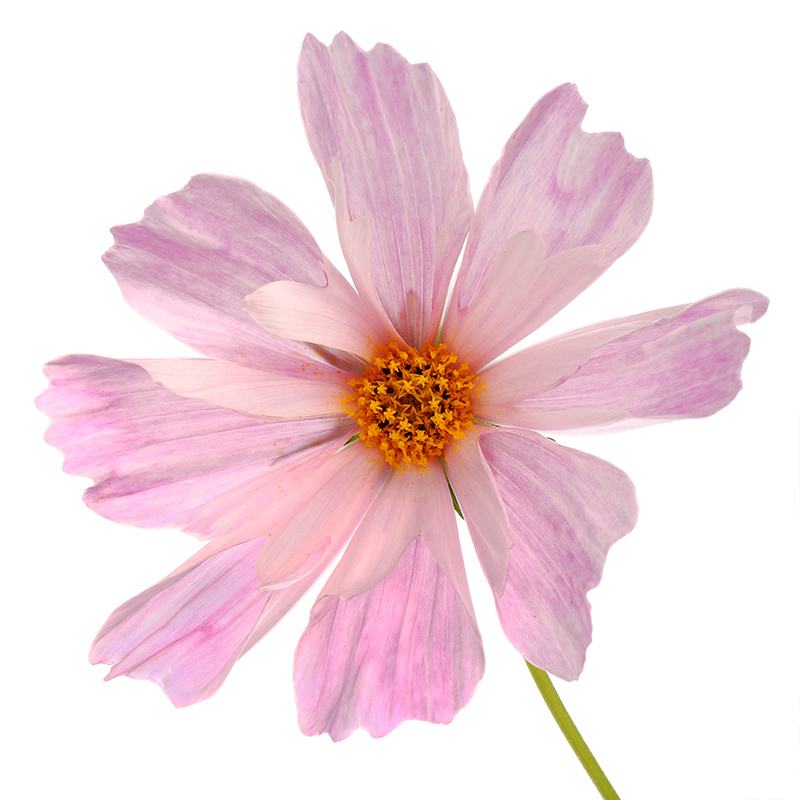
Flower of Cosmos 'Seashells'

NB: A note for WordPress Reader users – you need to click on the title of the post again to come out of the reader and go to the post itself. This allows you to see the whole of the top photograph. (Otherwise you may see just a tiny section!)

It’s a post-and-run this week because we’re getting ready for work to start tomorrow to install our new heating system. There’s a slight feeling of chaos around here right now – hopefully it will be replaced by a good feeling of warmth soon! 🙂 (And the flower is Cosmos ‘Seashells’.)

Tranquillity Remembered: Wild Carrot in Autumn

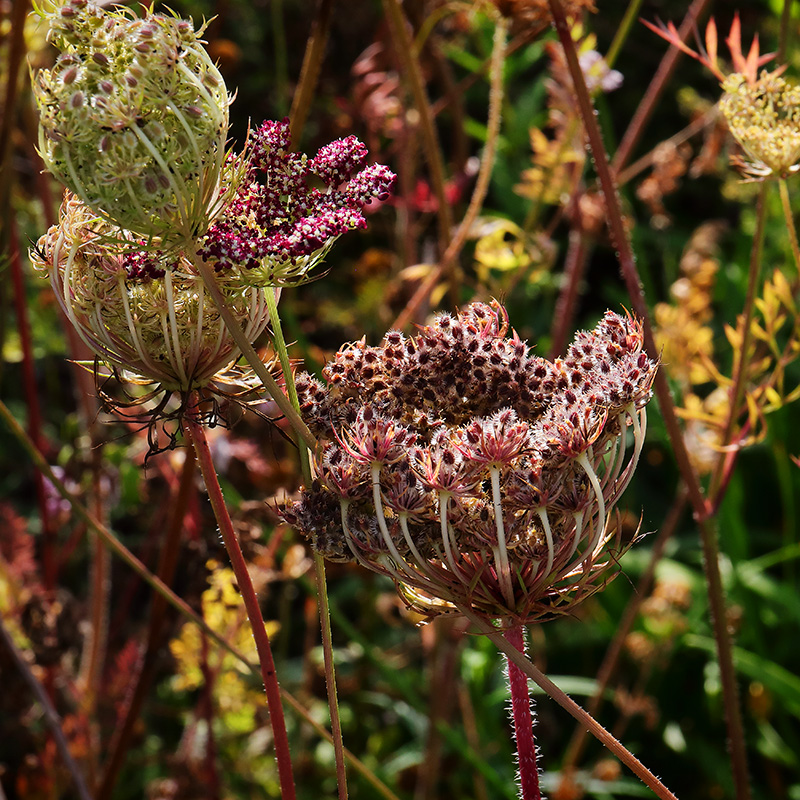
Daucus carota (wild carrot) in evening light in autumn

NB: A note for WordPress Reader users – you need to click on the title of the post again to come out of the reader and go to the post itself. This allows you to see the whole of the top photograph. (Otherwise you may see just a tiny section!)

Here’s a quick look back to wild carrot (Daucus carota) seed heads in early autumn, photographed in the light of a sunny evening.

Evening is a time I love in the garden, especially early on, while the sun is still out. It’s quiet and peaceful once the traffic of workers going home has gone, with just the occasional sounds made by a foraging bird. The light makes everything look better at this time of day.

Now the evenings are darker and those seed heads are gone. But there will be more new wild carrot plants in spring and sunny evenings will return. For now though, I’m very busy with preparations for a new central heating system being installed, so I haven’t had much time for the garden or photography. Our home has been in a state of disruption and reorganisation while we moved things around to allow the work to be done. Hopefully, all will be settled again soon and we will be warm this winter!

A Remnant of Summer

Scabiosa 'Kudo White' flower with variegated sage

NB: A note for WordPress Reader users – you need to click on the title of the post again to see the full photograph. (Otherwise you see just a tiny section!)

After Storm Babet passed by, there was not a lot left in flower in the garden. The asters which had provided some late colour have mostly gone over, and the last purple-blue ones that hang on now look tattered and disheveled after all the rain.

The white scabious flower pictured above is one of the flowers that remain and it even has buds yet to open. I find that the scabious and related knautia plants do continue to produce a few flowers until late in the year if I remember to deadhead them. At this stage, any colour that remains in my garden is a bonus. If it’s something that bees and other pollinators like, it’s an even bigger bonus. Scabious is very popular with insects, so it is proving its value here.

The white-flowered plant is Scabiosa ‘Kudo White’ and the dark red one below is Scabiosa atropurpurea ‘Chile Black’. I hope that the white one will self-seed as readily as the dark scabious has. They are so attractive and long-flowering (right from the middle of summer) that I’d be happy to give them quite a bit of space in the borders.

Hmm…for some reason ‘Scabiosa’ sounds to me like something Hermione from the ‘Harry Potter’ books would say, with a deft flick of her wand. Maybe it’s a spell for filling a garden with flowers… 🙂

Flower of a red Scabious with a hoverfly
Scabious with hoverfly

Daisy Days

Pink Michaelmas daisy

NB: A note for WordPress Reader users – you need to click on the title of the post again to come out of the reader and go to the post itself. This allows you to see the whole of the top photograph. (Otherwise you may see just a tiny section!)

Autumn means that there are few flowers left in the garden here, but there is at least a splash of colour still from the asters. The bright pink one above (name unknown because it came from a friend’s garden) is almost over now. It was glorious while it lasted, but now the softer shades of pink and blue have taken over.

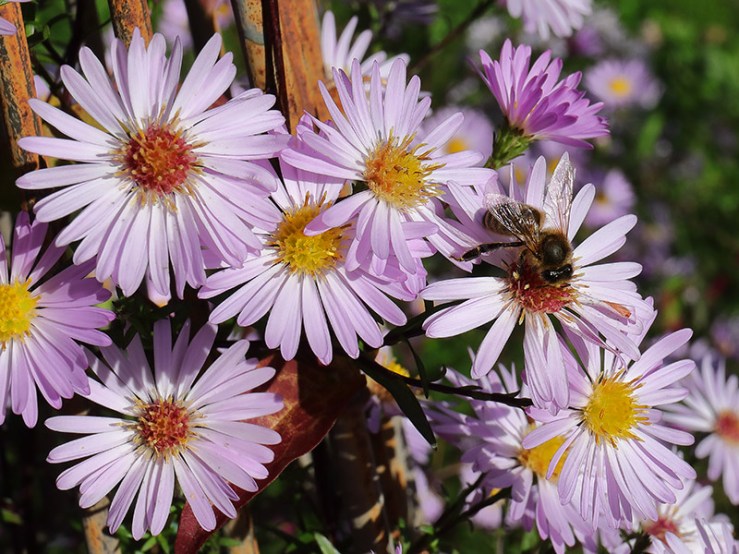
Honeybee on Michaelmas daisies
Honeybees were frequent visitors to these Michaelmas daisies.

The lavender-blue aster flowers have been especially popular with bees and hoverflies in the last week or so. We had a very hot and sunny spell, so the bees were out in force, making the most of the chance to find pollen and nectar before the flowers disappear. Every time I passed by these daisies, they seemed to be buzzing…a sound to make me happy!

Honeybee on pink Michaelmas daisies
This pink daisy seems less popular than the blue one, but still has its visitors.

It was interesting to see that there were fewer bees attracted to the pale pink asters. (I know the name of this one – Symphyotrichum laeve ‘Les Moutiers’. But I have to admit that I did a cut and paste for the name, rather than try to spell it!) Some time ago, I read that bees prefer blue and purple-blue flowers. That was probably the reason why they didn’t bother with this pink one as much.

I noticed too, that there were a lot more honeybees than bumblebees, but that won’t be surprising if there’s a hive not very far away. There were also what appeared to be a couple of tiny dark-coloured bees, but they were too quick for me to get a good look at them. A couple of weeks ago I wrote that this hasn’t been a good year for insects in the garden, so it was a pleasure to see these late flowers so busy with pollinators. Let’s hope they’re even busier next year!

Hoverfly on Michaelmas daisies
A hoverfly settles for a quick snack.

(Almost) Silent Sunday: Pale and Pretty

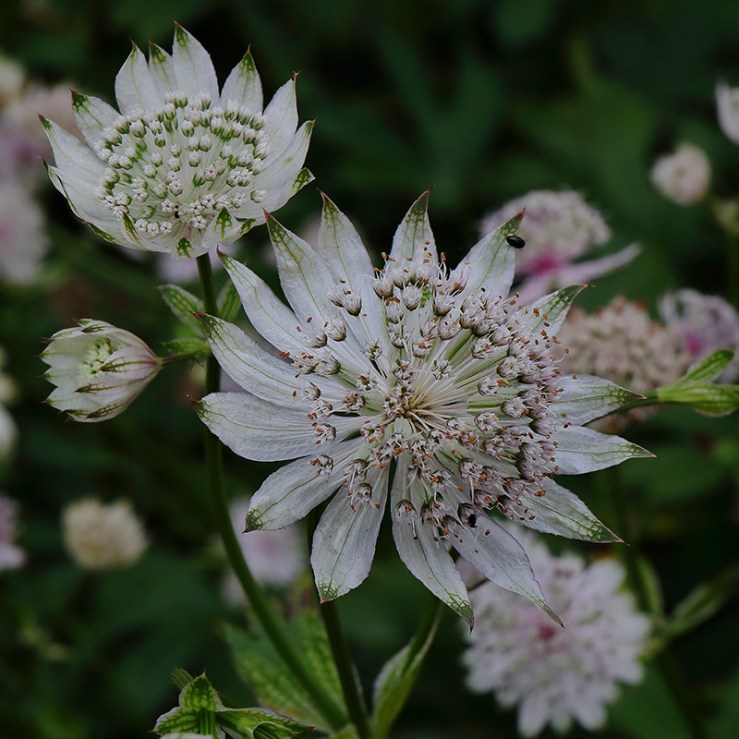
Astrantia flowers

NB: A note for WordPress Reader users – you need to click on the title of the post again to see the full photograph. (Otherwise you see just a tiny section!)

It’s the last bit of glorious weather here, so I am doing a post-and-run so that I can spend the time outside. Astrantia is still flowering in October. Its pale colours are a contrast with the dark astrantia flowers of this post.

Astrantia flowers