NB: A note for WordPress Reader users – you need to click on the title of the post again to see the full photograph. (Otherwise you see just a tiny section!)
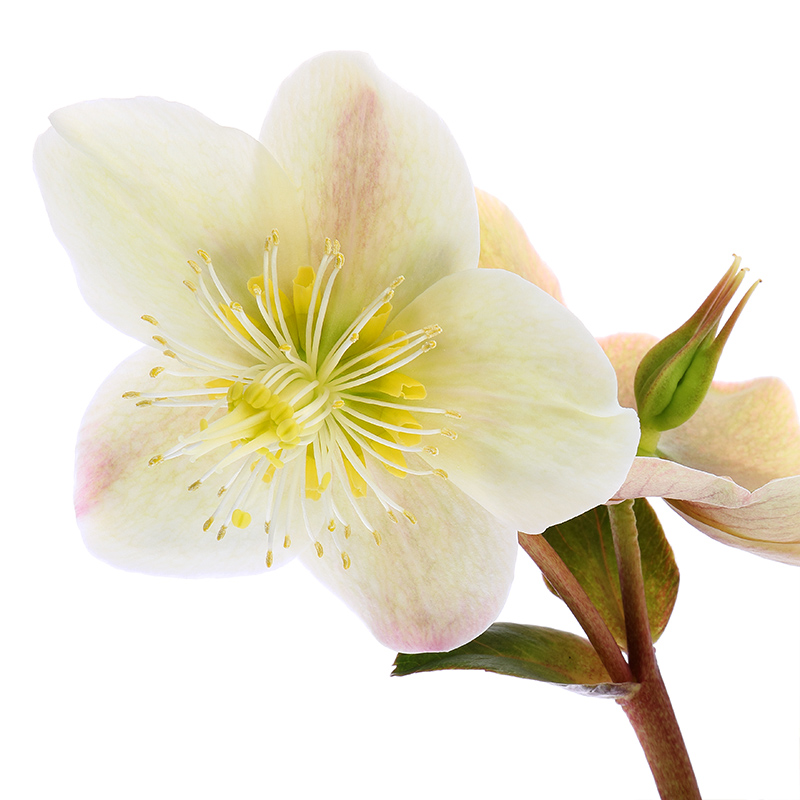
February has brought the opening of hellebore flowers in my garden. Along with a scattering of snowdrops, they’re the first of the year’s flowers. (Although there are still pink flowers on the viburnum ‘Dawn’ and yellow ones on the winter-flowering jasmine. But they’ve been around for quite a while now.)
It’s a cheering sight to see something pretty at last, after a rather wet and muddy winter. And now I have something that makes me want to be outside in the garden with my camera…or else indoors in my little studio, as with the flower below. I reckon that I can promise that there will be more hellebore photographs here very soon!
NB: A note for WordPress Reader users – you need to click on the title of the post again to come out of the reader and go to the post itself. This allows you to see the whole of the top photograph. (Otherwise you may see just a tiny section!)
Last year I created a small bog garden here to make it easier to grow moisture-loving plants. For inspiration beforehand, I went to see a bog garden at East Bergholt Place. This is a large garden and arboretum which also has a plant centre (‘The Place for Plants’). Although my own bog garden is tiny – just five foot in diameter – I reckoned that being able to see what was growing happily in a large and well-established bog garden would be useful.
This garden is only about 16 miles away from our home, but the conditions are very different. The soil in it is naturally moist, due to there being a high water table and there is plenty of shade from large trees. (While walking around I noticed how damp the ground was underfoot. And being in the shade made it an excellent place to spend a very hot afternoon.)
The bog garden sits along the banks of a narrow, stone-edged stream that runs down from the area of a large formal pond. The damp soil here supports very lush growth which hides much of the watercourse.
A very small part of East Bergholt’s bog garden. You can just see the stone edges of the stream.
The structure of the bog garden at East Bergholt is obviously entirely different to my own one. Mine is entirely artificial, created by using an old tent groundsheet to trap moisture. (I first made holes in the groundsheet with a garden fork and then added a layer of stones and gravel to provide some drainage.) But I’m hoping that many of the plants that grow well at East Bergholt will be fine for my bog garden too.
I made the bog garden with the intention of providing suitable conditions for astilbes and Siberian irises. Other plants in it now include ragged robin (Lychnis flos cuculi, AKA Silene flos-cuculi), purple loosestrife (Lythrum salicaria) and a red hesperantha that had been struggling in too-dry soil elsewhere. (It is much happier now!)
Left: primulas, hostas and irises along the damp edges of the stream. Right: a view over the formal pond uphill from the bog garden.
It was reassuring to see the astilbes and Siberian irises growing well in the very damp soil at East Bergholt. There were lots of candelabra primulas,which were in full flower on our visit in mid-May last year. From the photographs, you’ll see that there were also ferns and hostas and I spotted the blue flowers of camassia and the pretty leaves of Alchemilla mollis too.
There is one thing that is worrying me a little about having made a bog garden: what will happen if we get a lot of rain over a long period? There are drainage holes in the groundsheet I used to line it, but they may not allow water to escape quickly enough if there is too much. The danger then is that roots may rot. But that is something I will just have to look out for – and my fingers will certainly be crossed!
Although the bog garden at East Bergholt was the focus of my attention, we did take the time to see the rest of the garden and arboretum. There is a formal garden area beside the house with lawns surrounded by topiary and hedges, but I preferred the arboretum, with its beautiful trees and flowering shrubs. The wilder area of the ‘lower garden’, with naturalistic planting and a large, totally informal pond was delightful too. I’ll be happy to visit this garden again!
Candelabra primulas were the star of the show in May.
NB: A note for WordPress Reader users – you need to click on the title of the post again to see the full photograph. (Otherwise you see just a tiny section!)
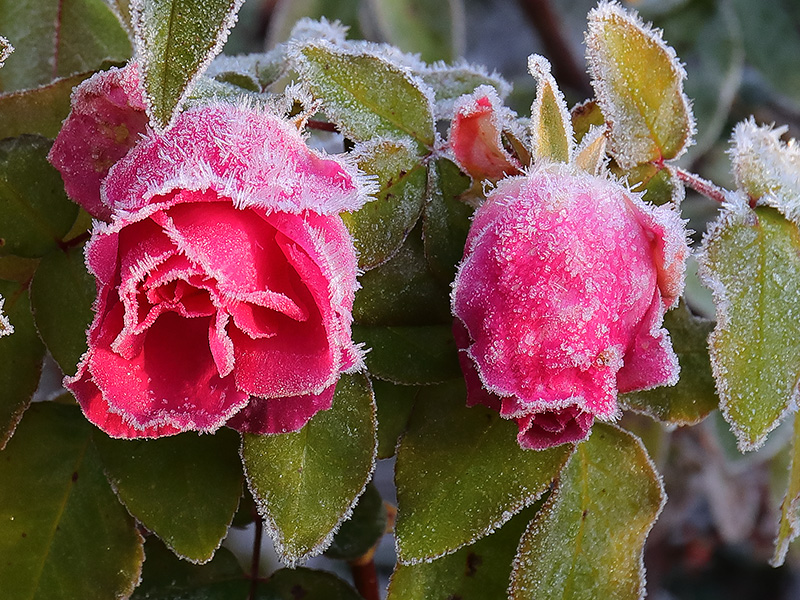
I have Covid (for the first time), so I’m using it as an excuse to take it easy this week and just re-posting a photograph from 2019. Sometimes I get lucky and there’s something still in flower when the first frosts arrive. This is the rose ‘Zepherine Drouhin’.
NB: A note for WordPress Reader users – you need to click on the title of the post again to come out of the reader and go to the post itself. This allows you to see the whole of the top photograph. (Otherwise you may see just a tiny section!)
After a long spell of mild and rainy weather, we at last had some frost. Photographically, it was a bit disappointing because it was mostly on the lawn and shorter plants. The taller plants, such as the Stipa gigantea (golden oats) above, had very little frost. So there were not many opportunities for photography. The pictures you see here are from last year.
Despite the thin coating of frost, it has felt really cold this week. The ground is frozen hard and there is thick ice over the top of the pond and in containers of saved rainwater. Only the week before, I had been able to spend time doing some weeding in the garden – not a chance of that now!
For the sake of this blog, I’m glad that I took lots of photos during last winter’s heavy frosts. The weather can’t be taken for granted, so there’s no guarantee of having anything to photograph at this time of year. Luckily for me, when it is frosty, the most ordinary of things look a lot more interesting!
A blackberry leaf looks as if its edges have been dipped in sugar.
NB: A note for WordPress Reader users – you need to click on the title of the post again to see the full photograph. (Otherwise you see just a tiny section!)
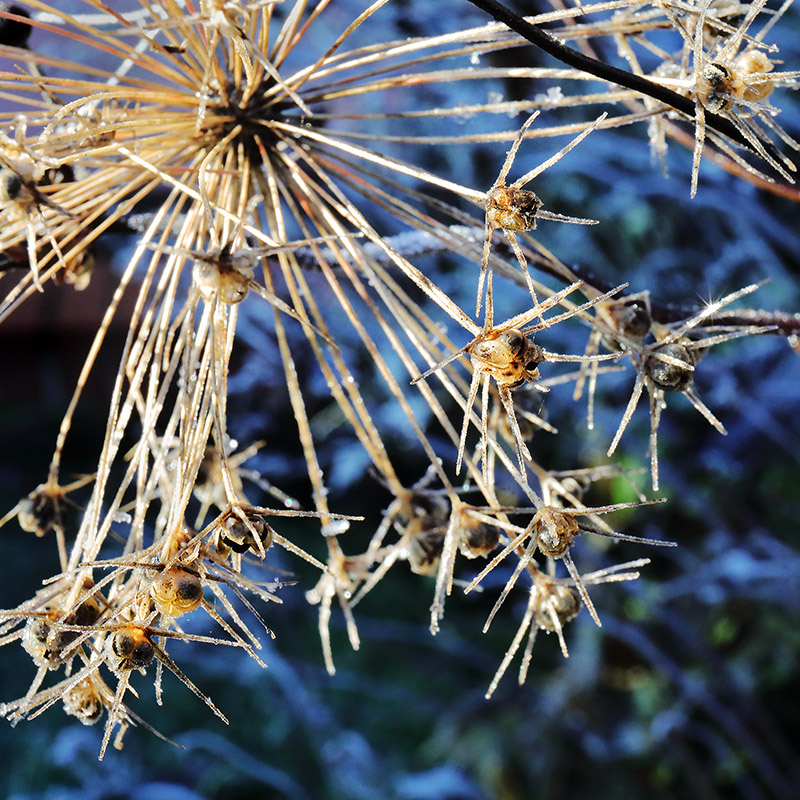
The Allium christophii seed heads pictured here are held motionless in the thinnest coating of frost. On a freezing winter morning the tiny seed pods, and the remains of the flowers behind them, gleam softly in the early sun.
It has just occurred to me that it’s unusual for a seed head to retain the remains of the flower like this. The petals have lost their colour and their edges have curled inwards. They’ve shrunk a little as they’ve dried too, but those petals are still there. Now they are little icy stars.
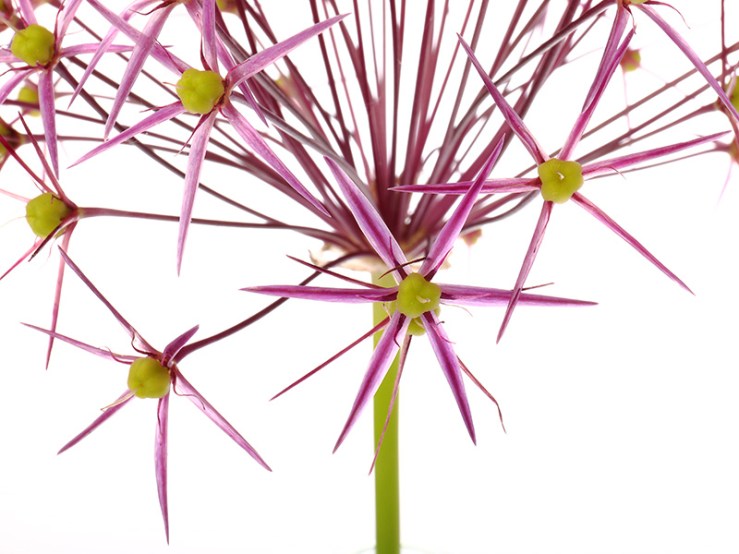
You can see what those stars looked like while the flower was still alive:
The living flowers are lilac, with a delicate metallic sheen. Already the green seed pods are forming in the centre of each individual floret. If you look closely you’ll see that there’s also an inner ring of filaments. (These are the lower part of the stamens, which would have held the anthers.) Their tapered, almost spiky, appearance makes them look like another set of much smaller petals.
Now my imagination is playing with the idea of having the ‘ghosts’ of the year’s flowers sprinkled throughout the garden. For company, the alliums would have hydrangeas (as in last week’s post) and perhaps, if there were any late flowers, astrantias. (But in both of these plants, what look like petals are not. The hydrangea has minute flowers surrounded by showy sepals and the astrantia has large bracts around a tiny pincushion-like arrangement of true flowers. Perhaps that is why they keep their flowery appearance for longer.)
Hmm, I wonder if a slightly spooky winter garden would be fun… 🙂
NB: A note for WordPress Reader users – you need to click on the title of the post again to see the full photograph. (Otherwise you see just a tiny section!)
During winter direct sunlight doesn’t penetrate along much of one side of the garden. Photographing plants in this area can be frustrating. Even if they have a good coating of frost, they don’t catch the sun to make that frost sparkle.
Taller plants, like those here, do get some sun for a very short while, so there may be just enough light to make photographing them worthwhile. The light changes very quickly at this time of year, so the opportunity doesn’t last long.
A climbing hydrangea is just tall enough to catch the light.
Happily, January brings a gradual increase in how far the sun reaches over the garden fences and tall shrubs, over time illuminating more of the smaller plants. By the time spring is here, the sun will be high enough to allow me to take photographs throughout the whole garden. That is a time I look forward to!
Meanwhile, it occurs to me that I should plan to place the plants that look good when frosted in places where they will catch a little sparkle of sun. (But not somewhere too sunny, otherwise the frost may melt before I get outside with my camera.) I may be developing my own style of garden planning – ‘hortus photographicus’, hehe!
A frosted Daucus (wild carrot) seed head lurks on the dark side of the garden.
NB: A note for WordPress Reader users – you need to click on the title of the post again to come out of the reader and go to the post itself. This allows you to see the whole of the top photograph. (Otherwise you may see just a tiny section!)
A guid new year to ane an a An mony may ye see, An during a the years to come, O happy may ye be. An may ye ne’er hae cause to mourn, To sigh or shed a tear; To ane an a baith great an sma A hearty guid New year.
A Guid New Year to Ane AnA
As in the words of this traditional Scottish song, I wish everyone a ‘guid new year’. May it bring you all the best of health and happiness. (I think most of the meanings of the Scots words are fairly clear, but just in case they aren’t: guid = good, ane = one, a = all, mony = many, baith = both, sma = small)
I’d like to take this opportunity to thank everyone who reads my blog and to say how much I appreciate your comments and the chance to chat a little. I hope that my small patch of the internet brings you some pleasure in the natural world. Here’s to 2024! 🌿
NB: A note for WordPress Reader users – you need to click on the title of the post again to come out of the reader and go to the post itself. This allows you to see the whole of the top photograph. (Otherwise you may see just a tiny section!)
I hope that this Christmas, whether you celebrate it or not, will bring you happiness and wellbeing. It has been a busy year for us, so a time of good cheer and a little bit of indulgence will be welcome. (We value quieter Christmases these days – they give a great feeling of peace and time to just relax.)
Despite my usual frosty photo for Christmas, it looks as if we’ll see no frost or snow over this year’s festive period. Christmas day is forecast to be sunny, so time outside in the garden is a possibility. But there will be no hoar-frost photos like this one taken last December…a rest for the camera maybe!
However you spend Christmas, I hope that it’s a good one. Merry Christmas! I wish you joy. 🎄
NB: A note for WordPress Reader users – you need to click on the title of the post again to come out of the reader and go to the post itself. This allows you to see the whole of the top photograph. (Otherwise you may see just a tiny section!)
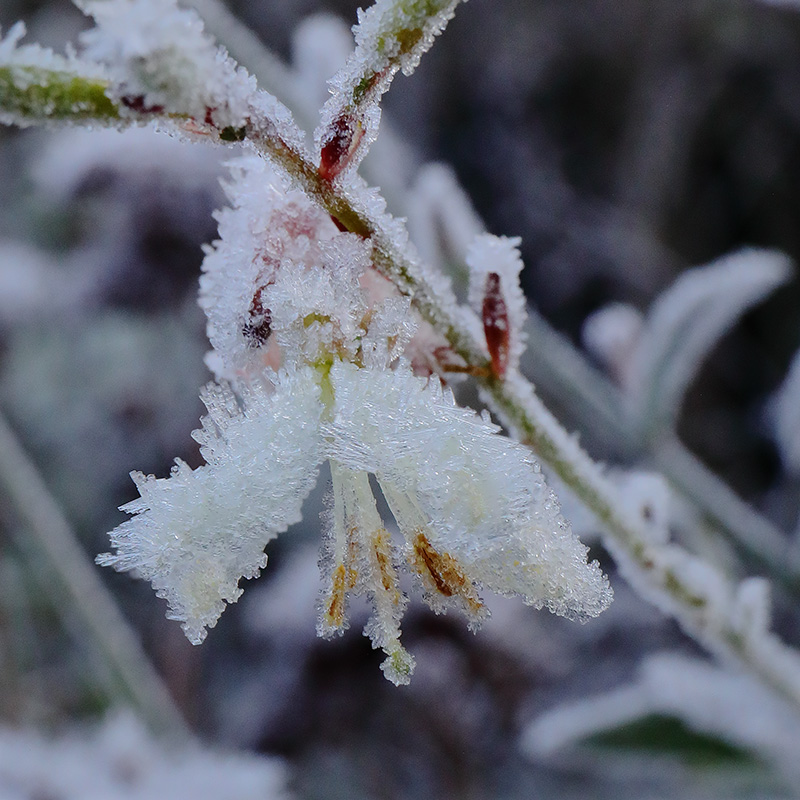
Last year’s hoar frost made icy little sculptures out of many of my garden plants. The one you see here is Gaura lindheimeri. (Now known as Oenothera lindheimeri, but I still call it by it’s old name. There are too many plant name-changes to keep up with these days!) This plant carries on flowering until late in the year, so frequently ends up covered in frost.
The area where the gaura is growing stays in the shade for much of the day in winter, so the frost lasts here for a long time. That gives me plenty of opportunities for taking photographs, but means that the sun doesn’t reach the frost to make it sparkle. So photography here is a bit of a compromise. Perhaps I should consider the effect of sun on frost when planting!
Eventually the frost will go, changing the look of the flower again. This time the petals are likely to be left translucent and looking very fragile indeed. (They usually wilt quickly after being frosted.) The drops of melted frost give an interesting texture to the flower – you can see right through the petals to the drops that are actually on the other side. ❄
NB: A note for WordPress Reader users – you need to click on the title of the post again to come out of the reader and go to the post itself. This allows you to see the whole of the top photograph. (Otherwise you may see just a tiny section!)
Frost has an amazing ability to enhance the smallest of garden details. It takes very little to allow it to create a fleeting beauty. Anything can suddenly become attractive when encrusted by these tiny, white crystals of ice.
The last of the year’s flowers, dried-out seed heads, leaves, or slender grasses stilled by the cold air – all are made much more interesting to look at by a touch of frost. These are the leaves of Pulsatilla vulgaris (pasqueflower). In spring they are soft and hairy and a delight to stroke. By winter those hairs have disappeared, giving the curving shapes of the deeply-cut leaves more prominence. To my mind, the dead and frosted leaves suggest the look of a woodcut image or engraved stone.
As I’m writing this, the ground is still frozen. Tomorrow, though, is forecast to be milder and rainy, so the magic of the frost will be gone from the garden. These leaves won’t last long once the frost has finished with them, but will be left limp and probably rather translucent. The frost will have helped them along their path of decomposition and their eventual contribution to the richness of the garden soil. 🍂








 Ann Mackay: Inspired by Nature