NB: A note for WordPress Reader users – you need to click on the title of the post again to come out of the reader and go to the post itself. This allows you to see the whole of the top photograph. (Otherwise you may see just a tiny section!)
After a long spell of mild and rainy weather, we at last had some frost. Photographically, it was a bit disappointing because it was mostly on the lawn and shorter plants. The taller plants, such as the Stipa gigantea (golden oats) above, had very little frost. So there were not many opportunities for photography. The pictures you see here are from last year.
Despite the thin coating of frost, it has felt really cold this week. The ground is frozen hard and there is thick ice over the top of the pond and in containers of saved rainwater. Only the week before, I had been able to spend time doing some weeding in the garden – not a chance of that now!
For the sake of this blog, I’m glad that I took lots of photos during last winter’s heavy frosts. The weather can’t be taken for granted, so there’s no guarantee of having anything to photograph at this time of year. Luckily for me, when it is frosty, the most ordinary of things look a lot more interesting!
A blackberry leaf looks as if its edges have been dipped in sugar.
NB: A note for WordPress Reader users – you need to click on the title of the post again to see the full photograph. (Otherwise you see just a tiny section!)
During winter direct sunlight doesn’t penetrate along much of one side of the garden. Photographing plants in this area can be frustrating. Even if they have a good coating of frost, they don’t catch the sun to make that frost sparkle.
Taller plants, like those here, do get some sun for a very short while, so there may be just enough light to make photographing them worthwhile. The light changes very quickly at this time of year, so the opportunity doesn’t last long.
A climbing hydrangea is just tall enough to catch the light.
Happily, January brings a gradual increase in how far the sun reaches over the garden fences and tall shrubs, over time illuminating more of the smaller plants. By the time spring is here, the sun will be high enough to allow me to take photographs throughout the whole garden. That is a time I look forward to!
Meanwhile, it occurs to me that I should plan to place the plants that look good when frosted in places where they will catch a little sparkle of sun. (But not somewhere too sunny, otherwise the frost may melt before I get outside with my camera.) I may be developing my own style of garden planning – ‘hortus photographicus’, hehe!
A frosted Daucus (wild carrot) seed head lurks on the dark side of the garden.
NB: A note for WordPress Reader users – you need to click on the title of the post again to come out of the reader and go to the post itself. This allows you to see the whole of the top photograph. (Otherwise you may see just a tiny section!)
A guid new year to ane an a An mony may ye see, An during a the years to come, O happy may ye be. An may ye ne’er hae cause to mourn, To sigh or shed a tear; To ane an a baith great an sma A hearty guid New year.
A Guid New Year to Ane AnA
As in the words of this traditional Scottish song, I wish everyone a ‘guid new year’. May it bring you all the best of health and happiness. (I think most of the meanings of the Scots words are fairly clear, but just in case they aren’t: guid = good, ane = one, a = all, mony = many, baith = both, sma = small)
I’d like to take this opportunity to thank everyone who reads my blog and to say how much I appreciate your comments and the chance to chat a little. I hope that my small patch of the internet brings you some pleasure in the natural world. Here’s to 2024! 🌿
NB: A note for WordPress Reader users – you need to click on the title of the post again to come out of the reader and go to the post itself. This allows you to see the whole of the top photograph. (Otherwise you may see just a tiny section!)
I hope that this Christmas, whether you celebrate it or not, will bring you happiness and wellbeing. It has been a busy year for us, so a time of good cheer and a little bit of indulgence will be welcome. (We value quieter Christmases these days – they give a great feeling of peace and time to just relax.)
Despite my usual frosty photo for Christmas, it looks as if we’ll see no frost or snow over this year’s festive period. Christmas day is forecast to be sunny, so time outside in the garden is a possibility. But there will be no hoar-frost photos like this one taken last December…a rest for the camera maybe!
However you spend Christmas, I hope that it’s a good one. Merry Christmas! I wish you joy. 🎄
NB: A note for WordPress Reader users – you need to click on the title of the post again to come out of the reader and go to the post itself. This allows you to see the whole of the top photograph. (Otherwise you may see just a tiny section!)
Frost has an amazing ability to enhance the smallest of garden details. It takes very little to allow it to create a fleeting beauty. Anything can suddenly become attractive when encrusted by these tiny, white crystals of ice.
The last of the year’s flowers, dried-out seed heads, leaves, or slender grasses stilled by the cold air – all are made much more interesting to look at by a touch of frost. These are the leaves of Pulsatilla vulgaris (pasqueflower). In spring they are soft and hairy and a delight to stroke. By winter those hairs have disappeared, giving the curving shapes of the deeply-cut leaves more prominence. To my mind, the dead and frosted leaves suggest the look of a woodcut image or engraved stone.
As I’m writing this, the ground is still frozen. Tomorrow, though, is forecast to be milder and rainy, so the magic of the frost will be gone from the garden. These leaves won’t last long once the frost has finished with them, but will be left limp and probably rather translucent. The frost will have helped them along their path of decomposition and their eventual contribution to the richness of the garden soil. 🍂
NB: A note for WordPress Reader users – you need to click on the title of the post again to come out of the reader and go to the post itself. This allows you to see the whole of the top photograph. (Otherwise you may see just a tiny section!)
Winter is fast approaching us, with some heavy frosts already here. But it hasn’t arrived quickly enough for frost to catch the leaves of this elder (Sambucus ‘Black Lace’) this year. The leaves stayed on the shrub unusually late last year – right into December – and gave me the chance of this photograph during a hoar frost.
Hoar frost itself is unusual here. This was the first time I’d seen it in my garden and I made the most of my chance to take some photos of it. (Got a bit frozen though!) This year I’ll be on the lookout for it happening again.
I’d have been happier if this year’s frosts had held off for a little while because I still have a lot of work to catch up with in the garden. Weeks of rain have meant that the ground was much too wet for planting and needed a chance to dry out. Now the ground has dried out and I have plants I want to move. There are others in pots that are waiting to be planted out. But the ground is frozen! I will just have to wait a little longer. Right now, it seems like a very good idea to stay indoors and warm, perhaps just venturing out for a few more frosty photos… 🙂
NB: A note for WordPress Reader users – you need to click on the title of the post again to come out of the reader and go to the post itself. This allows you to see the whole of the top photograph. (Otherwise you may see just a tiny section!)
There are hardly any flowers left in the garden now, so almost everything is in shades of green, with a few leaves turning yellow here and there. (There are still the purple leaves of the smoke bush in the front garden. With a bit of luck, these will turn some interesting shades of yellow and orange – if they don’t get blown off first!)
During the last week, I’ve seen a bit of colour from fruits and berries in the garden. We finished picking the fruit from our apple trees a couple of days ago…you can see the last of the fruit on our Braeburn tree above. Our other apple tree is a Cox’s Orange Pippin which had already had its fruit picked a little while ago, so the Braeburn’s apples give later colour.
Near the apples we have a holly bush. I was considering cutting it back a lot this year because it has grown somewhat tall and spindly. I’m glad I didn’t do it, because this year there are more berries on it than I’ve seen before. This means a feast for the blackbirds!
The blackbirds (which are my favourite garden bird – alongside the robin) must do quite well here. We have two grapevines, one of which is huge and shades an arbour. The blackbirds seem to be constantly in and out of this when there are ripening grapes. We only eat a few of the grapes ourselves (they don’t get very sweet), so we don’t begrudge them to the birds. There are plenty of other berries, including the orange-red berries of our rowan tree and, later on, the ivy berries. It’s just as well that we have these to distract the birds, because blackbirds are partial to apples too… 🙂
NB: A note for WordPress Reader users – you need to click on the title of the post again to come out of the reader and go to the post itself. This allows you to see the whole of the top photograph. (Otherwise you may see just a tiny section!)
It is raining, it has been raining, and there is more rain to come…
If you’ve been reading this blog for a while, you will probably have noticed that I frequently mention that we have a dry climate here in the east of England. Drought is something I worry about in the garden and I try not to have many plants that require moist ground.
Not raindrops but melted frost drops from last winter.
This week has felt quite strange because it has rained and rained. In fact, this summer was unusually rainy and our grass even stayed green. I’ve read that the heavier rainfall may be a part of global warming (because warm air can hold more moisture) but this does feel unexpected.
Because it has been so wet, I thought it appropriate to post some watery pictures. However, I have a confession to make…they aren’t raindrops, but drops of melted frost photographed last winter. (It has been much too wet and grey for me to want to take the camera outside.)
We have been lucky here. Storm Babet hasn’t caused much disruption. But elsewhere, especially in Scotland, people have been forced to leave flooded homes and much damage has been done. Sometimes the forces of Nature can be thoroughly alarming!
The golden oat (Stipa gigantea) looks at its best when covered in frost, even if that frost has melted.
NB: A note for WordPress Reader users – you need to click on the title of the post again to see the full photograph. (Otherwise you see just a tiny section!)
This year was a worrying one as far as tiny visitors to the garden went. In spring and early summer it definitely felt as if there were fewer bees and other pollinators around. Butterflies, too, seemed scarcer this year. Things improved in the later part of the summer and there were days when there were a fair number of insects around, but not as good as previous years.
Last winter was a very cold one, with much harder frosts than we usually get. Presumably, this must have made it harder for hibernating insects to make it through to spring. I’ve also read that last year’s drought didn’t help insect numbers. Hopefully the wetter summer this year will have produced an improvement.
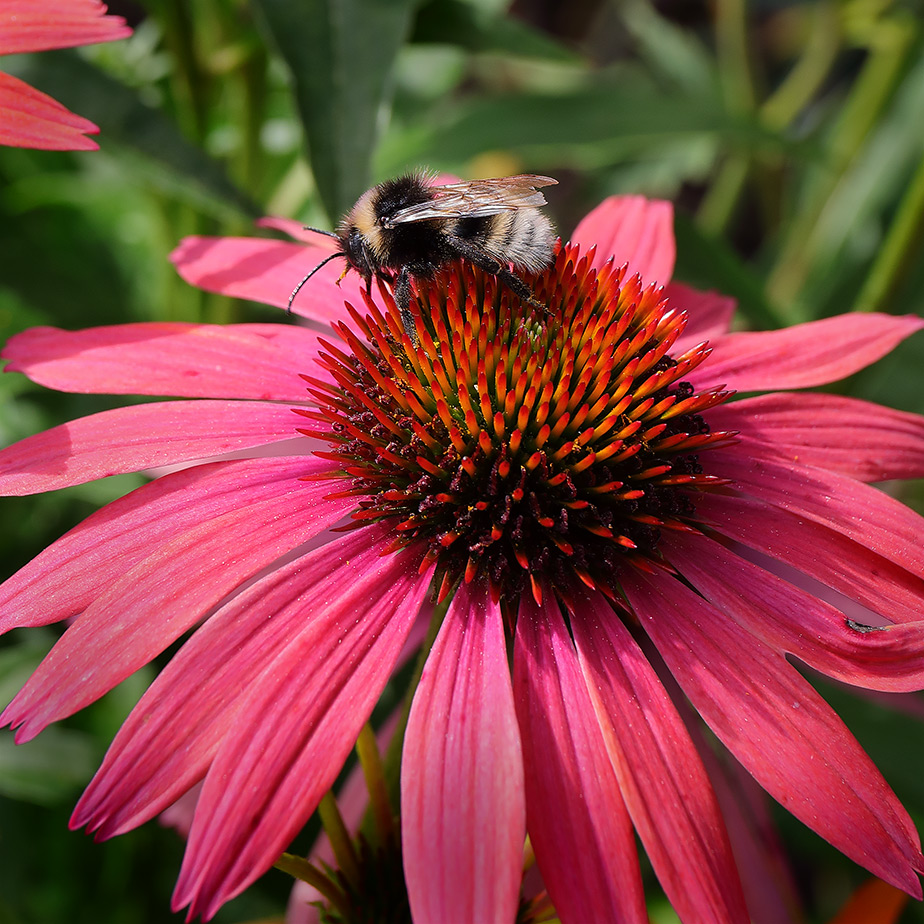
Common Carder bee
It was a relief to see bees and butterflies appearing as the summer progressed. But there were some things that I didn’t see here, such as the Small Tortoiseshell butterfly in the photo below.
Peacock butterflies were a rare sight here too, but Red Admirals appeared in good numbers. (They are the commonest butterflies in my garden, along with the Cabbage Whites.) The largest number I saw was on a particularly sunny day, when about a dozen Red Admirals and a solitary Peacock were feasting on a buddleia. For a few warm days there were enough of them around to swirl past me whenever I walked along the path and brushed against our butterfly bushes.
Small Tortoiseshell butterfly photographed in a previous summer
There was an increase in dragonflies visiting – they have obviously become more aware of our pond. It was amusing to watch these fairly heavy creatures try to settle on the nearby stems of evening primrose, which quickly bent and swayed under their weight. To give them better lookout posts, I pushed some big birch twigs into the pots of a couple of the pond plants. I hope they appreciated them!
Although this appeared to be a poor year for insects, there are some signs of hope in the attitudes towards their welfare. I’ve noticed a lot more wild plants and food plants for bees and butterflies in garden centres and nurseries, a response to the growing interest in gardening for wildlife. And, much to my delight, our local council stopped mowing many grassy areas. This means that the green that runs in front of the houses here is being allowed to become wilder. I’m hoping that in a few years we’ll have a decent little wildlife meadow out there!
NB: A note for WordPress Reader users – you need to click on the title of the post again to see the full photograph. (Otherwise you see just a tiny section!)
Summer is gradually morphing into autumn here. Despite reaching the autumn equinox, the days can be sunny and warm, making it feel as if the season hasn’t yet changed. Most of the leaves on the trees and shrubs around us are still green. The red leaves here really aren’t autumnal at all – they were photographed on a visit to a garden in early August.
North American readers may recognise these gloriously-coloured leaves as belonging to Cercis (redbud), a native of their area. I believe this is Cercis canadensis ‘Forest Pansy’, which has leaves of a deep reddish-purple. (They look much more red here, because I’ve photographed them with the light shining through them. However, the two below were just starting to become a bit more red before turning to the more orange shades of autumn.)
‘Forest Pansy’ is a cultivar that I’ve seen in some of the larger gardens that I visit, but it is not common around here. I do see it available in garden centres, so maybe there will be more of these delightful trees in our area in the future. I certainly hope so! Their heart-shaped leaves are a beautiful sight, especially when the low sunlight catches them and makes them glow.
Cercis (Redbud) leaves
An update: it turns out that the comment box was black because the Orvis theme (for some weird reason) now shows the text and the box as the same colour. (It only happens if you have a white background. It works OK if your background is black.) The ‘Happiness Engineers’ were quick to help, but the only solution was to pick a different theme. (This is Libre 2.) Hope this is helpful for anyone having a similar problem. 🙂




 Ann Mackay: Inspired by Nature