NB: A note for WordPress Reader users – you need to click on the title of the post again to come out of the reader and go to the post itself. This allows you to see the whole of the top photograph. (Otherwise you may see just a tiny section!)
We still have some below-zero nights forecast, but it feels as if the worst of the cold is over. Of course, that feeling may turn out to be entirely wrong, because there’s still plenty of time left for more wintry weather. Despite that, the sight of the early daffodil leaves poking up through the soil and the first hellebore flowers makes it feel like spring isn’t so far away.
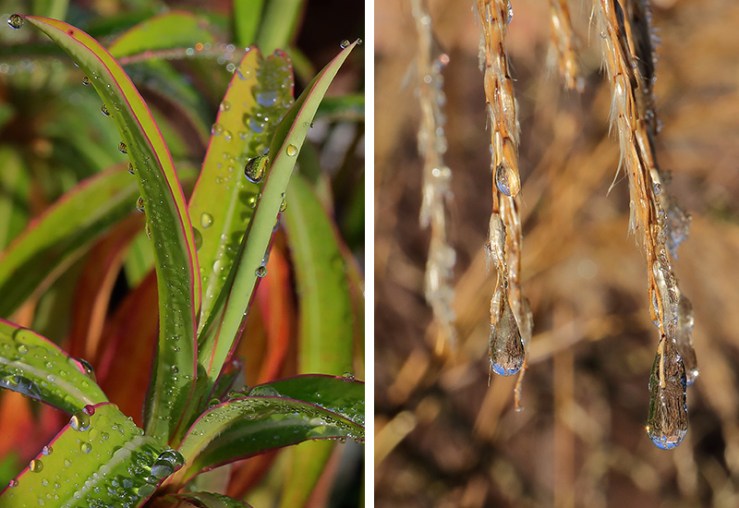
Thawing frost created several opportunities in the past few weeks for me to get busy with my camera. The tiny meltwater droplets looked especially clear and they glittered where the sun struck them. Other drops, in dark corners where the defrost was slower, were still half-frozen.
Sunshine brings out the sparkle on the drops of melted frost on Euphorbia mellifera leaves and the seed heads of a Miscanthus grass.
Thinking about that clarity in the drops of melting frost made me wonder if they were purer than ordinary raindrops. After all, raindrops pass through the atmosphere, collecting any pollutants along the way, whereas frost is formed from condensed water vapour. So, like a distilled liquid, they should be free of impurities…well, that’s my theory, anyway! In any case, I enjoy seeing the plants here all decked out in these sparkling little beads.
I am very much looking forward to spring; now I’m longing to see new growth and feel the sun warm the air. At the same time, I realise that I should take care to notice winter’s small details and the way that the natural world changes through this period of cold weather. Soon enough, the changes will be those of approaching spring…🌱
Thawed frost forming drops around the edges of rose leaves.
NB: A note for WordPress Reader users – you need to click on the title of the post again to come out of the reader and go to the post itself. This allows you to see the whole of the top photograph. (Otherwise you may see just a tiny section!)
Apparently honesty (Lunaria annua) has around 25 common names. (According to the RHS, you can see their list here.) That’s a lot of names, probably because it’s a plant that has been in our gardens for a very long time. It is known to have been in cultivation in the UK since the sixteenth century and is mentioned in Gerard’s Herbal at that time.
Among these names are several that relate to money, including ‘St Peter’s pence’ and, in an interesting contrast, ‘Judas’s penny’. The names ‘money flower, ‘penny flower’ and ‘silver dollar’ have their origins in the way the seed pods look like coins. The name ‘money-in-both-pockets’ was probably given to the plant for the same reason, but to me, the pods also look like tiny pockets with the coins – seeds – inside. That the seeds are visible through the outer layers of the pods has given rise to the name most of us know it by, the familiar ‘honesty’.
The money-inspired names gave me a fair excuse for the title of this post. (Finding new titles can be hard at times!) But there are many names with other inspirations. ‘Grandpa’s specs’, for instance, which makes me smile, while ‘matrimony’ makes me wonder. (A hopeful name, arising from the plant’s associations with both honesty and prosperity, perhaps?) ‘White satin’, ‘silver leaf’ and ‘satin pod’ are all very descriptive of the central membrane that is left when the outer layers of the seed pods fall away.
But the names that appeal to me most are those that refer to the moon-like appearance of the pods. There’s the Latin name, of course – ‘luna’ means ‘moon’. Then there’s ‘moonwort’ and ‘moon seed’, both of which make me imagine honesty’s tiny papery moons gleaming in the reflected moonlight of an autumn evening.
The seeds have been gathered from the seed pods photographed here, and sprinkled where I’d like the plants to come up in future. Now only the silvery central discs are left and are dripping with slowly thawing frost. To me, they look even more like tiny glowing moons. I see them as little wintry moon-pennies.
In the spirit of honesty, I must admit that I’ve never actually heard anyone use the names mentioned here. Lunaria has always been ‘honesty’ to me. It’s a little sad for old names to die out and be forgotten. They’re part of our culture and the history of our relationship with plants..
Frost melting on honesty (Lunaria annua) seed heads
NB: A note for WordPress Reader users – you need to click on the title of the post again to come out of the reader and go to the post itself. This allows you to see the whole of the top photograph. (Otherwise you may see just a tiny section!)
A lot of changes in the garden take place slowly, sometimes without being noticed until they’re complete. But frost, and the way it changes to semi-frozen beads before melting into glistening droplets has been a very visible feature here recently.
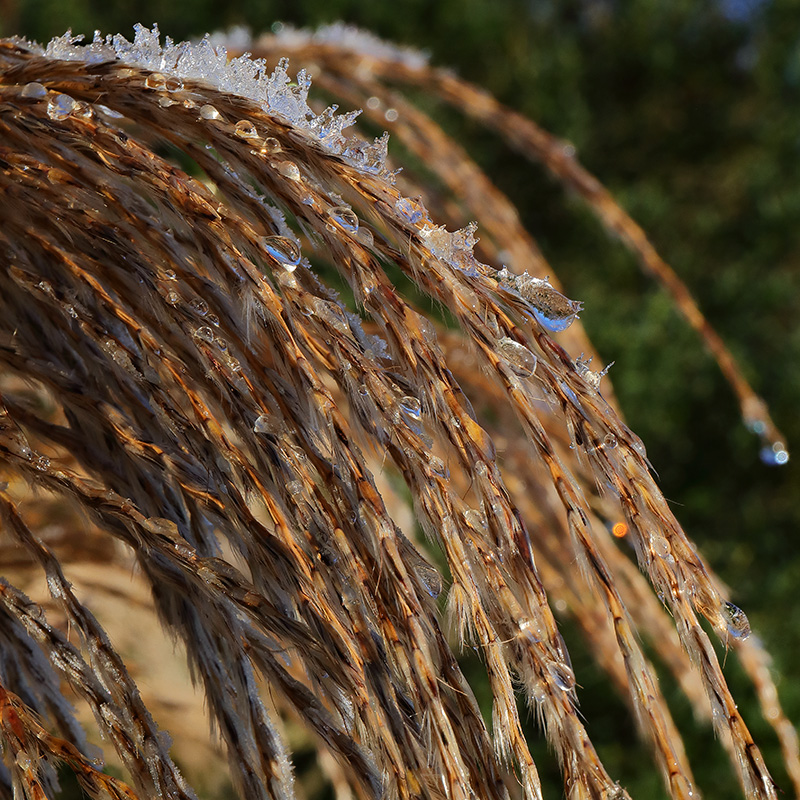
The top photograph shows the process of the thaw caught mid-way. There’s still an icy ridge of frost crystals running along the seed head, but below it the sun has melted the rest. It was the first time that I’ve photographed these Miscanthus seed heads – the frost added something extra to give interest to the image. (And they do tend to blow around in any breeze, so very still weather is needed for a decent photo.)
The Miscanthus seed heads were at their frostiest for this photograph.
You can see the seed head at its most frost-covered in the image above. It didn’t stay that way for long because the Miscanthus is growing in the area that gets the first sun of the morning. Any frost on this grass melts away very quickly. It’s only because we had several days of very low temperatures that there was this build-up of frost crystals.
Those frost crystals soon thawed in the sun and became the icy little drops that are seen in the photo below. But this wasn’t the only change taking place as I photographed the Miscanthus. I was surprised to see how quickly the hairs on the individual grass seeds fluffed out in the sun. (You can see how dry and airy-looking they’ve become in a very short space of time.)
I suppose the seeds must be programmed to wait until there’s some warmth before opening out their hairs and getting ready to fly away in the wind. Later on, when it was cooler, I noticed that they had closed up again. Since that morning, I’ve seen the fluffiness appear in the sunshine and disappear as the hairs close when it’s cold. Perhaps this is a way of protecting the seed-hairs in bad weather, so that they don’t get bedraggled, and allowing them to stay dry enough to let the seeds float away when the time is right. It’s an intriguing little change that had gone unnoticed here before.
Here the Miscanthus seed heads have suddenly opened up and become fluffy.
NB: A note for WordPress Reader users – you need to click on the title of the post again to come out of the reader and go to the post itself. This allows you to see the whole of the top photograph. (Otherwise you may see just a tiny section!)
The leaves here are mostly long gone, but the few that remain can give an interesting texture to the frosted garden. The gently curving leaves in the photograph above are those of Mahonia eurybracteata ‘Soft Caress’. This small shrub is in a very sheltered position, so this is the first year that I’ve seen frost on it.
This Mahonia is very different from the larger one (probably a Mahonia japonica) at the back of our garden. ‘Soft Caress’ is smaller (3 to 4ft high) and not as hardy. It’s a cultivar that doesn’t like to be in a hot, dry position, so I’ve planted it where it is shaded by other larger shrubs.
Unlike other varieties of Mahonia, the leaves of this one aren’t prickly (hence the name), so it’s a much ‘friendlier’ plant to have around. I like the effect of its foliage so much that I’d like to grow it elsewhere in the garden too, but that will be if I can find a suitable spot for another one. (Most of our garden is likely to be a bit too hot and dry in summer.)
The second set of leaves are those of a fennel. We have lots of bronze fennel in the garden (it spreads very easily from seed), but I notice that this one is green. I think a bee must have brought in some pollen from a green fennel and that this is a cross between it and one of our bronze plants. We’ll probably end up with more green ones, but I’ve been getting rid of a lot of the self-sown seedlings. If I didn’t, they’d soon take over the garden! But I would never get rid of them all. They look far too good when frosted for me to do that, and I love to photograph both the leaves and the seed heads. (As you may have noticed…you can see a couple of my favourites on this post.) ❄
Fennel leaves become a delicate tracery when the frost gets to them.
NB: A note for WordPress Reader users – you need to click on the title of the post again to come out of the reader and go to the post itself. This allows you to see the whole of the top photograph. (Otherwise you may see just a tiny section!)
This week the weather forecast promised us frost and sunshine – a great combination for photography. Unfortunately, our two very cold mornings didn’t give the conditions I had hoped for. The first morning had plenty of frost, but was exceedingly grey and dull until about the middle of the day, then the next day the ground was frozen but there wasn’t any visible frost on the plants.
The photographs here are from previous winters. The frost on honesty pods (below) is a subject that I’d like to pursue further. I’ve even prepared a few of the dried pods by picking some, peeling the outer skins from the seed pods, and then leaving them in a position where they’re likely to catch both frost and sun. Now I have to wait for the weather to play along!
Frost can make a lot out of very little!
While I keep a watch on the weather, I’ve been staying warm indoors and learning a bit more about printmaking. It’s been a long time since I did printmaking of any kind. I am now trying out methods that I can fairly easily do at home, rather than needing the facilities of a printmaking workshop. There’s a lot for me to learn and it may be a little while before I have results that I can show here, but it will keep me happily occupied while it’s cold outside. ❄
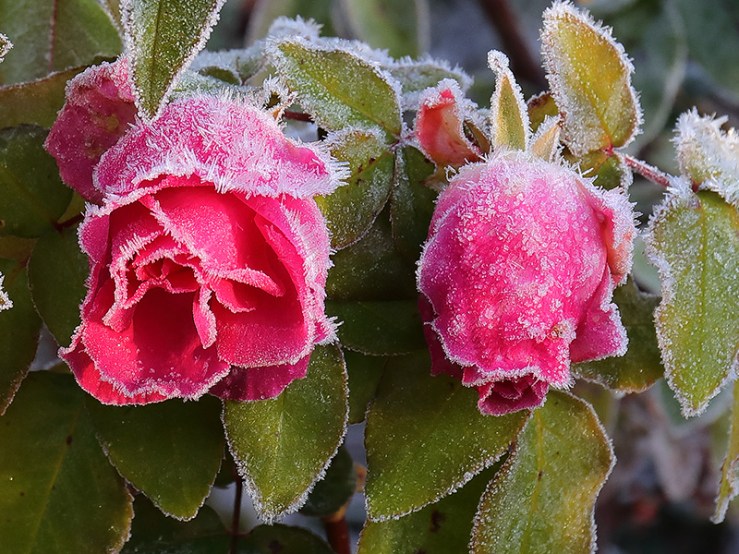
Frost sometimes manages to catch the last flowers of Rose ‘Zepherine Drouhin’.
NB: A note for WordPress Reader users – you need to click on the title of the post again to come out of the reader and go to the post itself. This allows you to see the whole of the top photograph. (Otherwise you may see just a tiny section!)
It’s amazing to see how much difference some sunshine makes to the garden in autumn. After days of smothering grey, we suddenly have an airiness and brightness that brings out the best in the leaves that are turning yellow and gold. For a while, the outdoors feels welcoming again, and thoughts of the approach of winter can be set aside.
There is still some warmth in the sun, enough to entice me outside to work in the garden. This year I have been making lots of changes to the planting here. New plants have gone in and others moved to places where they will grow better or look more at home with their neighbours. (If only moving plants was as easy as moving furniture!)
As they become dormant for winter, plants can be moved to more suitable sites. Theoretically, I have plenty of time to get it all done before early spring, but it would be good to get it finished before the weather gets really cold or wet. So these sunny days have been ideal. At the same time, the low sunlight is reminding me to think about the effects of sunlight streaming through foliage and to look for ways to take advantage of it. It is, after all, primarily a photographer’s garden!
NB: A note for WordPress Reader users – you need to click on the title of the post again to come out of the reader and go to the post itself. This allows you to see the whole of the top photograph. (Otherwise you may see just a tiny section!)
In gardening, it often feels as if there is a pause while you wait for something to happen. Waiting for the right time to sow seeds, to see buds open, or to pick your harvest of fruit or vegetables. This week I’m waiting (and hoping) for the grey sky to clear and let a little sunlight through to the autumn leaves. They need that gleam of light to pick out their details and bring their images alive when I photograph them.
I’m waiting for the first frost of the year too… 🍂
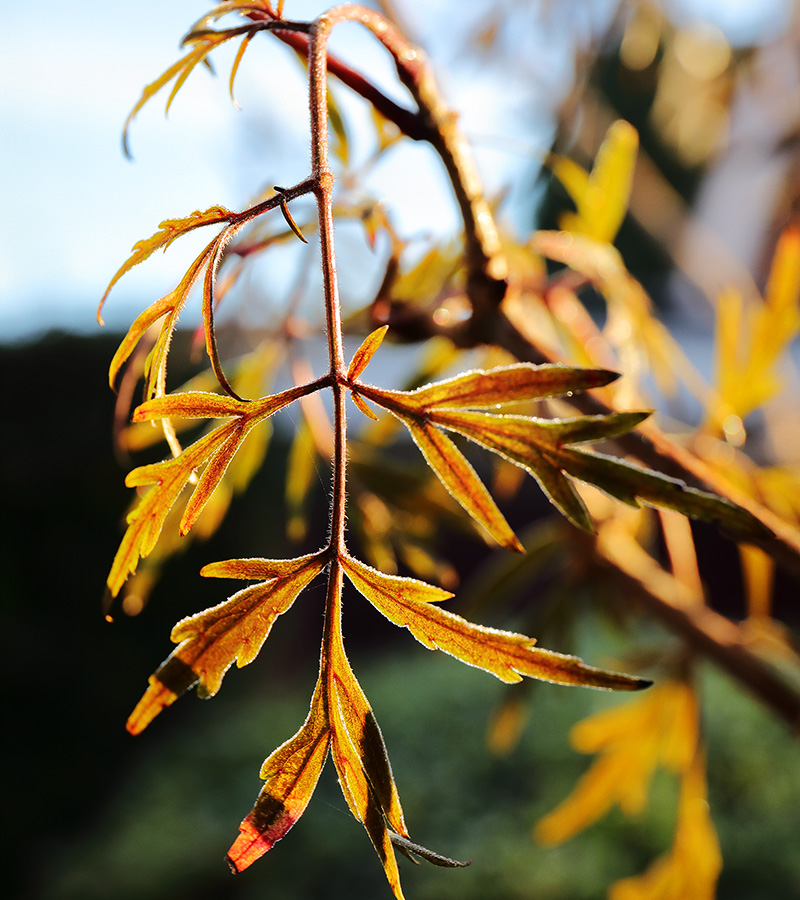
Autumn leaf of Elder (Sambucus ‘Black Lace’), photographed on a frosty morning a couple of years ago.
NB: A note for WordPress Reader users – you need to click on the title of the post again to come out of the reader and go to the post itself. This allows you to see the whole of the top photograph. (Otherwise you may see just a tiny section!)
Last year I created a small bog garden here to make it easier to grow moisture-loving plants. For inspiration beforehand, I went to see a bog garden at East Bergholt Place. This is a large garden and arboretum which also has a plant centre (‘The Place for Plants’). Although my own bog garden is tiny – just five foot in diameter – I reckoned that being able to see what was growing happily in a large and well-established bog garden would be useful.
This garden is only about 16 miles away from our home, but the conditions are very different. The soil in it is naturally moist, due to there being a high water table and there is plenty of shade from large trees. (While walking around I noticed how damp the ground was underfoot. And being in the shade made it an excellent place to spend a very hot afternoon.)
The bog garden sits along the banks of a narrow, stone-edged stream that runs down from the area of a large formal pond. The damp soil here supports very lush growth which hides much of the watercourse.
A very small part of East Bergholt’s bog garden. You can just see the stone edges of the stream.
The structure of the bog garden at East Bergholt is obviously entirely different to my own one. Mine is entirely artificial, created by using an old tent groundsheet to trap moisture. (I first made holes in the groundsheet with a garden fork and then added a layer of stones and gravel to provide some drainage.) But I’m hoping that many of the plants that grow well at East Bergholt will be fine for my bog garden too.
I made the bog garden with the intention of providing suitable conditions for astilbes and Siberian irises. Other plants in it now include ragged robin (Lychnis flos cuculi, AKA Silene flos-cuculi), purple loosestrife (Lythrum salicaria) and a red hesperantha that had been struggling in too-dry soil elsewhere. (It is much happier now!)
Left: primulas, hostas and irises along the damp edges of the stream. Right: a view over the formal pond uphill from the bog garden.
It was reassuring to see the astilbes and Siberian irises growing well in the very damp soil at East Bergholt. There were lots of candelabra primulas,which were in full flower on our visit in mid-May last year. From the photographs, you’ll see that there were also ferns and hostas and I spotted the blue flowers of camassia and the pretty leaves of Alchemilla mollis too.
There is one thing that is worrying me a little about having made a bog garden: what will happen if we get a lot of rain over a long period? There are drainage holes in the groundsheet I used to line it, but they may not allow water to escape quickly enough if there is too much. The danger then is that roots may rot. But that is something I will just have to look out for – and my fingers will certainly be crossed!
Although the bog garden at East Bergholt was the focus of my attention, we did take the time to see the rest of the garden and arboretum. There is a formal garden area beside the house with lawns surrounded by topiary and hedges, but I preferred the arboretum, with its beautiful trees and flowering shrubs. The wilder area of the ‘lower garden’, with naturalistic planting and a large, totally informal pond was delightful too. I’ll be happy to visit this garden again!
Candelabra primulas were the star of the show in May.
NB: A note for WordPress Reader users – you need to click on the title of the post again to come out of the reader and go to the post itself. This allows you to see the whole of the top photograph. (Otherwise you may see just a tiny section!)
Last year my husband and I joined other visitors on ‘The Great Garden Trail’. This is a summer-long event for which volunteers open their gardens to raise money for the St Elizabeth Hospice in Ipswich, Suffolk. Gardens of all sorts take part in the scheme, big and small, filled with exciting plants, or more modestly planted. Some of the gardens are the setting for interesting historic houses and occasionally there may be a village with many of its gardens open to explore.
Otley Hall turned out to be in the ‘modestly planted’ category. I would have been disappointed if I’d gone there just to see the gardens, but I also love Suffolk’s quaint medieval houses, so the visit was worthwhile.
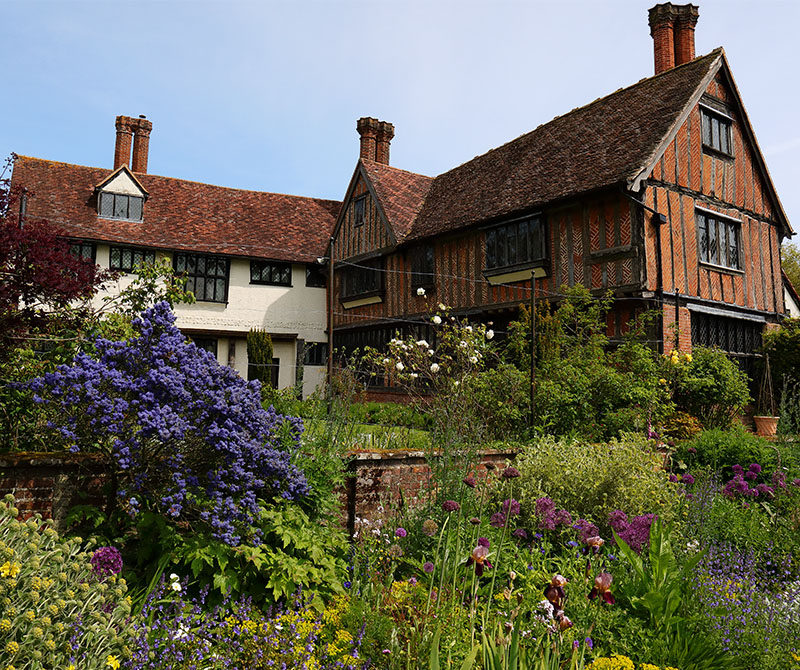
I couldn’t help but stop and admire the massive chimney, which looks as if it was built to impress anyone approaching the door.
Built in the early sixteenth century, Otley Hall is said to be the oldest house in Suffolk to have remained ‘largely intact’, with some parts of the building added later in the same century. Timber-framed buildings from medieval times are a feature of Suffolk’s countryside and many of its towns and villages. They make you feel as if you could step back in history by just walking inside them. (But we didn’t go inside this one – it was only the garden that was open on our visit.)
In the garden itself, my attention was captured by the beautiful irises which were in full flower, especially the white iris above, with the little hints of colour, and the blue one below. (Our visit was at the end of May, a little too early for the many roses there to be in bloom.)
The main flower borders edged a croquet lawn, one of several lawns throughout the gardens. Other grassy areas featured a labyrinth, ‘The Mount’ – an artificial mound which allows views of the surrounding countryside, and an H-shaped canal. (The house still has a moat on one side too.)
Otley’s ten acres have a mix of both formal gardens and informal, more natural grounds. For example, near the house there is a small ‘knot garden’ with box hedging and herbs planted up in a classic Tudor-style design. Elsewhere there are woodlands and hedgerows, maintained to encourage wildlife and areas planted up with wildflowers.
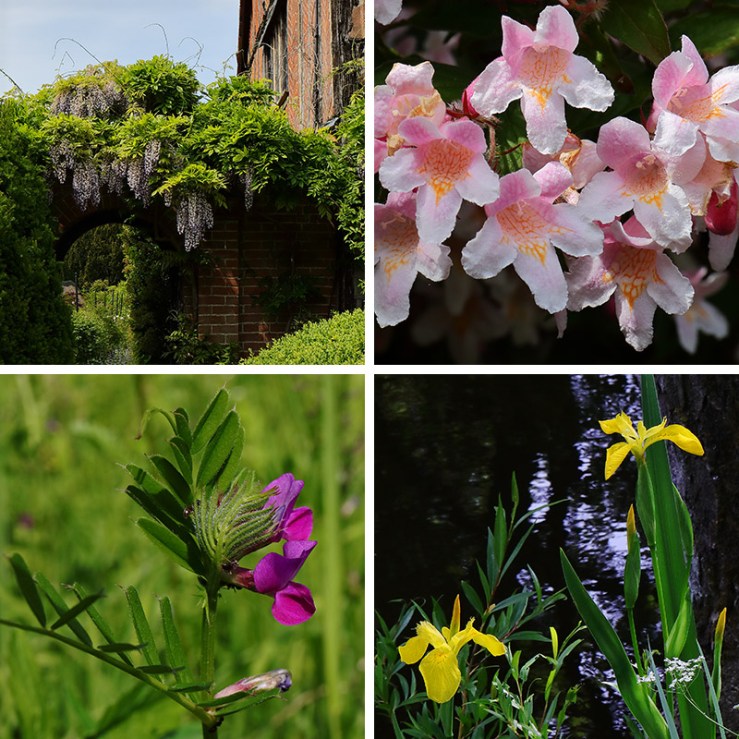
Formal and informal, clockwise from top left: wisteria on an arch beside the house, abelia growing beside a lawn, irises along the wilder edges of the canal, a vetch in a wildflower area.
The combination of traditional and wilder areas gives an easy-going feel to a stroll around the gardens of Otley Hall. It’s not the best garden for a plantaholic to visit, but it does offer a pleasant afternoon with the opportunity to see a fine example of a medieval timber-framed house. (It has an excellent cafe too…coffee and cake is an important part of our garden visits!)
There’s a walk beside the moat which allows a glimpse of the back of the house.
NB: A note for WordPress Reader users – you need to click on the title of the post again to come out of the reader and go to the post itself. This allows you to see the whole of the top photograph. (Otherwise you may see just a tiny section!)
After a long spell of mild and rainy weather, we at last had some frost. Photographically, it was a bit disappointing because it was mostly on the lawn and shorter plants. The taller plants, such as the Stipa gigantea (golden oats) above, had very little frost. So there were not many opportunities for photography. The pictures you see here are from last year.
Despite the thin coating of frost, it has felt really cold this week. The ground is frozen hard and there is thick ice over the top of the pond and in containers of saved rainwater. Only the week before, I had been able to spend time doing some weeding in the garden – not a chance of that now!
For the sake of this blog, I’m glad that I took lots of photos during last winter’s heavy frosts. The weather can’t be taken for granted, so there’s no guarantee of having anything to photograph at this time of year. Luckily for me, when it is frosty, the most ordinary of things look a lot more interesting!
A blackberry leaf looks as if its edges have been dipped in sugar.














 Ann Mackay: Inspired by Nature