First Frost

A frosted geranium leaf.

It’s been quite mild here in Suffolk for the last few weeks but during the week we had the first frost of the season. Suddenly it feels like winter, although it was soon wet again.

While there’s a frost it’s great to be able to nip out into the garden and look to see what might be worth photographing.

If it’s sunny, the sparkle on the frost is wonderful but, of course, it means that the frost will soon disappear. That can make it can hard to decide what to photograph first. There’s never time to photograph all of the frosty subjects, no matter how fast you work.

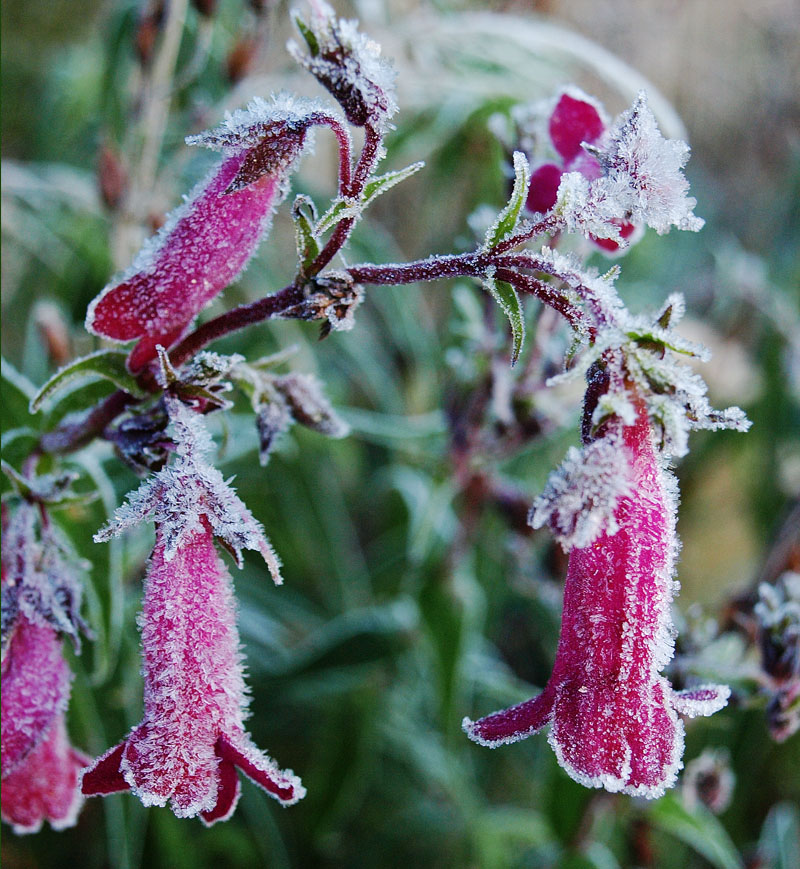
Frost-covered penstemon flowers.
Frost covers these penstemon flowers.

I like to leave seed-heads on the plants in the garden here in the hope that they’ll get frosted. Sometimes there are a few flowers still. Penstemon ‘Garnet’ is especially good at continuing into the winter, although by this time there is only a sprinkling of flowers left.

Frosted heads of Stipa gigantea

Waiting for the frost to create opportunities for photography is a great reason for not being too tidy in the garden. Anything might look good with a coating of frost – flowers, seed-heads, leaves, grasses. It doesn’t matter if they’re dead or alive, so long as there’s an interesting shape or texture.

Frost is a kind friend to the garden photographer in winter – it makes interesting photographic subjects out of very little. (And you can leave tidying up the garden ’til springtime – well that’s my excuse anyway!)

Frosted fennel heads.
These fennel heads have just lasted long enough to get frosted.

Seed-heads: Textural Interest in the Garden

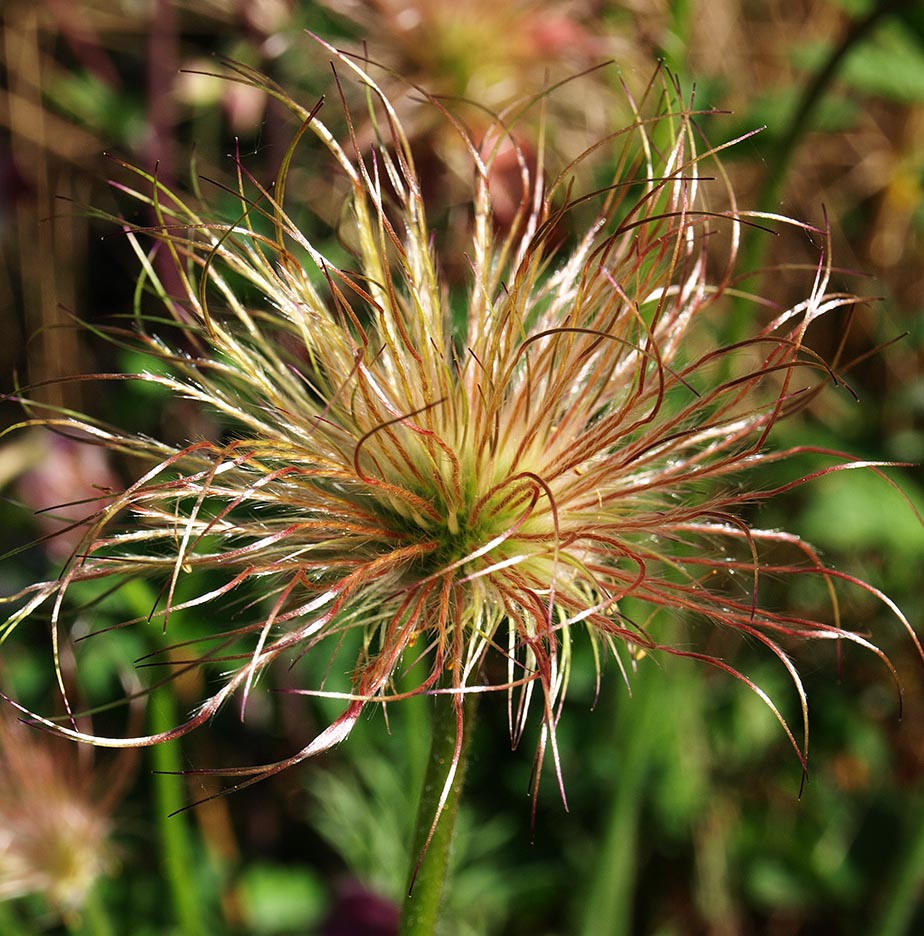
Pasque flower (Pulsatilla) seed-head

After flowers fade in the garden, there’s a certain feeling of loss, of knowing that they have disappeared for another year. But some plants have something more to give the garden – attractive seed-heads that add their own texture and interest to the planting.

For a photographer, seed-heads make a great subject. They can have very ‘architectural’, interesting shapes and their textures range from soft and fluffy to extremely prickly. There’s plenty of variety to inspire pictures with different moods. Could be something soft and gentle, or something bold and eye-catching, or perhaps an image with a more nostalgic feel.

Seed-heads have that inbuilt message that something is ending but also remind us that there will be something new – new life – in the future. And for a gardener, seed-heads can be a reason for hope, if there is a chance of new plants springing up – or dread if they’re weeds!

I love to see the Pasque flower seed-heads every year. (Top photo.) They are so soft that you want to stroke them but they can also really catch the light. The fine hairs reflect the sun and make them gleam on a sunny day. (They’re irresistible to my cats too, who find that the heads swaying on their long stems make a great toy to bat a paw at, especially those that can just about be reached through the slats of a nearby seat. Fun for all!)

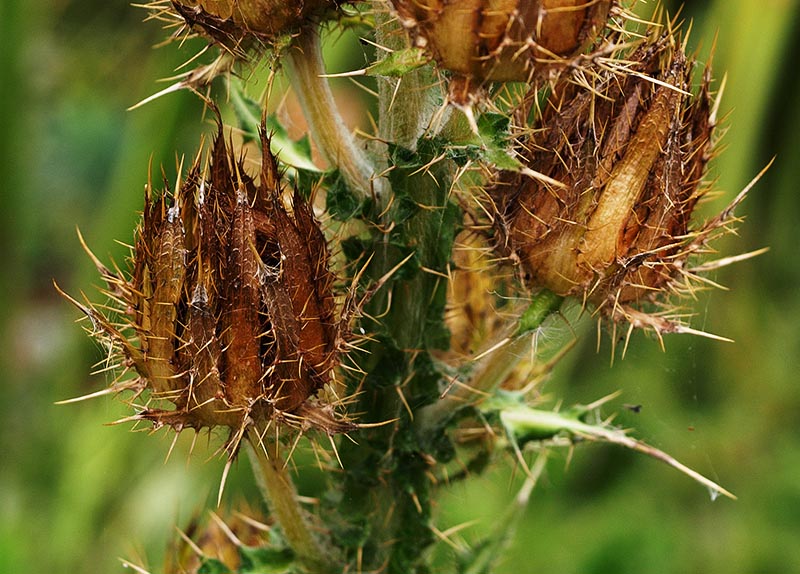
prickly seed-head
I wouldn’t like to touch this seed-head!

Other seed-heads are not at all welcoming to the touch. But they do at least look interesting in a photograph. I’m happy to say that the plant above was in someone else’s garden. I don’t know what it is, but I really wouldn’t fancy brushing against it in a border. Ow!

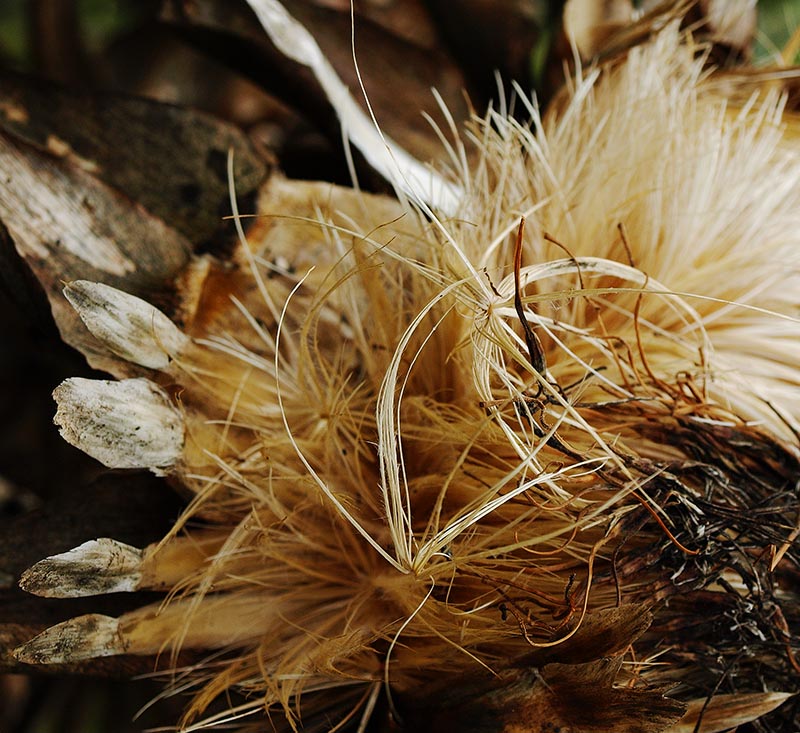
I don’t know what the seed-head in the bottom photo is either. It might be a protea. The photograph was taken in a garden that had big glasshouses, so there were a fair number of  non-hardy plants. The combination of textures and shapes and the soft browns, yellows and creams of this seed-head appealed to me. It’s very different to the seed-heads that I would find in my own garden and, like the Pasque flower, makes me feel that I want to reach out and touch it.

At this time of year, when there are few flowers left and so many garden plants are dying back for winter, seed-heads can linger. I like to leave as many as possible in my garden, so that when the frosts arrive, there will be something to photograph. A coating of frost can make a dried-out seed-head turn into something wonderful – a delicate structure with grace and sparkle. So if you like to photograph plants, it’s a good idea not to be too tidy in your garden. Leave those seed-heads standing and wait to see what magic a touch of frost or snow can bring!

I love to read your comments! Do you have any plants that you like for their seed-heads?

Seed-head
Mystery seed-head – could it be a protea?

Rowan Lore

Red rowan tree berries

Autumn is the ‘berry time’ of year. In our neighbours’ garden, a rowan tree is now heavily laden with glistening red fruits.

This small tree reminds me of the rowan trees that grew in the garden of my childhood home in the north of Scotland. Rowans can often be seen growing beside houses throughout the Scottish Highlands.

In the past, these trees were seen as a ‘lucky’ tree – a superstition which was a diluted form of earlier beliefs in the rowan’s magic powers, especially as an antidote to evil.

In Britain, the rowan was once regarded as one of the most powerful protectors against the forces of darkness. It was believed to keep away witches and malicious spirits and to avert the evil eye.

Witches were believed to be afraid to come near a rowan tree because, if a christened person should touch a witch with any part of the tree, then the Devil would be entitled to carry her away to Hell as his tribute.

Faeries and spirits also kept their distance from the rowan. An old tale tells of a woman who prevented a ghost’s return to its grave by barring its way with a rod of rowan.

Another tale shows that even the Devil himself was believed powerless against the supernatural force of the rowan. A young miller’s apprentice had rashly arranged to meet the Devil. His anxious friends advised him to take a rowan branch with him, draw a circle around himself with it and, whatever happened, to remain within the circle.

When the Devil appeared, he threw a book to the boy and asked him to write his name in it. The boy refused to return the book. Enraged, the Devil made the most terrifying attempts to reach him, but could not break through the magic circle. Defeated, the Devil eventually disappeared, leaving his book in the hands of the startled apprentice.

Since any part of this magical tree was able to turn aside evil, both its wood and its berries were used to make charms.

To make a more powerful charm, red thread was combined with rowan because red, as the colour of blood, possessed a strong magic. Red rowan berries were strung on a red thread to make an amulet which could be placed around the neck of a child to keep it safe from the powers of the unseen world.

”Rowan tree and red threid

Gar the witches tyne their speed”

(Scots traditional charm,  gar = makes,  tyne = lose)

Red thread was also used to bind rowan twigs in the form of a cross which was frequently used to protect young children and livestock. During the dangerous period before baptism, when a new-born child was particularly at risk from witchcraft, the evil eye, or even abduction by faeries, a rowan cross might be fastened to its clothing or to the cradle.

Beltane (1 May) and Halloween were reckoned to be the most dangerous times of the year, because evil forces were then at their strongest. To stay safe, it was wise to carry a sprig of rowan or even to have a piece of rowan wood sewn into your clothing. You might also place a rowan cross above the doorway of your house to make sure that no witches could get in.

It was thought unlucky to use rowan for ordinary firewood, or to cut one down, except for special uses. The tree that protected the Scottish Highlander in life, sometimes protected him in death too, for a coffin or bier made of rowan wood was regarded with great respect.

During its long history as a magical protector, the rowan has earned affection and respect. Nowadays, however, it is more valued as a graceful garden tree which is also very beneficial to wildlife. Next time you see one, I hope you’ll think of the significance the rowan has had for our ancestors and, maybe, imagine how they felt about it. Sometimes a tree isn’t just a tree!

I’m intrigued by beliefs, superstitions and folk-tales about the plants that surround us. I’d love to know more, so if you know any, I’d be delighted to hear about them in the comments……

Not Always Greener

red-flowered miscanthus grass

Late summer and autumn can be a great time for grasses in the garden. Some change colours around this time and there’s an amazing variety of flower and seed heads which add texture and interest to garden borders.

Grasses can give a lovely ‘natural’ look to a garden and help to create a relaxed atmosphere, especially when they’re grown with the other plants that are at their best at this time of year – rudbekias, echinacea, heleniums and asters are the obvious ones. (The slightly ‘wild’ look that many daisies have makes them ideal companions for grasses.)

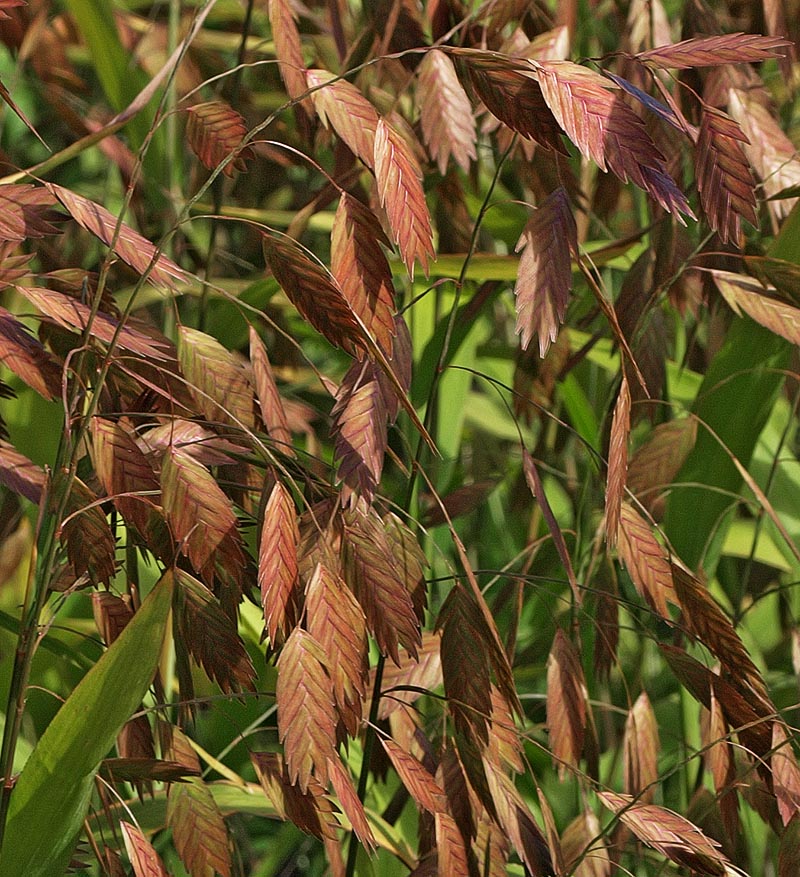
Chasmanthus latifolium
The flat heads of this chasmanthus are a lovely coppery colour

The natural look of grasses can create a problem because they don’t look right with many of the more traditional plants. Hybrid roses, for instance and many of the double-flowered plants (like clematis).

In my own garden, the solution has been to create different areas. (Not that easy because it’s not a very big garden.) In one area, the planting is what I’d describe as ‘modern cottage-garden’, with a wide mixture of flowering plants, including roses and clematis, small shrubs, herbs, and bigger plants such as lilac, wisteria, philadelphus, viburnum and hydrangeas. The other area is beside the site for my in-progress pond. (Still digging!) This is where the planting will be much more informal. The perennials in this area are generally taller. I have the little yellow sunflower, Helianthus ‘Lemon Queen’ and Japanese anemones here, as well as crocosmias – all of which can be very thuggish. So the plants going into this border will need to be vigorous enough to make their own claim on some space without letting themselves be crowded out. (And there may need to be quite a bit of interference from me to ensure fair play!)

Grass flower-heads
Grass heads like these add a lot of texture to a border

When I was a kid, I was very attracted to the textures of grass heads and loved to run them through my fingers. (Sometimes stripping off the seeds – I must have spread a few plants around that way!) This tactile quality of grasses helps to make the garden a more inviting place. Somewhere that you can touch the plants, feel them in your fingers and become involved with them – not just somewhere that you look at from a distance.

If you look at them closely, grasses, especially the flower heads, can have a lot of detail. They can be delicate and airy, bold and attention-grabbing, brightly-coloured or subtle, and some have a slightly metallic sheen to them. They are wonderful when they are back-lit by the low light of autumn, even more so if there’s a spider’s web sparkling with dew-drops suspended from the leaves.

Grasses, like other plants, are a reason to spend time in a garden: time just looking and enjoying the detail. There’s a quote from writer Henry Miller that is particularly appropriate here, ‘The moment one gives close attention to any thing, even a blade of grass, it becomes a mysterious, awesome, indescribably magnificent world in itself’.

Do you enjoy the details of plants? Does anything particularly catch your eye? I’d love to know in the comments!

Panicum virgatum
The delicate heads of Panicum virgatum

A Plant Photographer’s Paradise.

I’m lucky that East Anglia has some great gardens to visit. Last weekend there was the chance to get over to the Fullers Mill Garden near Bury St Edmunds, before it closes for the season. (It’s open from the start of April until the end of September every year.)

The garden is entered by a narrow lane that passes through the edge of the ‘Kings Forest’, Forestry Commission woodland at West Stow. So as soon as you arrive, you are surrounded by the sound of the wind rushing in the trees. This changes when you get right into the garden and arrive at Fullers Mill Cottage – now the sound you will hear is the River Lark forcing itself through a narrow weir before it spreads out again and becomes calmer on its journey through the garden.

As you continue into the garden, the sounds from the forest and the weir recede and you’re surrounded by a feeling of tranquility and calm. Even when the garden is full of  visitors, you can find a quiet spot just for yourself. (And if you’re lucky, it might just happen to have one of the benches that are dotted around the garden.)

House and border at Fullers Mill Garden
Left: Looking towards the house. Right: A shrub border

The original garden at Fullers Mill was small when the creator of the garden, Bernard Tickner and his wife Bess bought the cottage in 1958. Over a period of more than 50 years, Bernard was able to gradually buy land from the Forestry Commission and turn it from rough ground into a garden filled with a vast collection of  plants, many of them uncommon and unusual.

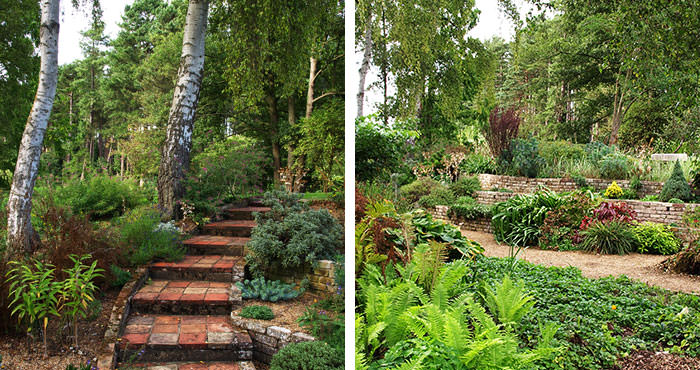
Steps and terraces at Fullers Mill Garden
Steps and terraces in the Low Garden

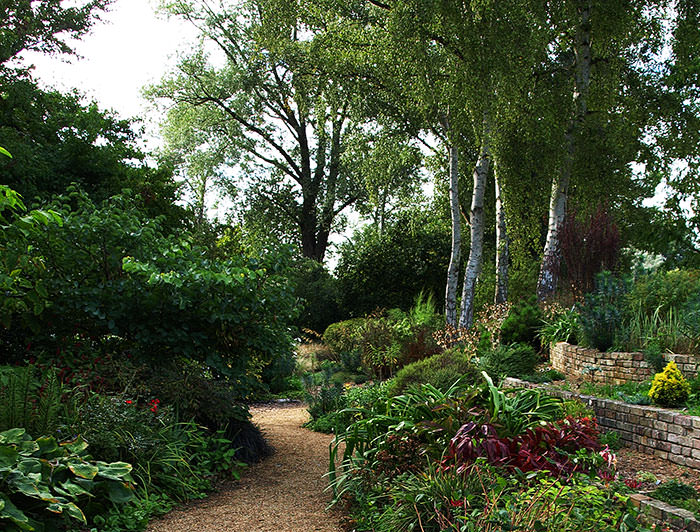
The first area to be developed was the ‘Low Garden’ (Photographs above and below). The terraces here are full of flowering bulbs in spring, and in summer there are the beautiful flowers of the giant lily, Cardiocrinum giganteum.

Path below the terraces at Fullers Mill Garden
Path below the terraces

Bernard said that his ‘gardening heroine’ was Beth Chatto and reckoned that there was a similarity in the way both gardens grew and developed over time. The gardens now cover seven acres and offer a wide variety of planting conditions. While the Low Garden has a mix of shady and sunny areas that suit woodland plants and lilies, the Top Garden has poor soil and dry conditions, so is much better suited to Mediterranean plants. Moisture loving plants are happy around the mill pond and along the river and stream banks. (The garden has both the River Lark and the Culford Stream running through it.) There are open areas too, so sun-loving plants can also be found a suitable home.

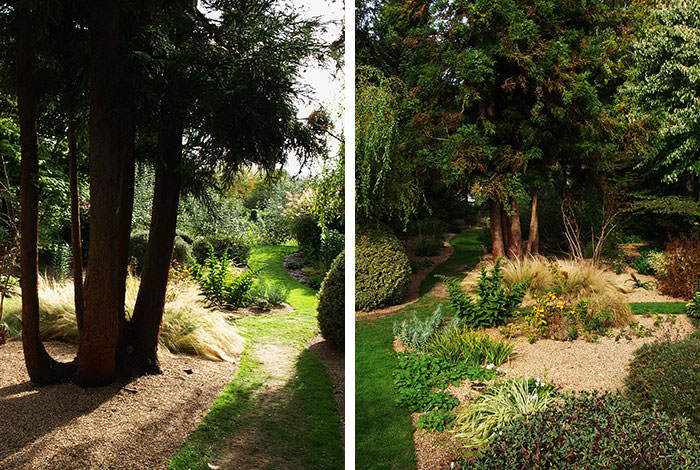
Trees in Fullers Mill Garden
Two views of the same area in the ‘Top Garden’

One of the great things about having such a wide range of growing conditions is the sheer variety of plants that can be grown. I was amazed by the huge number of different trees, shrubs and perennials growing here. It made me wish that I had a better knowledge of plants and could recognise more of what I saw. I suspect that even then, I’d still find that there were a lot of rare or unusual cultivars here that I didn’t know.

For me, the wonderful collection of plants was an opportunity to take lots (and lots!) of photographs. I could easily spend days in this garden and still find that I wanted even more time for photographing the plants. (My husband did have some difficulty in getting me to leave the garden. Next time, maybe he’ll just leave me there!)

Flowers in Fullers Mill Garden
There were plenty flowers to keep me busy taking photographs!

Despite the fact that there are large collections of plants (around 70 or more euphorbias and the same number of lilies and snowdrops are just a few of these), the garden is designed to be in sympathy with the character of its site. The river and stream areas are allowed to keep a fairly natural, informal look and the planting in the woodland areas feels very appropriate – somehow very ‘comfortable’ there. This is the sort of garden that I love. (I’m much less keen on formal gardens and have never come to like topiary or parterres – or even box edging.) Overall, the feel of the garden is unfussy and relaxed, and extremely welcoming.

Perennial border and riverbank at Fullers Mill Garden
Left: A perennial border Right: The river bank

In 2013 Fullers Mill Garden was gifted to Perennial, The Gardeners’ Royal Benevolent Society to ensure its future and keep it open for visitors to enjoy. Bernard remained involved with his garden right throughout his later years. (He died last year, at the age of 93.) In a radio interview when he was almost 90, Bernard said that he didn’t believe a garden was ever finished. ‘I’m still buying plants, much to Annie, the head gardener’s distress, because then she’s got to find a spot for them. And I say, ”You can find somewhere Annie, to fit those in”. And she does eventually…it may take a little while.’

You can hear the radio interview with Bernard Tickner here. It’s easy to hear, from listening to him talk, how much he loved the garden at Fullers Mill and how how happy it (and gardening) made him. That happiness is something that the visitors to the garden can’t help but share. It’s a delight to stroll around the peaceful grounds along the banks of the river and stream, to walk under the trees and to discover all the wonderful plants tucked into every corner of the garden.

Riverbank at Fullers Mill Garden
The riverbank retains a feeling of wildness and informality.

Fullers Mill Garden is now looked after by head gardener, Annie Dellbridge and her team of gardeners and volunteers. They tend the garden with obvious loving care and make visitors very welcome. (The garden is open from the start of April to the end of September, on Sundays, Wednesdays and Fridays. You can find full details on their website here.)

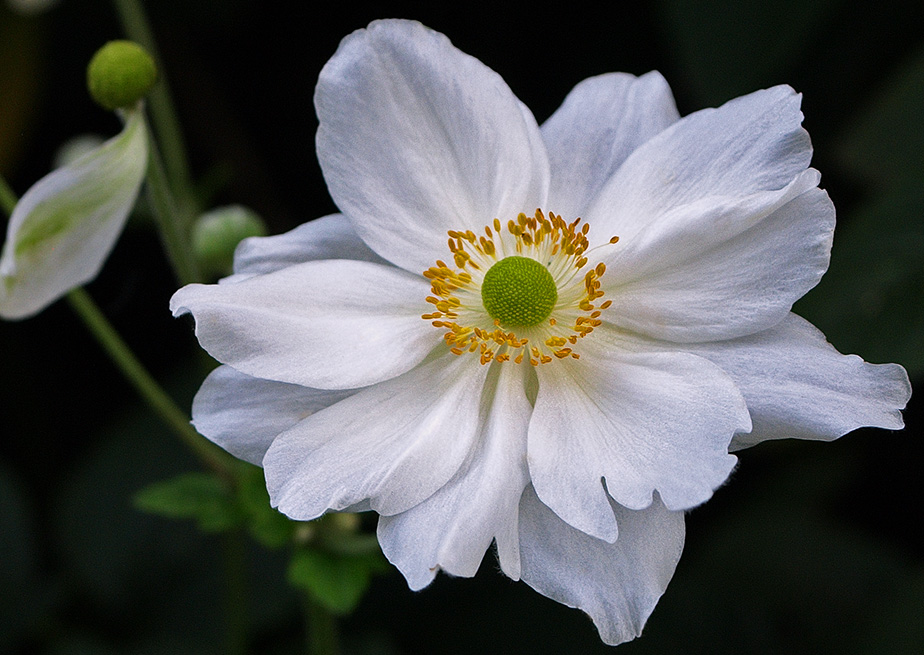
I fell in love with this garden and I know I’ll be back for several visits next year. And I even managed to bring a little bit of it home with me by buying a couple of white Japanese anemones and an aster, ‘Les Moutiers’.

Bernard Tickner said he liked the idea of buying a plant raised in a garden as a memento of it. But then, he was a man thoroughly in love with plants. I’ll give him the last word here, because it’s something I feel too (and I do hope he’s right!): ‘I love plants. Once you’ve got the ”disease”, you’ve got it for life. It doesn’t ever desert you.’

Autumn colour at Fullers Mill Garden

A Change In The Air

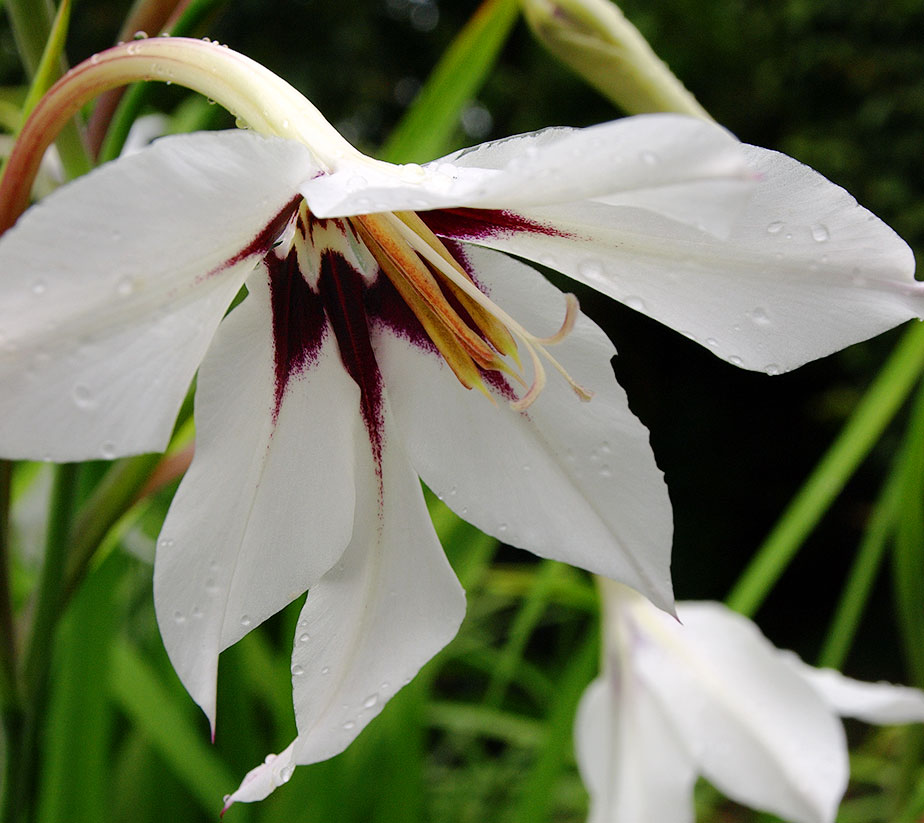
Acidanthera murielae (aka Gladiolus callianthus)

There’s been a change in the last week or so. Early mornings have been misty and daytime temperatures have dropped enough to make it feel like time to put the summer clothes away. (Though after the extremely hot days we’ve had this summer, anything ‘normal’ will feel very cool.)

We’re no longer woken by the light in the early hours of the morning and the evenings suddenly feel darker.

I love the beauty of autumn – the changing colours and (especially) the softer light that it brings. It’s a light that has lost the harsh glare of summer, making it much better for photography.

Even so, I always feel a slight melancholy at the ending of summer. It’s something I’ve felt since childhood. I was brought up in Caithness, the ‘far north’ of Scotland, where it seemed to hardly get dark at all on summer nights. That, coupled with the long school holidays created a marvellous feeling of freedom and unlimited time. (And the windy winter days, when darkness would fall by about 4 pm were, by contrast, something to dread.)

Now, as a keen gardener, it’s not just the leisure of summer that I miss, but all of its plants and flowers too. I miss watching new leaves unfurling and buds fattening up and showing that first little sliver of colour before they pop open and reveal their glorious petals…..but this year is different. Because I can see that I need to be more positive and enjoy the moment rather than regretting the fact that summer is ending. Instead, it is time to plan for next year and to do the work that was impossible in summer. (Right now that means digging. A lot of it. The hot weather meant that the ground became rock hard and my plans to dig a pond and new borders have been put off until this last couple of weeks. It’s amazing how much easier a drop of rain makes the work!)

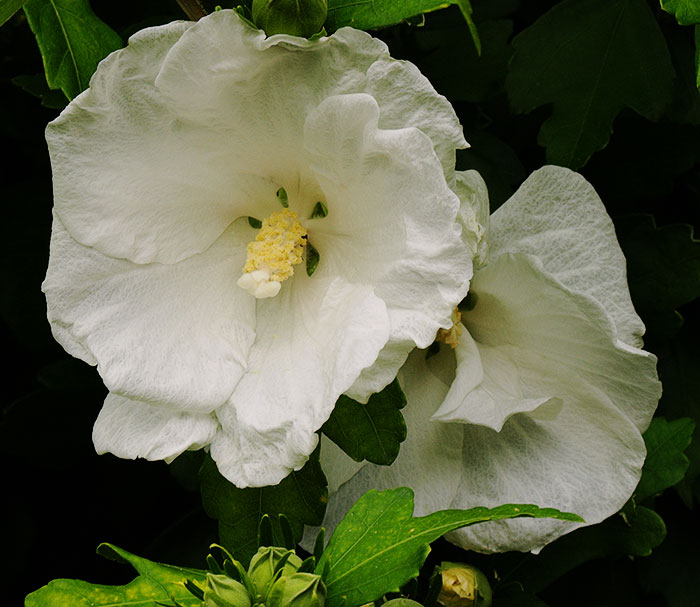
white Hibiscus syriacus
A white hibiscus would look good near the acidanthera.

Of course, new borders means new plants too. The fun part! And time to indulge in a bit of fantasy…. That’s where the photo at the top comes in. I saw the acidanthera in a garden last September and was impressed by how graceful they looked. (Much taller than I expected too.) So now I’m imagining how lovely they would look reflected in the planned pond and thinking what else might look good on that side of the garden – particularly if it’s a plant that looks good now and helps to extend the life of the border later into the year. (My overall plan is to have a garden with plenty to photograph for as much of the year as possible.)

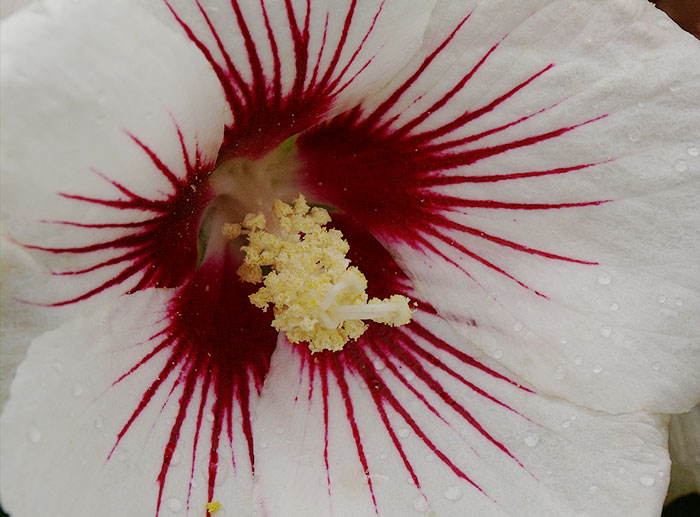
The white hibiscus was in a garden I visited a few weeks ago. It has a simple elegance which I think would look good if I keep the planting around the pond fairly unfussy. (And I already have a couple of other hibiscus bushes in the garden which still have some flowers, so there’s a decent length of flowering period.) The white hibiscus with red markings (below) would echo the colouring of the acidanthera but would be a bit much if planted close to them and could look too fussy in the pond area.

White Hibiscus syriacus with red markings
Showy but very pretty – for further along the border perhaps.

Other flowers that could look good planted in my imaginary (so far!) border would be white gaura, with it’s flowers that look like dancing little moths or tiny butterflies and the dark buttons of the tall red scabious that already seeds itself around my garden.

My mother would never have approved of this white and red border – she always said the two colours should never be used together for cut flowers because it was unlucky. (The colours suggest blood and bandages, apparently.) And this was from someone who denied that she was the slightest bit superstitious…hmm. (Anyway, a real border would have other colours too – not sure what yet.)

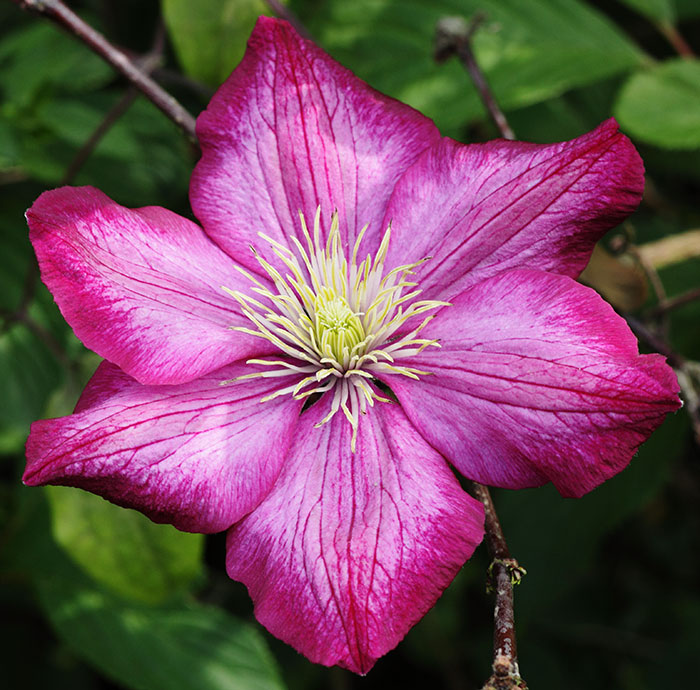
It’s quite fun to design a fantasy border, and to finish with, I can’t resist adding a clematis to the mix. (They’re one of my favourites and I find them very hard to walk past in the garden centres. This one is in my garden already and it’s called ‘Ville de Lyon’.)

If you have any suggestions for planting to go around my pond and the border behind it, please do add them in the comments. I’m happy to gather as many ideas as possible because the pond and border will be a reality next year – I’m digging them at the moment!

Clematis 'Ville de Lyon'
I always have clematis in my borders.

A Favourite Garden

I’ve mentioned before that I enjoy visiting other people’s gardens. They’re a great source of both pleasure and inspiration. One of my favourites to visit is the lovely garden created by the late Beth Chatto at Elmstead Market in Essex.

Fortunately for me, I live in the neighbouring county (Suffolk) and I’ve been able to visit the Beth Chatto Garden many times over recent years. But my first visit to the garden was much earlier, while I was still living in Scotland. At the time I was still fairly new to gardening and Mrs Chatto’s book, ‘The Green Tapestry’ had just come out. The book soon became one of my most relied-on sources of information about how to create a garden, so it was a great treat to actually be able to visit the garden that had inspired it.

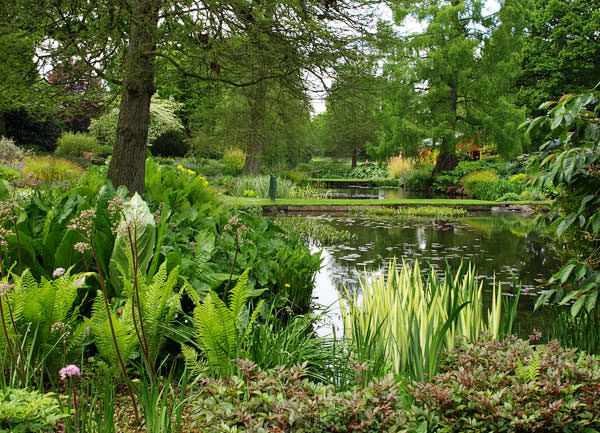
Water garden at the Beth Chatto Gardens
The view as you enter the garden and look towards the ponds

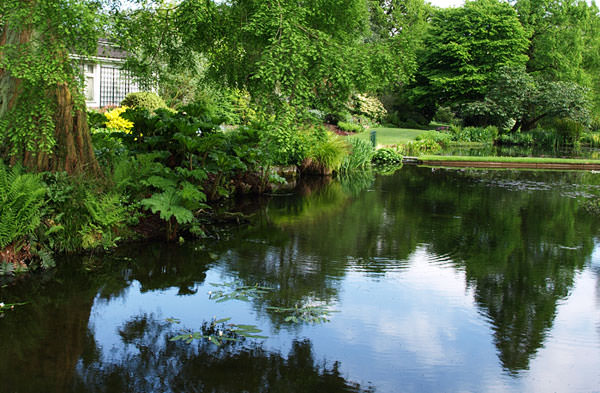
As you walk into the main part of the gardens, your eye is caught by a series of four large ponds that form the impressive centrepiece of the garden. The water-garden was created to take advantage of  water coming from a natural spring and to solve the problem of what would otherwise be heavy, waterlogged ground. The results are beautiful and invite you to wander and linger or just have a seat on one of the benches and relax.

Water garden planting at the Beth Chatto Gardens
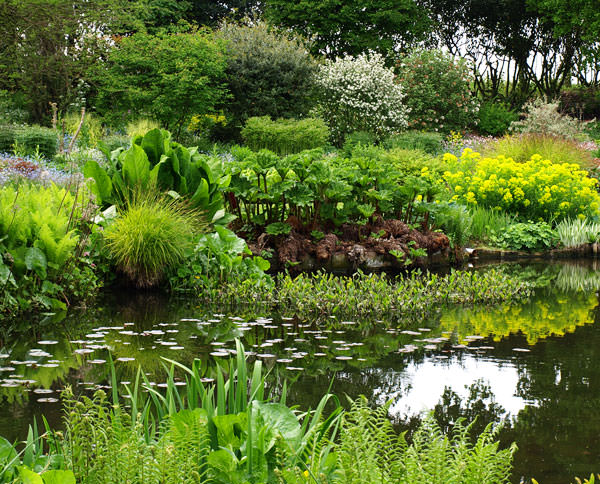
Planting along the bank of one of the ponds

It was late spring when we visited and there was new growth everywhere. The garden changes a lot with the seasons and can be dramatically different when the plants have grown to their full size later in the year. Our previous visit had been last autumn, so this felt like quite a contrast, with everything very fresh and green and full of promise for the summer.

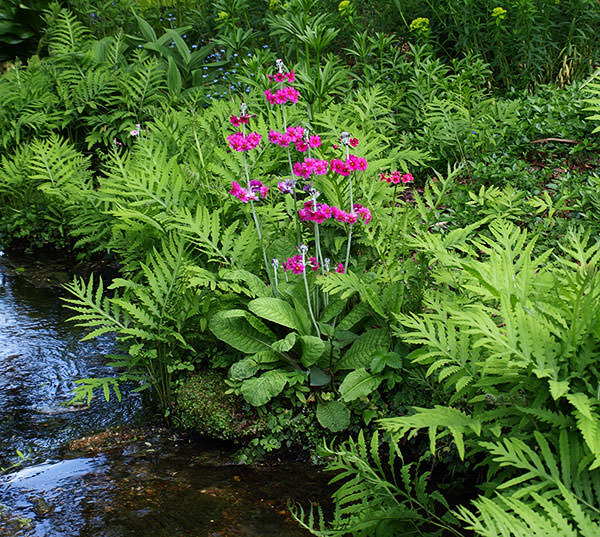
A candelabra primula growing by the water

Many of the plants here are familiar to me from Scottish gardens – candelabra primulas, gunnera and ferns particularly – but sadly they won’t grow well in my own very hot and dry garden. (One of the things I learned through reading Beth Chatto’s books was the importance of choosing the right plant for the situation. I’m afraid I condemned a few plants to a slow death by putting them in entirely the wrong place in my earlier gardening days!)

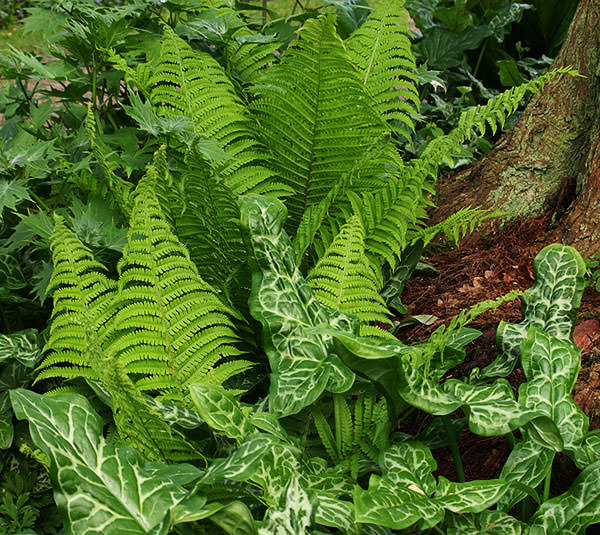
Arum italicum 'Pictum' echoes the shape of the fern but has a contrasting texture and markings.
Arum italicum ‘Pictum’ echoes the shape of the fern but has a contrasting texture.

The planting in the garden is a delight. I love to see the way texture and shape are contrasted (as in the photo above). Actually, I’d really like to grow Arum italicum ‘Pictum’ in my own garden because the lines on the leaves make it a great subject for black and white photographs. (The wild arum keeps popping up here, so it should do well enough.)

Looking across part of the water garden

Our visit to the Beth Chatto Garden was partly prompted by wanting to get ideas for making a pond in our own garden. (OK, so our pond will be absolutely tiny in comparison, but you might as well look for inspiration from the best!) And there’s a nursery at the garden, so inspiration can easily turn into a few plants to take home with you…
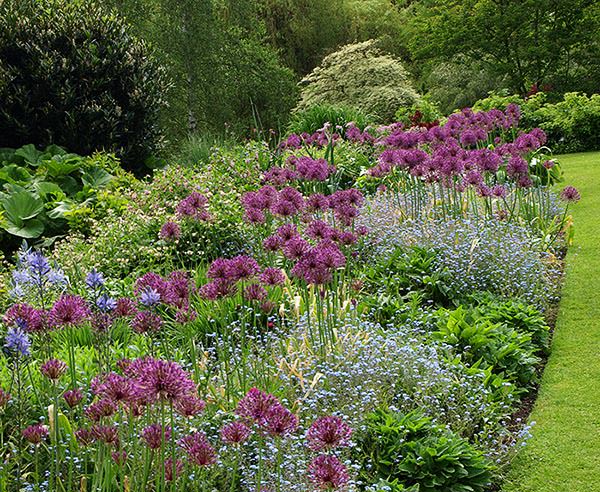
Alliums and forget-me-nots in a border

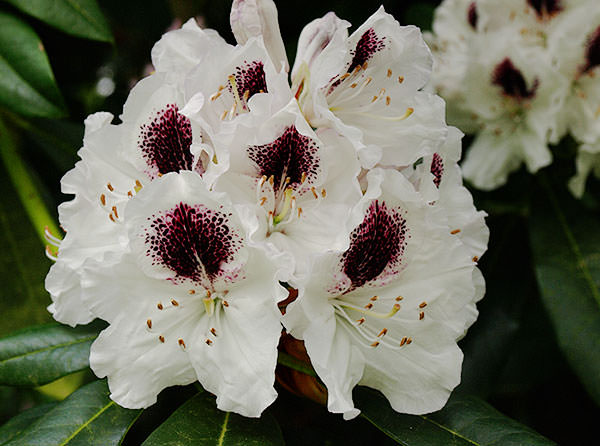
Of course, there are plenty of familiar plants that I can (and do) grow, like the alliums, camassia and forget-me-nots in the border above. And then there’s the plants that I could grow when I lived in Scotland, like the rhododendron below. (Ah, now I really wish I could grow that here!)

White rhododendron
A plant I wish I could have….

The gardens have far more than I can possibly describe here. There appears to be just about any habitat that you can think of – water garden, woodland, shady areas and the sunny scree beds. And then there’s the famous gravel garden with its drought-tolerant planting – it has been a great source of inspiration for our own very dry garden. It’s a garden that I feel I can thoroughly recommend to anyone visiting this area, at any time of year. There’s a nursery and a good tearoom too, so you can easily spend a few hours here.

As you will probably know if you read gardening papers or magazines, Beth Chatto passed away in May this year, aged 94. She has been an inspiration to many and I know that a lot of my own enthusiasm for gardening has come from reading her books. I feel that her legacy is not just in the beautiful gardens that she has created, but also in the love of plants and the understanding and knowledge of them that she has shared with other gardeners.

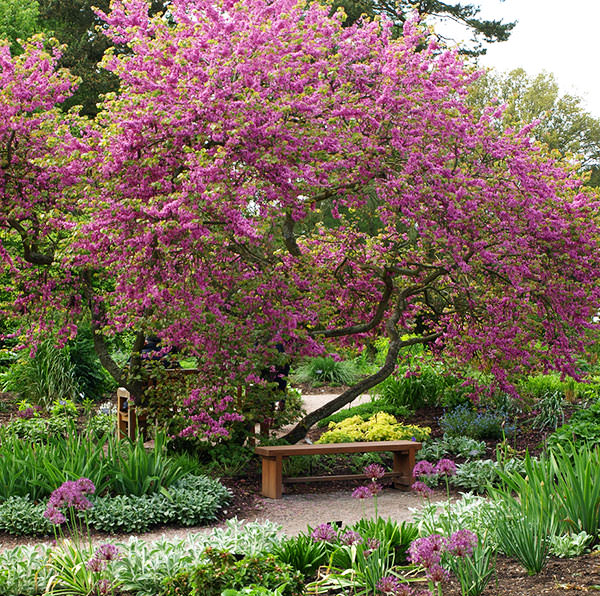
Cercis siliquastrum (Judas tree or redbud)
A quiet spot under a beautiful Cercis siliquastrum (Judas tree or redbud)

A Summer Pleasure

One of the pleasures of summertime is spending a lazy afternoon wandering around someone else’s garden.

Garden-visiting is a source of inspiration for me. It gives me ideas for how I can improve my own garden. (Seeing new plant combinations, and even just the size that mature plants can get to, is tremendously helpful.) And – in many ways more important for me – it allows me to see plants that I would like to have growing in my own garden so that I can photograph them.

My hubby and I had the chance to spend a couple of days staying at Huntingdon (in Cambridgeshire) this week, so we took the chance to pay a visit to the garden at The Manor in Hemingford Grey.

The Manor at Hemingford Grey is said to be one of England’s oldest continuously-inhabited houses. Building was begun by the Normans in the 1130s. (You can see the evidence of this on one side of the house where the windows have the typical Norman building-style that you can see on old churches. Look out for the round-headed window with it’s zig-zag ornamentation in stone above. Lower down on the same wall you can also see a narrow slit of a window…just like you might find on an old castle wall.)

We entered the garden from the path along the River Ouse, crossing a lawn by walking along a path bordered with topiary yews to reach the house itself. Around the house, the garden looked, to me, like a cottage garden on a big scale. It felt relaxed and welcoming in its informality – just the place to put visitors at their ease.

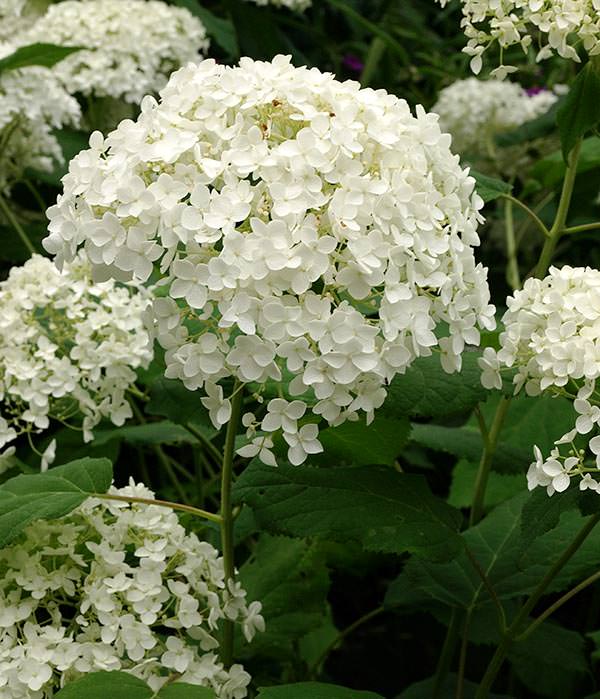
white hydrangea
White hydrangeas add a dreamy softness to the planting

Visiting in mid-July meant that the roses that the garden is well-known for were over and the flower borders were taking on a late-summer feel. Some areas were bright with the reds and yellows of crocosmias and rudbekias, while other areas were more delicate, with plants such as hydrangeas and daucus carota (wild carrot) adding a more romantic feel.

yellow rudbekia at the Manor, Hemingford Grey
Bright rudbekias gave a sunny touch to the borders

I enjoyed meandering around the garden with camera in hand. Photographing flowers in a garden that you’re visiting is more difficult than it would be in your own garden. You can’t use a tripod, so a macro lens isn’t ideal, nor do you have any control over lighting or the placing of the plant. So for me, the camera is more of a notebook-tool when I’m garden-visiting. It lets me see what plants appeal to me as future subjects and what their possibilities may be. (And it fuels my plant-buying too!)

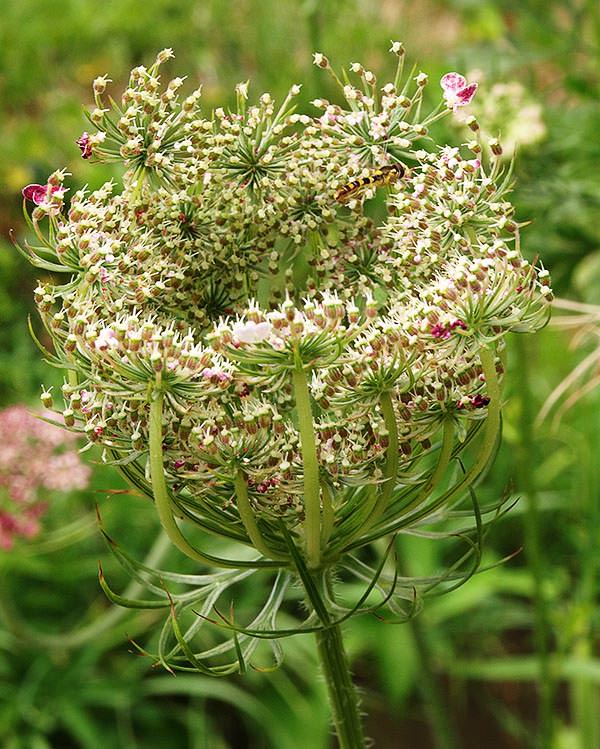
Daucus carota (wild carrot)
Daucus carota (wild carrot) is a plant that I want to grow in my own garden.

One of the plants that really caught my eye was the wild carrot (Daucus carota). It is a wonderful shape for photographing and would repay the effort of using a proper macro lens and a good hefty tripod. I have already sown a few plants, which are still tiny and won’t flower until next year. So it was interesting to see the full-grown plant here and to see just how lovely the structure and textures of the plant are. (I think they were probably growing the same variety as I have sown – ‘Dara’, which produces flowers in pink, burgundy-red and white and gives a beautifully delicate effect.)

It’s lovely to visit a garden and see plants through someone else’s eyes,  to see their vision for the space within their garden, and to see their own ways of combining plants. This is a garden that I’ll make the effort to come back to again – hopefully timing a visit so that I can see their wonderful collection of irises and then again so that I can see their roses.

We could have visited the house as well as the garden and will do next time. (Visits to the house need to be booked beforehand.) Many people come to see the house because it is the setting for the series of children’s books about ‘Green Knowe’ by Lucy Boston. Her daughter-in-law, Diana Boston, gives a tour of the house that sounds both charming and highly entertaining and would be an essential for fans of the Green Knowe books.

The Manor at Hemingford Grey has a website, which you can see here:  https://www.greenknowe.co.uk/

My Favourite Source of Inspiration

garden border in summer

I’ve always loved gardens. Early morning in summer is the best time in mine. It’s still peaceful then, and the demands of the day can be ignored for a little while.

Part of what makes it feel so special to me is the quality of the light at that time of day. It hasn’t yet got the bright glare that it will have later on. Instead, the light slants into the garden, picking out the textures of soft, feathery grass heads and glowing through the translucent petals of flowers. It brings a feeling of joy.

I’m certainly not an expert gardener, so it feels like a small miracle when plants grow well. (Especially if they haven’t had the care they should!) Self-seeded ”babies” are an excitement and sometimes a mystery…

sweet pea and aster flowers
Sweet peas and asters grown for a photograph

There are failures too, and there are always plenty of weeds, but somehow the garden always feels like a place of hope.

From childhood, I’ve been attracted by the look of plants. Not just for their colours, but for their textures and their structures too. (Think of the velvety petals of a petunia or of almost metallic-looking Allium christophii flowers.)

As I’ve grown older, my interest has widened to include the history of plants, the folklore, the stories told about them. (In general the relationship between man and plants. Probably because, for me, it represents the link between ourselves and nature. Because we are a part of nature too.)

There you have it – I’m a plant nut! (And always will be.) And yes, you may have found me out – photographing plants makes an excellent excuse for buying more!

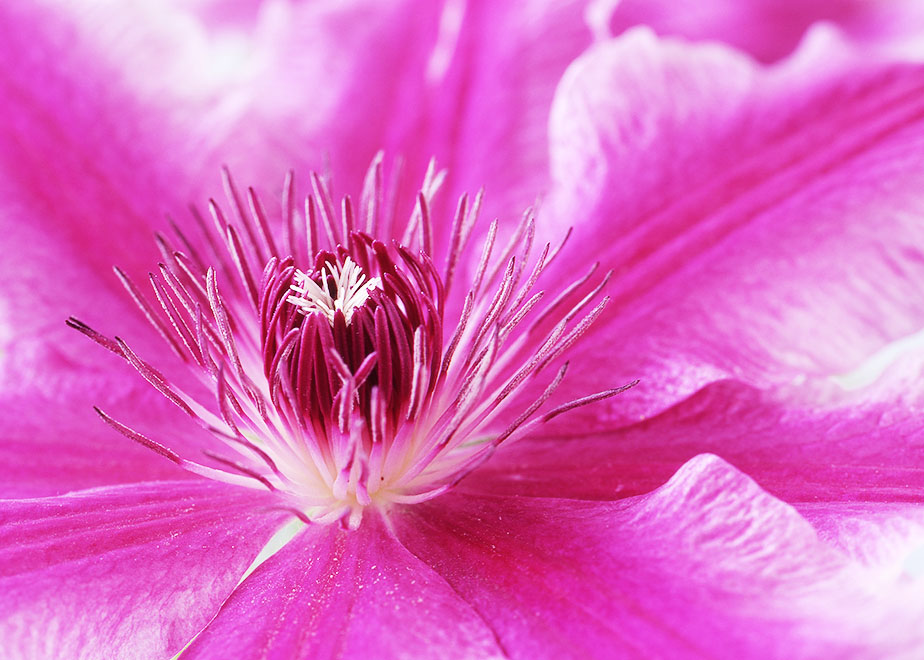
clematis flower close-up
One of my favourites – a clematis