Autumn Elegance

Japanese anemone 'Honorine Jobert'

NB: A note for WordPress Reader users – you need to click on the title of the post again to see the full photograph. (Otherwise you see just a tiny section!)

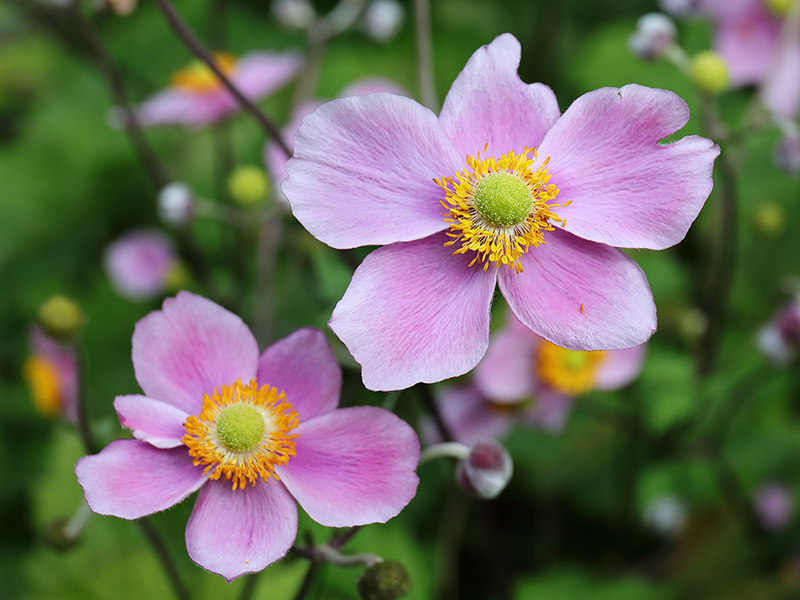
This white Japanese anemone (‘Honorine Jobert’) has just finished flowering in the last week. I’m impressed that the flowers have lasted so well, despite it getting very little extra watering in summer.

Many of the other plants in the garden appeared to finish flowering earlier than usual due to the stress of the hotter than usual weather and lack of rainfall. (Some plants, like the red echinacea have loved the sunshine and produced masses of flowers.)

The pink Japanese anemones here (‘Hadspen Abundance’ and ‘September Charm’, which always flowers much earlier than September) have struggled this year. Both have produced far fewer flowers than usual and much less leaf growth too. Perhaps drought and heat will help to keep these thuggish plants in check in future!

It’s a relief to see that this anemone hasn’t spread as much as the pink ones. So far it hasn’t caused any problems by crowding the plants around it. (But it has only been in the ground for around three years. Maybe it will start a takeover bid when it has had more time to get thoroughly established. I will have to wait and see.) Originally I had thought of keeping this plant and a second one in pots to limit their spread but eventually decided that they would be better off in the ground.

Japanese anemones may be inclined to swamp their neighbours, but so far ‘Honorine Jobert’ has been much better behaved than her pink cousins. Even if that does happen, I will have to forgive the plant because the white flowers with their touch of glowing yellow are delightful, especially when the other flowers are fading away.

(Almost) Silent Sunday: Passionflower

Passionflower (Passiflora caerulea)

NB: A note for WordPress Reader users – you need to click on the title of the post again to see the full photograph. (Otherwise you see just a tiny section!)

I’m having a little break this week because a very dear friend who lives a long way away has come to stay. Lots of fun and friendship here, but not much attention for the garden for a little while. Back to normal next week! 🙂

Brief Glories

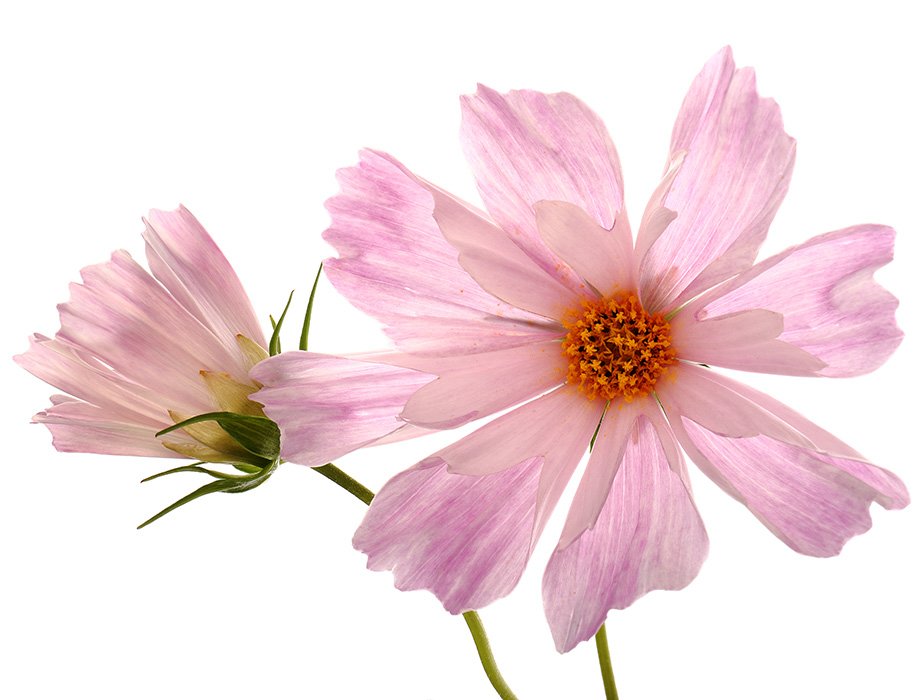
Flowers of Cosmos 'Seashells'

NB: A note for WordPress Reader users – you need to click on the title of the post again to see the full photograph. (Otherwise you see just a tiny section!)

My title isn’t entirely true! Annuals, like the cosmos in this post, can flower for months. But here I’m thinking of the difference between annuals and perennials.

Most of my garden is made up of perennials because I rely on them coming back year after year and gradually spreading. I wouldn’t have time to grow much from seed every year, so I need plants that are long-lived and can pretty much do their own thing once they are planted.

That makes lots of sense for building up the planting of the garden. But annuals have the advantage of providing me with something new to photograph. These – such as the zinnias, cosmos and nigella I’ve grown in past years – add some variety to the images I can create. This year I’ve missed having that variety because I didn’t grow any annuals at all.

There are sometimes a few annuals and biennials that reappear from self-sown seed. The love-in-a-mist (nigella) manages to spread itself around, as do evening primroses, wild carrot (daucus) and borage (which gets everywhere if it gets a chance). This year I’ve noticed that there is a small self-sown cosmos in a border. I’ve never had them do this before, so it’s an unexpected surprise and I’ll have to wait to see what the flower will be. (Probably a pink and white ‘Candy Stripe’, since they were the most recent. You can see them here.)

Waiting for that little cosmos bud to open is making me feel that I must make time to sow some annuals next year. I’ve missed the added interest and excitement that growing something new and unfamiliar from seed brings. Hmm, now I need to look at some seed catalogues… 🙂

Flower of Cosmos 'Seashells'
Flower of Cosmos ‘Seashells’

Low-Growing Beauties: Herbaceous Clematis

Clematis Sapphire Indigo

NB: A note for WordPress Reader users – you need to click on the title of the post again to see the full photograph. (Otherwise you see just a tiny section!)

Tall, climbing clematis are amongst my favourite plants. I love the different flower forms, as well as their wonderfully rich colours and the velvety look of their petals. But I can struggle to keep them going here, in the dry and baking soil of my East-Anglian garden.

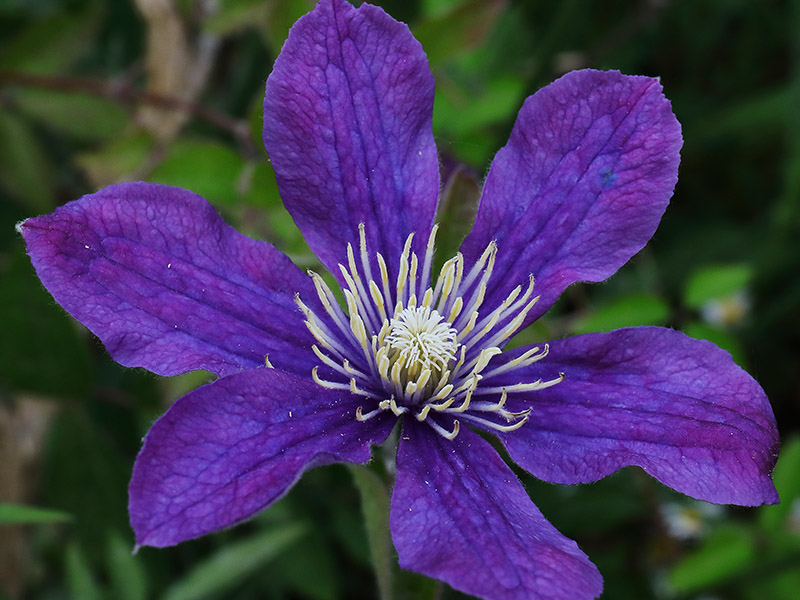
The short-growing herbaceous varieties of clematis may be a dependable alternative here. I have two at the moment: ‘Sapphire Indigo’ ( just opening in the top photograph) and the popular ‘Arabella’ below. They have been in the garden for a number of years and have managed to come through the drought and unusually high temperatures of this summer without any extra watering. Both are still in flower now, at the beginning of October and have been in flower on and off from June. (They would probably be more constantly in flower if they had more moisture.)

Clematis Arabella
Clematis Arabella

Reading up on these clematis tells me that they don’t suffer from clematis wilt and that they are long-lived. They have no tendrils to help them climb and are only 30 to 60 cm tall, so are good where they can grow through another plant for some support. I have ‘Arabella’ growing through a shrubby sage that gets to over 60 cm and provides a useful home where the clematis can lean against its twiggy framework.

The only problem that I’ve found so far is that slugs and snails like snacking on the flowers. So I’ll need to find something gritty or prickly (we have a holly and mahonia bushes, so perhaps some of their leaves) to sprinkle around the stems in the hope of keeping these marauders away.

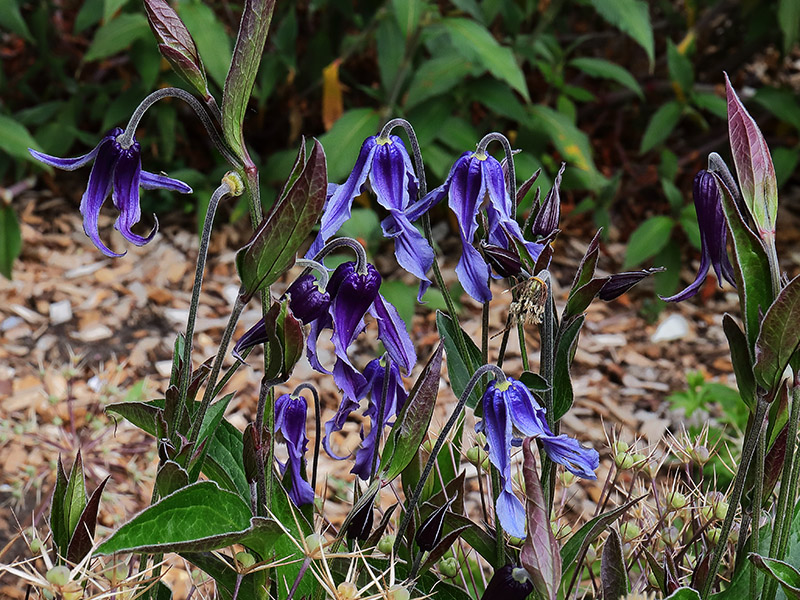
The flowers on these two plants start off with a lot of purple in their colour when they first open and then gradually become more blue as they age. (You can see the newly-opened flowers of ‘Arabella’ here.) My last photograph is another purply-blue short-growing clematis, probably a clematis integrifolia. This one was photographed on a visit to Fullers Mill Garden and is one that I would like to try here. These lovely purple-blues are my favourites, but I’m sure I’ll be tempted by pink and white varieties too. For now though, I’m going back outside with my camera to take some more pictures of ‘Sapphire Indigo’…

Clematis integrifolia

Glowing Embers

helenium flowers

NB: A note for WordPress Reader users – you need to click on the title of the post again to see the full photograph. (Otherwise you see just a tiny section!)

Here we’ve gone from unusually high temperatures to autumnal chills in a very short time. I’m still wondering how the summer disappeared so quickly. (And hoping for some more gentle sunshine that we can enjoy rather than be baked by.)

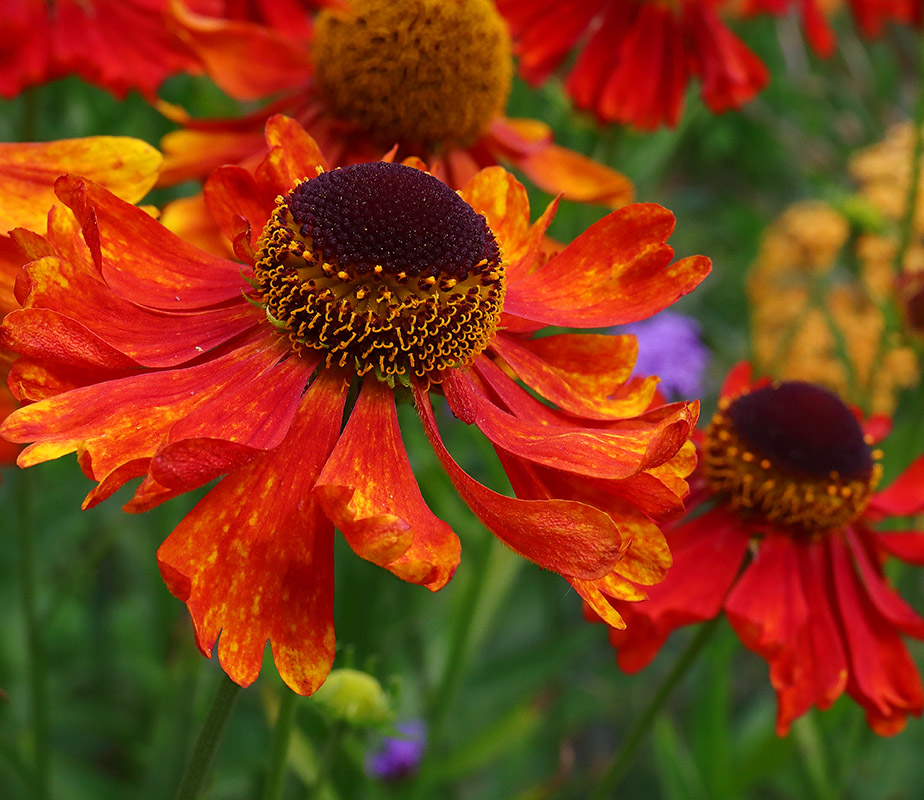
Late summer flowers have become a memory too. These heleniums (aka sneezeweed) are in colours that remind me of that summer heat. They are fiery and glowing and demanded to be gazed at and photographed.

The heleniums in the top image were in a garden I visited. I wouldn’t plant this particular helenium in my own garden because I’m not keen on its combination of colours. However, the flowers made a good picture anyway, so I was pleased to be able to photograph them.

The flowers in the bottom photograph were in my own garden. (Unfortunately the plant didn’t come back this spring – but I think it would have struggled to survive this dry summer, even if it had.) The colour here is much redder than the other plant and makes me think of the hot embers of a fire. Maybe I’ll try to grow it again in the future.

helenium flowers

It’s all in the Detail

zinnia flower

NB: A note for WordPress Reader users – you need to click on the title of the post again to see the full photograph. (Otherwise you see just a tiny section!)

The detail of plant structure has always fascinated me. When you think of the different forms of flowers and plants it’s mind-boggling. Just in the plants you might see in the UK (never mind all those in countries over the rest of the world) there’s an amazing variety, especially in our gardens.

In my own garden, I can, for instance, see the flower of a daisy near a passionflower. Or a rose and the lavender growing by it – such a range of shapes, textures and colours. These differences make for a more appealing garden and they make photography more interesting too.

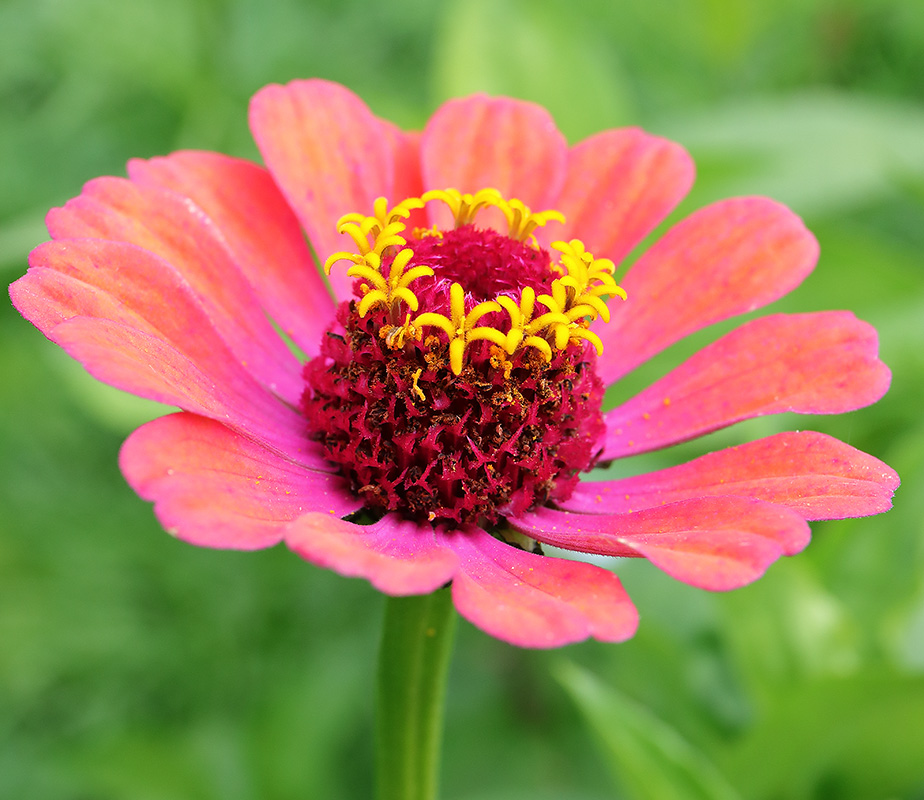
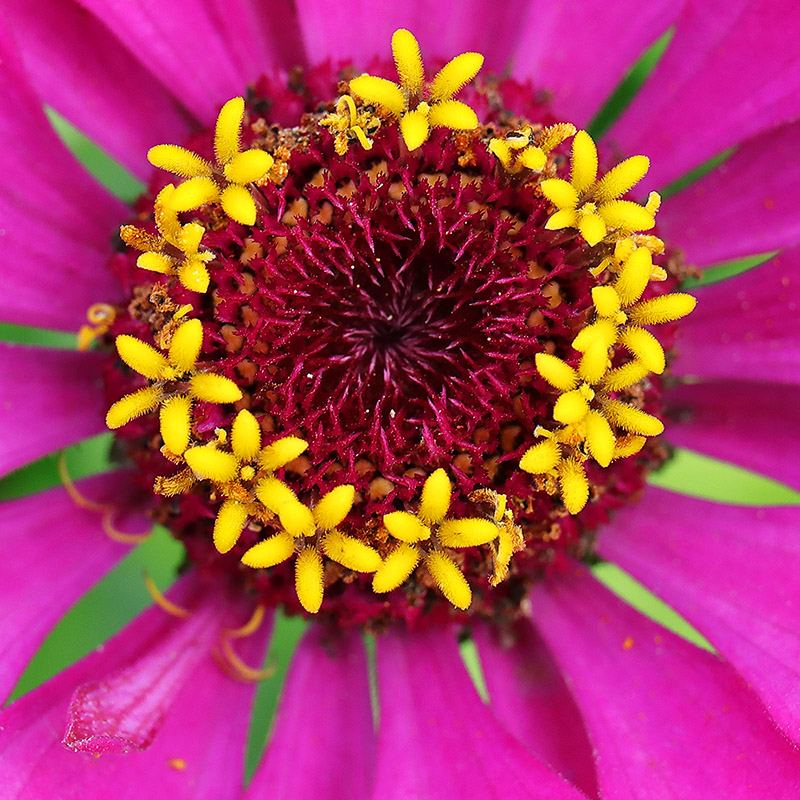
The individual details of flowers entice me to capture them in a photograph. Here, with these zinnias, it’s the tiny yellow ‘disc florets’ that have opened in a ring around the flower centre (the ‘eye’). If you look at the photo below, you can see, tucked deep among the curving red bracts (‘paleae’ or chaff) there are more yellow disc florets waiting their turn to open. Each red palea is like a tiny flag, with a fine tip and a jagged-looking edge. They add an attractive texture and contrast to the other parts of the flower head.

centre of zinnia flower
The ‘eye’ of the zinnia flower head, showing the ring of disc florets and the red paleae in the centre.

As the zinnia matures, the shape of the centre of the flower head becomes more conical due to the growing seeds within. (As you can see in the top image.) The ring of open disc florets advances towards the tip of the cone as the older disc florets finish and the new ones open. This gives a different look from the flatter head of the immature zinnia and new photographic possibilities.

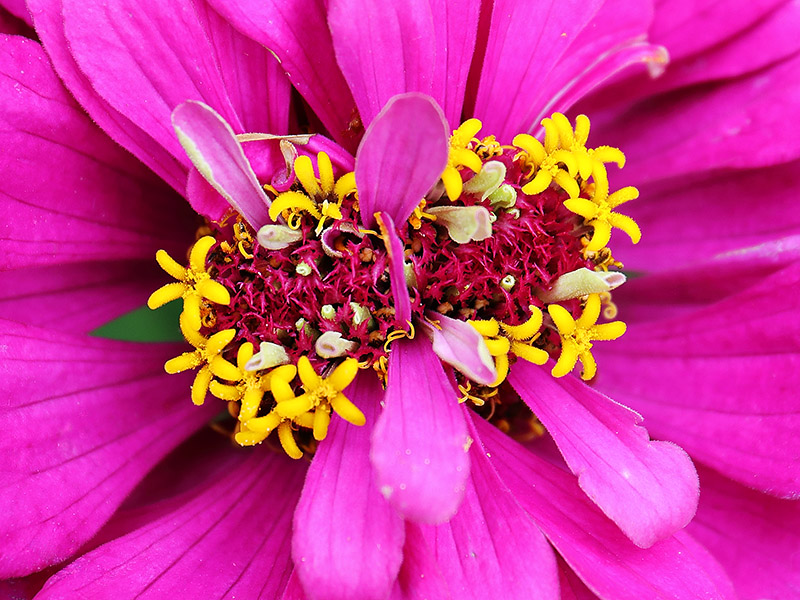
The photograph below shows a variation I hadn’t expected. This flower head has developed fasciation due to abnormal behaviour of the growing tip (perhaps because of damage, disease, genetics or environmental factors). As a result, there are two conjoined flower heads instead of the normal single. It just shows that you never know what you’ll find when you take a wander around a garden!

Zinnia with fasciation

Pink Profusion – or Not!

Anemone huphensis 'Hadspen Abundance'

NB: A note for WordPress Reader users – you need to click on the title of the post again to see the full photograph. (Otherwise you see just a tiny section!)

There are fewer flowers left in our garden than usual this autumn. That’s partly because I didn’t plant any annuals this year. But the main reason is because of the effects of heat and drought on the plants here.

There are still a number of Japanese anemones – even though they too have suffered from the lack of rain. Usually the anemone clumps would be bigger and would have more flowers. Many of the flowers are smaller, presumably because the plants have been able to take fewer nutrients out of the dry soil. So this year this anemone hasn’t been able to live up to its name – ‘Hadspen Abundance’.

In case you’re thinking that these anemones look OK, I need to tell you that the photographs are from last year. I haven’t got much left to photograph in the garden now, so let’s hope they’re a bit more abundant next year!

Japanese anemone 'Hadspen Abundance'
Anemone hupehensis ‘Hadspen Abundance’

(Almost) Silent Sunday: Arisaema

Arisaema flower

NB: A note for WordPress Reader users – you need to click on the title of the post again to see the full photograph. (Otherwise you see just a tiny section!)

It may look slightly sinister as it lurks in the shade, but this plant isn’t carnivorous. The deep flowers are this shape to make sure that they are pollinated by insects. The insects aren’t on its menu!

Alluring Alstroemerias

Alstroemeria flowers

NB: A note for WordPress Reader users – you need to click on the title of the post again to see the full photograph. (Otherwise you see just a tiny section!)

More flowers from Fullers Mill Gardens this week – and I’m glad I have these to post because my own garden is looking frazzled and sad after all the heat and drought. I just hope that most of my plants will survive.

Alstoemerias (Peruvian Lilies) are gorgeous flowers that I would love to grow in my garden. I had thought of buying a couple of the plants earlier in the year. However, I decided to leave it for a while because I already had other plants to find homes for. (Like many gardeners, I tend to buy plants and then wonder where I will have space for them.) I’m glad I delayed, because it has been difficult to keep the garden watered this hot summer and they might not have done well.

Although they look exotic, alstroemerias are reasonably hardy. They just need a sunny, sheltered spot in decent soil that doesn’t get too wet in winter. (Otherwise the tubers may rot.)

Next year I’ll plan to have somewhere ready to plant an alstroemeria or two. I’ll even make sure to reserve some of the best of the contents of the compost heap for them. (It’s very much needed in the soil here!) Then I should be able to grow some beauties like these, and photograph them too of course. My main problem might be deciding which of the many colours to go for…

Alstroemeria flowers
Alstroemeria flowers come in a range of colours, from bold and bright to the more delicate.

Lilies: Deadly Beauty

NB: A note for WordPress Reader users – you need to click on the title of the post again to see the full photograph. (Otherwise you see just a tiny section!)

You may wonder why I’ve gone for such a dramatic-sounding title, especially as lilies don’t pose us a threat. But if you own a cat (or it owns you), you’ll probably know what my reason is. Lilies, especially their beautiful, golden-yellow pollen, are a deadly threat to cats.

If a cat gets lily pollen on its fur, perhaps while brushing past the flowers, and then licks it off, the cat can suffer severe kidney damage which can be fatal. (The other parts of the lily plant are also highly toxic, but less likely to be ingested by a cat…unless it has a habit of nibbling plants.)

Lilium regale – the regal lily – is tall and beautiful.

When I had my first two cats, I had no idea about the damage lilies could do them and I did actually have some lilies growing in a large tub. They were Lilium regale, which is tall, so the cats didn’t get close to the flowers. Even so, the thought of what might have happened if some of the pollen had fallen on them makes me shudder!

Other members of the lily family are equally toxic to cats. Daylilies (Hemerocallis), Lily of the Valley (Convallaria) and Peace Lilies (Spathiphyllum) can all cause damage that needs to be treated by a vet immediately to try to save the cat’s life.

We have two cats here, so I don’t grow any lilies in the garden now. But if I see them growing in gardens I visit, I love to photograph them. The lilies you see here were growing in Fullers Mill Gardens. (Just a few of their lovely collection.)

Leopard Lily (Lilium pardalinum)