NB: A note for WordPress Reader users – you need to click on the title of the post again to come out of the reader and go to the post itself. This allows you to see the whole of the top photograph. (Otherwise you may see just a tiny section!)
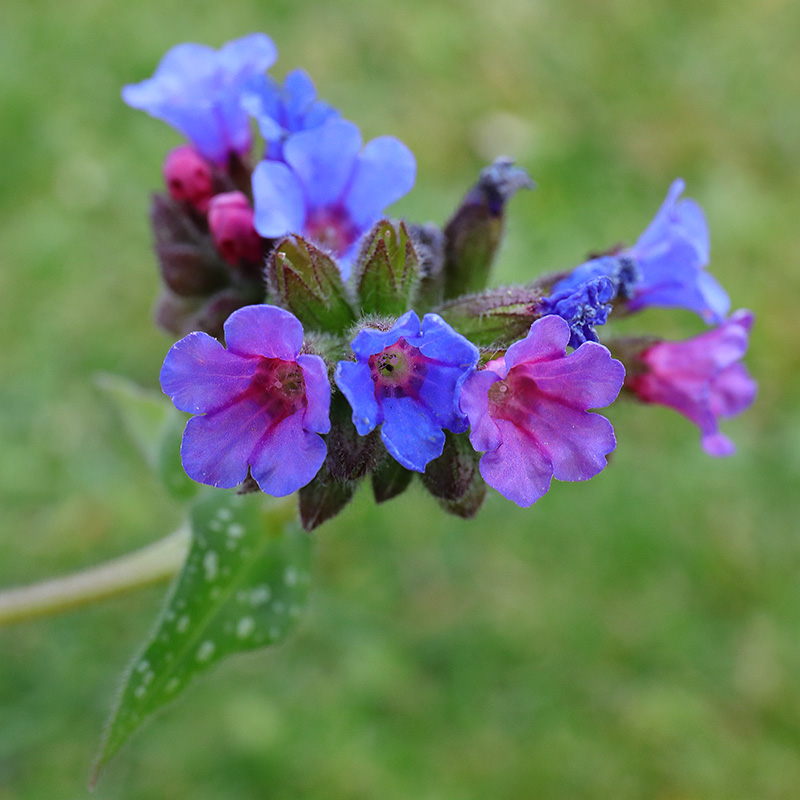
Pulmonaria (lungwort), like some other plants, changes its flower colour, presumably as a message to bees. The flowers start off by opening pink and gradually change through violet to a bold blue. If you look at the background to the top photo, you can (I hope) make out the deep pink unopened buds, while, just behind the foreground flowers, there are the shrivelled blue remains of a dead flower.
I’ve mentioned flower colour change in previous posts: Lathyrus vernus (spring vetchling or spring pea) changes colour in the same way, going from a pale magenta-pink to a soft blue, while Nigella damascena flowers changed from white with blue veining or a pale blue to a much deeper blue.
Not all pulmonarias have this colour sequence. There are now cultivars which mature to a much softer lavender-blue. Others change from red to a softer pink and there are some that have pink buds that open to pale blue or white flowers…lots of tempting choice for the gardener!
The flowers of pulmonaria are small, but the variation in colours on the plant at the same time make them more attractive and worth the effort of a close look. As a plant that can begin to flower in late winter, those small flowers are particularly valuable to the first bees visiting the garden.
It is believed that the colour-change in the pulmonaria flowers allows the plant to let the bees know which flowers are freshest and still have plenty of nectar. That ensures that bees are likely to visit those flowers that are still to be pollinated. This strikes me as clever evolution and particularly good design by nature. I’m sure the bees must appreciate the convenience and saving of their time and effort too! 🐝


 Ann Mackay: Inspired by Nature
Bees are attracted to our bluebonnets (Lupinus texensis) by a white banner spot on the flowers, indicating the presence of fresh nectar and pollen. When the pollen is fresh and sticky, the white spot is seen by bees as reflected UV light that lures them to visit. As the floret ages, the banner spot turns reddish and is ignored by the bees, who can’t see red. The details differ, but the principle is the same as you described with your flowers; there’s no end to the intriguing behavior of plants that many people think don’t “do” anything!
LikeLiked by 1 person
The mechanisms of nature are absolutely fascinating! It makes a lot of sense for flowers to have developed ways of letting bees know which to visit, but I’m sure many would be surprised by it. I love coming across things like this in the garden (and elsewhere).
LikeLiked by 1 person
So good to see different colour shades in a single bunch, Ann! Lovely!
LikeLiked by 1 person
It does make the plant a lot more interesting to see in the garden, and the markings on the leaves can be attractive too. (There are now some cultivars with more silvery colouration in the leaves than this one.)
LikeLiked by 1 person
I have a very pale pulmonaria ‘opal’ maybe, I just thought it was multi-coloured! I do believe that with forget me nots the yellow ring at the flower’s centre fades to white after pollination, signalling to insects there’s no more nectar. Plants are very clever.
LikeLiked by 1 person
I’ve seen photos of ‘Opal’ – it’s lovely. It’s impressive to see how plants have evolved such neat tricks as letting bees know which flowers to visit and it must make a great difference to the number of flowers that get pollinated. I reckon nature is amazing! 🙂
LikeLike
What a pretty flower. I also like its colour-changing strategy.
I wonder if the bees pick up on any other signals from the blossoms in their different stages that we don’t see with our human eyes but they can see with their super-bee vision.
LikeLiked by 1 person
I wouldn’t be surprised if there was more information for them to see. I have seen ultraviolet photos which show that there are guides to the nectar on some flowers that we can’t see…it would be exciting to be able to do that sort of photography.
LikeLiked by 1 person
You previously shared a link to an article about the ultraviolet photos and that’s what I was thinking. But there might be other factors, such as smell, for example. It’s really quite fascinating to ponder.
LikeLiked by 1 person
That’s a great point – presumably there must be a good reason for plant scents and it’s not likely to be for our benefit! Maybe the way scent can spread out alerts bees and other pollinators to the presence of flowers nearby. Now you’ve got me intrigued…
LikeLiked by 1 person
Have fun with your research . . . 😊
LikeLiked by 1 person
Just imagine if people changed color as they aged.
LikeLiked by 1 person
Might be interesting if we got a colour choice… (And I suppose we do in a way, with our hair going grey.)
LikeLike
[…] to the mix to further enliven this quiet green corner of our garden. (You can see the brunnera and pulmonaria in previous […]
LikeLike