
NB: A note for WordPress Reader users – you need to click on the title of the post again to come out of the reader and go to the post itself. This allows you to see the whole of the top photograph. (Otherwise you may see just a tiny section!)
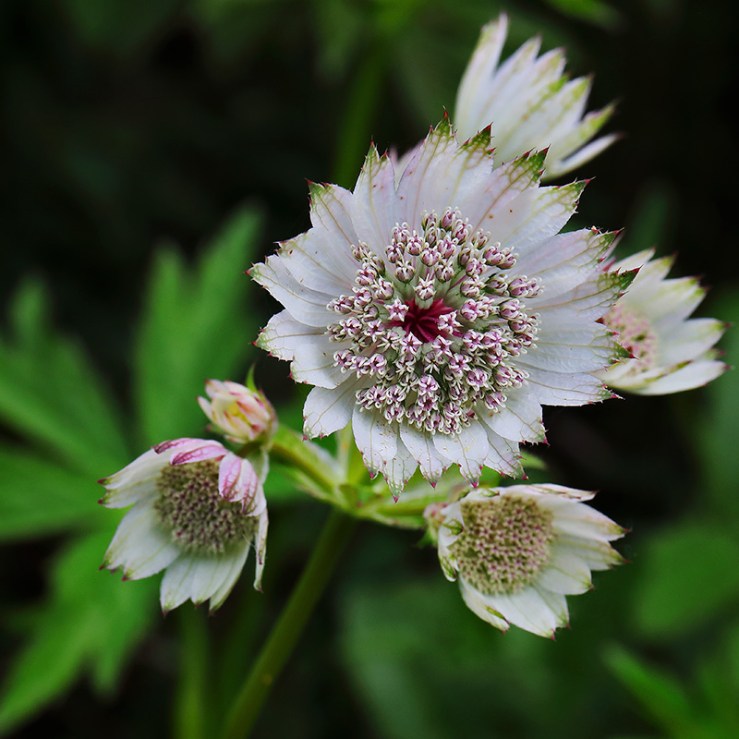
The pincushion flowers of astrantia are making an impact in the garden at the moment. The flowers are quite different to anything else around them, so provide interest and variety to the border.
Over the years, I’ve tried growing several different cultivars of Astrantia major, notably the lovely pink ‘Roma’ and the darker red ‘Rubra’. Neither of those lasted very long, probably due to drought. The white cultivars in the garden now are doing better. That’s because I take more care to water them when the weather is very dry. (Not sure what they are. One was supposed to be ‘Shaggy’, with the longer bracts, but doesn’t look any different to the other plants. They probably all are simply the original species of Astrantia major, rather than one of the cultivars.)
I would like to try again with some of the coloured cultivars of astrantia, but will look for plants that are in flower. When grown from seed there can be variability in the plants, and those grown from the seed of cultivars or hybrids are unlikely to come true to the parent plant. That might mean the possibility of an interesting seedling or two. On the other hand, I wonder if they tend to revert to the commoner white.
At present, the astrantias here are looking good. That is likely to be because of all the rain we’ve had recently. It’s pouring down as I’m writing this and has been raining for a few days. I was able to get out and photograph the flowers above in a brief pause between showers – can you spot the raindrops? (The flowers below were photographed on a dry day that now feels like a long time ago!)

 Ann Mackay: Inspired by Nature
I have one white astrantia and really look forward look forward each summer to its beautiful delicate flowers. They do love a good drink though, I really have to watch that it doesn’t get too dry, even though it’s in semi shade in our already quite shady garden.
LikeLiked by 1 person
It took me a while to realise how much they needed to be kept from drying out – something to take note of in our normally very dry Suffolk climate. (It’s not at all dry at the moment, so great for the astrantias but not so good for getting anything done in the garden!)
LikeLike
The flowers are so very beautiful and look crisp in appearance, Ann!
LikeLiked by 1 person
Thank you Indira! They somehow managed to stay looking good, despite all the rain we’ve had, so they must be quite tough little flowers! 🙂
LikeLiked by 1 person
Don’t you just love raindrops on flowers, Ann? I do. The first photo is my favorite, the floral gems are adorned by water droplets.
That being said, I hope you will get some breaks from your rains
LikeLiked by 1 person
Like you, I love to see raindrops on flowers and plants and I was lucky to get this break in the rain for some photography. I have other photos from that session for future use… 🙂 (And today is sunny – yippee!)
LikeLiked by 1 person
They are so pretty., I love them too specially the darker pink ones.
LikeLiked by 1 person
I love the darker ones – they can be dramatic and exciting. I’ll be on the lookout for them when I get the chance to fit one or two in…soon, I hope!
LikeLike
It took me a minute to figure out what these lovelies remind me of: Nigella! We have a different plant called a pincushion flower: Gaillardia suavis. I think the common name applies equally well to both flowers.
LikeLiked by 1 person
I can see why Gaillardia suavis is called the pincushion flower – it is a good name for it. Actually, I got the common name for astrantia a bit wrong – I should have said ‘Hattie’s pincushion’ but I forgot about Hattie, hehe! (I wonder who she was?) You might guess that I always call them astrantia. 🙂
LikeLike
I’ve always wondered about the Barbara in Barbara’s buttons, too. It’s fun to make up stories!
LikeLiked by 1 person
Hehe…there could be a whole group of mysterious women out there. (Some are less mysterious though, like Ellen Willmott of ‘Miss Willmott’s Ghost.)
LikeLiked by 1 person
These are interesting, Ann. They’d do well here if they like wet and rainy.
LikeLiked by 1 person
Yes, I reckon they’d be very happy, Jill. Mine are a lot better after the extra rain! Though, like me, they do like a bit of sun too! 🙂
LikeLike
Pretty pincushions indeed. Not familiar with Astrantia, but recognizing the starry root in the word, I looked it up. “The genus name [is] derived from the Latin ‘aster’ meaning star and this refers to the open star-shaped floral bracts of the plant.” I was surprised to find the genus is in the Apiaceae, which includes parseley, dill, and carrots.
LikeLiked by 1 person
It surprised me too when I first read about it. It’s not so strange when you discover that each ‘flower’ is actually a flower head of tiny flowers, making it an umbellifer. 🙂
LikeLike