Frost and After

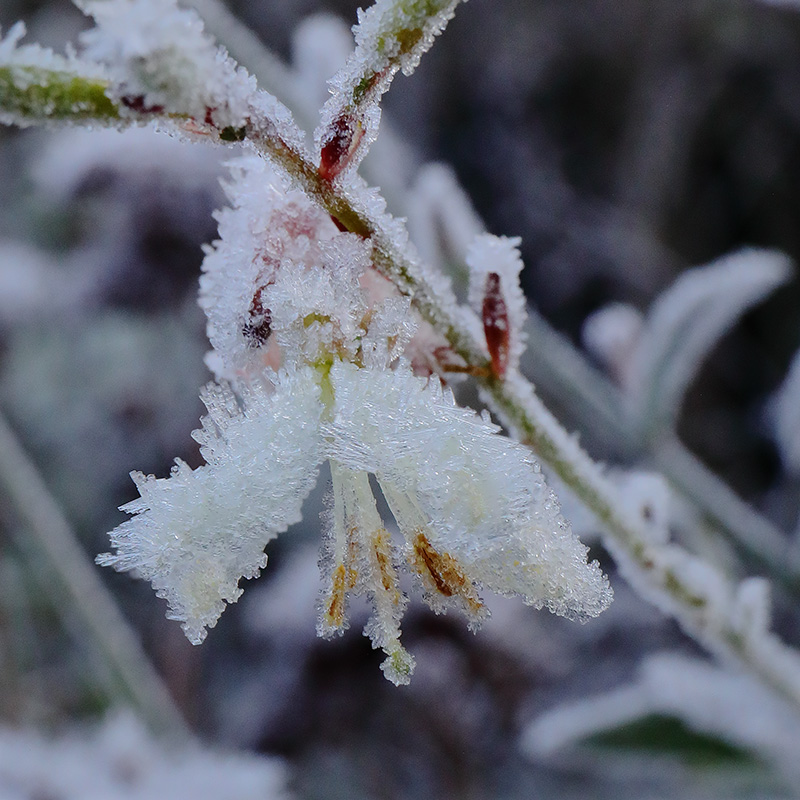
frosted gaura flower

NB: A note for WordPress Reader users – you need to click on the title of the post again to come out of the reader and go to the post itself. This allows you to see the whole of the top photograph. (Otherwise you may see just a tiny section!)

Last year’s hoar frost made icy little sculptures out of many of my garden plants. The one you see here is Gaura lindheimeri. (Now known as Oenothera lindheimeri, but I still call it by it’s old name. There are too many plant name-changes to keep up with these days!) This plant carries on flowering until late in the year, so frequently ends up covered in frost.

The area where the gaura is growing stays in the shade for much of the day in winter, so the frost lasts here for a long time. That gives me plenty of opportunities for taking photographs, but means that the sun doesn’t reach the frost to make it sparkle. So photography here is a bit of a compromise. Perhaps I should consider the effect of sun on frost when planting!

Eventually the frost will go, changing the look of the flower again. This time the petals are likely to be left translucent and looking very fragile indeed. (They usually wilt quickly after being frosted.) The drops of melted frost give an interesting texture to the flower – you can see right through the petals to the drops that are actually on the other side. ❄

Gaura with melted frost drops

From Very Little…

Frosted Pulsatilla Leaves

NB: A note for WordPress Reader users – you need to click on the title of the post again to come out of the reader and go to the post itself. This allows you to see the whole of the top photograph. (Otherwise you may see just a tiny section!)

Frost has an amazing ability to enhance the smallest of garden details. It takes very little to allow it to create a fleeting beauty. Anything can suddenly become attractive when encrusted by these tiny, white crystals of ice.

The last of the year’s flowers, dried-out seed heads, leaves, or slender grasses stilled by the cold air – all are made much more interesting to look at by a touch of frost. These are the leaves of Pulsatilla vulgaris (pasqueflower). In spring they are soft and hairy and a delight to stroke. By winter those hairs have disappeared, giving the curving shapes of the deeply-cut leaves more prominence. To my mind, the dead and frosted leaves suggest the look of a woodcut image or engraved stone.

As I’m writing this, the ground is still frozen. Tomorrow, though, is forecast to be milder and rainy, so the magic of the frost will be gone from the garden. These leaves won’t last long once the frost has finished with them, but will be left limp and probably rather translucent. The frost will have helped them along their path of decomposition and their eventual contribution to the richness of the garden soil. 🍂

Frosted Pulsatilla Leaves

Here Comes Winter

NB: A note for WordPress Reader users – you need to click on the title of the post again to come out of the reader and go to the post itself. This allows you to see the whole of the top photograph. (Otherwise you may see just a tiny section!)

Winter is fast approaching us, with some heavy frosts already here. But it hasn’t arrived quickly enough for frost to catch the leaves of this elder (Sambucus ‘Black Lace’) this year. The leaves stayed on the shrub unusually late last year – right into December – and gave me the chance of this photograph during a hoar frost.

Hoar frost itself is unusual here. This was the first time I’d seen it in my garden and I made the most of my chance to take some photos of it. (Got a bit frozen though!) This year I’ll be on the lookout for it happening again.

I’d have been happier if this year’s frosts had held off for a little while because I still have a lot of work to catch up with in the garden. Weeks of rain have meant that the ground was much too wet for planting and needed a chance to dry out. Now the ground has dried out and I have plants I want to move. There are others in pots that are waiting to be planted out. But the ground is frozen! I will just have to wait a little longer. Right now, it seems like a very good idea to stay indoors and warm, perhaps just venturing out for a few more frosty photos… 🙂

Frosted leaves of Elder

In the Winter Garden

Frosted flowers of Knautia macedonica

NB: A note for WordPress Reader users – you need to click on the title of the post again to see the full photograph. (Otherwise you see just a tiny section!)

With January over, I hope that the cold will begin to ease. It feels like it’s time to get back to work in the garden, but I don’t fancy getting frosted when I do!

We haven’t had any more freezing mornings in the last week, so perhaps these will be the last of my frosty pictures for this year. I’ve been very glad to have the heavy hoar frosts around to give me something to photograph. They have made some very unremarkable parts of the garden take on a new interest.

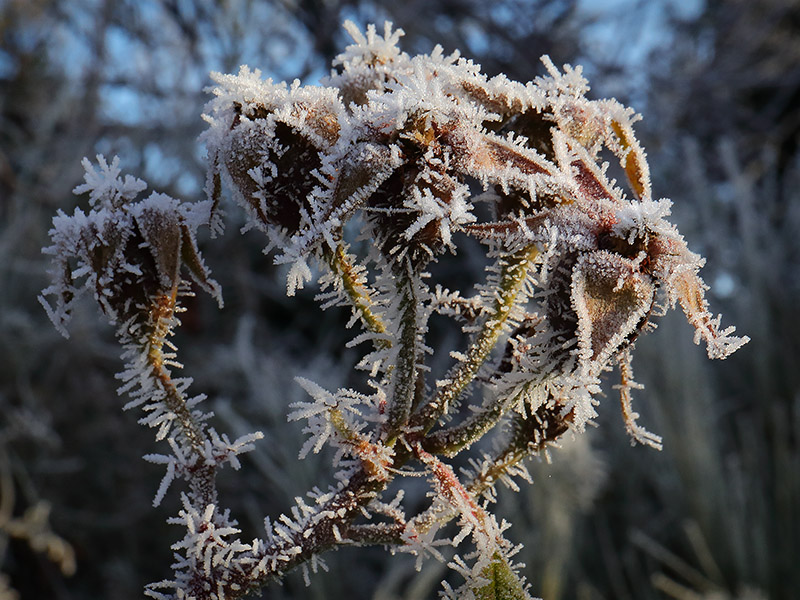
Frosted rosehips
I’d normally have deadheaded this rose, but this year a few rosehips were left and the frost found them.

Some plants, like the Knautia macedonica (top), are generous in producing late flowers that are likely to get frosted. That makes them an obvious subject for me to photograph. But many of the other plants look much more ordinary until the frost decorates them. So plants that I might not have thought of photographing earlier in the year suddenly demand my attention.

The tiny yellow flowers of the pond plant below (Sisyrinchium californicum, aka yellow eyed grass) are long gone and have been replaced by its seed pods. The frost has turned these into odd-looking spiky growths, almost as if they’ve become some strange winter flowers reaching towards the frozen pond.

Frosted pond plant
Pond plant Sisyrinchium californicum takes on a different appearance when covered in hoar frost.

Sometimes there are non-plant things for me to photograph on a frosty day, like the spider’s web below. I can’t help wondering if the spider has survived the very cold spell – maybe it’s hiding in a warmer spot under some leaves somewhere. At any rate, I’m sure that any spiders and other creatures in the garden will be much happier when it warms up a bit.

However, since I began writing this, I’ve noticed that the latest weather forecast has promised us some very chilly nights. So I may have to be patient and wait a while yet for the warmer weather. (But roll on spring!)

Frosted Spider Web
Chilly weather for spiders!

In a Shady Corner: Frosted Hydrangea Flowers

Frosted hydrangea flowers

NB: A note for WordPress Reader users – you need to click on the title of the post again to see the full photograph. (Otherwise you see just a tiny section!)

A climbing hydrangea (Hydrangea anomala subsp. petiolaris) grows in a cool and rather dark spot in our garden. It is beside our main seating area, under a laurel that has grown into a large tree.

The laurel’s shade is a very welcome protection from the hot sun in summertime, both for us and for the hydrangea. Without that bit of shade, the hydrangea would struggle to cope with the way heat can build up here.

The RHS describes this plant as ‘best grown in partial shade in a moist but well-drained soil’. Unfortunately, the soil here is rarely moist in summer. (Winter is a different matter!) This was something I did not realise when I planted it many years ago. Nor did I make much allowance for how dry the tree roots must make the area. Nevertheless, the climber has survived, though growing slowly.

From May to July the hydrangea’s white flowers add a cool note to my favourite place to sit. I get to enjoy their grace and airiness from close quarters. By winter any remaining flowers have turned brown and leathery, but a light dusting of frost makes them graceful again.

You can see the summer flowers of Hydrangea petiolaris in this post.

Frosted hydrangea flowers
Frosted hydrangea flowers in a shady corner of my garden.

A Hint of Gold

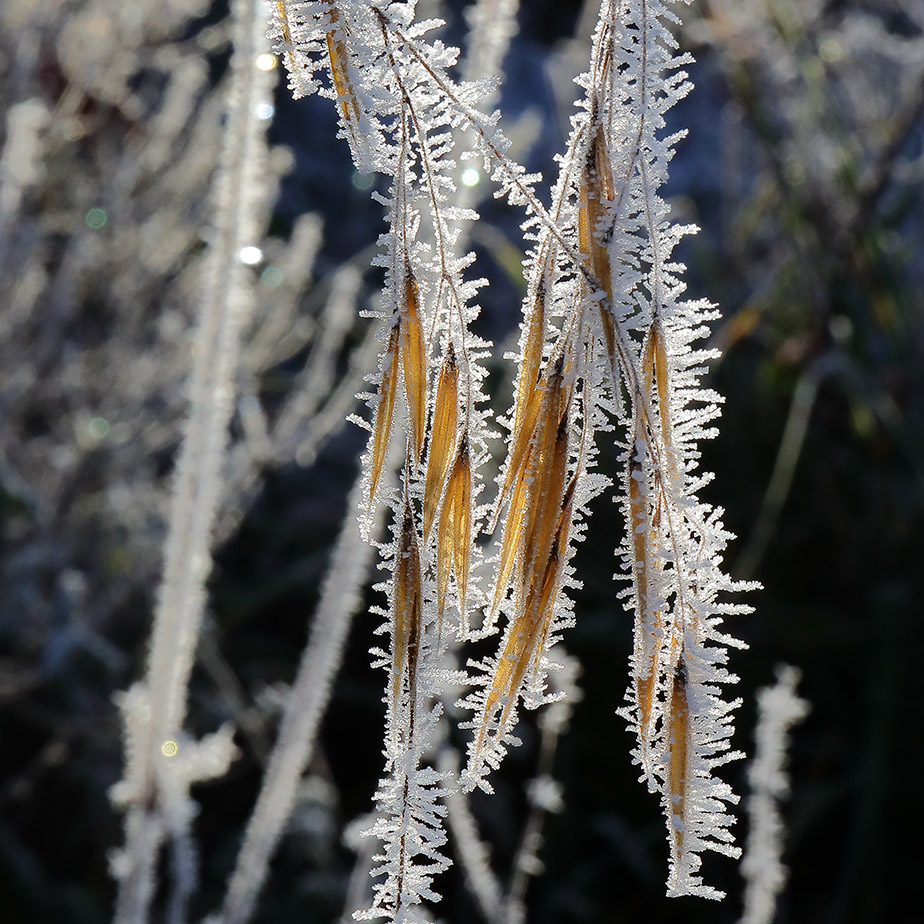
Frosted Stipa gigantea (golden oats)

NB: A note for WordPress Reader users – you need to click on the title of the post again to see the full photograph. (Otherwise you see just a tiny section!)

The winter chill continues here, with more frozen mornings. Frost brings an icy elegance to the remains of last year’s plant growth. Amongst the most attractive of these frosted plants are the seed heads of Stipa gigantea (golden oats). They become especially lovely when they are coated with a filigree of tiny crystals and backlit by the low morning sun.

The mix of frost and winter sun has brought out the golden tones of the seed heads and made them stand out against their dark background. It’s as if they’ve taken on new life for a short while. On mild days these same seed heads would look drab and dead and would go unnoticed in the garden. A dusting of frost is all it takes to bring subtle details to our attention in winter.

It won’t be long before life is starting again all around the garden. Old leaves and seed heads will be stripped away to make room for spring growth. (I don’t remove these in autumn because they provide shelter for overwintering insects.) For the moment, though, the frost creates its own magic upon the most ordinary of things.

(If you’d like to see how Stipa seed heads look with melting frost, see this post from last year.)

Frosted Stipa gigantea (golden oats)
Frosted Stipa gigantea (Golden Oats)

Frozen Lace

Frosted leaves of Sambucus nigra 'Black Lace'

NB: A note for WordPress Reader users – you need to click on the title of the post again to see the full photograph. (Otherwise you see just a tiny section!)

These well-frosted leaves belong to Sambucus nigra ‘Black Lace’ (a black cut-leaved elder). I was captivated by the way that the shapes of the hoar frost imitated the lacy shapes of the leaves, giving a very decorative effect.

We rarely get hoar frost here. Temperatures don’t normally get low enough for long, but we had a very chilly period before Christmas. For several days we had hard frosts and then snow. It created a magical look to the garden, so I made the most of it and got out there with my camera.

This elder would usually have lost all its leaves by December, but the milder weather in the weeks before must have delayed its urge to shed its leaves. Some leaves, as in the picture below, hadn’t even changed colour but remained a deep blackish-brown.

Right now I am very happy that I have a large stash of frosty photos from last month to use here. It is very grey and wet outside, so the urge to stay warm and dry indoors is strong! There isn’t, anyway, a lot to photograph in the garden in January. (However there are always some jobs to be done whenever the weather is dry enough.) I’m looking forward to the time – not far away – when the new growth starts and the garden comes fully alive again.

Frosted leaves of Sambucus nigra 'Black Lace'
Frosted leaves of Sambucus nigra ‘Black Lace’ (black cut-leaved elder).

Winter Roses

Frosted rose 'Blue Rhapsody'

NB: A note for WordPress Reader users – you need to click on the title of the post again to see the full photograph. (Otherwise you see just a tiny section!)

We had a few days of frost and snow towards the end of December. This created lots of opportunities for winter photographs, so you can imagine how pleased I was to see it. (Finding something to photograph for the blog can get difficult at this time of year!)

The warm autumn and mild early winter had encouraged the roses ‘Rhapsody in Blue’ (above) and ‘Zepherine Drouhin’ (below) to produce a few very late blooms. I love to photograph frosty and frozen flowers because they’re like little icy sculptures. Sadly the frost brought these particular flowers to an end. Freezing damaged the cells of the petals too much for them to survive once the frost melted.

Most of my frosty pictures are photos of seed heads and leaves, so it makes a change to be able to photograph frosted flowers. Because there are only a few winter-flowering plants in my garden, I’d like to plant more flowers that will appear during this time. That would mean that I have more to enjoy in the garden in winter and more to photograph – that’s always a pleasure!

Frosted rose 'Zepherine Drouhin'

A Happy New Year to You

Frosted blackberry leaves

NB: A note for WordPress Reader users – you need to click on the title of the post again to see the full photograph. (Otherwise you see just a tiny section!)

It’s time to say goodbye to 2022 and welcome in 2023. I hope that this coming year is a good year for you and treats you kindly. If you celebrate today, I hope you have fun!

I’m not one for New Year’s resolutions but I do look back at what I’ve done over the previous year and make a few small plans for the future. One of the main areas that I plan for is, of course, my garden. The biggest step forward with it in 2022 was the completion of the pond, which delighted me by bringing more wildlife into the garden.

In 2023 I have more work to do in the area around the pond to create a bog garden. I also have plans to create more small wildlife areas and perhaps a bit of space for growing veggies for ourselves. It’s very unlikely that I’ll manage to do all the things I want to, but it feels good to have an idea of where it’s all heading. (I might even take time away from the garden to do a bit of printmaking… 🙂 )

Whatever your hopes and plans for 2023 are, I wish you a very Happy New Year. May it bring you health and happiness and peace!

Wishing You a Happy Christmas

NB: A note for WordPress Reader users – you need to click on the title of the post again to see the full photograph. (Otherwise you see just a tiny section!)

Christmas already! It feels as if it has sneaked up on me very quickly again this year. As usual, I’ve been on the lookout for a photograph of a suitably frosty ‘decoration’ from the garden for this post.

Luckily, our recent frost and snow, which lasted for several days, was a great opportunity to spend time in the garden with my camera. There are always some seed heads left in the garden and these look good when they’re heavily coated with frost. The seed head you see here is on a bronze fennel. It’s the same plant that I used for the photo of a seed head with water drops (from melted frost) in this post. (The photographs in that post were taken in a previous winter.)

Whether or not you celebrate Christmas, I wish you a time of happiness, and a time to get together with the people you love. I hope that it will be a chance to enjoy being with family and friends. Merry Christmas everyone! 🙂