Signals for Bees: Pulmonaria

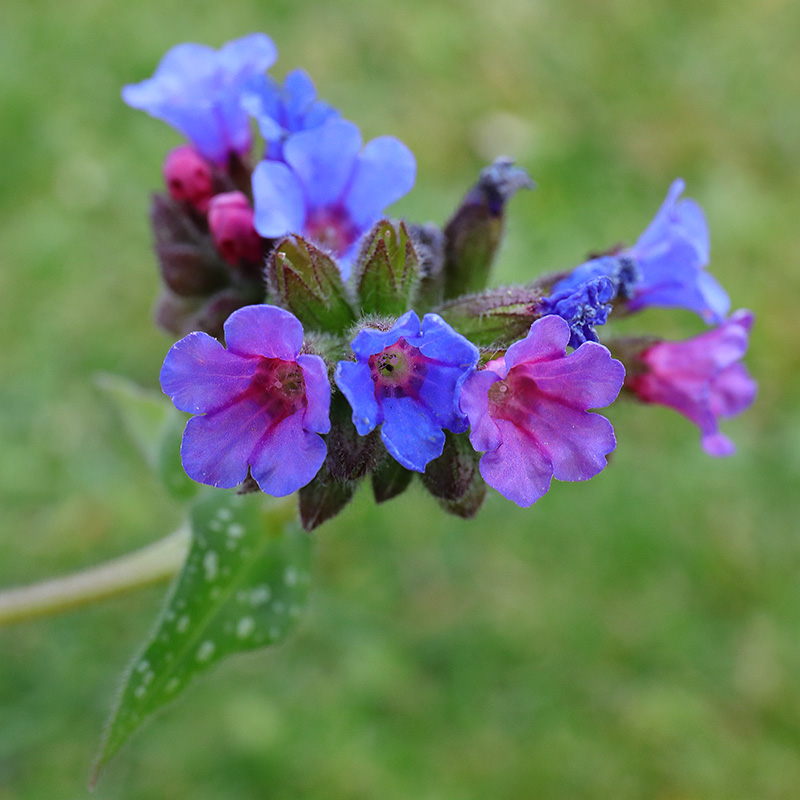
Blue and pink Pulmonaria (lungwort) flowers

NB: A note for WordPress Reader users – you need to click on the title of the post again to come out of the reader and go to the post itself. This allows you to see the whole of the top photograph. (Otherwise you may see just a tiny section!)

Pulmonaria (lungwort), like some other plants, changes its flower colour, presumably as a message to bees. The flowers start off by opening pink and gradually change through violet to a bold blue. If you look at the background to the top photo, you can (I hope) make out the deep pink unopened buds, while, just behind the foreground flowers, there are the shrivelled blue remains of a dead flower.

I’ve mentioned flower colour change in previous posts: Lathyrus vernus (spring vetchling or spring pea) changes colour in the same way, going from a pale magenta-pink to a soft blue, while Nigella damascena flowers changed from white with blue veining or a pale blue to a much deeper blue.

Not all pulmonarias have this colour sequence. There are now cultivars which mature to a much softer lavender-blue. Others change from red to a softer pink and there are some that have pink buds that open to pale blue or white flowers…lots of tempting choice for the gardener!

The flowers of pulmonaria are small, but the variation in colours on the plant at the same time make them more attractive and worth the effort of a close look. As a plant that can begin to flower in late winter, those small flowers are particularly valuable to the first bees visiting the garden.

It is believed that the colour-change in the pulmonaria flowers allows the plant to let the bees know which flowers are freshest and still have plenty of nectar. That ensures that bees are likely to visit those flowers that are still to be pollinated. This strikes me as clever evolution and particularly good design by nature. I’m sure the bees must appreciate the convenience and saving of their time and effort too! 🐝

Spotted leaves and blue flower of Pulmonaria (lungwort)
The shape of lungwort’s leaves (like a lung) gave rise to the plant’s name. Their white spots were once believed to indicate that they could be used to treat lung diseases.

Gleaming Gems: Tulipa humulis ‘Little Beauty’

The red and purple flowers of Tulip 'Little Beauty'

NB: A note for WordPress Reader users – you need to click on the title of the post again to come out of the reader and go to the post itself. This allows you to see the whole of the top photograph. (Otherwise you may see just a tiny section!)

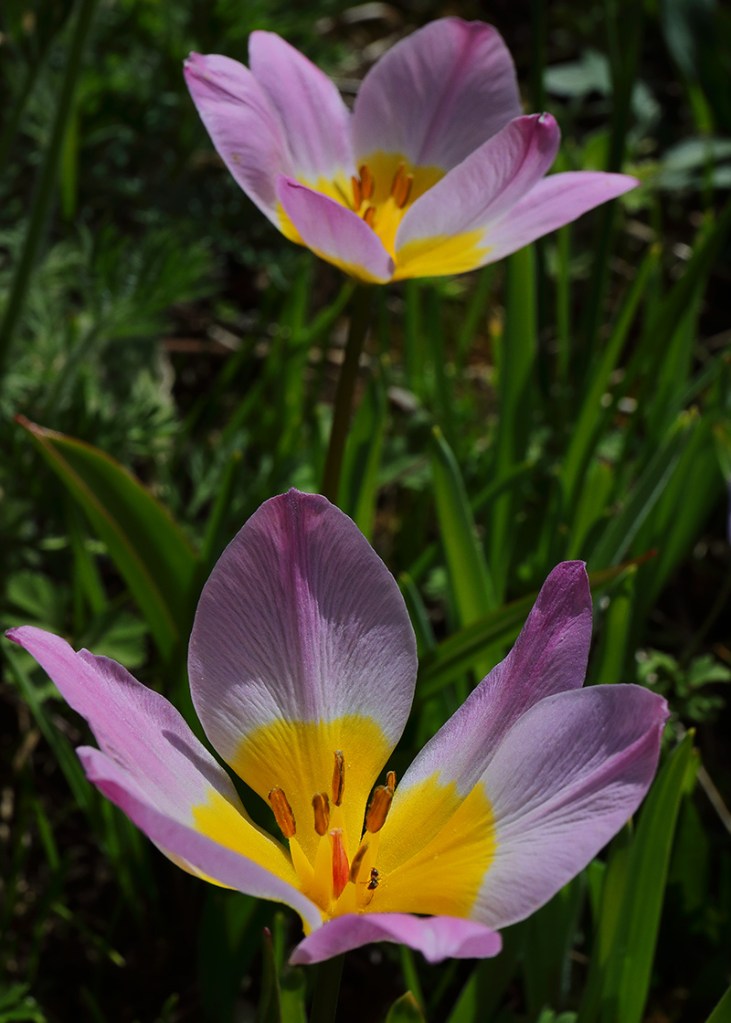
These bright little flowers are Tulipa humilis ‘Little Beauty’, a dwarf tulip that is creating a vibrant glow of colour here in my garden. They are very small tulips, growing only 4 to 6 inches high, with flowers around the size of a large crocus.

My reason for planting these, as opposed to the bigger tulip cultivars, is that they are a species tulip. That means that they are fully perennial and will probably multiply over the years. Most of my larger tulips have gradually died out and now there are just a few lonely leftovers scattered here and there in the borders. (The exception to this is a clump of viridiflora tulips which continue to flower well and slowly increase in numbers.)

I’m glad to say that these dwarf tulips have been a success since they were planted in 2002, having – so far – reliably reappeared each spring. Their resilience encourages me to try more species tulips in future. (I still like the bigger hybrid tulips, but to avoid the sad look of stray tulips left alone as they dwindle, I’d plant the hybrids in pots initially. After their first year I could move the bulbs to a mixed cut-flower area in our planned veggie garden to see if any survive and flower again.)

Tiny though they are, these tulips make plenty of impact when the sun shines. Then the petals open wide, allowing you to see their attractive markings. Inside the deep crimson flowers are centres of a rich purple-blue, edged by a border of pale pink. For me, ‘Little Beauty’ certainly lives up to its name, with its vivid colouration adding a lively gleam to the springtime garden.

Reddish-pink flowers of Tulipa humilis 'Little Beauty', which have a purple centre.
The crimson flowers of Tulipa humilis ‘Little Beauty’ have a purple-blue centre.

Fluff, Glorious Fluff!

A magenta-purple flower of Pulsatilla vulgaris (pasqueflower)

NB: A note for WordPress Reader users – you need to click on the title of the post again to come out of the reader and go to the post itself. This allows you to see the whole of the top photograph. (Otherwise you may see just a tiny section!)

We may think of flowers as firstly a visual delight, but they can appeal to the sense of touch too. That’s very much the case with these pasqueflowers (Pulsatilla vulgaris) that have just started to open their fluffy blooms. The flowers themselves are a jewel-bright purple/pink, making them eye-catching, and their soft fluff makes them enticing to the fingers too.

Magenta-purple flowers of Pulsatilla vulgaris (pasqueflower)
Left: The bright colour makes it harder to see the hairs, but you’ll feel them if you reach out and touch. Right: Fluffy bracts cocoon the opening buds.

The backs of the flower’s petals (actually sepals – pasqueflowers don’t have true petals) are covered in fine hairs that can become almost invisible against the flower’s rich colour. Bracts below the flower are more noticeably covered in a slightly longer fluff, which, no doubt, provides protection from cold for the developing buds. The stems and leaves are hairy too, as are the seed heads later. (The hairs on the seeds help them to disperse in the wind.)

A pasqueflower bud.
Their fine furry coats protect pasqueflowers against cold weather, dehydrating winds, and hungry creatures.

The silky hairs are a delightful invitation to stroke the plant, so I am planning to grow some right at the front of a border, where they will be easy to reach. It’s a simple pleasure, but one that brings a smile and the chance to have a closer look at this lovely plant. In fact, I’m smiling right now because I have discovered that my two original plants are surrounded by some tiny seedlings – happy (and fluffy) days!

Magenta-purple flowers of Pulsatilla vulgaris (pasqueflower)
Pasqueflowers enjoying the spring sunshine.

From My Old Files: Pink Power!

A pink flower of Ranunculus asiaticus (Persian buttercup)

NB: A note for WordPress Reader users – you need to click on the title of the post again to come out of the reader and go to the post itself. This allows you to see the whole of the top photograph. (Otherwise you may see just a tiny section!)

Ranunculus flowers are richly colourful and flamboyant. These are Ranunculus asiaticus (Persian buttercup); fabulously pink and frilly and very appealing to photograph. The plants are becoming available in garden centres now (just in time for Mother’s Day in the UK), but these are photos from a few years ago.

I find it useful to have some unused photos in my files that I can go back to at times when there isn’t much to photograph here. It keeps the blog going and gives me a chance to catch up with images that didn’t get processed the first time round.

The garden here feels a little bare right now, despite the start into growth that recent sunshine has brought. The hellebores are still in flower, but got covered in brick dust as parts of a nearby wall were being cut up with an angle-grinder. Not to worry, a good wash-off with a watering can has made them look perky again. The anemones from last week have all opened and now we have a good range of purply-blues and a few that are much paler. The pale flowers would have been a good subject if I hadn’t already posted the darker ones. There are daffodils, of course, and the first of the pulsatilla flowers have opened.

There are a few other flowers elsewhere in the garden, but they’ve already been photographed for the blog several times over the years. Only the pulmonaria has yet to have it’s tiny flowers photographed. (I’ll need my kneeler for those!) So I feel that it’s time to explore the possibilities for additional early-spring flowers. A trip to a garden centre may be necessary…😁🌿

A pink flower of Ranunculus asiaticus (Persian buttercup)
Ranunculus asiaticus (Persian buttercup)

More Spring Blues…

Blue flowers of Anemone blanda (winter windflower)

NB: A note for WordPress Reader users – you need to click on the title of the post again to come out of the reader and go to the post itself. This allows you to see the whole of the top photograph. (Otherwise you may see just a tiny section!)

Warm sunshine has brought the opening of these blue-mauve Anemone blanda flowers. They’re scattered in amongst perennials that are just beginning to come into growth in a very hot and dry bed. It would probably be better if they had a little more moisture, but they are slowly spreading anyway.

I may plant some more Anemone blanda on the sunny edge of the area where the fruit trees are. They would look pretty in a mix of the blue and some white when combined with blue Scilla. I’m still on the lookout for more early spring bulbs which will suit the area around these little trees. The front edge of the fruit-tree border gets sunshine all day, but further back will be shaded by the leaves on the trees later.

There are already snowdrops in the garden which can be lifted and replanted in the area with more shade. These could be combined with yellow winter aconite (Eranthis hyemalis), but I’ve read that, like snowdrops, these are best planted ‘in the green’ rather than as a dry tuber, because those don’t always establish well.

Lebanon striped squill (Puschkinia scilloides var. libanotica) is another possibility for the sunnier part of the fruit tree area. It’s similar in appearance to the related squill of last week’s post, but has white flowers with a blue stripe rather than blue flowers. Another member of the Scilla family, the grape hyacinth (Muscari armeniacum) would be happy in the same area and would provide another early source of nectar and pollen.

In my imagination, I’m envisaging an early spring carpet of mostly blue flowers, with some white and yellow….and bees! (Butterflies and other pollinating insects too, of course. They would all be welcome.) It’s a plan. I hope it’s a successful one! 🐝

Blue flower of Anemone blanda (winter windflower)
An anemone is just starting to open it’s flower, ready for a passing bee…

Tiny Blue Blooms…And a Touch of Confusion!

Blue flowers of a Scilla (squill)

NB: A note for WordPress Reader users – you need to click on the title of the post again to come out of the reader and go to the post itself. This allows you to see the whole of the top photograph. (Otherwise you may see just a tiny section!)

A few days ago I bought the little blue flowers that you see in the photo above as bulbs growing in a pot. They were from a local nursery that sells plants at very reasonable prices. Sometimes, however, they are not labelled with the particular cultivar.

These bulbs were labelled – as ‘Chionodoxa forbesii’. As it turns out, that’s not what they are. I had a quick look at the RHS site to check on the name change from Chionodoxa to Scilla. That showed me that my pot of flowers didn’t look like the RHS’s photo of Chionodoxa/Scilla forbesii. I don’t mind – they’re a Scilla of some sort and they’re pretty.

More importantly, they’ll be useful to any early bees that are around. Scillas are in flower now, at the same time as the crocuses, and provide lots of pollen and nectar.

I’d bought them as part of my planting project to provide more flowers to feed the first bees and butterflies to come out of hibernation. Bulbs will be one of the easiest things to use for this because they don’t take up much space. Conveniently, their very early flowering means they should suit an area area around our fruit trees, which will come into leaf after the bulbs have gone over.

What I minded most about the naming mistake was having to go back and change the name of my photo file…there’s enough confusion with plant names without me creating more! While it was probably just a mistake due to the wrong label being replaced in a pot, it can cause frustration when this happens. If you’re looking for a particular plant, you want to be sure of getting the right one. And if someone sees a plant they want in one of my photos, that plant needs to be correctly identified to allow them to find one. Ho-hum, what fun! Well, at least the bees won’t mind!

The Scilla below is a different variety to the one above, with only one flower on each stem instead of several. I don’t know the cultivar, but there’s only a few left of these. That’s because they’re growing beside a brick path and the bricks have been re-laid a couple of times. That has taught me a lesson…I won’t plant bulbs in a position that’s as likely to be disturbed in future. And maybe I’ll eventually have a carpet of blue flowers. (I can dream!)

Blue flowers of a Scilla (squill)
Early blues: tiny Scilla flowers just waiting for a bee…

A Liminal Time

Frosted seedhead of wild carrot (Daucus carota)

NB: A note for WordPress Reader users – you need to click on the title of the post again to come out of the reader and go to the post itself. This allows you to see the whole of the top photograph. (Otherwise you may see just a tiny section!)

For the last week or two it has felt as if winter is ending, but spring is not quite here. This is a time of transition, and of hope inspired by the resurgence of nature. In fact, March 1st is the start of meteorological spring in the northern hemisphere, so technically, spring is here. (Unless you go by the astronomical definition, which says that spring starts at the Vernal Equinox, around March 20th.)

As far as our garden here is concerned, spring is just starting to show the first signs, but the cold of winter isn’t far behind us. There are still frosts on some mornings; enough to coat the grass but nothing as spectacular as the seed heads here. (These wild carrot seed heads were photographed back in January, when we had several days of heavy frost.) It may be tempting a chilly fate to say that winter is definitely over, but it feels like it is.

Frosted honesty (Lunaria annua) seed head lying on frosted grass
An honesty (Lunaria annua) seed head was caught in one of the last frosts of the year.

So winter appears to be gone…but spring isn’t entirely here. We’re at a threshold, where the season is neither one thing, nor yet the other. I think of it as ‘pre-spring’. It’s a short time when the approach of spring is eagerly looked for and plans made to welcome both new growth and new life.

Being poised on the brink of spring is an exciting time for me, and other gardeners too I’m sure. Everything starts to get busy now; the gardening year takes on a new urgency as we try to keep up with the rush of returning life that spring brings with it. And now it is time for this blog to put the frosty photographs away…I hope!🌱

Frosted seedhead of wild carrot (Daucus carota)
Daucus carota (wild carrot) coated in a heavy January frost

Young and Old: Hellebores

hellebore flowers

NB: A note for WordPress Reader users – you need to click on the title of the post again to come out of the reader and go to the post itself. This allows you to see the whole of the top photograph. (Otherwise you may see just a tiny section!)

A question in response to last week’s post about hellebores has prompted this one. Linda (who blogs at https://shoreacres.wordpress.com/ ) made this comment: ‘What really surprised me was finally figuring out that the green was a sign of aging rather than a sign of ‘youth.’ I assumed the petals were green at first, and then turned rose. But from what you’ve said, the fresh petals are cream colored — is that right?’

In my reply to Linda I said that the flowers turn green as a part of the aging process. Sometimes, however, there is a slight blush of green on the younger flowers too. (That green shows that there is chlorophyll present, which contributes to the plant’s overall photosynthesis.)

The ‘petals’ of a hellebore are actually sepals. That’s the part of a flower that is normally green and leaf-like, and sits behind the petals. The hellebore sepals turn green after the flower has been pollinated. Some hellebores have sepals that age and darken to a peachy-pink shade, as you can see in my top photo. Whatever their colour, the flowers can last for weeks, with the sepals being more robust than normal petals.

hellebore flowers
An older flower of Hellebore ‘Rosali’ with a paler flower that’s just opened to its left.

You might be wondering why the hellebore has no true petals. In fact, they’re still there, but over time have evolved into the tubular structures arranged in a ring in the centre of the flower. These are the nectaries, which produce nectar to attract any of the wild bees and other insects that may be active during winter or early spring. In the photo above, you can see the ring of nectaries is still on the old flower, but the stamens have dropped off after pollination.

In the bottom photo, you can see that the nectaries have now also fallen off this old flower. That leaves just the carpels that contain the developing seeds in the centre. How different the aging flower looks compared to the younger ones below it! Those still have both their stamens and their nectaries. (In this case I think the nectaries very pretty, like little ruffles with delicate pink stripes inside.) This particular plant does have a greenish tint to the cream flowers, which later become a vivid green.

Oh, and just to confuse things a little, there are green-flowered hellebores. Helleborus viridis and Helleborus foetidus are both native to the UK and have green sepals throughout their flowering period. Then there’s the Corsican hellebore (Helleborus argutifolius), also known as the holly-leaved hellebore because it has spiny leaves. This one has attractive lime-green flowers and I’m tempted to try growing it, both for the novelty of green flowers and for the handsome foliage.

hellebore flowers

Time to Awaken

Deep pink hellebore flower

NB: A note for WordPress Reader users – you need to click on the title of the post again to come out of the reader and go to the post itself. This allows you to see the whole of the top photograph. (Otherwise you may see just a tiny section!)

It’s been wet and miserable outside for a few days, so there’s not much temptation to go outside. However, now there’s a little treat for every time I venture out into the garden. The slight rise in temperatures has encouraged the hellebores to begin to bloom, giving some bright colour under the grey sky.

The photos here are both of the same hellebore – ‘Rosali’ – although the flowers look rather different. (I’ve used photographs from previous years because the flowers of this one are still just in the process of opening.) Looking at the flower colours, you might think they’re different plants, but no, they’re the same one. I must admit, I did wonder if they could really be the same, but last year’s post of Rosali’s flowers convinced me.

I think the difference in appearance is due to a combination of things; variations in the plant from year to year, flower age, and the effect of lighting. The flower in the bottom photo is aging, and you can see the green creeping into what had been the cream colour of the petals. On the other hand, the top photo is of a fairly newly-opened flower, which will probably become more cream as it develops. In the photo, the crimson which usually just edges the petals shows through the whole flower. Probably this is because of the way the strong sunlight is lighting the flower from behind, carrying the deep colour of its reverse right through it.

Earlier I went out to check on this hellebore and was delighted to see a generous mass of dark-coloured buds, with just the first few starting to unfurl. Soon it should have lots more flowers open – enough to make a winter day feel brighter and spring just a little bit closer!

Pink and cream flower of Hellebore Rosali
Hellebore ‘Rosali’ in flower in late winter.

Thawing…for now!

thawed frost drops on winter jasmine

NB: A note for WordPress Reader users – you need to click on the title of the post again to come out of the reader and go to the post itself. This allows you to see the whole of the top photograph. (Otherwise you may see just a tiny section!)

We still have some below-zero nights forecast, but it feels as if the worst of the cold is over. Of course, that feeling may turn out to be entirely wrong, because there’s still plenty of time left for more wintry weather. Despite that, the sight of the early daffodil leaves poking up through the soil and the first hellebore flowers makes it feel like spring isn’t so far away.

Thawing frost created several opportunities in the past few weeks for me to get busy with my camera. The tiny meltwater droplets looked especially clear and they glittered where the sun struck them. Other drops, in dark corners where the defrost was slower, were still half-frozen.

clear drops of thawing frost
Sunshine brings out the sparkle on the drops of melted frost on Euphorbia mellifera leaves and the seed heads of a Miscanthus grass.

Thinking about that clarity in the drops of melting frost made me wonder if they were purer than ordinary raindrops. After all, raindrops pass through the atmosphere, collecting any pollutants along the way, whereas frost is formed from condensed water vapour. So, like a distilled liquid, they should be free of impurities…well, that’s my theory, anyway! In any case, I enjoy seeing the plants here all decked out in these sparkling little beads.

I am very much looking forward to spring; now I’m longing to see new growth and feel the sun warm the air. At the same time, I realise that I should take care to notice winter’s small details and the way that the natural world changes through this period of cold weather. Soon enough, the changes will be those of approaching spring…🌱

Frost thawing on rose leaves.
Thawed frost forming drops around the edges of rose leaves.