Frosted Seed Heads: Wild Carrot

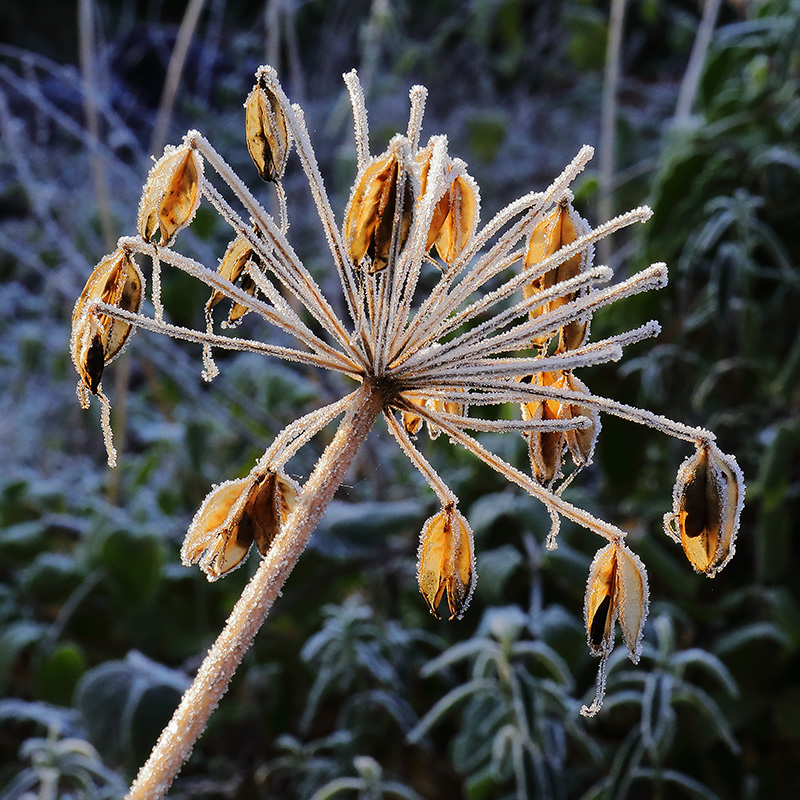
Frosted seed head of Daucus carota

NB: A note for WordPress Reader users – you need to click on the title of the post again to see the full photograph. (Otherwise you see just a tiny section!)

Back in September I wrote a post about the flowers and seed heads of wild carrot (Daucus carota). I was hoping that the seed heads would last long enough to be frosted when winter arrived. Luckily for me they did, so I had the chance to photograph them. (You can see my original post here: https://annmackay.blog/2021/09/19/going-to-seed-wild-carrot/ )

This wild carrot is a variety named ‘Dara’. It has white flowers that gradually turn a deep burgundy and are very lacy and delicate-looking. The seed heads are just as interesting as the flowers, especially when they curve inwards into a little ‘nest’ which protects the maturing seeds. By this time of the year most of the seeds have escaped (some with a fair bit of help from me) and may become the new plants for future years.

Meanwhile, the remains of the seed heads provide a great framework for frost. The top photograph was taken when the frost was particularly heavy, making it look as if the seed head had been dipped in sugar crystals.

This plant was in a position that is shaded from the early morning sun, so the frost lasts and allows time for photography. The cold lingers here, and the shade from the fence creates a bluish cast which makes it feel even chillier. (The bottom photograph is of a plant that is further from the fence, so frost there doesn’t last as long. It was also taken earlier in the winter, when there was a much lighter frost.)

I’m grateful for simple things like these frosted seed heads in winter, because they keep me supplied with something to photograph. They give me something to enjoy and to marvel at as I look at them closely…and something that is enough to get me outside on an icy winter morning!

Frosted seed head of Daucus carota

A Little Winter Colour

Winter Jasmine

NB: A note for WordPress Reader users – you need to click on the title of the post again to see the full photograph. (Otherwise you see just a tiny section!)

It always delights me that some flowers can tolerate rough weather to give us a bit of cheering colour at this time of year. Even if the frost eventually proves too much for the tiny flowers of this winter jasmine (Jasminum nudiflorum), there are lots of new buds which will soon open to continue the show.

These flowers are especially welcome when almost everything else seems dormant in the coldest days of winter. They encourage me to take a wander round the garden so that I can see them up close and enjoy their exuberant colour.

Unlike other jasmines, winter jasmine isn’t a twining plant. Instead it has very thin and floppy stems which can be easily trained against a fence or trellis. Or you can do what I’ve done – just allow it to weave its way through other shrubs for support. (That does get rather untidy!)

Although it’s said to be an excellent winter nectar-source, I haven’t yet seen bees on it. Perhaps there will be in early spring, as this shrub has a long flowering period. (From December or January right through into March.)

But whether the bees like it or not, I certainly do. These little flowers are brightening an otherwise dark area of the garden like a sprinkling of yellow stars. They bring some joyful colour to the garden as it waits for spring.

Winter jasmine flowers

Caught by the Frost: Frosted Flowers

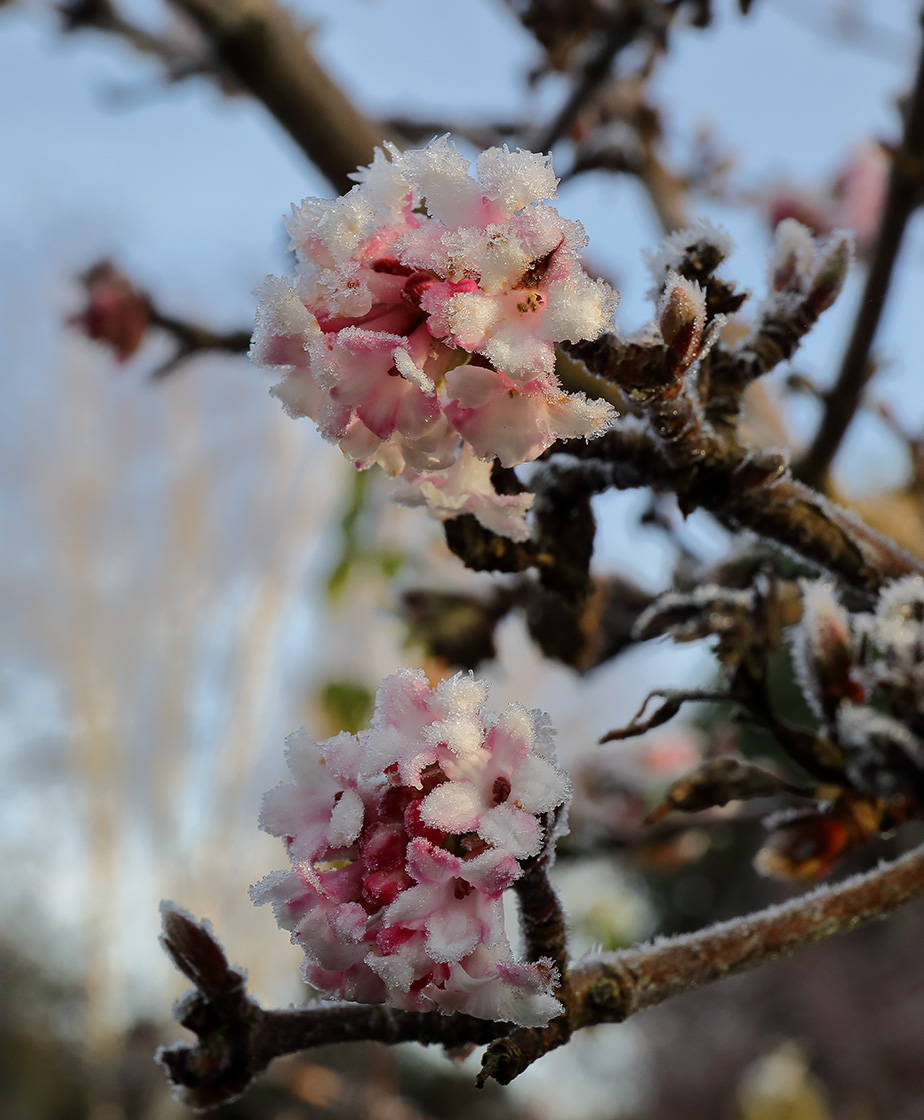
Frosted Viburnum flowers

NB: A note for WordPress Reader users – you need to click on the title of the post again to see the full photograph. (Otherwise you see just a tiny section!)

The cold has returned and it feels more like winter after the very mild New Year. There has been more frost and the new pond has had a covering of ice. What a change from the previous days that were more like mid-autumn!

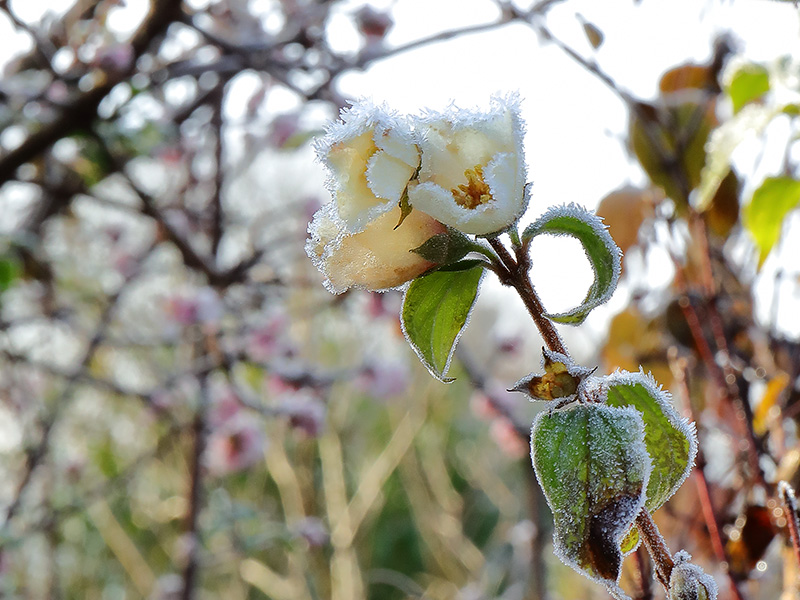
The frost has caught a few flowers in the garden. Viburnum bodnantense ‘Dawn’ (top photo) is a reliable flowerer for winter and often gets a little bit of icy decoration. The phildadelphus below is a summer-flowering shrub but somehow managed to produce the few flowers here. They make an unusual frosty image, but I wonder if the warming climate will make occasional winter flowers on this shrub more likely.

The unusually warm temperatures over the last few weeks must have been confusing for plants and for wildlife too. I’ve noticed the occasional bumblebee buzz past me while I’ve been working in the garden. It’s not unusual to see one or two out of hibernation on a sunny day. They seem to prefer the mahonia flowers to the viburnum, but maybe it depends on what the choice of flowers is, and what stage they’re at.

In any case, I think I should add some new plants to expand the choices for any bees active at this time of year. (Winter-flowering heathers, aconites, crocuses, hellebores and winter-flowering honeysuckle are all frequently recommended. As are willows, but I wouldn’t have room for one of those!) For now, I’m hoping that the bumblebees are safely tucked up and asleep – it’s cold out there!

Frosted Philadelphus flowers

Wishing You a Happy New Year!

Frosted aster plant

NB: A note for WordPress Reader users – you need to click on the title of the post again to see the full photograph. (Otherwise you see just a tiny section!)

It’s New Year’s Eve as I’m typing this, and it has been a strangely warm day for the time of year. Not a trace of wintry weather. The frost that I photographed here happened a few days before Christmas, so is long gone.

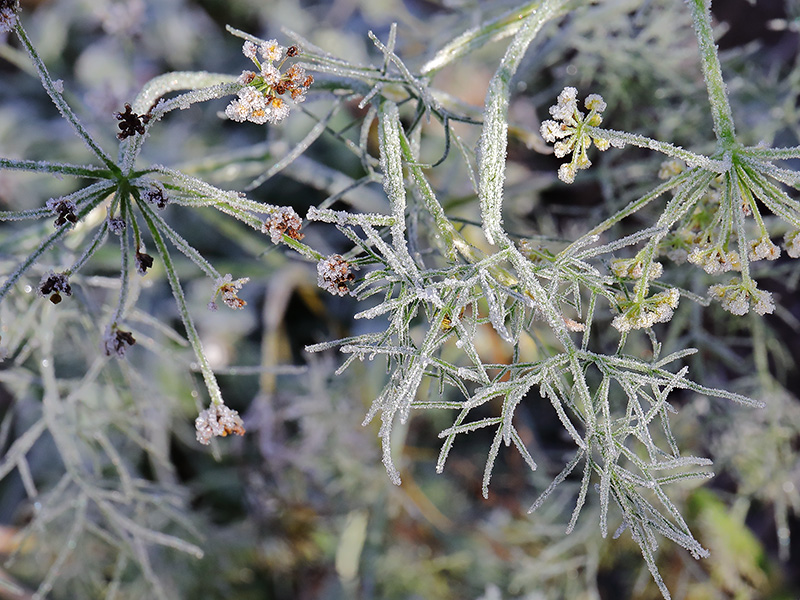
I was lucky to get that one frosty morning so that I could take a few sparkly photos for my Christmas and New Year posts. It’s amazing how frost can make the most ordinary of things look special. (Top photo is the remains of an aster, bottom is a young fennel plant that has flopped over in the cold.)

2021 has been a year of enjoying small, simple things here. The garden has been an ever-increasing source of happiness and has given me a sense of purpose when life has been rather constricted. I hope that 2022 is a year that will bring us back to being able to live our lives safely and healthily.

For 2022, I wish you all a year of joy, health and peace. May it be a year that brings you delight in life. Happy New Year!

Frosted fennel plant

A Christmassy Red for You

Flowers of Dipladenia Rio

NB: A note for WordPress Reader users – you need to click on the title of the post again to see the full photograph. (Otherwise you see just a tiny section!)

I hope that you are all enjoying a peaceful, healthy and very happy holiday, whether you celebrate Christmas or not. Covid has given us another difficult year but I hope that, despite it, you and yours have a time full of magic and joy.

I’d also like to thank you for reading my blog posts and for commenting and chatting here. Your company has brightened my days and the warmth of the blogging community has cheered me at a time when it is difficult to visit family and friends. It is a joy to interact with you!

The flowers here are Dipladenia ‘Rio’, a climber that I grow in our conservatory. The colour feels festive and Christmassy, so appropriate for this time of year. I hope that you are feeling festive too!

Dipladenia Rio

Frosty Christmas Decorations

Frosted fennel seed-head

NB: A note for WordPress Reader users – you need to click on the title of the post again to see the full photograph. (Otherwise you see just a tiny section!)

As this is the last post here before Boxing Day, I reckoned it was time to post some natural ‘Christmas decorations’ created by the frost. These are from a couple of years ago – there hasn’t been enough frost for photography yet this year. (But there probably will be in January, as it’s usually colder then.)

I’m relieved that we haven’t had much frost yet because I have lots of plants sitting around in pots. They’re waiting for me to use them in a border renewal, but work has gone more slowly than I expected. The plants will probably be OK, because they’re in quite big pots and are mostly very hardy. Even so, I always feel a bit guilty about the possibility that they may freeze and worry about them making it ’til next spring.

The border I’m re-planting is an area that has partly been taken over by Japanese anemones. It stretches to the side of the new pond. (The pond is still a big black hole at the moment – I’m hoping that it will fill up with rain or snow over the winter.) It feels good to be able to keep going with this while the weather isn’t too cold.

Until it does get really wintry, I’ll keep pottering about in the garden. For Christmas though, I’ll take refuge in the warmth indoors. I’ll probably spend most of the time curled up on the sofa with hubby and the two cats, lots of good books, plenty of tasty food and (very likely) a generous amount of wine. (Maybe even something decent on the TV.) Whatever you’re doing this Christmas, I hope that it’s a good one, and that it brings you much happiness. I wish you and your families and friends good health and good cheer. 🙂

A Last Blaze of Colour

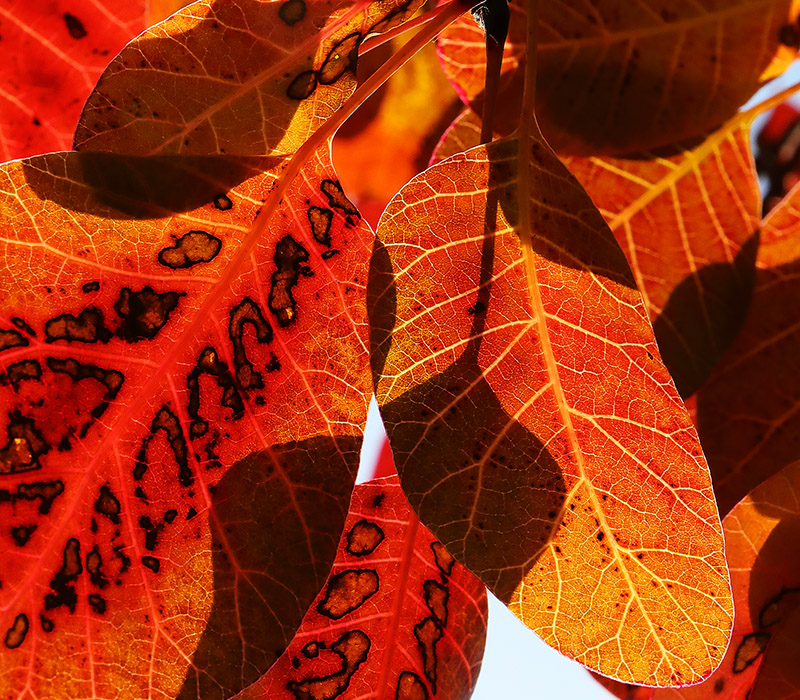
Cotinus (smoke bush) autumn leaves

NB: A note for WordPress Reader users – you need to click on the title of the post again to see the full photograph. (Otherwise you see just a tiny section!)

I took these photographs in my front garden just a couple of weeks ago. It already feels like a long time since we had such rich colours. These glowing leaves belong to a smoke bush (Cotinus coggygria ‘Royal Purple’) which has been positioned to allow us to see the evening sun shine through its branches.

During the summer the leaves are a striking deep purple. Autumn changes them to the glorious mix of reds, oranges and yellows that you see here. For a little while, this large shrub almost looked as if it had burst into flames. (Appropriate, I think, for a ‘Smoke Bush’!)

This was the last of the really warm colours as the garden is taken over by winter. The leaves on this smoke bush have now faded to a soft brownish yellow and will probably soon be blown away by the wind. But for this one shrub, there was a spectacularly fiery finale to it’s year.

Cotinus (smoke bush) autumn leaves

Going, Going, Gone 3: Long Gone

Rudbeckia flowers

NB: A note for WordPress Reader users – you need to click on the title of the post again to see the full photograph. (Otherwise you see just a tiny section!)

Almost all of the autumn flowers here are gone. One or two remain. The hesperantha and gaura (posted here two weeks ago) still have a few flowers, and the dark flowers of Scabious ‘Chile Black’ keep coming well into the winter frosts. Others have only just finished for the year.

Many other flowers are now a more distant memory. The yellow flowers of the rudbeckia (top photo) have been gone for a few weeks, but for a long time they were their own little splash of autumn sunshine.

The red dahlia below is a lovely plant that was grown and given to me by my friend Barbara. It’s Dahlia variabilis ‘Bishop’s Children’. From seed, it can be anything in a range of reds, pinks, oranges and yellows, with deep red/bronze foliage. This one has survived several winters in the garden in its well-drained and sheltered spot. But as soon as the slightest touch of frost gets to it, the flowers stop. So one day you can have several red flowers looking radiant, and the next they’ve gone.

Dahlia 'Bishops Children'

Another splash of bright colour came from the New England aster in the photo below. (OK, I know I should call it Symphyotrichum, but ‘aster’ is so much easier!) I believe this one is ‘September Ruby’ (aka ‘Septemberrubin’). It’s a tall plant, covered in wonderfully pink daisies – usually about 4 ft. tall, but one year nearer 5ft. It’s glorious and one of the cheeriest sights of our garden in autumn.

These plants have finished for the year, but having their photographs gives me a reminder of warm late summer and autumn days. That’s something very welcome while it’s raining and the wind is stripping the leaves from the trees

Even now, though, there is a scattering of colour in the garden as the winter flowers start to appear. The winter jasmine is gleaming with delicate yellow stars and nearby a Viburnum bodnantense ‘Dawn’ is showing its tiny pink flowers. A mahonia bush now has yellow buds promising to open soon. As we approach the darker days of winter, these will give little touches of colour to cheer our hearts.

Aster flowers (Symphyotrichum)

Going, Going, Gone 2: Going Soon

purple penstemon flower

These flowers are likely to be pretty much gone by the time I post this. They’ve done well to last as long, but the next touch of frost will probably be enough to finish off the cosmos (below) and the osteospermum (bottom).

The penstemon (above) can usually flower a little longer than the others. Sometimes it’s still flowering when the heavier frosts arrive, which makes for some attractive photographs. I don’t think it will manage to keep going long enough this year because there are fewer flowers. None of our penstemons have had as many flowers as usual this year, but I don’t know why. They’re pretty drought-tolerant but I suppose it’s possible that they got a bit too wet in winter. Hopefully they’ll have stopped sulking by next year!

Cosmos 'Candy Stripe'
Cosmos ‘Candy Stripe’ has a pretty colouration.

I was glad to get the photograph of the cosmos, even though I’d already taken several others back in August, because at last it had developed the colouring that I had been hoping for. That was my last chance to get a decent photograph too, because although there are still several flowers, they’re now smaller and starting to look a bit ragged as the weather gets rougher.

Next year I will probably plant cosmos again, but I’ll try to find a different cultivar so that I have something new to photograph. (That’s the pleasure of having some annuals in the garden – I must make time to grow more.)

We have several osteospermums tucked into sunny spots in the garden. They don’t usually survive the winter but a local nursery sells them quite cheaply, so we don’t mind buying some more. The flowers are looking a bit ragged as a result of the little bit of frost we’ve had and the rain more recently. However, there’s still a few buds, so maybe they’ll manage to open to give us a last few flowers. (Next summer, I must remember to photograph the pretty daisy-like osteospermum flowers when they’re at their best – not leave it ’til they’re getting roughed up by the weather!)

purple osteospermum flowers
Pink osteospermum flowers – not quite ready to open.

Going, Going, Gone: Still Going

Red hesperantha (formerly Schizostylis) flowers

It’s come to the time of year when the garden is starting to feel rather empty. The leaves are falling, there are gaps in the borders where plants have died down for the year, and there are few flowers left.

With the gradual disappearance of the flowers, I have a lot less to photograph. (There’s still the changing colour of the leaves, of course.) By the time the frosts come, I’ll be grateful for whatever photographic opportunities they bring. Meanwhile, the next couple of posts will be the last chance to capture these flowers before they’re gone for the year.

The top photo is of Hesperantha coccinea – the crimson flag lily or river lily. (It used to be called Schizostylis, but plant names are always being messed about with. At least the newer name is a bit easier to spell!) This plant is one of the latest to flower in my garden, usually not until late September, but the flowers will last through the first frosts. I’ve read that it should normally start flowering in August, so I wonder if ours is later because it is not well enough established yet, or whether it’s because it is a bit hot for it here at that time. It will be interesting to see if this changes as it develops.

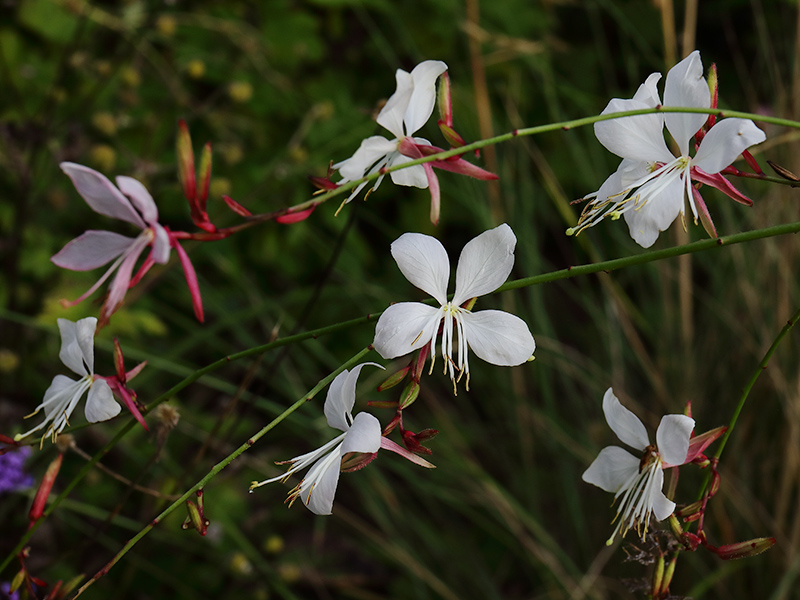
The plant pictured above is Gaura lindheimeri. (Well, I thought it was – I’ve just discovered that it’s had a name change too. Now it’s Oenothera lindheimeri. Keeping up with plant names is tricky!) This is one that I love for the delicate flowers that sway on long stems. It’s one of those airy plants that (like Verbena bonariensis) take up little space in the garden, but whose flowers combine beautifully with many other plants.

Next year I’ll try the gaura alongside the lacy white and red flowers of wild carrot (Daucus carota) and probably the small dome-shaped flowers of a dark red scabious too. Gaura flowers for ages – right from summertime until the frosts stop it.

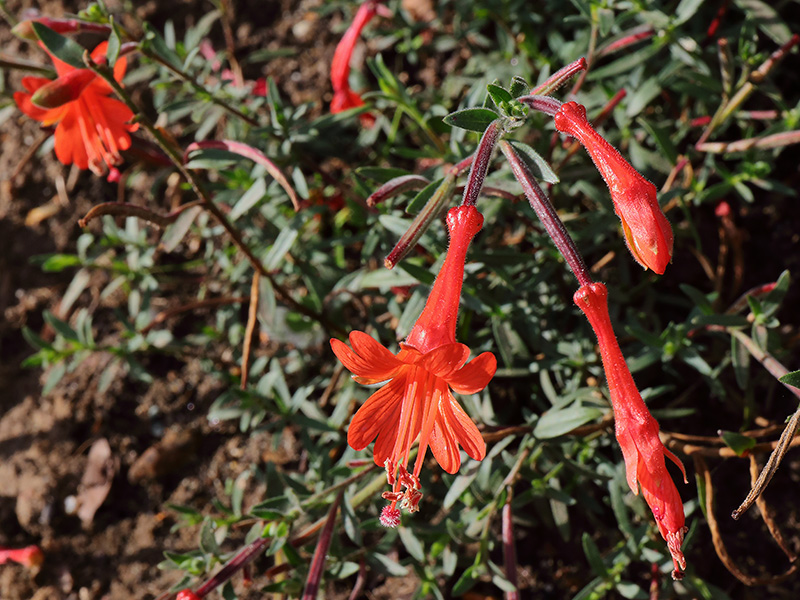
My last plant is Zauschneria californica ‘Glasnevin’ (California fuchsia). This was just planted last year, so is still settling in, but it does seem to be happy in its patch of hot dry soil. Its flowers won’t last much longer but it has kept flowering later than I expected it to. The plant is tiny now, but hopefully in future it will be a mass of little orange flowers to brighten dull autumn days.

Now I must get back out there with my camera and see what else I can find…

Zauschneria Glasnevin