NB: A note for WordPress Reader users – you need to click on the title of the post again to come out of the reader and go to the post itself. This allows you to see the whole of the top photograph. (Otherwise you may see just a tiny section!)
It is raining, it has been raining, and there is more rain to come…
If you’ve been reading this blog for a while, you will probably have noticed that I frequently mention that we have a dry climate here in the east of England. Drought is something I worry about in the garden and I try not to have many plants that require moist ground.
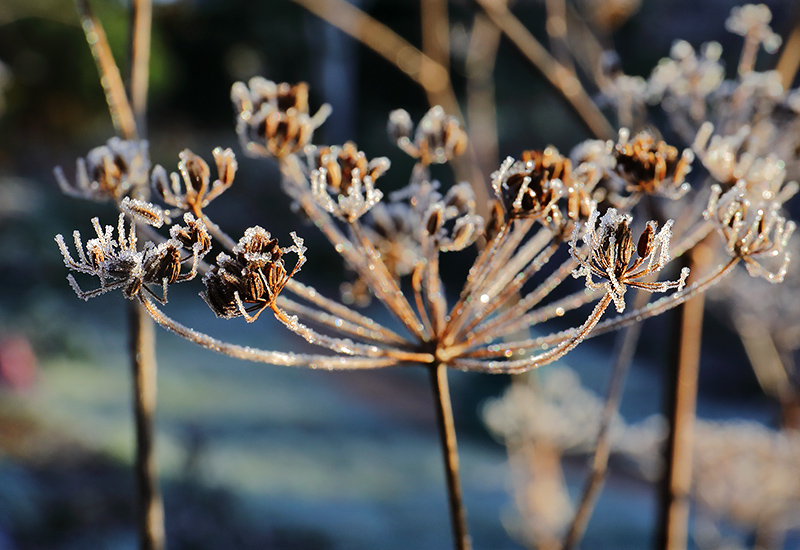
Not raindrops but melted frost drops from last winter.
This week has felt quite strange because it has rained and rained. In fact, this summer was unusually rainy and our grass even stayed green. I’ve read that the heavier rainfall may be a part of global warming (because warm air can hold more moisture) but this does feel unexpected.
Because it has been so wet, I thought it appropriate to post some watery pictures. However, I have a confession to make…they aren’t raindrops, but drops of melted frost photographed last winter. (It has been much too wet and grey for me to want to take the camera outside.)
We have been lucky here. Storm Babet hasn’t caused much disruption. But elsewhere, especially in Scotland, people have been forced to leave flooded homes and much damage has been done. Sometimes the forces of Nature can be thoroughly alarming!
The golden oat (Stipa gigantea) looks at its best when covered in frost, even if that frost has melted.
NB: A note for WordPress Reader users – you need to click on the title of the post again to see the full photograph. (Otherwise you see just a tiny section!)
This year was a worrying one as far as tiny visitors to the garden went. In spring and early summer it definitely felt as if there were fewer bees and other pollinators around. Butterflies, too, seemed scarcer this year. Things improved in the later part of the summer and there were days when there were a fair number of insects around, but not as good as previous years.
Last winter was a very cold one, with much harder frosts than we usually get. Presumably, this must have made it harder for hibernating insects to make it through to spring. I’ve also read that last year’s drought didn’t help insect numbers. Hopefully the wetter summer this year will have produced an improvement.
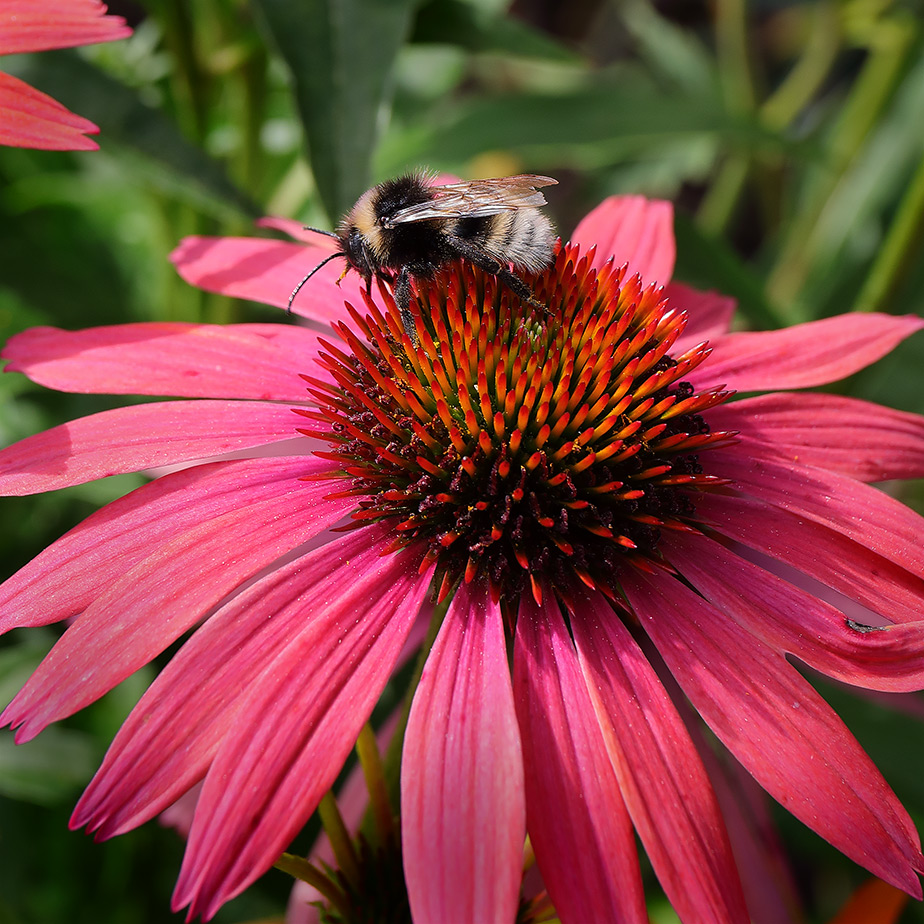
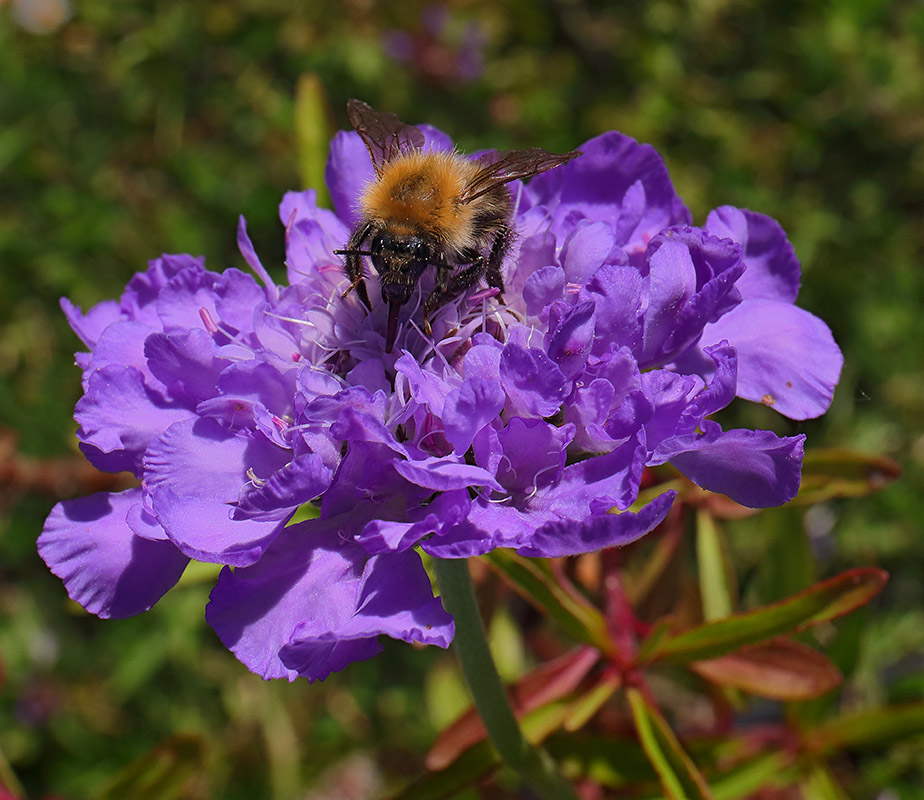
Common Carder bee
It was a relief to see bees and butterflies appearing as the summer progressed. But there were some things that I didn’t see here, such as the Small Tortoiseshell butterfly in the photo below.
Peacock butterflies were a rare sight here too, but Red Admirals appeared in good numbers. (They are the commonest butterflies in my garden, along with the Cabbage Whites.) The largest number I saw was on a particularly sunny day, when about a dozen Red Admirals and a solitary Peacock were feasting on a buddleia. For a few warm days there were enough of them around to swirl past me whenever I walked along the path and brushed against our butterfly bushes.
Small Tortoiseshell butterfly photographed in a previous summer
There was an increase in dragonflies visiting – they have obviously become more aware of our pond. It was amusing to watch these fairly heavy creatures try to settle on the nearby stems of evening primrose, which quickly bent and swayed under their weight. To give them better lookout posts, I pushed some big birch twigs into the pots of a couple of the pond plants. I hope they appreciated them!
Although this appeared to be a poor year for insects, there are some signs of hope in the attitudes towards their welfare. I’ve noticed a lot more wild plants and food plants for bees and butterflies in garden centres and nurseries, a response to the growing interest in gardening for wildlife. And, much to my delight, our local council stopped mowing many grassy areas. This means that the green that runs in front of the houses here is being allowed to become wilder. I’m hoping that in a few years we’ll have a decent little wildlife meadow out there!
NB: A note for WordPress Reader users – you need to click on the title of the post again to see the full photograph. (Otherwise you see just a tiny section!)
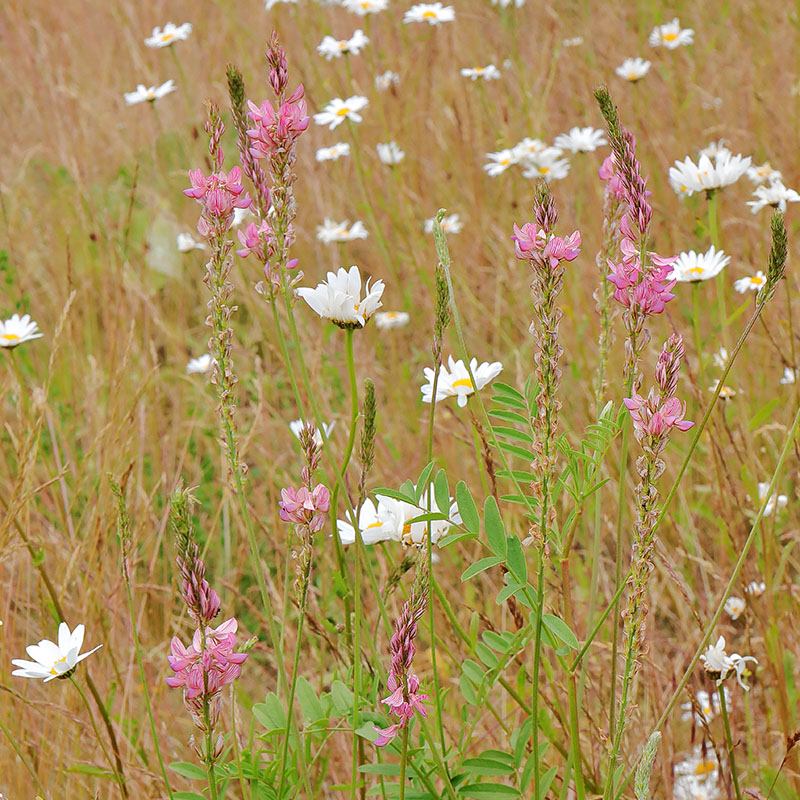
The flowers of sainfoin (Onobrychis viciifolia) were sprinkled throughout the meadow that I wrote about in last week’s post. It’s a plant that I had never seen before. I was enchanted by the spikes of delicate pink flowers with darker pink veining, so I took the opportunity to photograph it.
Reading up about this grassland plant afterwards, I discovered that it is a native of Europe and Asia. Sainfoin is an ancient forage crop grown to feed cattle, sheep and horses. It fell from favour in modern times but is apparently making a comeback. The plant has several benefits, including controlling worms in grazing animals and improving the quality of the soil by fixing nitrogen. (The common names of ‘healthy hay’ and ‘holy hay’ reflect the benefits to livestock.)
But it’s not the usefulness to animals that caught my attention. I’m far more interested in the benefits that sainfoin offers to bees and other pollinators. Apparently sainfoin produces large amounts of both pollen and nectar, making it very attractive to pollinating insects, including bumblebees and butterflies.
This suggests that it would be worth growing in a selection of wildflowers for a semi-wild area that will be a habitat for wildlife. It’s an idea that appeals to me greatly, but I would need to be able to fit my wild patch into a small space. A possibility for next year… 🙂
Sainfoin (Onobrychis viciifolia) with ox-eye daisies
NB: A note for WordPress Reader users – you need to click on the title of the post again to see the full photograph. (Otherwise you see just a tiny section!)
An awareness of the importance of wildflowers in creating spaces for nature is growing in the UK. Plants for bees and other insects are recognised as being vital to help species survive. Many gardeners are trying to help nature by allowing their gardens to become a little wilder, and some are creating their own ‘meadow’ areas within their gardens.
Recently I visited a large garden at a Suffolk farm and had a walk around the adjacent wildflower meadow. There are already a few wildflowers in my own garden and I’m interested to see what else I can grow to encourage insect life. (But without letting something take over the garden, e.g. white deadnettle. Although its flowers are great for bees in the early part of the year, I’m finding it almost impossible to stop the plant from spreading everywhere.)
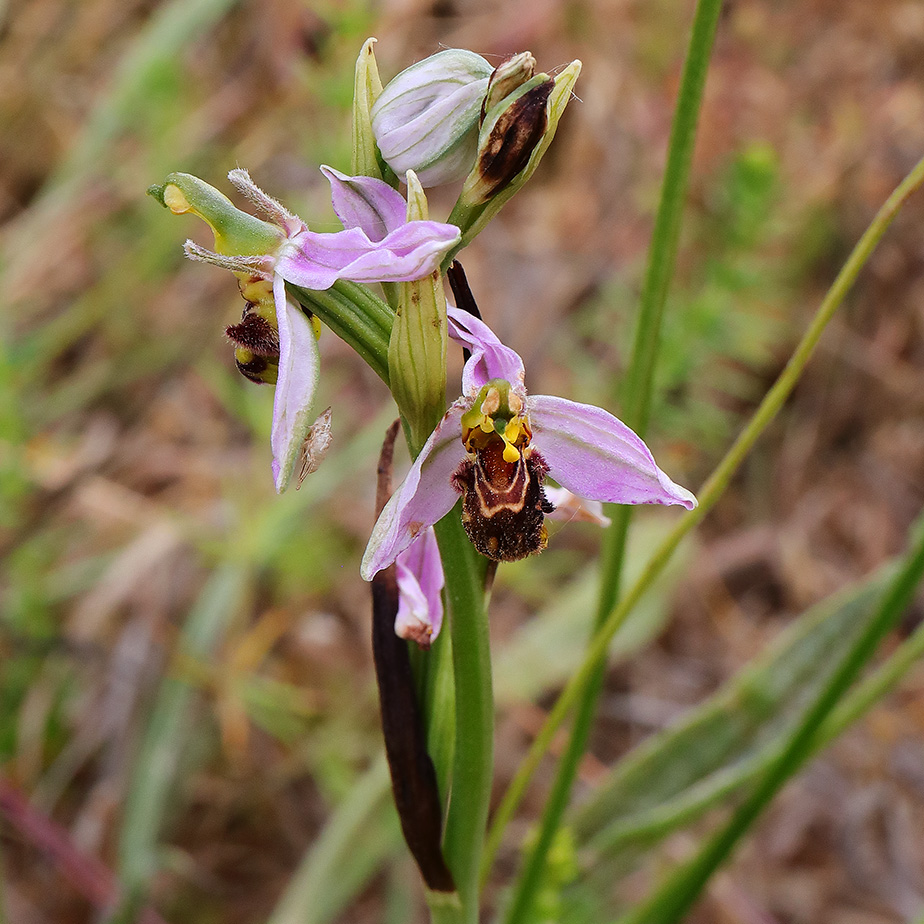
I’m on the lookout for wildflowers to grow, but I know that the plant in my top photograph is unlikely to appear in my garden. It’s a bee orchid (Ophrys apifera), an orchid that is native to the UK. This is a cheeky wee plant – the flowers mimic female bees so that the male bee comes along hoping to mate, but pollinates the flowers instead. (A bit disappointing for the bee, I reckon!) An uncommon plant, however, it does appear in meadows here in the east of England.
The plant below is one that I do already have, but mine is growing in a pot. This is bird’s foot trefoil (Lotus corniculatus), another native grassland plant which grows throughout the UK. The flowers are a great source of nectar for bees and it is a food plant for caterpillars too. It was interesting to see how it grows in the wild, but because the RHS website says it can become invasive, I will probably keep mine in its pot. (I like the idea of having pots of it dotted around the garden in sunny spots. The bees and butterflies would love it.)
NB: A note for WordPress Reader users – you need to click on the title of the post again to see the full photograph. (Otherwise you see just a tiny section!)
Although the phrase ‘going to seed’ suggests going into a decline, I’m usually happy to see seed heads in the garden. (Not all, mind you – weeds may not be so welcome!) For a garden photographer they are another opportunity to create an image. That’s especially welcome at a time of year when there are fewer flowers and plants to photograph.
Seed heads are, of course, very valuable for wildlife too. The seeds are a good source of food for birds in winter and, before that stage, the flowers are a great source of pollen for insects.
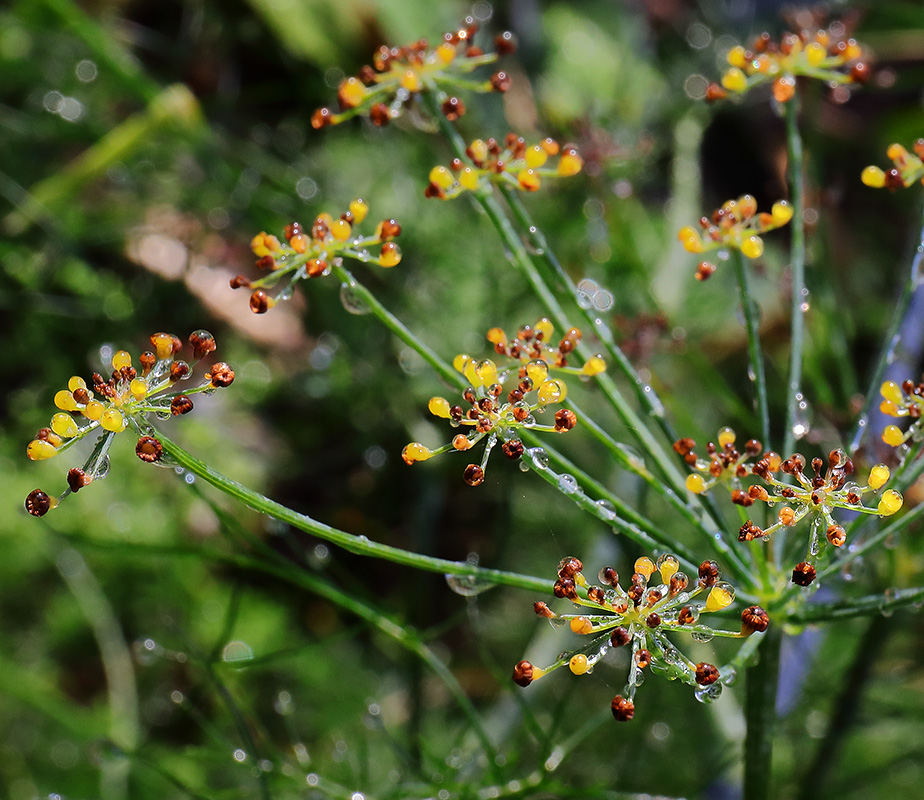
The seed heads here are bronze fennel (Foeniculum vulgare ‘Purpureum’). In the top picture, there are still many of the tiny yellow flowers but you can also see the brownish/orange ridged shapes of the newly-formed seeds. I was attracted to it by the neat drops of melted frost encasing them. (This was a young plant that had flowered very late and got caught by the first of the frosts last year.)
In winter, the seed heads of fennel provide a very graceful shape for frost to decorate. The frost in the second photo was especially hard and covered the whole garden with its delicate filigree. The air was so cold that the frost had time to glitter in the sun for a little while before it melted. We haven’t had any frost yet this year, but I’ll be checking the fennel plants when it arrives! Hopefully it will last long enough for me to take some more sparkly photographs.
NB: A note for WordPress Reader users – you need to click on the title of the post again to see the full photograph. (Otherwise you see just a tiny section!)
Autumn brings a restrained feel to my garden. There is nothing showy here at the moment and the remaining touches of colour are easy to miss. But if the sun shines, there might be a sudden brief glow as it brings the leaves alive like small flames.
Mostly this is a time of rain (needed after the summer’s drought) and winds that tear the remaining leaves from the trees. Not so nice for gardening, until a dry and mild day comes along. Then I can get some digging done in the loosened soil. (It gets so dried out in summer that digging then is very hard work. Adding more compost will help, but it will take a lot to make a difference.)
As the autumn colours begin to fade or get blown away, new winter colour is starting to arrive. Bright yellow flowers are ready to open on both a mahonia and winter jasmine. Near the jasmine, a viburnum bush has the dark red bells of a winter-flowering clematis to accompany its own pink buds. And, at last, I can see buds of hesperantha (see this post) which should open soon. So I will still have one or two things to photograph while the winter draws closer.
NB: A note for WordPress Reader users – you need to click on the title of the post again to see the full photograph. (Otherwise you see just a tiny section!)
Often the leaves don’t change colour very much here in autumn. This year though, they were much more golden than usual.
Our autumns are usually mild, with rain and stiff breezes that carry away a lot of the leaves. This October, however, was much warmer and sunnier than usual during the day and the clear skies allowed the temperature to drop a lot at night. The result has been good displays of golden leaves in gardens and the countryside around us. (Happy timing for us, because a good friend had come to stay, so we were keen to show off the beauties of Suffolk.)
The leaves above belong to our smoke bush (Cotinus), which is the most reliable producer of autumn colour in the garden. It also provides me with leaves that are low enough down for me to be able to photograph them close up. A large Himalayan birch and a rowan tree have both coloured well, as has a wisteria. There are not many red leaves though. A cherry tree and a crab apple both produce some red but the leaves have already blown off. (And had to be fished out of the pond! Luckily that’s a job I find quite satisfying.)
NB: A note for WordPress Reader users – you need to click on the title of the post again to see the full photograph. (Otherwise you see just a tiny section!)
A look through my photo files shows me that I have taken very few images of bees this year and none at all of butterflies. That may be partly due to me being busy finishing off the pond, rather than paying so much attention to the flower borders. But the relative absence of these garden friends has been very noticeable over the last few months.
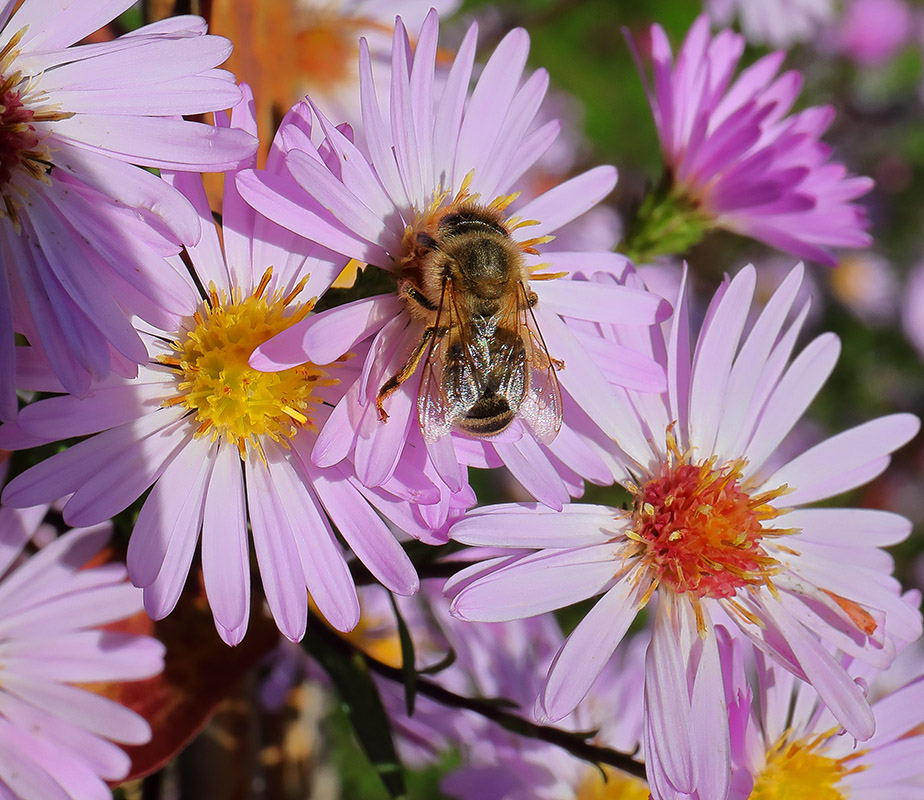
Spring wasn’t so bad. There were Buff-tailed bumblebees and Common carder bees keeping busy in the spring flowers as usual. A little later, lots of honeybees made the most of the flowers of the Ceanothus bush. It fairly buzzed at times! But when the temperatures began to climb, there certainly appeared to be less activity in the garden.
Butterflies clockwise from top left: Red Admiral, Peacock, Comma
Keeping myself out of the heat probably means that I was less aware of any bees that were around. Normally, though, I would see quite a lot of them – hoverflies too. I’m more sure about the drop in butterfly numbers here. There are warm, sheltered spots in the garden that frequently attract butterflies but this year there were rarely any there.
I’ve read that this year’s ‘Big Butterfly Count’ had lower numbers recorded, despite an expected increase because of the warm weather. It is feared that environmental changes and habitat loss account for the drop. For many bees, though, the heat of this summer is suggested to have been a disadvantage. A study by US scientists has found that the larger, heavier bodied bees (including bumblebees) declined as temperatures increased, while smaller bees increased in numbers.
Does this explain why I’ve seen fewer bumblebees this year? I don’t know. All I can really do is to try to provide as much as I can in the way of useful plants and habitats in the hope that it will help both bees and butterflies.
NB: A note for WordPress Reader users – you need to click on the title of the post again to see the full photograph. (Otherwise you see just a tiny section!)
Flowers with bright, hot colours feel particularly appropriate to post after the hottest week I’ve ever experienced. The temperatures have been hotter than I could ever have imagined in the UK, reaching over 40C in a number of places. (Here in Suffolk it was a couple of degrees cooler, but still very difficult to cope with.)
We were lucky. Using fans to keep ourselves and our two cats reasonably cool worked. (Although there were a couple of panicky moments when the electricity went off. Fortunately it came back on both times, after just a few minutes.)
Elsewhere in in England (mostly in the London area) there were those who were desperately unlucky. In several places people have been made homeless as houses and possessions were burned to nothing but ash by wildfires. And I’m sure we’ve all seen the news about the dreadful wildfires that have been causing huge destruction across Europe.
Surely there cannot be any doubt that our climate is changing massively from what we are used to. Now is the time to do everything we can to care for our environment, our world and all that lives upon it. The changes we individually make may be small, but they all count. Together they help.
This photo: Daylily (Hemerocallis) Top photo: Leopard Lily
NB: A note for WordPress Reader users – you need to click on the title of the post again to see the full photograph. (Otherwise you see just a tiny section!)
Helping bees is the annual focus of ‘Bees’ Needs Week’ again, starting tomorrow. By helping bees to survive and thrive, we’re really helping ourselves. A large part of agriculture relies on bees (and other pollinators) to pollinate the crops that provide our own food.
It seems deeply ironic to me that while agriculture relies on wild pollinators to pollinate an estimated 85-95% of the UK crops that require it, that agriculture is also a main reason for their decline. The destruction of wild habitats by intensive farming and the use of pesticides and weedkillers is making the survival of insects more difficult. But we can all help to fight the decline in wild bees and other insects in our own gardens, on balconies, allotments, and on any patch of spare ground.
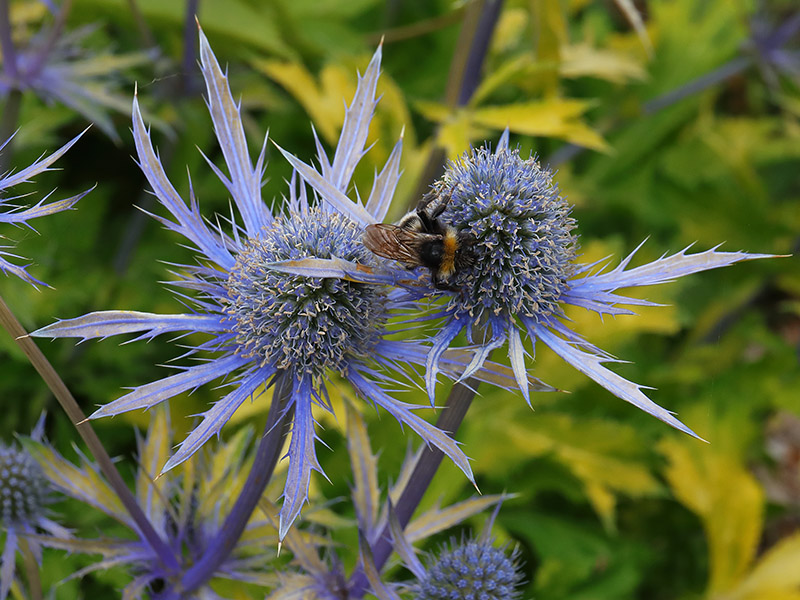
Bumblebee on Eryngium
Plants with plenty of pollen and nectar are the most obvious thing we can provide. A wide variety of garden plants are attractive to bees, so there’s lots to choose from for the gardener. There is a list of some of the best plants for bumblebees here. And here is an excellent (and longer) list of good pollinator plants from bee expert Dave Goulson. (Scroll down his page for it.)
If you garden, you’ll soon notice which of your plants the bees prefer. I try to be aware of the most popular flowers in my own garden and grow a few more of them if I can squeeze them in. I keep an eye open for the plants that are being visited by bees in other people’s gardens too.
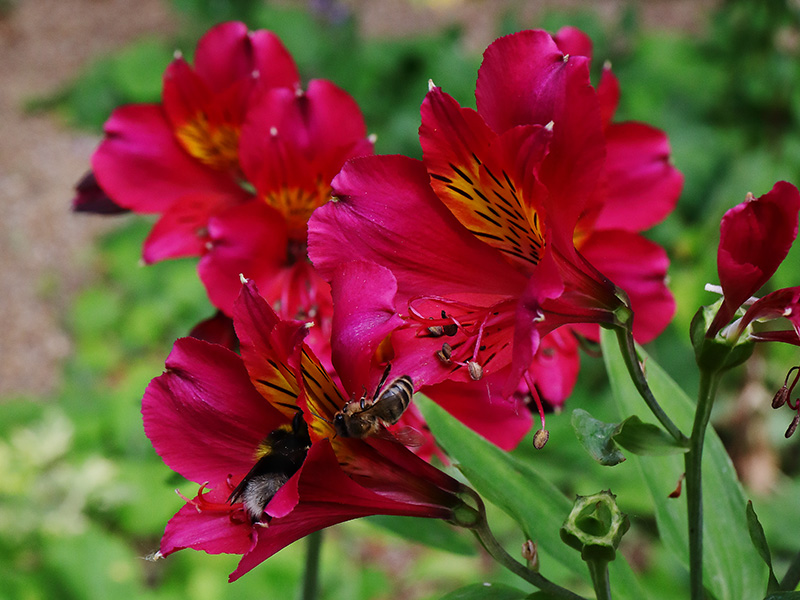
I was very pleased to see the bees on the alstroemeria in the photograph below because it’s one that I’d like to plant here. It looks to me as if the honeybee is impatiently waiting for the bumblebee to get out of that flower! (I wonder why that one – there were plenty of others to choose from.)
Honeybee and Bumblebee on Alstroemeria: ‘Hey wake up in there, it’s my turn!’
Water, obviously, is another essential to life for the bees and you can make their search for it easier and safer by providing some. (It’s easy for bees to drown in deep water.) The recommended method is simply to fill a shallow bowl with pebbles and top it up with water. Then the bees can land on a pebble and stand there safely while drinking. But do remember to change the water occasionally so that you don’t get any mosquitos breeding in there!
Planting for bees brings a lot of satisfaction to my own garden. In late spring the distinct buzzing of bees from our ceanothus bush makes me grin…they sound so busy there! And the catmint attracts not only our cats but lots of bees too. They also love our apple trees, the lavender, thyme, alliums, hardy geraniums, and daisies of all kinds. Best of all here are the different varieties of scabious (top photo), which flower for a long time and always seem to have a bee or other pollinator somewhere. (OK, that is an exaggeration, but they are very popular.)
I hope that this will give you some ideas about a plant or two to add to your own space for the bees. Happy (buzzing) Bees Needs Week!










 Ann Mackay: Inspired by Nature