Ever So Pretty In Pink: Cyclamen

Some flowers have a personality all of their own.

This little cyclamen looks to me as if it (she?) is all dressed up for a party in ‘her’ best dress – in frills, flounces and soft pleats of magenta silk. She’s a real show-off, dancing around with her skirt swishing and swirling around her.

Even the details of this glamorous bloom are exquisite. The cap behind the petals has the appearance a soft fabric, contrasting with the silky smoothness of the petals. I can just imagine this as an embroidered velvet, with perhaps some tiny seed beads added into the stitch-work. (Can you tell that I’m interested in textile art?)

By the way, I just had to go and look at a botany book to find that the ‘cap’ is actually the calyx, made up of leaf-like sepals.

Close-up of calyx and petals of pink Cyclamen persicum cultivar
The velvety-looking calyx surrounded by silky, swirling petals

It seems odd then, that earlier relatives of this flower had the distinctly earthy common name of ‘sowbread’. This was because the root of the plant, despite being poisonous to both man and most animals, was believed to be a favourite food of wild boar. (I don’t know about that, but I have seen a grey squirrel run across my garden with a nice fat cyclamen tuber in its mouth.)

The name ‘cyclamen’ also comes from the plant’s root (a disc-shaped tuber). It is derived from the Greek word ‘kyklos’ (circle).

The ancient Greeks, according to Hippocrates, used cyclamen in their medicine. Over the centuries its uses have been very varied. It was used for dressing wounds and was also thought to help ease childbirth but feared as a danger to pregnant women. In medieval times, the tuber was believed so powerful that if it was worn around the neck, or its juice smeared on the belly, that it could trigger a miscarriage.

Other uses for cyclamen root have been as diverse as using it to make soap (the tuber contains saponins) and fishermen using it to stun fish. (The fishermen would grate the toxic root and sprinkle it over water where there were fish. They would then gather the stunned fish that floated to the surface. Makes me wonder if the fish became at all toxic to eat…)

Today cyclamen is, despite its toxicity, still used in homeopathy. But it is far more likely that you’ll come across one of the many cultivars as either a beautiful (but tender) houseplant or as a hardy autumn or spring-flowering plant for your garden. Whichever they are, they’re little beauties!

Pink Cyclamen persicum
The swirling petals almost appear to be moving…

Astrantia – A Pretty Flower With An Intriguing Past

In last week’s post, I said that a flower’s structure is one of the main things that makes me want to photograph it.

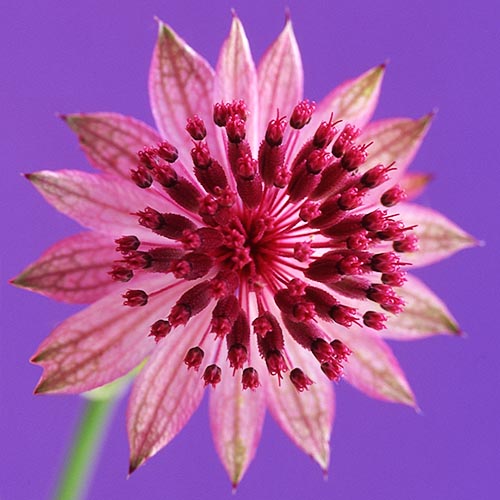
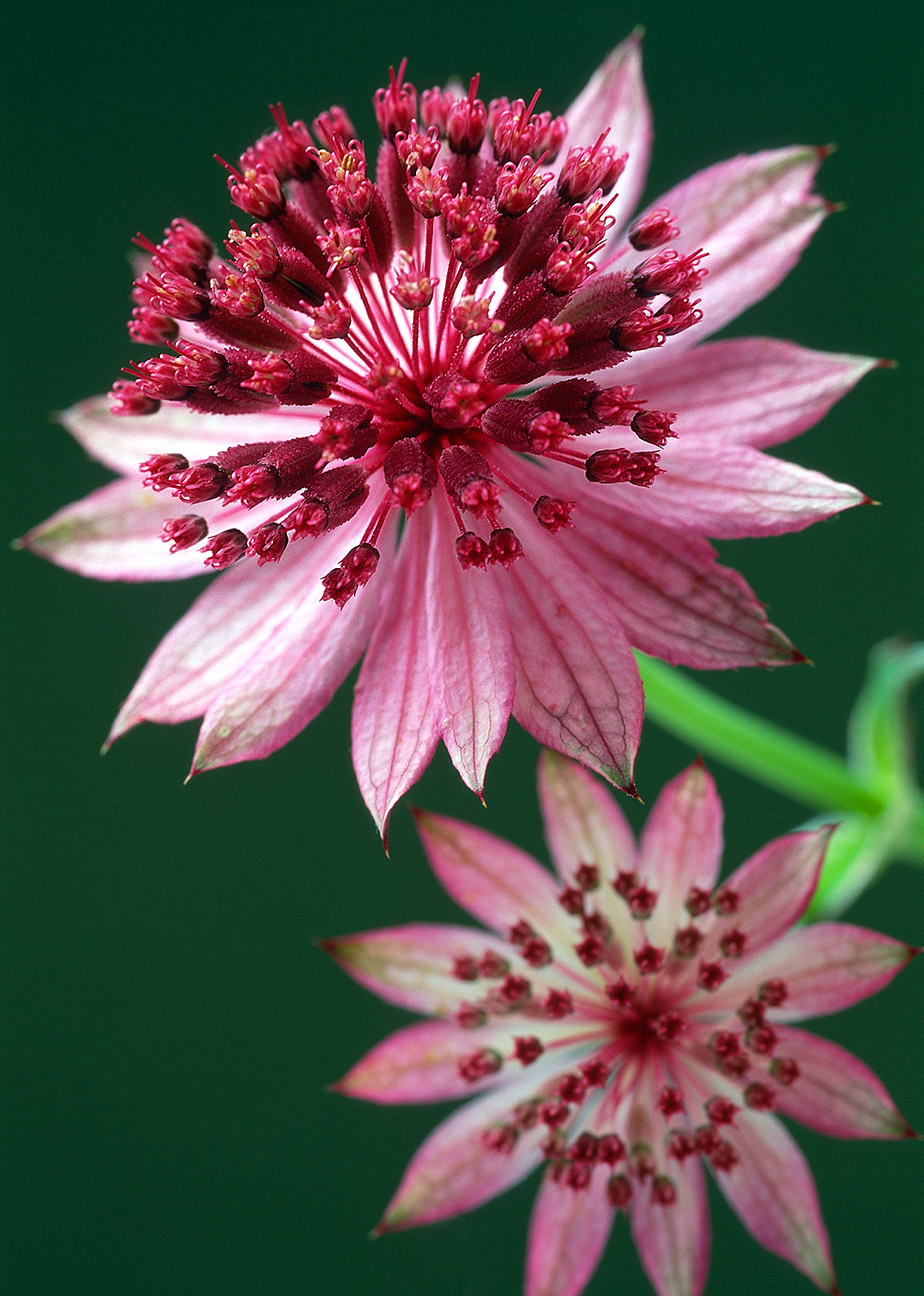
Astrantias are a good example of this. The shapes created by the outer ruff of petal-like bracts and the inner ‘pincushion’ of tiny flowers make it irresistible to me and my camera.

The astrantia flower offers plenty of detail to photograph. The inner pincushion of flowers has stamens that are like little threads. Just behind each minute flower is a ribbed part that looks like a miniature corn-cob – this will eventually become the seed.

Behind the flowers, the papery bracts are delicately veined with pink or green. Choosing to either bring these veins into sharp focus or to let them blur softly into the background allows for a different feel to the resulting photograph. To take advantage of this, I usually make a series of photographs. Experimenting with different depths of focus and photographing from varied angles is a very pleasant way to spend a morning and it’s ever so easy for time to just pass me by…

The shape of the astrantia flower has given it one of it’s common names – ‘Hattie’s Pincushion’. Who Hattie was, I have absolutely no idea. But it’s a sweet little flower to have as the last trace of her memory.

Astrantia’s other common name is ‘Masterwort’ and it’s this name that you find in historical references.

As ‘Masterwort’, astrantia was believed to have a number of medicinal uses. In ‘Culpeper’s Complete Herbal’, Nicholas Culpeper describes many ways that it could help his patients.

Maladies ranged from ‘all cold griefs and diseases, both of the stomach and body’, to cleansing and healing wounds, and preventing rheumatism and gout. Culpeper also suggests that it should be taken with wine to ‘extract much water and phlegm from the brain, purging and easing it from what oppresses it’.

However, I really wouldn’t recommend trying astrantia as a remedy for any of the ills that Culpeper mentions. His herbal was completed in 1653 and medicine has changed a bit since then!

Nowadays, being ‘a pretty face’ is quite enough for astrantia. It has become popular with garden designers and is easy to grow. Since astrantias prefer moist soil, I find that I need to keep them watered in my dry Suffolk garden. But they grow happily in shade and mix beautifully with other plants. (I think they’d look great combined with grasses, so I plan to try them with Stipa tenuissima next year.) For many gardeners, perhaps the best thing about astrantias is that slugs don’t seem to eat them. Yes, a plant that’s pretty much slug-proof – how wonderful!

Pink astrantia
Astrantias can be pink, red or white.