As spring becomes summer, there are new flowers opening every day. I wander round my garden, eyeing up the fresh buds with great anticipation – just waiting for the first glimpse of colour as the petals begin to unfold and burst out of their casings.
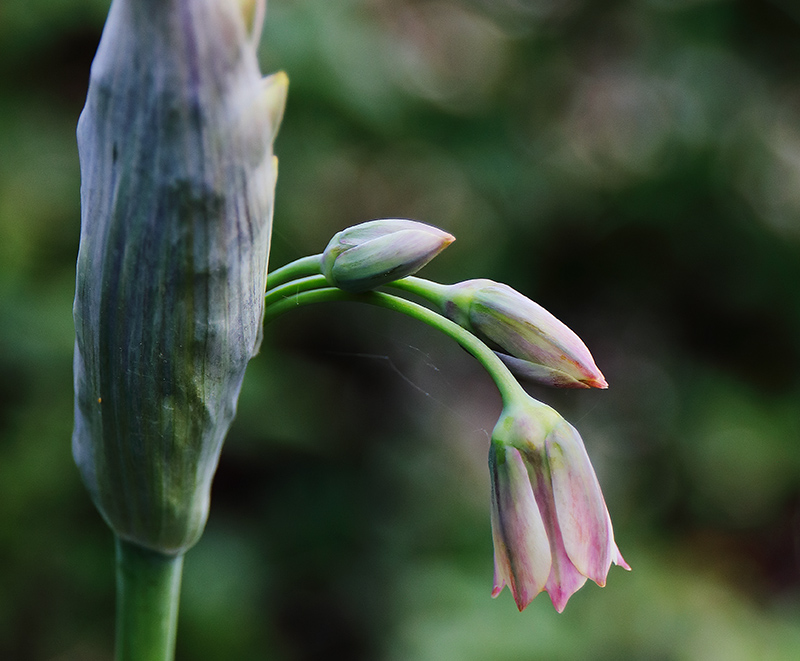
Nectaroscordum siculum (Sicilian honey garlic) is one of the plants I like to watch develop from bud to flower. It starts off with its buds all wrapped up in a papery covering, which you can see in the photo below. The buds look almost like a bunch of miniature tulips in a florists’ wrap as they peep out from behind their thin cover.
Buds emerging from their paper-like covering.
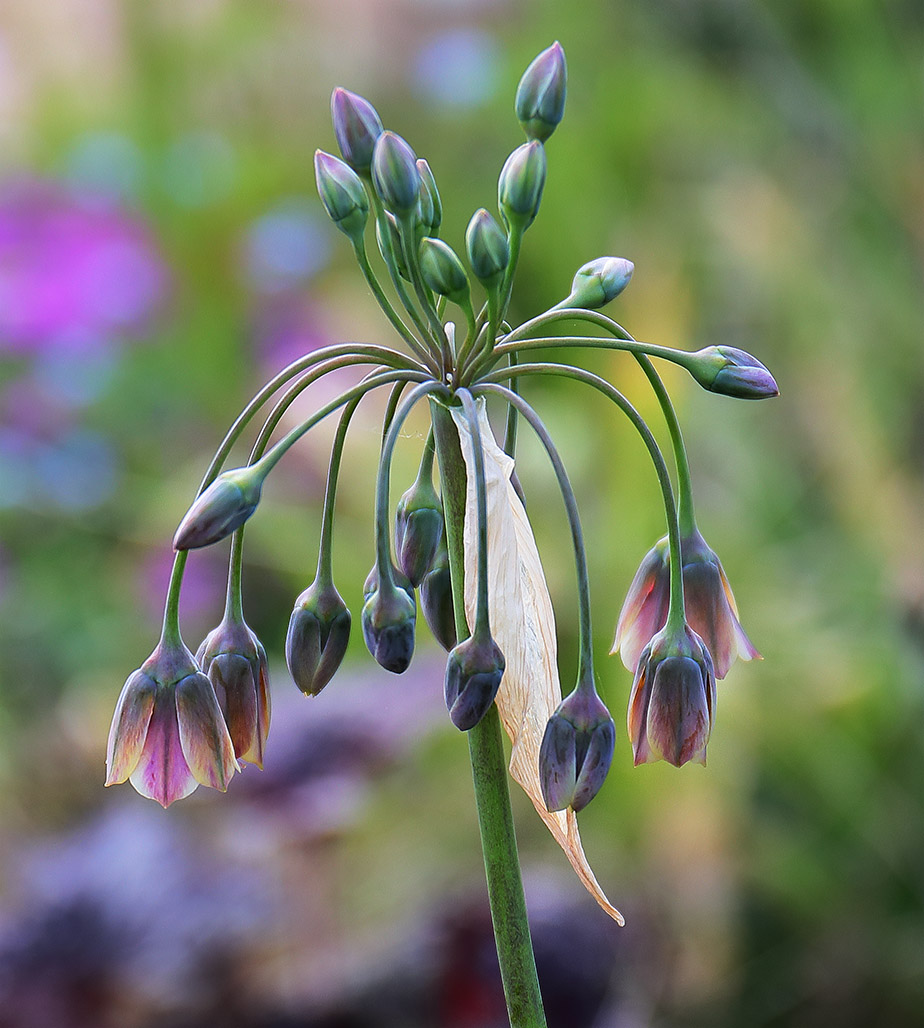
Gradually the individual flower buds manage to wriggle free of their protection. They then begin to move from sitting upright to hanging downwards as the bell-shaped flowers get ready to open. It takes a little while for the buds to get from being upright to hanging down, so that the flower head goes through a stage of having some of its buds still sticking upwards – making it look a bit like it has an unruly hair-do! (Top photo.)
And they’re out! The first buds emerge.
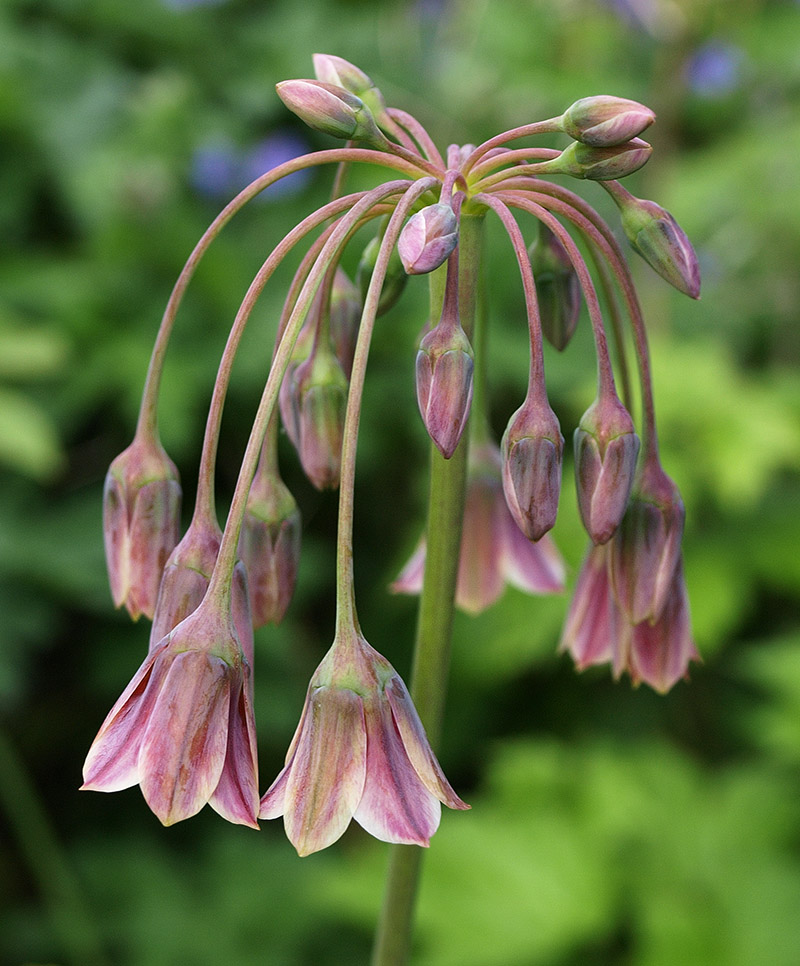
Eventually, all the flowers hang down, in a graceful umbel at the top of a tall stem. (And it sways in the slightest breeze, making it a little tricky to photograph if the air isn’t still!) Later, after the flowers have been pollinated, the seed pods will all turn upright again. Those little flower stems are extraordinarily mobile!
The flowers are a lovely sight, coloured with a soft blend of purply-pinks and cream that rather reminds me of mother-of-pearl.
Nectaroscordums are very easy to grow in a well-drained soil in sun and seem drought-tolerant in my garden. They multiply well too, though it will take a few years before the seedlings flower. If I’m lucky, maybe I’ll end up with a sea of them – that would certainly keep me happily taking photographs!
The top buds are starting to point downwards before opening.
It’s a Bank Holiday weekend here in the UK and that means that we have an extra day off for a bit of garden visiting or wandering around nurseries in search of whatever new plants might take our fancy. (Dangerous to the wallet – Hubby and I can always find something!)
Up until recently, I haven’t thought of planting many orange or peach/apricot-coloured flowers in the garden. That’s because there’s a lot of lilac-pink in the existing borders, which looks great with other blue-ish pinks, or crimson, purple or blue flowers, but really wouldn’t look good with the more yellowy pinks or oranges.
Now, though, I have a new opportunity to play with some different colours. For the past couple of months, I’ve been digging out a pond and clearing out the area around it. Previously, there had been massive conifers just on the other side of the fence in the neighbours’ garden and these had gradually starved almost anything I tried to plant along that side of the garden. So when the new neighbours came and promptly had these trees removed, it was time to plan a new border.
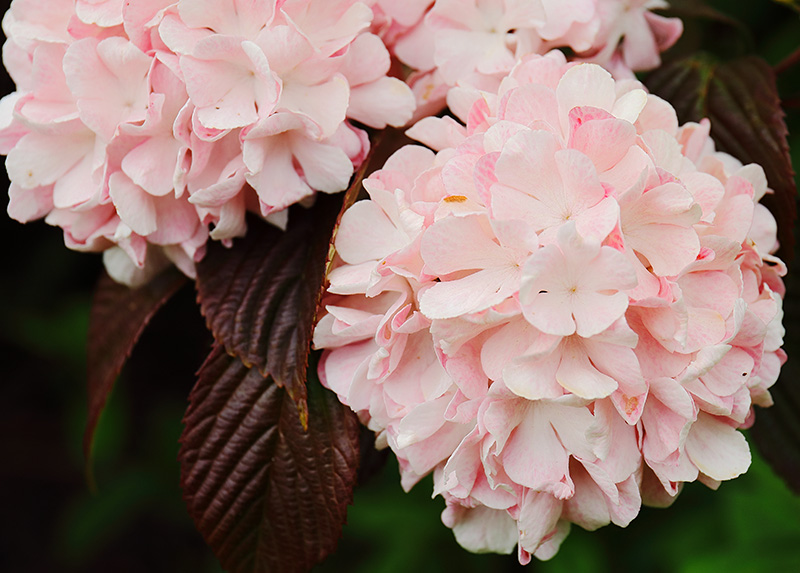
I like the peachy-pink flowers and copper-coloured leaves of this viburnum.
Visiting other people’s gardens is always enjoyable and intriguing, but becomes even more fun when you’re on the hunt for ideas and inspiration. (And it makes the ‘plants to buy’ list a lot longer!)
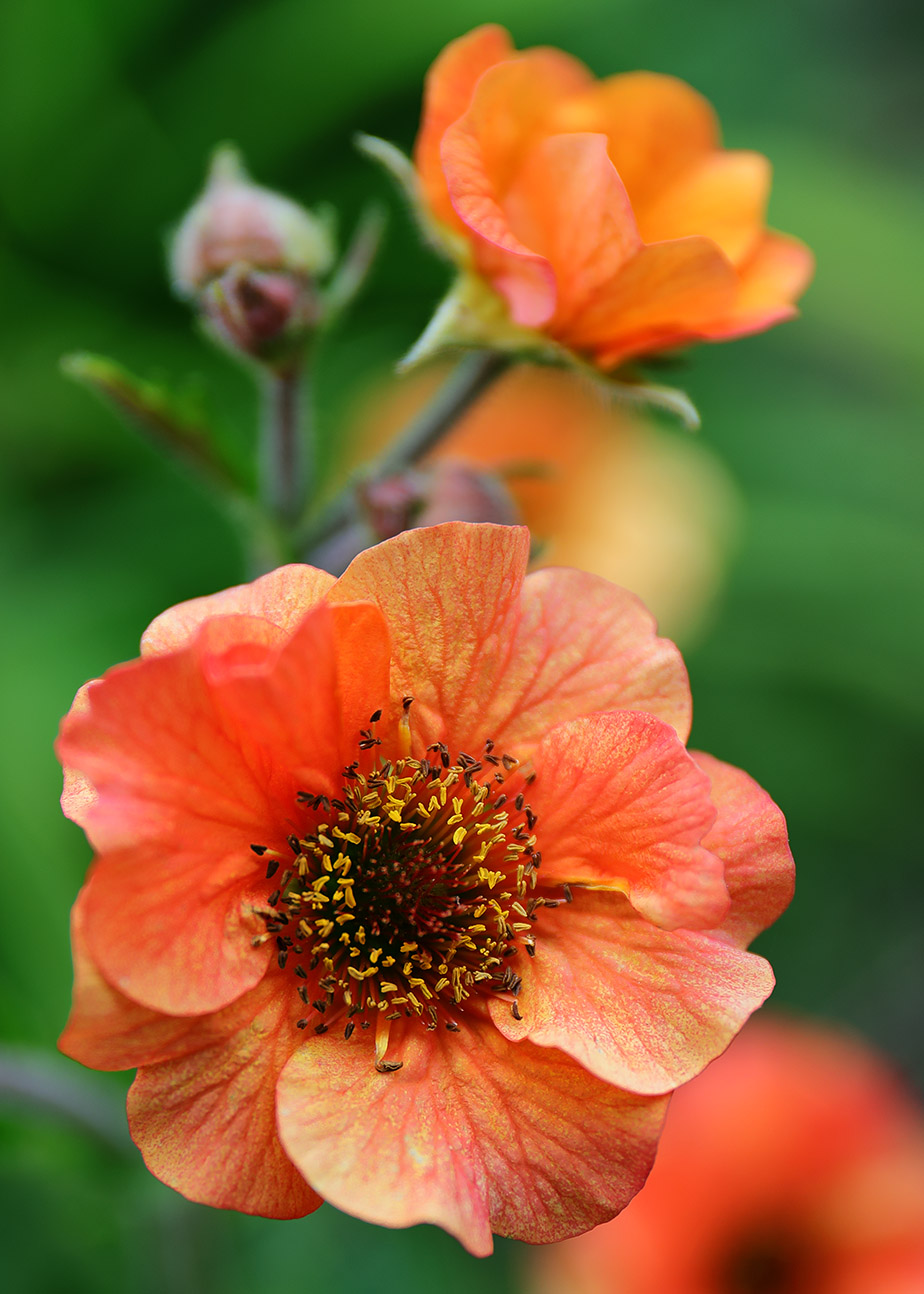
I saw the geum in the top photo while on a garden visit and decided that I’d like to grow it so that I could photograph it. (The swirly shape of the petals and the mottled yellow and orange colouring makes it a really appealing subject.) At first I thought it might be ‘Totally Tangerine’, but that, it turns out, is a single-flowered plant, while this one is ‘Rijnstroom’ and has semi-double flowers. By a lucky chance, I came across it in a nursery that we visited for the first time. Plant hunting is fun…but can be addictive too!
Another plant that caught my eye while I was garden-visiting is the viburnum above. While it wouldn’t have suited the lilac-pink areas, it could look good in the new border. Hmm, well, sadly I don’t think I’ll have space for many shrubs around the pond, so I’ll have to give that one a miss.
But that doesn’t mean that we’ve missed out on orange here. The clivia in the photo below lives in our conservatory and has been making it feel quite tropical recently! Now that is what I call a bold colour, hehe!
The vibrant orange of this clivia has brightened up my conservatory in recent weeks.
I nearly wrote ‘Cherry Blossom’ in the title rather than ‘Spring Blossom’, but then I realised that I’m starting the post with flowers that aren’t cherry blossom. (Cherry tree flowers have a little slit at the tip of each petal, as you can see in the photograph below.)
What the blossom actually is, is something I can only make a guess at. Though I’m fairly sure I remember seeing tiny crab apples on the tree (which is on a green near my house). I do have a crab apple in my own garden, but it has far fewer and smaller flowers. The fruits that it produces look very attractive though – they’re a rich deep red and make up for the less impressive flowers.
Early spring blossom – it flowered a couple of weeks ago and has gone now.
On the same green, which runs along the other side of the road just opposite us, there are several trees that blossom in the spring. I’m always happy to see the first flowers on the cherry trees there, and this year I made a point of photographing them. They flower earlier than the double-flowered cherry in my garden and they’re a joyful signal that spring has arrived. But they seem to disappear again so quickly! Now the trees that were covered in blossom just a few weeks ago have not a trace of blossom left.
Candy-floss pink blossom from the tree in my garden.
While those trees have finished, others are just now in bloom. The cherry tree in my front garden flowers in the last week or two of April. When we moved into this house, the tree was in full flower and felt like a generous welcome to our new home. So seeing it back in flower every year is like a little celebration of the happy years we’ve lived here.
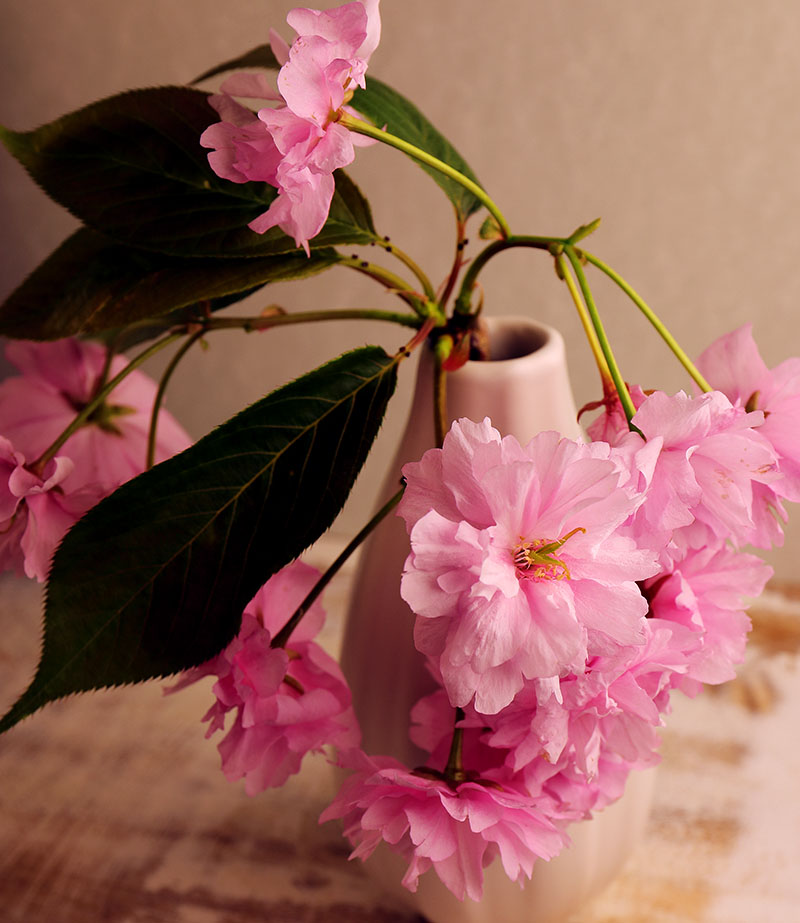
However, as soon as the tree has managed to come completely into flower, the wind is busy tearing the petals off. (Sometimes we’re lucky and the weather stays calm for longer.) This weekend has been a bit rough on the unfortunate little flowers with strong winds scattering their petals all over the grass. They look like giant pink snowflakes! I managed to bring some flowers inside to photograph before they got blown away but they won’t last long.
Perhaps its fragility and short-lived beauty is an important part of the attraction of spring blossom…I know I’ll enjoy seeing it again when it returns next year. And, as usual, I’ll try to photograph it before it escapes me!
The flowers look lovely in a vase for a little while, but the petals will soon start to fall.
Snake’s head fritillaries and crown imperial fritillaries are strange-sounding names for very unusual plants. For a photographer, the flowers make an enticing subject and I was lucky enough to be able to take some pictures of them in my friend Judy’s beautiful garden. (Thanks, Judy – I had a lovely time!)
The snake’s head fritillary (Fritillaria meleagris) gets its name from the shape of the unopened flower bud – long and pointy at the tip – a bit like a viper’s head. It has other folk-names, according to Richard Mabey’s ‘Flora Britannica’ (a fascinating book, worth dipping into if you happen to get the chance). These include crowcups, leper’s bells, sulky ladies, and frawcups (possibly derived from a place-name).
These fritillaries were recorded to be growing in gardens in the UK in 1578 but not recorded in the wild until 1736. Some say that this suggests they may not be native to the UK but, even so, they used to be seen in their thousands growing in damp meadows. Sadly, as agriculture developed over time and land was drained and ‘improved’, they lost these habitats. There are still a few places where they can be found growing wild and, thankfully, they’re popular with gardeners, so they are still able to create a magical sight every spring.
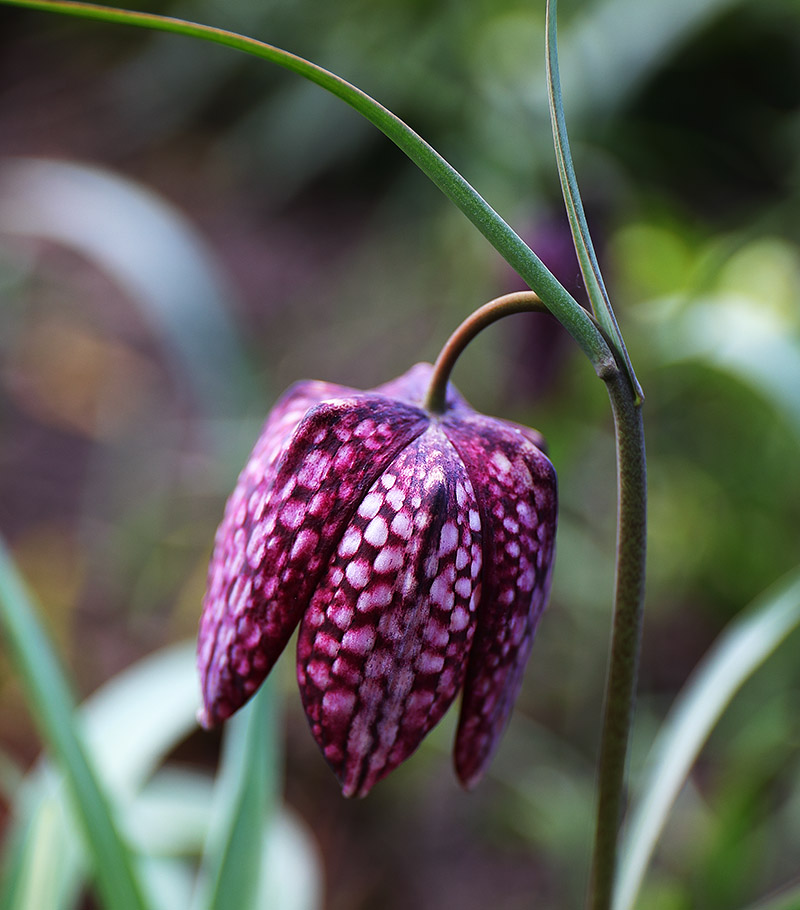
The markings on this fritillary look as if someone painted them on!
The tiny chequered markings on the snake’s head flowers are irresistible. They make me want to get as close as I can to photograph the flower, in an attempt to show how much they look as if they’ve been carefully painted on by hand. The graceful shape of the flower, with those almost umbrella-like ribs at the top adds to the attraction. (Doesn’t it look just as if the petals are fabric, stretching over the ribs that are holding it in shape? Umbrellas for the ‘wee folk’!) The way the bell of the flower hangs from its curving stem, with one or two long and slender leaves soaring up from it, completes a very elegant flower.
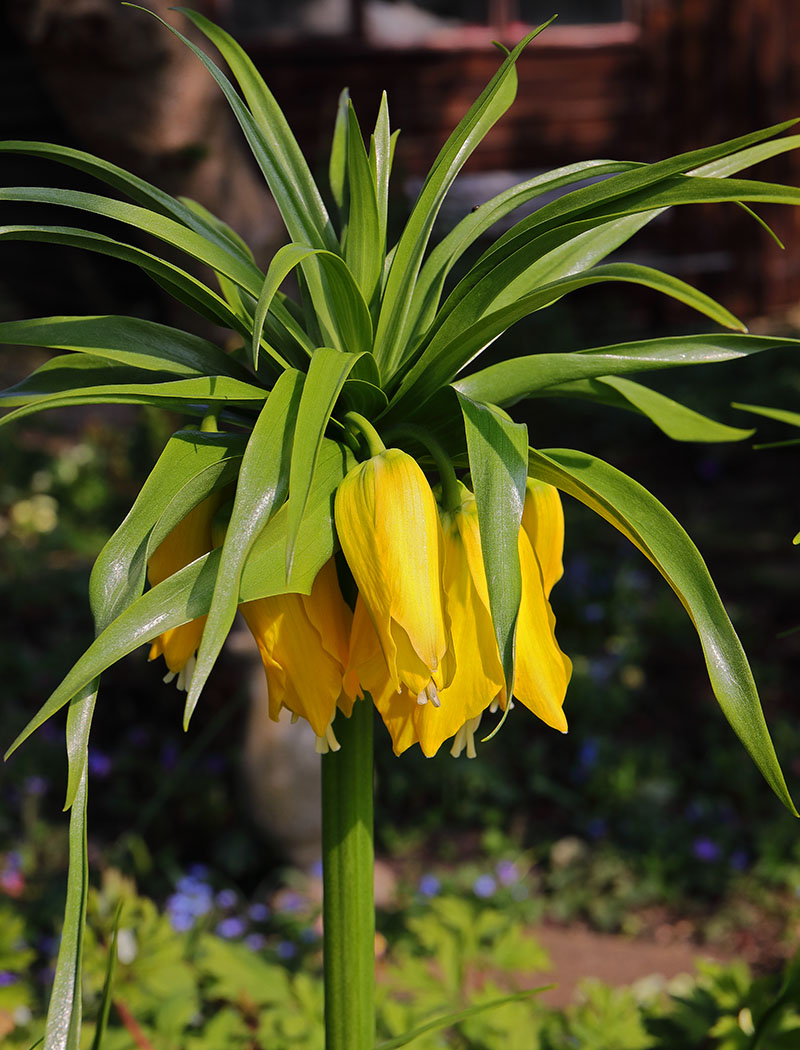
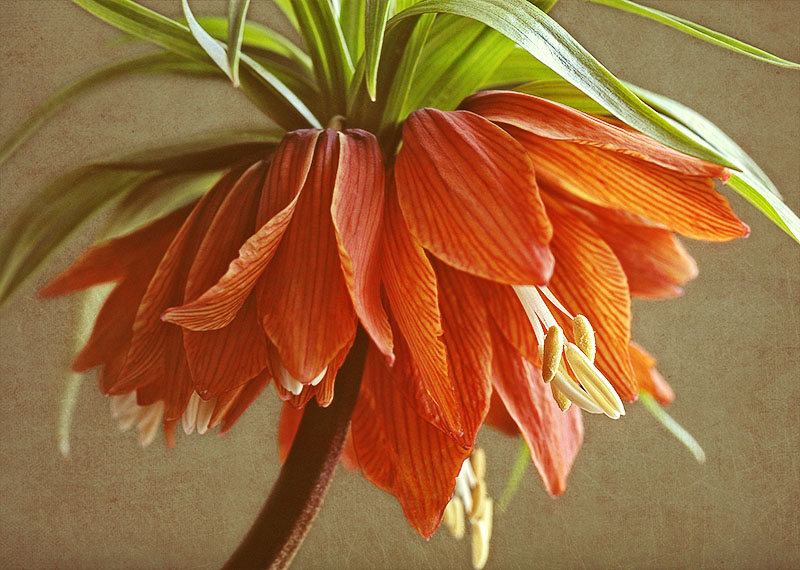
The crown imperial has an extraordinary top-knot of leaves!
The crown imperial fritillary is very different from its serpent-like sister. A dramatically long stem holds the bold cluster of flowers up high. Instead of the one or two leaves rising above the flowers, there is a generous top-knot of leaves, giving a very distinctive appearance. This ‘crown’ of arching leaves is said to have given the plant its name, due to its resemblance to the shape of an imperial crown. However, a competing claim suggests that the name derives from the plant having been grown in the Imperial Botanic Garden in Vienna after the plant was brought there from Persia in 1576.
Like the snake’s head fritillary, I wanted to be able to get close enough to the flower of the orange crown imperial to show the markings on its petals. (The veins on the petals of the yellow version are barely visible by comparison.) These darker veins create a strong pattern of lines that make the flower even more pleasing to photograph. These flowers are such star performers when you come to take their photograph, that I think I will need to try growing some fritillaries in my own garden.
The prominent veins of these orange crown imperial flowers make them all the more striking.
The first crocuses are in flower and it feels as if spring is on its way. The sun grows brighter and stronger, the air is quite a few degrees warmer, and the daylight is lasting for longer. Winter, at last, is receding and it feels good to get outside and enjoy the re-emergence of life in the garden.
Winter can be a time when life runs at a bit of a low ebb. Most days are too cold and grey to wish to spend a lot of time outdoors and you really just want to keep warm and dry. (But, if there is a warmish winter day, with perhaps a little bit of sun, then I do try to get some gardening done. It raises my spirits and allows me to escape the incarceration of being stuck indoors.)
Spring is an invitation to go out into the garden and look for the start of new growth. Right now the snowdrops are still in flower, crocuses are showing as little flashes of colour here and there, and the daffodils are promising flowers soon, as their leaves lengthen and their buds fatten.
The long wait of winter is almost over. It’s time to start work in the garden again.
There’s lots to do – new borders to dig, weeds to get rid of, and old dead growth to be cleared away to allow room for the new shoots. The work is invigorating and brings a connection to the earth and the life that is quietly pulsing within it. That connection creates an awareness of the natural world. It gives a feeling of being part of that world, and of well-being and pleasure at being able to contribute to it.
If you’re coming to the end of winter wherever you live, I hope that you’re starting to see the signs of spring. Do enjoy them!
It’s been quite mild here in Suffolk for the last few weeks but during the week we had the first frost of the season. Suddenly it feels like winter, although it was soon wet again.
While there’s a frost it’s great to be able to nip out into the garden and look to see what might be worth photographing.
If it’s sunny, the sparkle on the frost is wonderful but, of course, it means that the frost will soon disappear. That can make it can hard to decide what to photograph first. There’s never time to photograph all of the frosty subjects, no matter how fast you work.
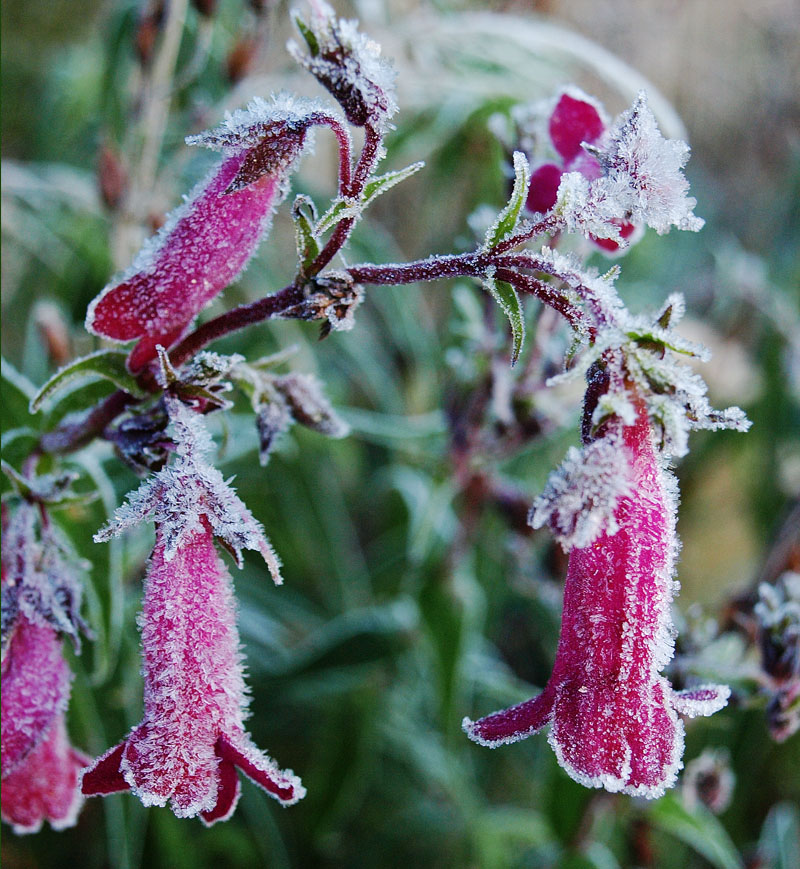
Frost covers these penstemon flowers.
I like to leave seed-heads on the plants in the garden here in the hope that they’ll get frosted. Sometimes there are a few flowers still. Penstemon ‘Garnet’ is especially good at continuing into the winter, although by this time there is only a sprinkling of flowers left.
Frosted heads of Stipa gigantea
Waiting for the frost to create opportunities for photography is a great reason for not being too tidy in the garden. Anything might look good with a coating of frost – flowers, seed-heads, leaves, grasses. It doesn’t matter if they’re dead or alive, so long as there’s an interesting shape or texture.
Frost is a kind friend to the garden photographer in winter – it makes interesting photographic subjects out of very little. (And you can leave tidying up the garden ’til springtime – well that’s my excuse anyway!)
These fennel heads have just lasted long enough to get frosted.
I’ve been transferring my photo files over to a new PC, so it has given a chance to look through images that haven’t been seen for a while. Among them was this set of hollyhock pictures which were taken on a long-ago summer evening.
We hadn’t been living here in Suffolk for long and still felt relatively new in the area. It was a warm evening with the sun still shining over the water meadows that run along one side of the town, so Hubby suggested that we should go for a walk. We decided to wander along the river and by some of the old cottages along its bank.
One of the cottages had a little bit of garden at the side that had been taken over by hollyhocks – they looked as if they had just seeded themselves wherever they fancied. The tall spires were spilling out of the garden and dotted along the side of the path. Luckily I had taken my camera…….
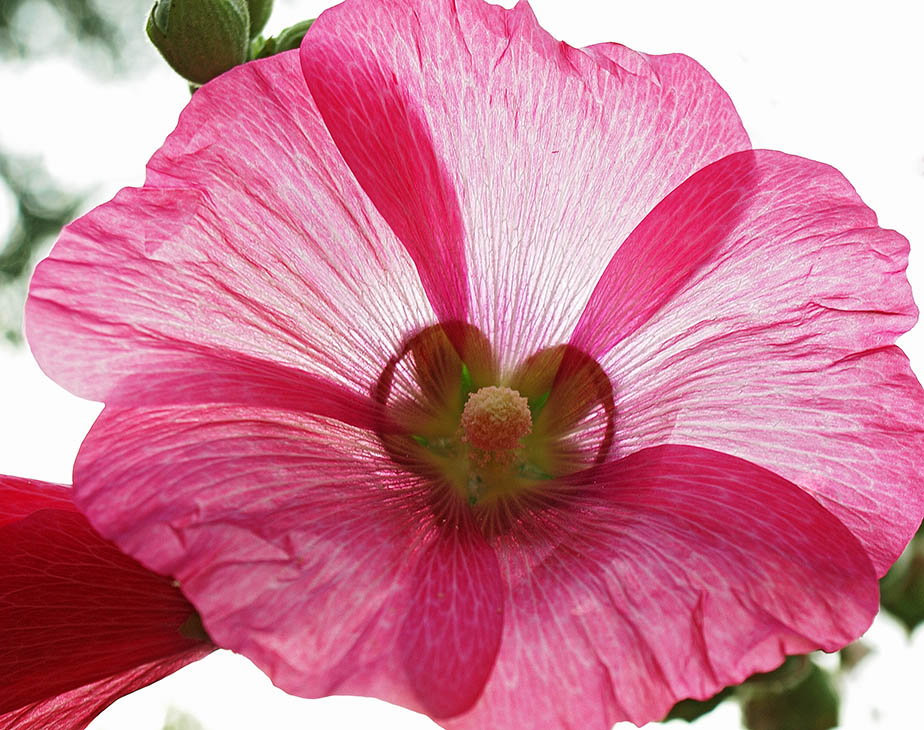
Pale veins stand out against the bright pink of this hollyhock.
For some reason, there was never the chance to photograph hollyhocks while I lived in Scotland. Some gardeners must grow them there but I don’t remember seeing them in Scottish gardens. (Maybe because they seem too tall and vulnerable for the rougher weather there – the winds can get quite fierce.) Here, though, they are everywhere. They’re a real ‘English cottage garden’ plant and an essential part of summer.
We now have a few in our own garden and they seem to be replacing themselves with their own seedlings. This means I never know what colours may come up – usually pink but there have been other colours – yellow and a deep, dark purply-red.
The dark centre is a strong contrast to the translucent petals.
The hollyhocks were a treat to photograph. Their petals were so thin and delicate that it was easy to capture the evening sun passing through them. The light made them vibrant. It showed up the marking of the veins on their petals and the jewel-like colours, especially those with the dark ‘halo’ in the centre.
Looking at the photographs now, they bring back happy memories of summertime and an evening spent exploring our new home town. They’re a reminder, too, that it won’t be so long before next summer is on the way!
After flowers fade in the garden, there’s a certain feeling of loss, of knowing that they have disappeared for another year. But some plants have something more to give the garden – attractive seed-heads that add their own texture and interest to the planting.
For a photographer, seed-heads make a great subject. They can have very ‘architectural’, interesting shapes and their textures range from soft and fluffy to extremely prickly. There’s plenty of variety to inspire pictures with different moods. Could be something soft and gentle, or something bold and eye-catching, or perhaps an image with a more nostalgic feel.
Seed-heads have that inbuilt message that something is ending but also remind us that there will be something new – new life – in the future. And for a gardener, seed-heads can be a reason for hope, if there is a chance of new plants springing up – or dread if they’re weeds!
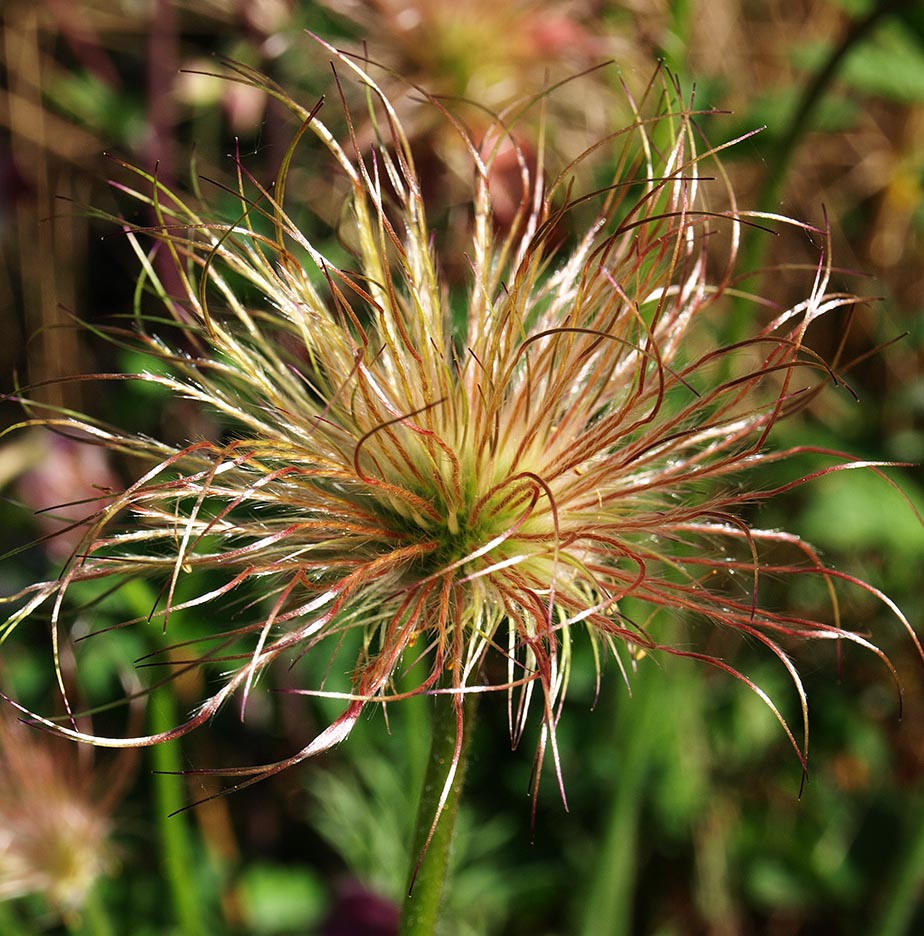
I love to see the Pasque flower seed-heads every year. (Top photo.) They are so soft that you want to stroke them but they can also really catch the light. The fine hairs reflect the sun and make them gleam on a sunny day. (They’re irresistible to my cats too, who find that the heads swaying on their long stems make a great toy to bat a paw at, especially those that can just about be reached through the slats of a nearby seat. Fun for all!)
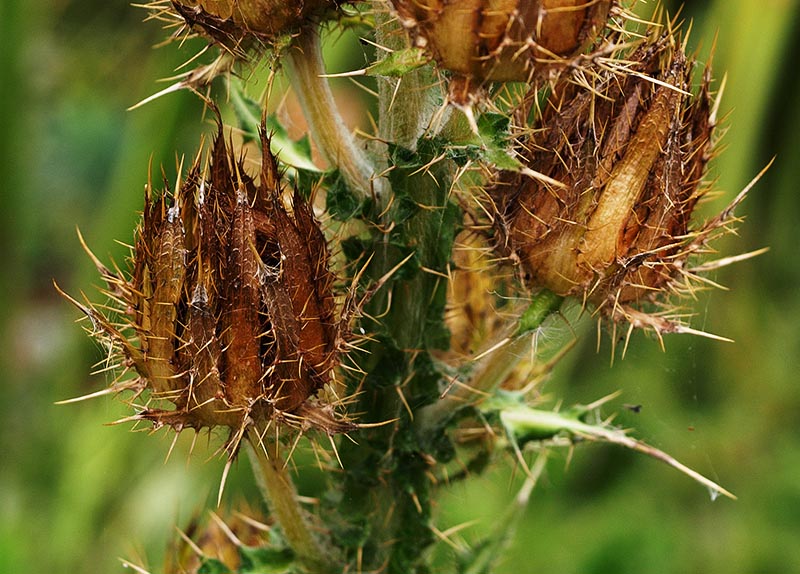
I wouldn’t like to touch this seed-head!
Other seed-heads are not at all welcoming to the touch. But they do at least look interesting in a photograph. I’m happy to say that the plant above was in someone else’s garden. I don’t know what it is, but I really wouldn’t fancy brushing against it in a border. Ow!
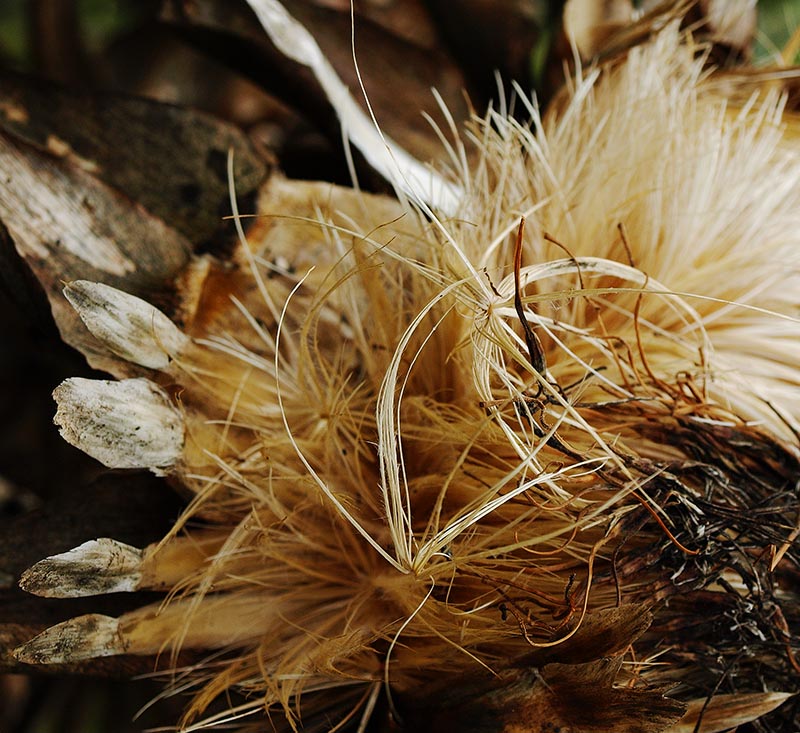
I don’t know what the seed-head in the bottom photo is either. It might be a protea. The photograph was taken in a garden that had big glasshouses, so there were a fair number of non-hardy plants. The combination of textures and shapes and the soft browns, yellows and creams of this seed-head appealed to me. It’s very different to the seed-heads that I would find in my own garden and, like the Pasque flower, makes me feel that I want to reach out and touch it.
At this time of year, when there are few flowers left and so many garden plants are dying back for winter, seed-heads can linger. I like to leave as many as possible in my garden, so that when the frosts arrive, there will be something to photograph. A coating of frost can make a dried-out seed-head turn into something wonderful – a delicate structure with grace and sparkle. So if you like to photograph plants, it’s a good idea not to be too tidy in your garden. Leave those seed-heads standing and wait to see what magic a touch of frost or snow can bring!
I love to read your comments! Do you have any plants that you like for their seed-heads?
The first time I saw a passion-flower was many years ago, on a holiday in England. It was the usual Passiflora ‘caerulea’, the blue passion flower. It seemed impossibly exotic for a flower growing in the UK at that time. And for someone still living in Scotland, with the colder winters there, the idea of growing one seemed to be pure fantasy.
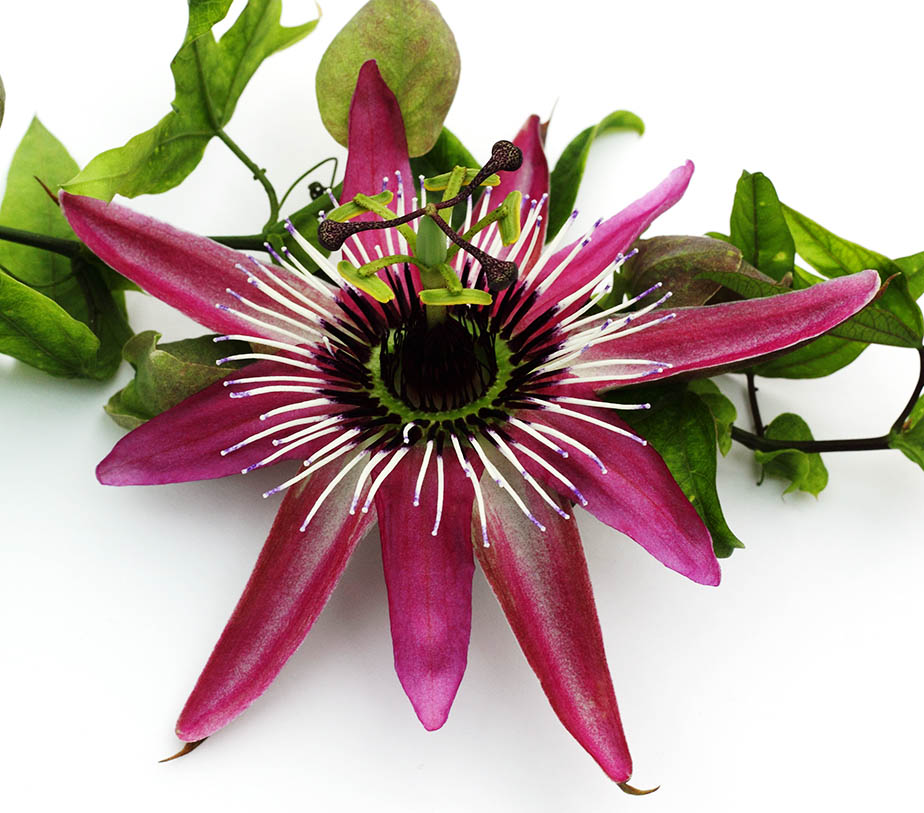
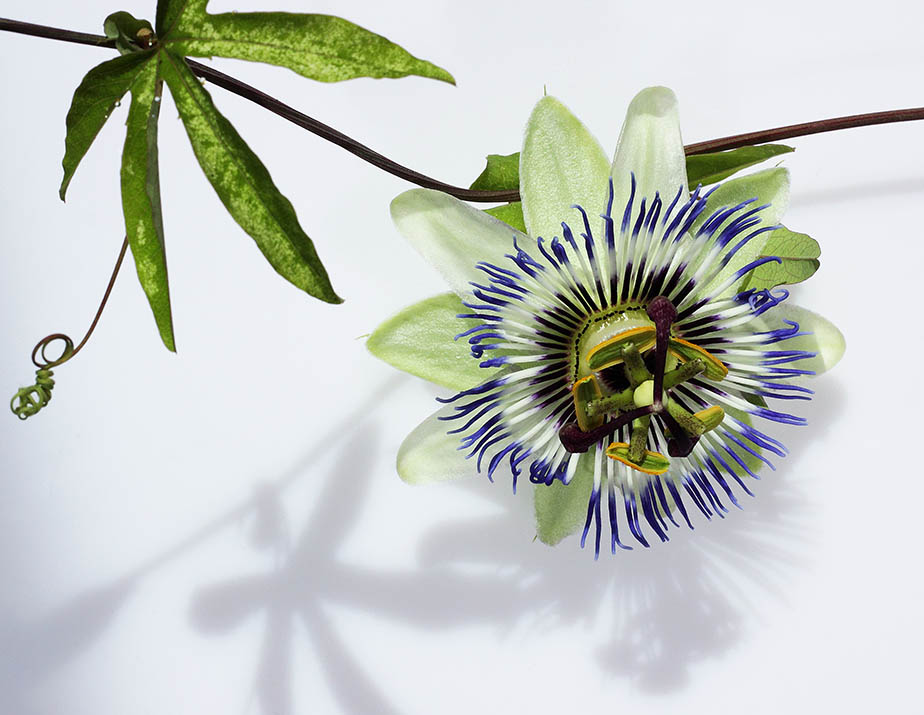
A few years later I found some plants of ‘caerulea’ for sale in an Edinburgh shop and just couldn’t resist buying one – and, of course, taking lots of photographs of the extraordinary flowers. Later on, I managed to buy a plant of Passiflora ‘Amethyst’ (top photo) and became thoroughly hooked on these beautiful climbers.
For photography they’re a wonderful subject. From further away, the flower is graceful. Every part of it is elegant. There’s the shape of the petals and the way the strands of the corona are held in a ring. And then there’s the sculptural quality of the reproductive parts of the flower.
If you come closer in, there are plenty of details to photograph. You have the way the strands of the corona change from dark purple at the centre, to white, to blue at the outside. You’ll also see the dark purple mottling of spots that covers the three ‘styles’, with more, less pronounced purple spots on the five green ‘filaments’ that hold the anthers.
The plants in these pictures were in pots sitting on a tiled conservatory floor, so I used a large sheet of white paper to give a plain background. Because the plants can be an untidy mass of leaves and stems, each flower was gently disentangled from the rest of the plant and the stem holding it was stretched across the white background. This isolated the flowers, got rid of background distractions, and allowed a bolder image to be made.
For the photograph at the bottom, I decided to simplify things further and removed a few of the leaves on that stem. (Cruelty to plants!) Then I placed the flower, with its leaf and the little tendril, in a way that would create a composition with the shadows that they cast.
Before taking close-up photographs like this, it’s a really good idea to check that there’s no dust or bits on your backdrop and that there aren’t any wee beasties in the plant (unless you want them there). It’s frustrating to open an image in Photoshop just to find some tiny critter practically waving and shouting, ‘Yeah, I’m here!’ And if you have pets, don’t forget to check for hairs. I have two cats, one long-haired, and it’s just amazing to see where those fine hairs can get to. (Thank goodness for Photoshop’s heal and clone tools!)
I’m always on the lookout for plants that will make good photographs. Many of the plants in the garden here are chosen this way. So you can imagine my delight when we moved into this house and I discovered that the neighbours had a blue passion-flower that was sneaking under the fence into our garden. There was great excitement when the first flowers opened. Sadly, the plant disappeared. I don’t know if it was due to a very cold winter or if the neighbours decided to get rid of it.
As you would expect, I soon got some plants of my own and the two you see in the photos here are currently living in our conservatory. (I’m trying to learn not to over-water them. They like better drainage than I had thought and I’ve nearly lost them a couple of times!)
In the garden, I’m trying ‘Constance Elliot’, which has pure white flowers and is said to be scented. It’s growing over an arbour and seems to be doing well but I don’t know if it’s hardy enough to come through a cold winter. (Mulching it should help.) It hasn’t flowered yet – that’s something to look forward to next year.
If you’re reading this from somewhere warmer than the UK, passion-flowers may be a common sight for you. You may have some of the more tender varieties that, here in England, I can only dream of. I wonder if there are plants that won’t grow where you are, that you really wish you could have? Do let me know in the comments!
Autumn is beautiful. Golden light filters through the trees, with their jewel-bright leaves set against a vibrant blue sky. (If you’re lucky – and we have been.)
Except when it’s not. Friday was suddenly grey and cold here in the east of England. Autumn quickly became a bit more serious and a heavy shower of hail was a brusque reminder that winter isn’t far off. (And the clocks going back this weekend will mean that time spent in the garden will have to finish earlier. There’s still lots of work to do out there and I have been known to continue until it’s dark.)
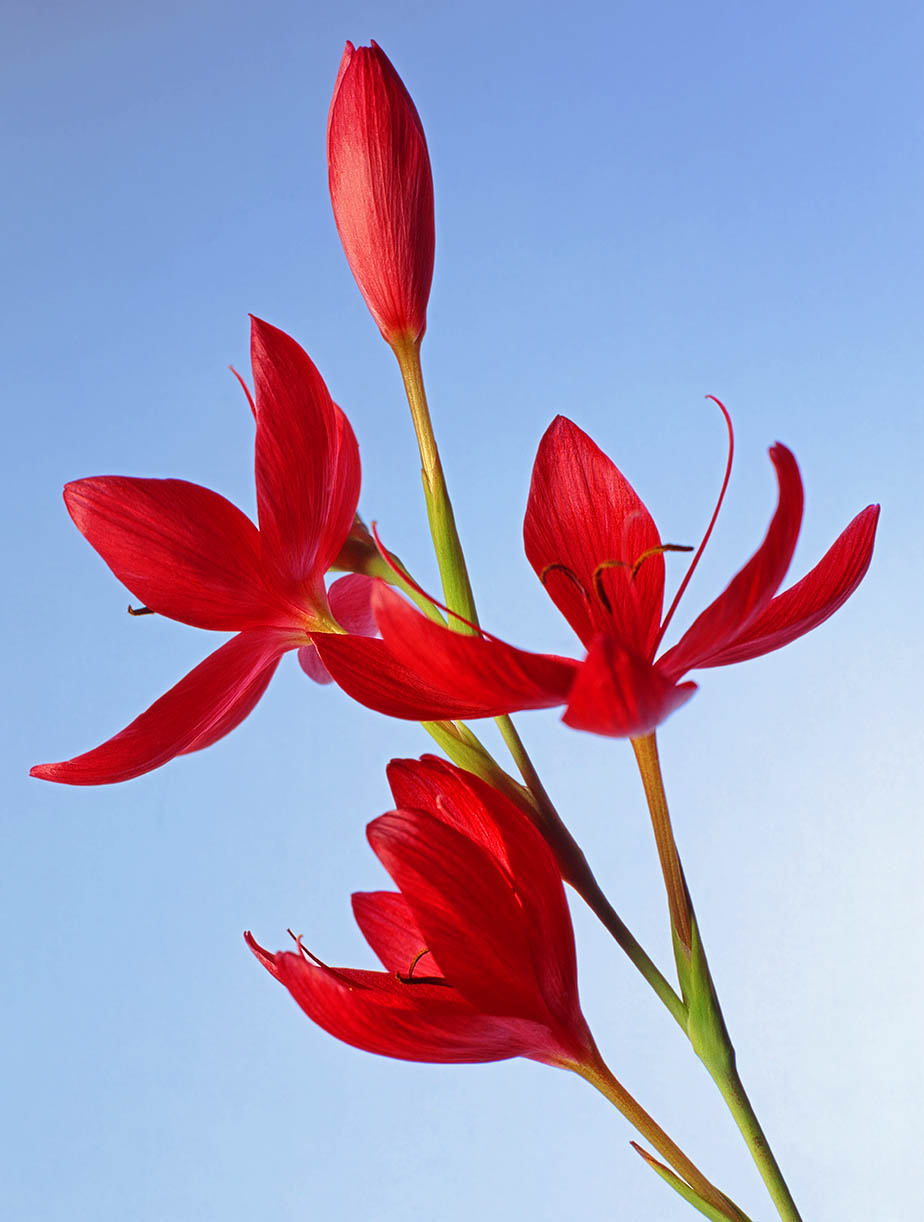
As always, I’m planning for the future and growing as much as I can to provide myself with flowers and plants to photograph. At the moment I’m working on the last bit of planting for the year. It should make a difference to next autumn, as the plants are mostly late-flowering. One that I’ve chosen because it is so good to photograph is Hesperanthus, also known as ‘Crimson Flag’. (You can see it in the picture above.) The plant used to be called Schizostylis, but the name changed a few years ago. Gardening is confusing at times!
Geranium ‘Rozanne’ flowers for months and continues into October and November if trimmed back in late summer.
Despite the cold turn to the weather, there are still some flowers in the garden. Geranium ‘Rozanne’ (pictured above) is still flowering its little socks off. I planted it late last autumn, so this is the first year that I’ve been able to see how long it will continue. It has done really well – flowering from early in the summer and still being well-covered in flowers now. I’m really glad of this, because it’s my chosen subject for the last week of my Natural History Illustration course. There aren’t many other flowers left in the garden for me to draw! (You can read about the drawing class here. It has been very worthwhile and now I feel that I’ll be able to continue to learn on my own.)
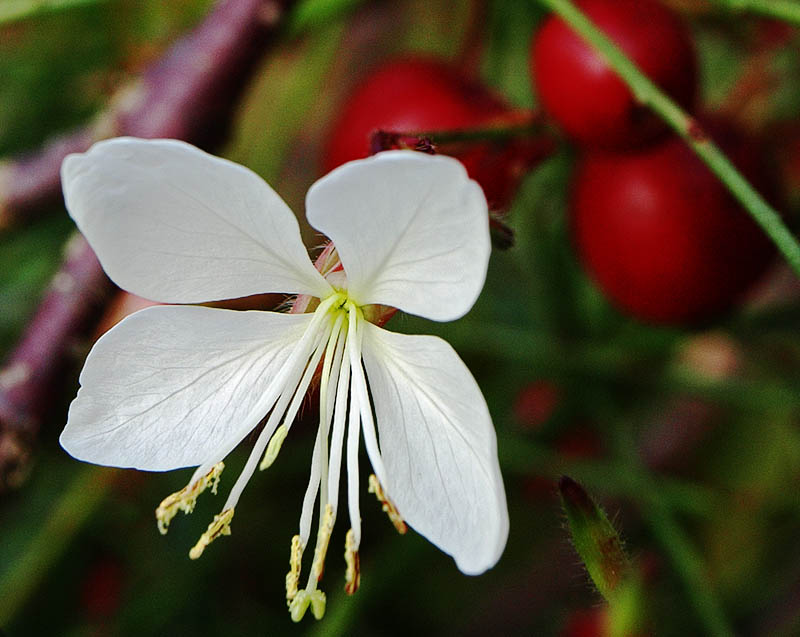
Elsewhere in the garden, there is a sprinkling of penstemon flowers, the last of the asters that are just about to finish, and some small dark crimson dianthus (pinks) that seem content to flower for a long time. The happy surprise has been to see how well a clump of Gaura lindheimeri is doing. I’ve tried to grow it a couple of times before and lost it in cold winters. This plant has survived and has been in flower from early summer. Its white, moth-like flowers are now creating a delicately lovely picture in combination with the red fruits of crab-apple ‘Royal Beauty’.
Have you any suggestions for extending the flowering season towards winter? I’d love to know what you grow – please feel free to comment!
Gaura linderheimeri flower in front of the fruits of malus ‘Royal Beauty’










 Ann Mackay: Inspired by Nature