Winter Bee-Feast

mahonia flowers with melted frost

NB: A note for WordPress Reader users – you need to click on the title of the post again to come out of the reader and go to the post itself. This allows you to see the whole of the top photograph. (Otherwise you may see just a tiny section!)

As I’ve been working in the garden in recent days, I’ve noticed that there are still a few buff-tailed bumblebees around. They’ve been attracted to the yellow flowers of our mahonia, which is a great source of nectar and pollen during late autumn and winter.

While most bumblebee colonies die off for the winter, with just the mated queens hibernating and then starting new colonies in spring, the buff-tails (Bombus terrestris) can stay active. 30 years or so ago, buff-tailed queens would have hibernated too, but in more recent times both queens and workers may be seen flying in winter. It seems that this is the result of winters becoming milder, especially in southern areas of the UK.

There are not many sources of nectar for winter-active bumblebees, so the mahonia, which is a large shrub and well-covered with flowers, has become a valued feature of our garden. (By the time the mahonia has finished flowering, there will be some hellebores and later on there is the plum blossom. We do, however, want to increase the available food for bumblebees over winter.)

As you can see from the photographs, the mahonia flowers don’t mind a bit of frost or snow. Ours has the sunniest spot in the garden, so bees can enjoy the warmth of any sunshine right from early morning until sunset. The shrub was already here (and mature) when we came to this house, so I can’t be sure of the cultivar, but it does look like the very popular Mahonia x media ‘Charity’. I’m certainly very glad that a previous owner did plant it and I should think that the bumblebees are too! 🐝

mahonia flowers with melting snow

Snow melting from mahonia flowers doesn’t seem to cause them much damage.

Varied Variegations

Variegated leaves of Arum italicum 'Pictum'

NB: A note for WordPress Reader users – you need to click on the title of the post again to come out of the reader and go to the post itself. This allows you to see the whole of the top photograph. (Otherwise you may see just a tiny section!)

At a time when there are fewer flowers around, you notice the leaves more. Coloured or variegated leaves can give longer-lasting interest to the garden than the shorter lives of most flowers. The occasional plant with variegated leaves can be a particularly striking and effective way to liven up an area of plain green foliage.

In my own garden, I have the silver and green variegated leaves of a brunnera alongside the green of a fern and some hellebores. Further along the same border is a pulmonaria, whose slightly more subtle markings echo the brunnera’s colouring without competing for attention. In summer, a climbing hydrangea brings its lacy white flowers to the mix to further enliven this quiet green corner of our garden. (You can see the brunnera and pulmonaria in previous posts.)

The two sets of variegated leaves here (photographed at Fullers Mill Garden) are very different to each other: one smooth and slightly shiny, the other deeply indented with many sharp-looking prickles. The plant in the top photo is Arum italicum (Italian arum), with very attractive markings of the palest creamy yellow. Below, you can see the spiny leaves of a Galactites (milk thistle), whose purple or white flowers will be a magnet for pollinators in summer.

I could be tempted by either of these plants, although I find that the plain green Arum maculatum that is native in the UK can be a terrible nuisance. It gets everywhere if it gets the slightest chance! So perhaps this arum would get out of hand too. The milk thistle might be a safer bet. It’s an annual or biennial, and, although it will self-seed in good conditions, it is easier to pull out. The only problem might be that I would need some robust gloves to protect my hands from all those spines! Seeing these two plants has made me feel that I should see if there’s room for one or two more variegated plants in my own garden.

Green prickly leaves with white variegation

A Chilly Glimpse of Winter

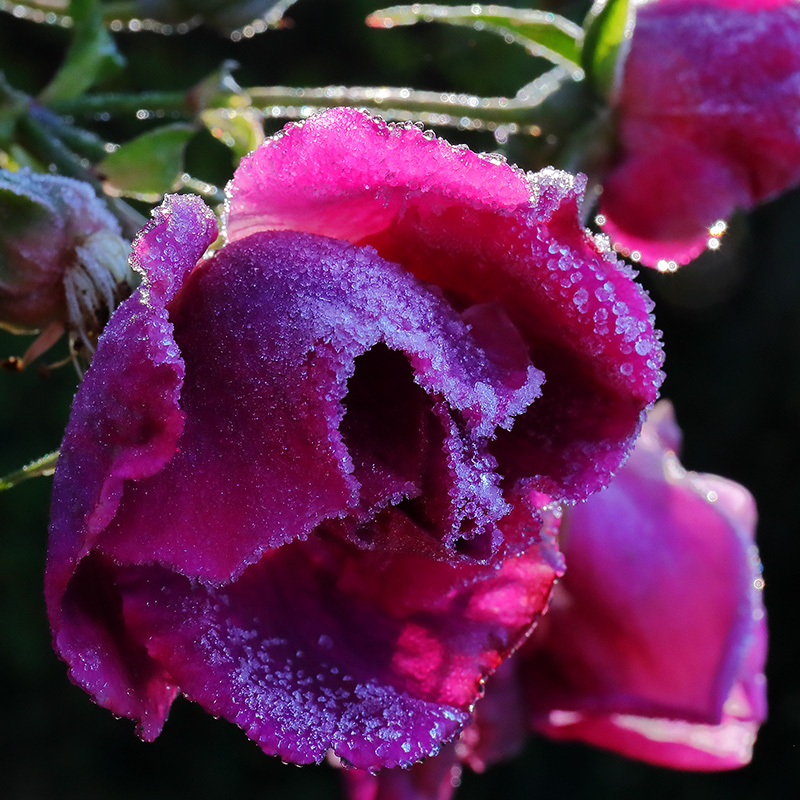
A frosted rose

NB: A note for WordPress Reader users – you need to click on the title of the post again to come out of the reader and go to the post itself. This allows you to see the whole of the top photograph. (Otherwise you may see just a tiny section!)

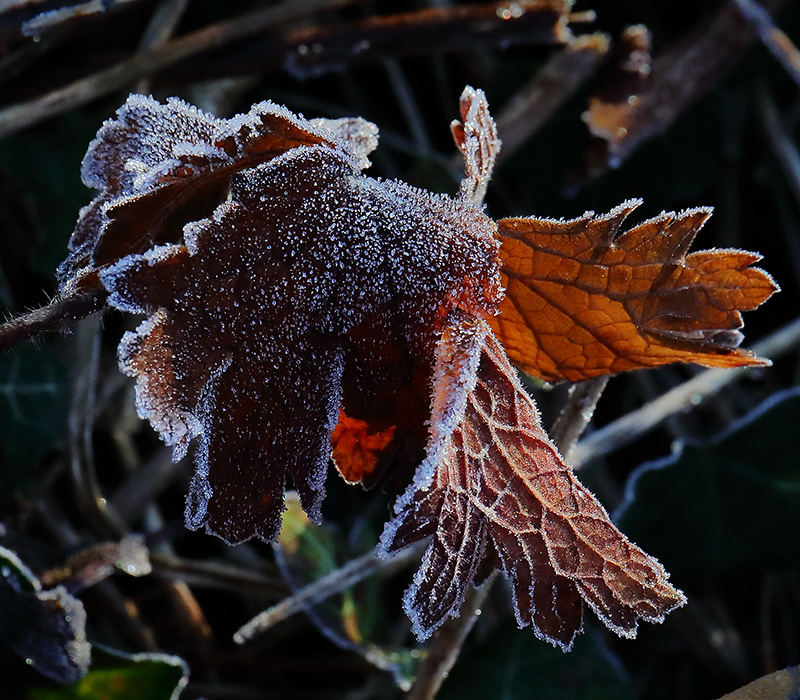
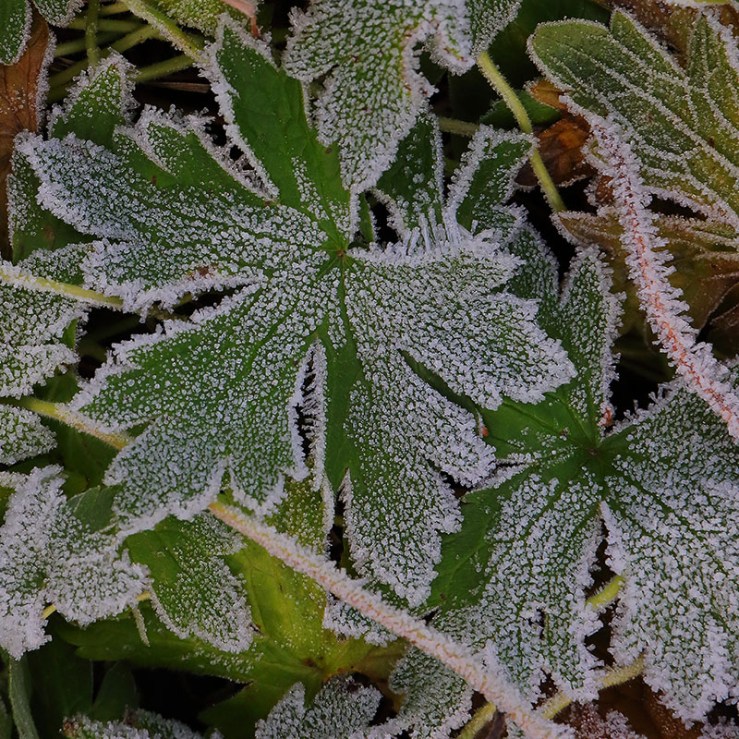
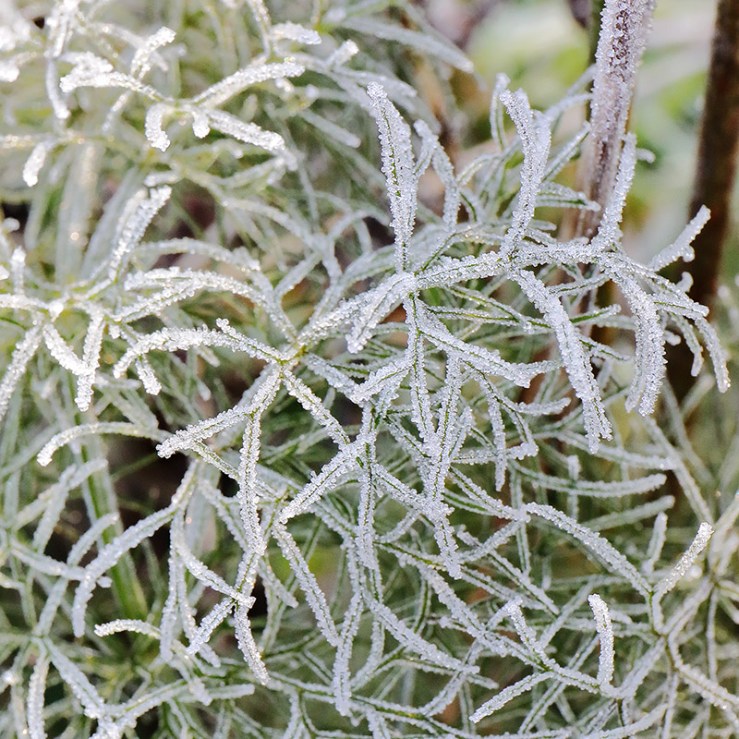
We had our first glimpse of winter this week, with a frost over most of the garden. There had been a dusting of frost over house rooftops and cars before that, but this was the first real cold of the year.

I’m always hoping that there will still be a few flowers around when the frosts arrive. There’s often a few lingering roses and, when frosted, these make likely subjects for a wintry photograph. The rose here is ‘Rhapsody in Blue’, although these flowers look more magenta than the usual dark purple. I don’t know why. Maybe it’s due to the effects of early morning light, or it might be because the petals are frozen. Whatever the reason, they look much lighter than they usually do. (However, you can see a slight trace of the darker colour on some of the petals in the photo below.)

At the start of winter there are not many flowers remaining in the garden. At the moment there are these roses, a couple of flowering shrubs, and here and there a flower or two still clinging onto the smaller plants. At the sunnier end of the garden, the few bumblebees that are still active are making good use of the yellow flowers of the mahonia bush. Nearer the house, the scented pink flowers of Viburnum bodnantense ‘Dawn’ should be with us right through until early spring.

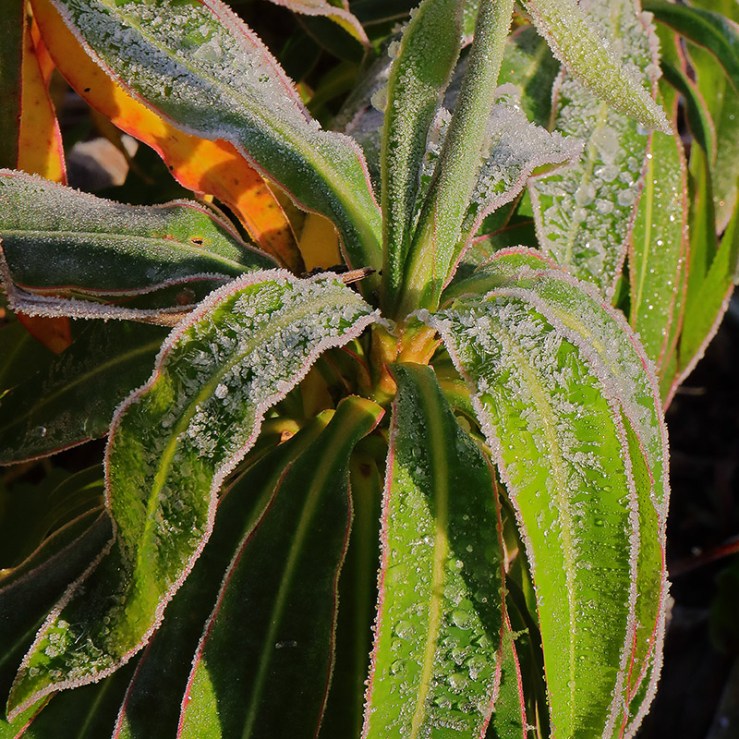
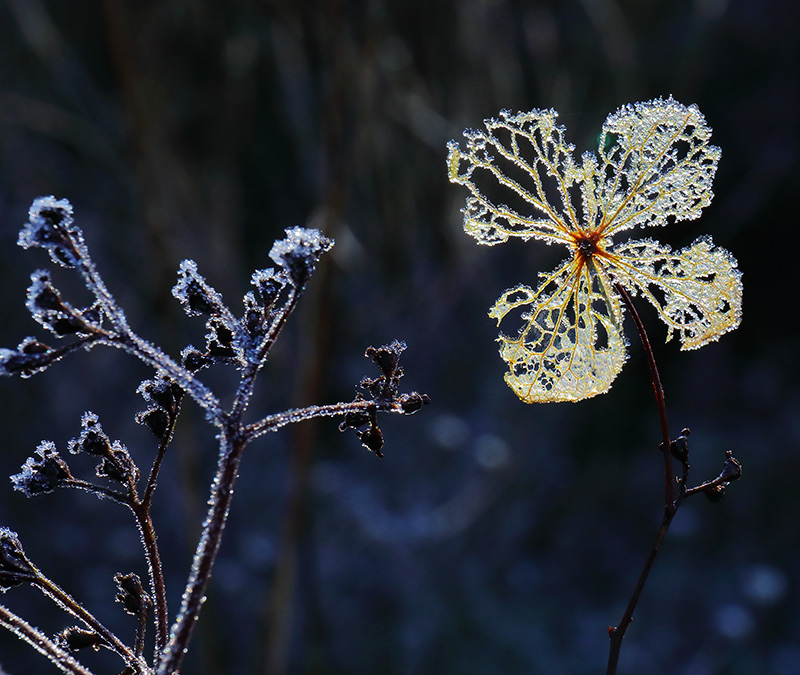
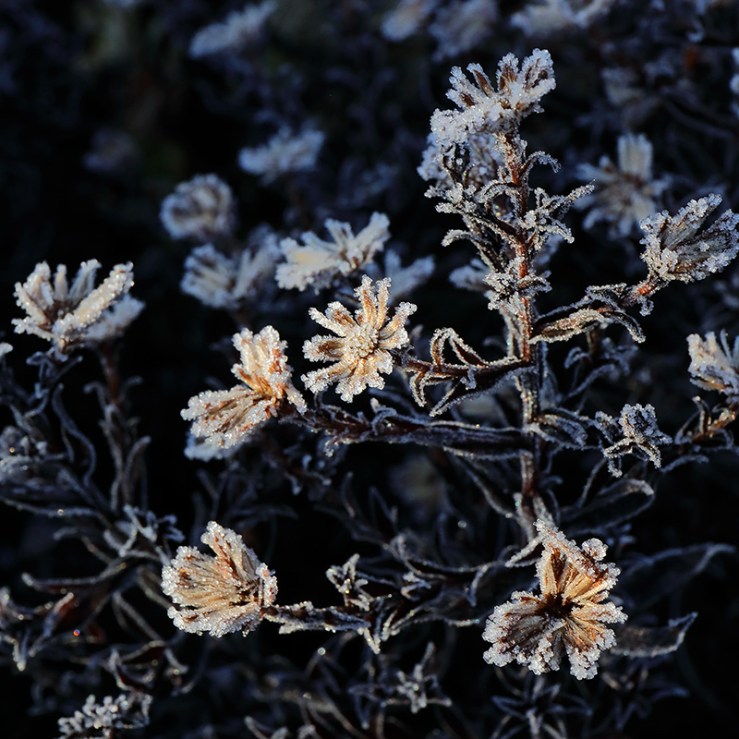
Photography in the garden can be very limited at this time of year, so if there’s a frosty morning I like to make the most of it and get outside before it melts. While the gardener in me worries about the effects of frost on plants that aren’t entirely hardy, my creative side is delighted to find something to photograph. I often have mixed feelings when things turn icy! ❄

Frosted roses and buds
Only a slight trace of the usual dark purple is visible on the petals of this frosted flower of ‘Rhapsody in Blue’.

After the Flowers…

Glycyrrhiza (liquorice) seed heads

NB: A note for WordPress Reader users – you need to click on the title of the post again to come out of the reader and go to the post itself. This allows you to see the whole of the top photograph. (Otherwise you may see just a tiny section!)

After the flowers have gone, then come a variety of interesting seed heads. Some are familiar and I come across them every year. Others are less common, like the liquorice plant (Glycyrrhiza) above, photographed on a recent visit to Fullers Mill.

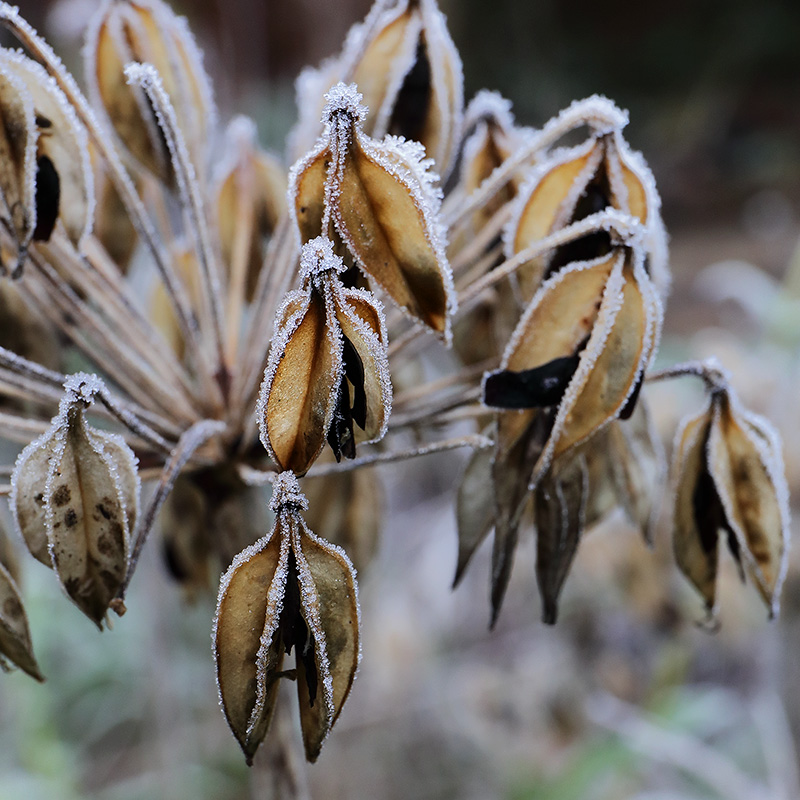
Liquorice is a plant I’d never seen before and the spiky seed heads were what drew my attention. They would be lovely coated with tiny frost crystals, like little Christmas decorations. I didn’t touch one, but they look as if the tips of their individual pods could be sharp…not the most friendly thing to brush up against!

cardoon seed heads
Cardoon seed heads are releasing the first of their hairy seeds.

The seed heads of the cardoons (Cynara cardunculus), shown above, would be much nicer to get close to. These, however, were too tall for me to get near enough to reach the fluffy seeds. I would have liked to have been able to touch the hairs on the seeds, just to see if they’re as soft as they look. The first seeds were already making their escape last month, so I think that recent wind and rain will by now have carried many of them away.

Hairy seed heads are produced by other plants too, like the silvery plumes of Clematis tangutica (below, left). This plant was photographed at the end of summer and the single ‘tails’ attached to each individual seed were still smooth and shiny. Later, those tails become more feathery as they develop and the individual hairs on them grow and open out. That helps the attached seed to blow away in the wind. (It’s in a garden I visited, so I haven’t seen it recently, but I should think that those seed heads are very fluffy indeed by now, or perhaps have dispersed or become bedraggled in the autumn rain.)

Left: A clematis flower and seed head
Right: Catananche seed heads
Left: A seed head of Clematis tangutica gleams in the sun.
Right: Catananche seed heads have a subtle shine.

Another seed head with a slight shine is the Catananche caerulea (Cupid’s dart), shown above, on the right. The seeds are light and papery, clustered in airy heads that have a silvery look on a sunny day. This one is in my own garden and I love it for its long-lasting good looks, both in flower and seed.

Wild carrot (Daucus carota ‘Dara’) also grows in my garden. It’s allowed to seed itself around so that I have plenty of the nest-like seed heads to photograph. I’m having to be a bit stricter with it these days, because it can get everywhere. Now I just sprinkle the seeds in areas where there’s a bit of room for its waywardness. The lacy flower heads of wild carrot are pretty, but to my mind, this plant is at its best when in bud and later, when the seed heads appear. Both stages display the intricate architecture and grace of the plant at its most beautiful. When possible, I try to keep the seed heads, so that they (and the seed heads of other plants) will be here when the frost comes…not long to wait now!

Daucus carota (wild carrot) seed head
Tiny spiky seeds of wild carrot curve inward on a seed head that develops a nest-like appearance.

Just in Time!

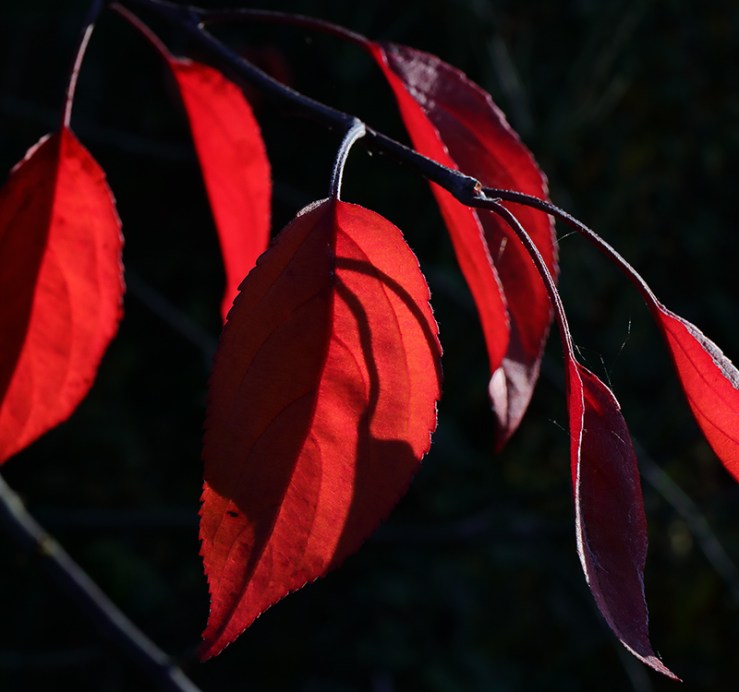
Liquidambar leaves in autumn

NB: A note for WordPress Reader users – you need to click on the title of the post again to come out of the reader and go to the post itself. This allows you to see the whole of the top photograph. (Otherwise you may see just a tiny section!)

On my visits to Fullers Mill Garden, I’d noticed a large Liquidambar (sweet gum tree). I’d hoped that I would get the chance to see its autumn leaves before the garden closed for the winter. As it turned out, my last visit of the year was about a fortnight before the end of the season and I was lucky enough to see the first of the Liquidambar leaves turn colour.

Although most of the leaves were still green on my last visit, there were those that created a beautiful display of red, orange and yellow. Strikingly, it also had leaves that were a dark purple. The garden closed near the end of October, so it was a bit early for the tree to produce its best display. I’m sure it will be magnificent around now!

Liquidambar leaves in autumn
Autumn leaves of Liquidambar styraciflua (sweet gum) that have turned dark purple and red.

The reddest leaves were on a different tree. This was a very much smaller Liquidambar, which I might have mistaken for a maple if I hadn’t noticed the distinctive spiky seed pods. As you can see in the photo below, this youngster was way ahead of the large tree in the colour-change process.

Most autumn leaves around here are yellow. We don’t see many that are red, so the Liquidambar trees in Fullers Mill Garden are a sight to enjoy. In future, I’ll make sure to visit the garden on the very last day that I can before it closes, in the hope of seeing these lovely trees at their most spectacular.

Liquidambar seed pods and leaves in autumn

Powerfully Pink

Brightly-coloured flowers of Echinacea purpurea

NB: A note for WordPress Reader users – you need to click on the title of the post again to come out of the reader and go to the post itself. This allows you to see the whole of the top photograph. (Otherwise you may see just a tiny section!)

The flowers of autumn will soon be a memory. There are still some around but most are are gradually ebbing away and there will soon be very few left to photograph.

My photo files are full of reminders of the flowers that I’ve seen this year. The photos of the two pink flowers here stood out among the more recent ones because of their vivid pink. It’s easy to think of pink as being delicate and soft, but these two are as boldly-coloured as any of the red or orange flowers of late summer. The echinacea in the top photo is a particularly strong shade and brighter than the more dusky pink echinaceas that I’ve had in my own garden.

Sadly there have been no established echinacea plants in my garden this year. The red one that lit up summertime for the last few years has at last petered out, but there are a couple of tiny seedlings. (Echinaceas are short-lived, but do carry on by self-seeding.) Other echinaceas in a mix of orange and pink shades didn’t last quite as long as the red one, but I’ve seen the odd seedling that has managed to produce a flower…hopefully they’ll survive and become bigger plants in future.

The Japanese anemone below is attractive, but not something I’m looking to plant here. I already have two other pink Japanese anemones that are being very greedy for space, so best not to risk another! I’ll be happy to just admire it in other people’s gardens. But, while I’m unlikely to choose this anemone, I’d be very happy to grow the vibrantly pink echinacea. It’s very pink and it’s fabulous!

A vibrantly pink Japanese anemone.

Stars of Autumn

Dark purple aster flowers

NB: A note for WordPress Reader users – you need to click on the title of the post again to come out of the reader and go to the post itself. This allows you to see the whole of the top photograph. (Otherwise you may see just a tiny section!)

Plants in the Asteraceae family bring charm and loveliness to late summer and autumn. Amongst those plants, asters (also known as Michaelmas daisies) are especially valued for their late flowering, as are other daisy-like flowers in this family. I like the thought that ‘aster’ means ‘star’ in both Latin and ancient Greek; for me the composite flowers of the Asteraceae are, indeed, stars of the garden.

The aster in the top photo appeals to me due to its dramatically dark purple, and I’ve looked around to see if I can buy something like it for my own garden. I haven’t found one yet, but last year I planted my favourite aster, the lavender-blue flowered ‘Monch’. (The photo below is not my own plant though, but one photographed at Fullers Mill, as the are the others here.)

Flowers of Aster 'Monch'
Aster ‘Monch’ is one of my favourite plants for autumn.

There are a number of asters in my own garden now, mostly in purply-blue shades, but some pinks and white too. They keep the colour going when other flowers have finished and give a feeling of continuing life to the garden. Anything that helps to hold off the gathering greys of approaching winter is very welcome here!

I’d like to plant more late-flowering members of the Asteraceae, perhaps the dainty flower pictured below. I believe it’s probably Bidens heterophylla aurea. (Coreopsis verticillata ‘Moonbeam’ looks very similar, but appears to have slightly narrower petals. It is also a shorter and more compact plant.) This bidens (AKA Arizona beggarticks) has long, graceful stems that give the plant an airy feel, like gaura or Verbena bonariensis. This should make it easy to combine with other plants. I think it could be lovely with a delicate, wispy grass such as Stipa tenuissima (Mexican feather grass).

Flowers of Bidens aurea
The pale yellow flowers of a cultivar of Bidens aurea sway gracefully above some asters.

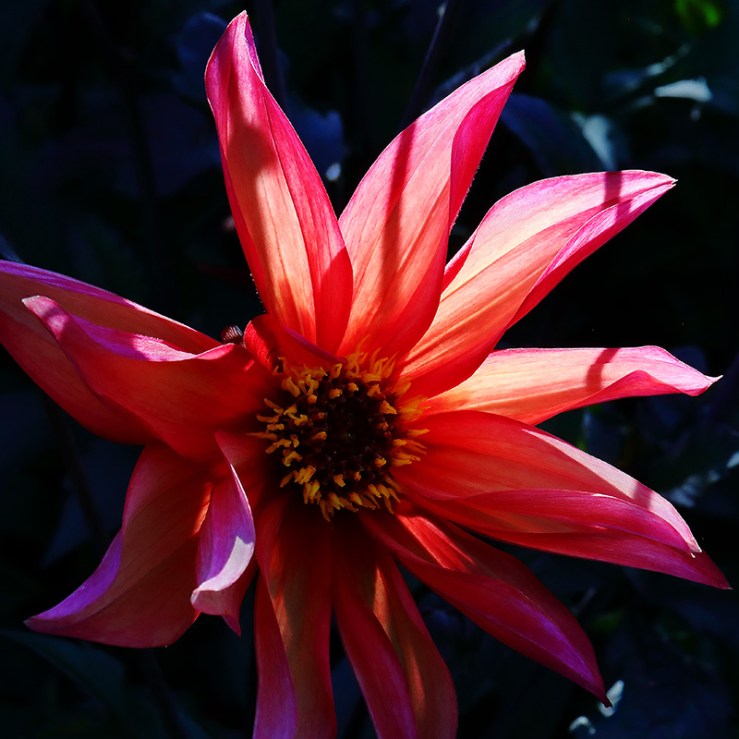
Some of the autumn-flowering Asteraceae are a bit less obviously daisy-like in appearance, like the dahlia below. However, you can easily see the family likeness in that centre made up of tiny individual ‘disc florets’, surrounded by the showier ‘ray florets’ (which we think of as petals). Rudbeckias, sunflowers, chrysanthemums, cosmos and zinnias are some of the varied members of this large family that can keep flowering when other plants have finished for the year. (You can see some of my previous photos of late-flowering Asteraceae in these posts: heleniums, cosmos, and zinnias. The Asteraceae bring beauty to our gardens in late summer and autumn and they’re all sparkling stars to me.

A dahlia flower glowing in evening light.
A dahlia glows in low-angled sunlight.

Worth the Risk? ‘Swan’ Anemones

Flowers of Anemone 'Wild Swan'

NB: A note for WordPress Reader users – you need to click on the title of the post again to come out of the reader and go to the post itself. This allows you to see the whole of the top photograph. (Otherwise you may see just a tiny section!)

Japanese anemones tend to go a bit mad here. They have lovely flowers that grace the late summer and autumn garden. But they can spread – oh, how they can spread! So it’s probably not a good idea for me to fall in love with the anemone that you see here.

This is one of the ‘Swan’ series of anemones, which began with the single-flowered ‘Wild Swan’. This first plant was immensely popular, becoming the RHS Chelsea Flower Show plant of the year for 2011. Since then, further cultivars have been grown in the ‘Swan’ family, and I think the plant here is likely to be the semi-double ‘Ruffled Swan’.

Ruffled Swan is a taller and more vigorous cultivar than Wild Swan, so might be inclined to try to take over my garden, just as the pink Japanese anemones ‘September Charm’ and ‘Hadspen Abundance’ do. For years I’ve been trying to keep these two under control, which works for a while until some pops up somewhere where it’s not wanted. (Hadspen Abundance was in the garden when we came and I was pleased to see it. That was before I knew that some Japanese anemones want to rule the world! And I brought a pot of September Charm from my old garden, where it had quietly sat in a small clump before running amok here.)

So, despite its beauty, I won’t be looking to buy this particular plant for the garden. I see that there are, however, some smaller cultivars with the same attractive violet-blue reverse to the petals. The most compact is said to be ‘Elfin Swan’, which would probably grow well in a container. It’s a ‘definite maybe’, but first of all I need to see if I can move some of the larger pink anemones into big pots. (I notice that the dry weather has made these much less vigorous this year, so maybe this is my chance to end their takeover of my garden!) 🌼

Flowers of Anemone 'Wild Swan'

(Almost) Silent Sunday: Gaura

Flowers of white gaura (Oenothera lindheimeri)

NB: A note for WordPress Reader users – you need to click on the title of the post again to come out of the reader and go to the post itself. This allows you to see the whole of the top photograph. (Otherwise you may see just a tiny section!)

I’m having a little holiday this week because we have visitors staying. So I’ll just leave you this pretty white gaura (Oenothera lindheimeri, AKA Lindheimer’s beeblossom). It’s a great plant for flowering profusely right up until the frosts start and a favourite of mine.

A Gleam of Light: White Autumn Crocuses

A white autumn crocus (Colchicum)

NB: A note for WordPress Reader users – you need to click on the title of the post again to come out of the reader and go to the post itself. This allows you to see the whole of the top photograph. (Otherwise you may see just a tiny section!)

The colchicums (autumn crocuses) that I’m familiar with are those that are pink with a white throat. I’ve seen them here and there in other gardens and even tried growing them here. They’re not uncommon. But these white colchicums are something that I haven’t seen before.

These are part of the large collection of Colchicum autumnale growing in Fullers Mill Garden. (I posted photos of a pink and white variety that grows there a couple of weeks ago. You can see them here.)

Whilst the pink and white ones are very pretty, there’s a startling purity to these white flowers that feels unusual when surrounded by the glowing reds, oranges and yellows of many autumn flowers. The white, especially when combined with nearby green, gives a freshness and a feeling of cool and calm that is especially welcome after the blaze of summer heat.

Colchicum autumnale is sometimes called ‘meadow saffron’, but the whole plant is highly toxic and should not be mistaken for the source of the spice saffron. (Saffron actually comes from the saffron crocus, Crocus sativus, an entirely unrelated plant. Somewhat confusingly, this crocus also blooms in autumn.) It may be best to stick with calling these flowers either the commonly used ‘autumn crocuses’, or perhaps the more amusing ‘naked ladies’ (so-called because the flowers appear long before the leaves). It might get a few startled looks if you’re able to tell folk that your garden is full of naked ladies…

White autumn crocuses (Colchicum)