Hello Frost!

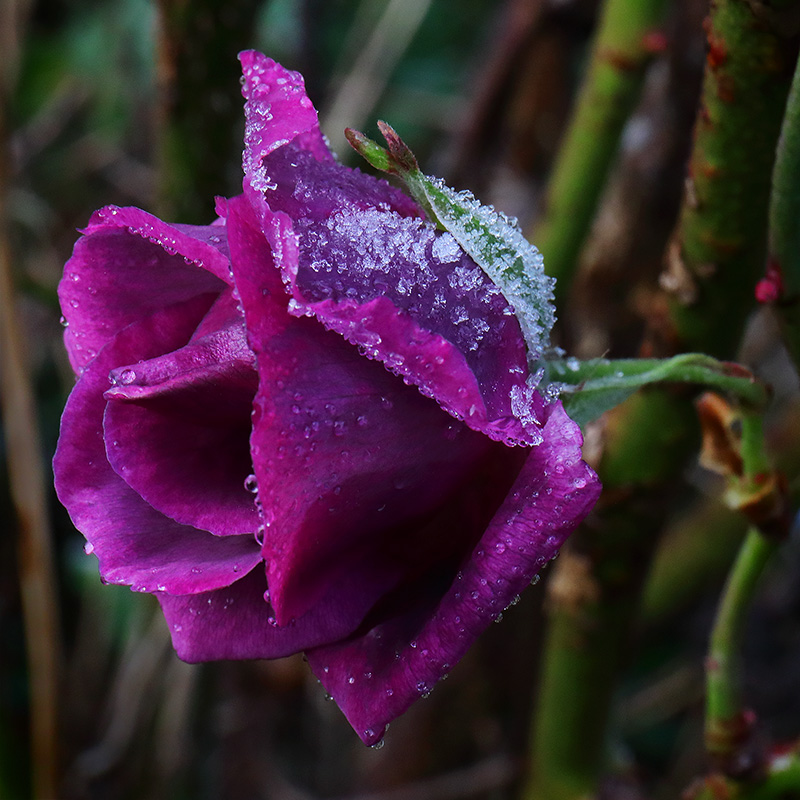
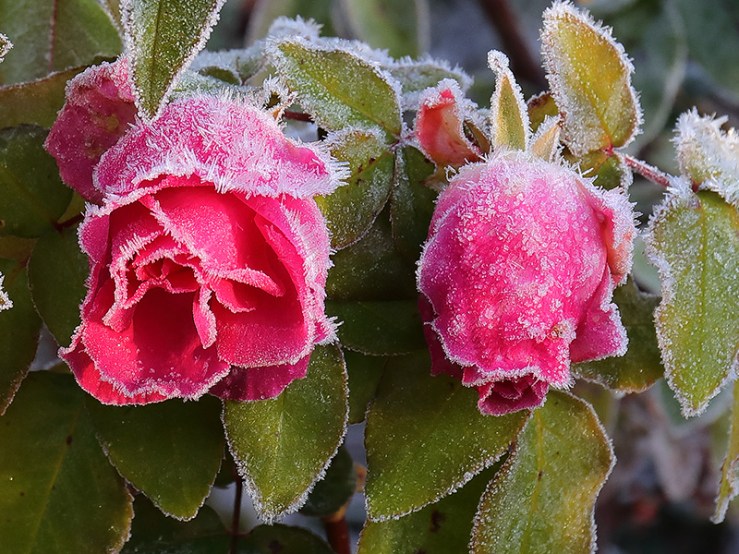
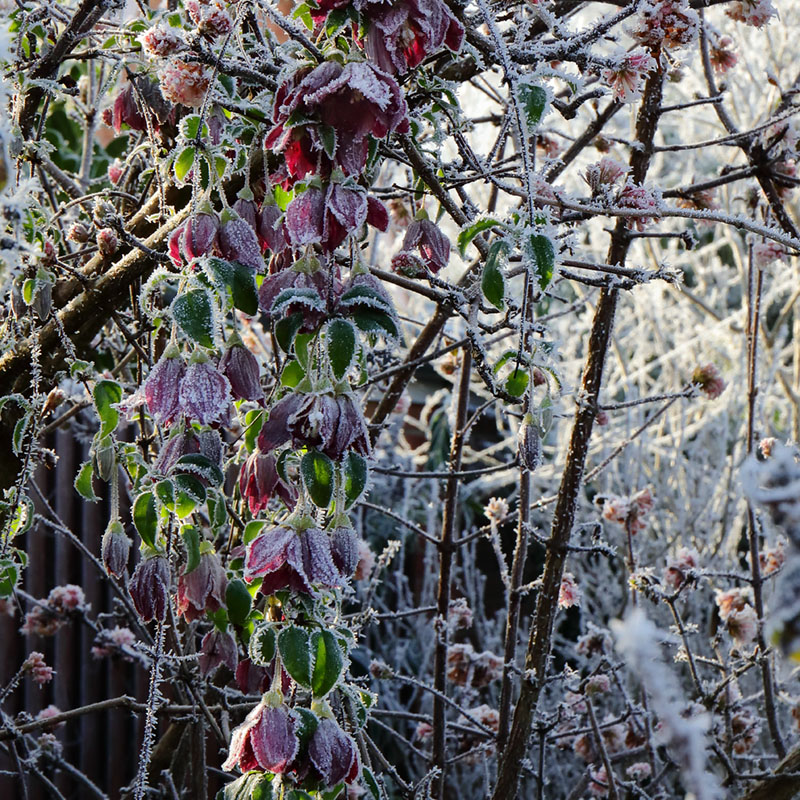
Frosted Rose 'Zepherine Drouhin'

NB: A note for WordPress Reader users – you need to click on the title of the post again to come out of the reader and go to the post itself. This allows you to see the whole of the top photograph. (Otherwise you may see just a tiny section!)

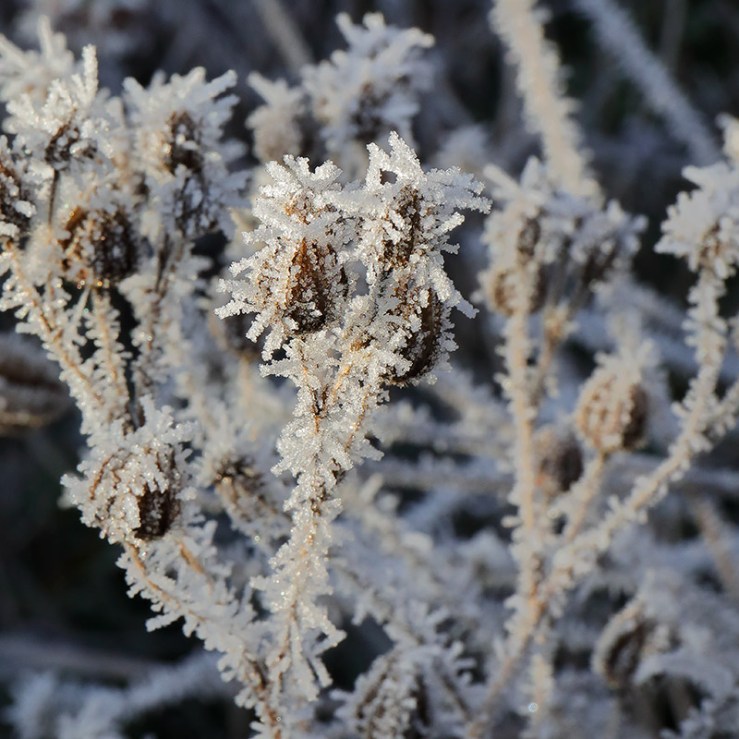
Last week I was hoping for the frost and sunshine that the forecast promised, but with no luck. Instead a frosty morning arrived unexpectedly a couple of days ago. There was even some sun…ideal for photography!

The rose you see here is Zepherine Drouhin, a fragrant climber that has no thorns. (A thornless rose is a delight – no getting scratched when you’re weeding beside it.) It often has a few flowers left late in the year, so is a frequent subject in my frost pictures. Luckily, it is even in a helpful position – just where it is protected from the earliest sun by nearby trees, but where the sun can make it sparkle by the time I’m likely to be outside with my camera.

The rose’s position with regard to the sun makes a huge difference. One side of my garden catches the earliest sun. That means any frost there is very quick to melt and it is often gone before I can photograph it.

In contrast, the other side of the garden remains in deep shade for a long time. This side is where the flowers that get deeply frozen usually are, but there is much less light to play with. It occurs to me now, that I should bring a big reflector outside to see if I can reflect some sun onto subjects there. Why hadn’t I thought of that before? Hmm, in too much of a rush to get outside while there was still frost, I guess…❄

Frosted rose petal
There’s not much left of this rose (‘Zepherine Drouhin’).

Almost, but Not Quite…

Frosted fig leaf.

NB: A note for WordPress Reader users – you need to click on the title of the post again to come out of the reader and go to the post itself. This allows you to see the whole of the top photograph. (Otherwise you may see just a tiny section!)

This week the weather forecast promised us frost and sunshine – a great combination for photography. Unfortunately, our two very cold mornings didn’t give the conditions I had hoped for. The first morning had plenty of frost, but was exceedingly grey and dull until about the middle of the day, then the next day the ground was frozen but there wasn’t any visible frost on the plants.

The photographs here are from previous winters. The frost on honesty pods (below) is a subject that I’d like to pursue further. I’ve even prepared a few of the dried pods by picking some, peeling the outer skins from the seed pods, and then leaving them in a position where they’re likely to catch both frost and sun. Now I have to wait for the weather to play along!

frosted honesty seed pods
Frost can make a lot out of very little!

While I keep a watch on the weather, I’ve been staying warm indoors and learning a bit more about printmaking. It’s been a long time since I did printmaking of any kind. I am now trying out methods that I can fairly easily do at home, rather than needing the facilities of a printmaking workshop. There’s a lot for me to learn and it may be a little while before I have results that I can show here, but it will keep me happily occupied while it’s cold outside. ❄

Rose 'Zepherine Drouhin', covered in frost.
Frost sometimes manages to catch the last flowers of Rose ‘Zepherine Drouhin’.

The Late Show

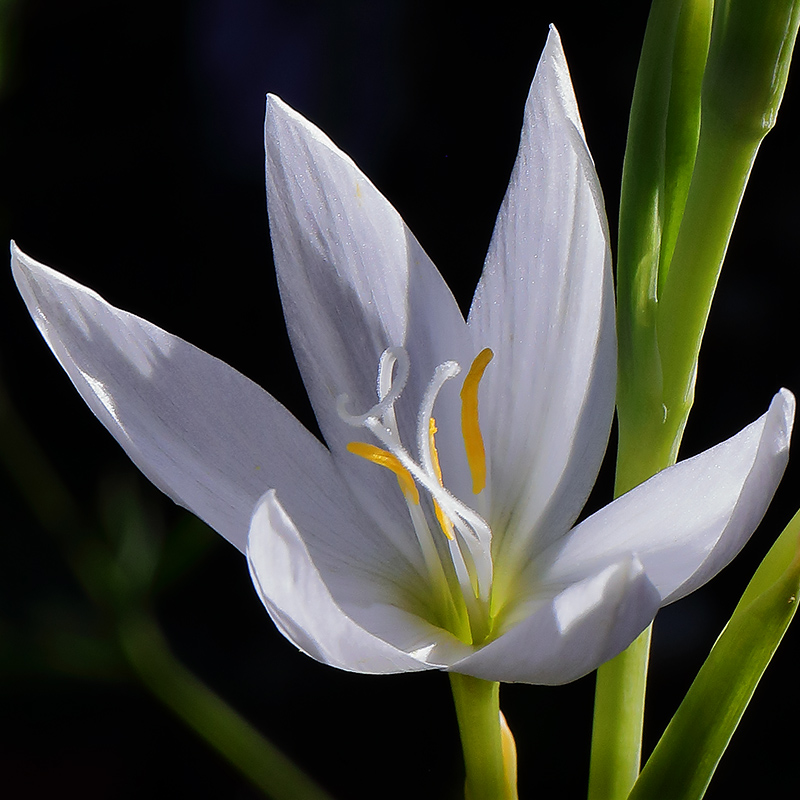
White Hesperantha flower

NB: A note for WordPress Reader users – you need to click on the title of the post again to come out of the reader and go to the post itself. This allows you to see the whole of the top photograph. (Otherwise you may see just a tiny section!)

By November there are few flowers left in the garden. The asters have almost all gone over now and many plants are beginning to die down for winter. Even so, there is a little colour left here and there. There are still the white ‘butterflies’ of the gaura flowers, which will continue to look good until a frost gets them. Also hanging on are some fuchsias, a couple of penstemons and the tiny daisies of Erigeron karvinskianus (Mexican fleabane).

Late October and November is the time when Hesperantha flowers here. The white one in these photographs is Hesperantha coccinea f. alba. It brings a beautiful freshness to the garden at a time when so much looks tired, and most foliage is turning yellow. (I have a red-flowered plant too, seen in this post.)

It brings great pleasure to see newly-opened flowers at this late stage of the year. Sometimes, however, there is disappointment if they don’t manage to flower before a frost arrives. Why the Hesperantha plants in my garden flower so late is a mystery to me. They’re said to flower from late summer, but it’s always well into autumn before we see any flowers here. Maybe the plants will flower earlier as they mature, or do they just prefer to flower in the cooler weather later on? In any case, I do love to have some flowers still around in November.

White Hesperantha flower and bud

A Last Gleam of Gold

Rudbeckia flower

NB: A note for WordPress Reader users – you need to click on the title of the post again to come out of the reader and go to the post itself. This allows you to see the whole of the top photograph. (Otherwise you may see just a tiny section!)

My recent posts for this month and September have almost all featured blue or lavender-blue flowers. (No surprise there, since they are amongst my favourite colours.) So for this week, I thought I should try to find something different. That’s not so easy now. I have a little bit of pink and red around, and a some white, but there’s not a lot left in flower here at this stage of autumn.

This Rudbeckia ‘Goldsturm’ is just coming to the end of its flowers after providing a bright gleam of yellow for the last few weeks. I’m waiting for it to die down a little more to allow me to move it to an area where it will have a bit more moisture. It’s a plant that isn’t really happy in the dry conditions here, and can struggle when there’s little rain. If I don’t remember to water it in the summer, it can very quickly begin to look sorry for itself.

It will be moved to an area beside the little bog-garden, where it will be easy to remember to water it. (The bog-garden itself needs regular watering, otherwise it can dry out surprisingly quickly. Probably that’s because it is small and is now well-filled with Siberian irises, astilbes and ragged robin. It could do with being bigger, but we don’t have the space.)

I hope that the new position will allow the rudbeckia to bulk up and flower more prolifically. Nearby there is a vibrant purple aster and another, much shorter, rudbeckia. With a bit of luck, there should, in future, be a bigger patch of yellow flowers to bring some extra ‘sunshine’ to our autumn days.

Rudbeckia flowers

(Almost) Silent Sunday: A Late-Summer Memory

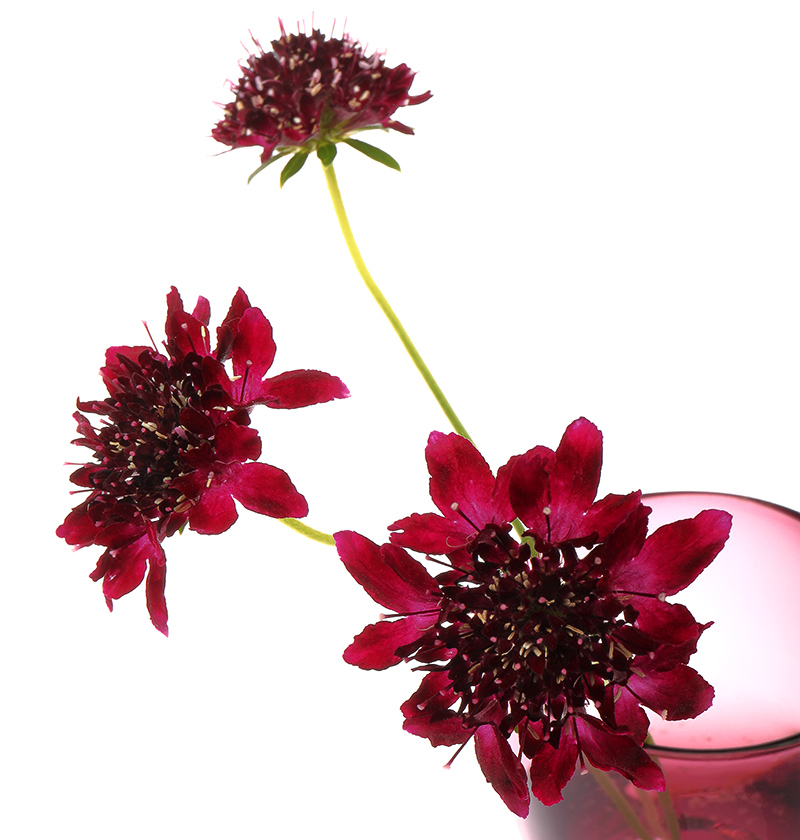
Scabiosa atropurpurea flowers (scabious 'Chile Black')

NB: A note for WordPress Reader users – you need to click on the title of the post again to come out of the reader and go to the post itself. This allows you to see the whole of the top photograph. (Otherwise you may see just a tiny section!)

We have a visitor staying with us at the moment, so this is a bit of a quick post-and-run! The photo is a re-post of Scabious ‘Chile Black’, photographed in 2020. For a few years we had this lovely plant self-seeding around the garden but there are only one or two left now. I think it might be time to either carefully collect some seed for sowing next year, or to buy a new packet of seed. I miss seeing these dark little flower heads all around the garden!

It’s Daisy Time Again…

Pink Michaelmas daisy

NB: A note for WordPress Reader users – you need to click on the title of the post again to come out of the reader and go to the post itself. This allows you to see the whole of the top photograph. (Otherwise you may see just a tiny section!)

After last week’s post, where I showed you the large-flowered aster I’d like to buy, I decided to show a couple of the asters already in my garden. To be honest, there’s not much other than asters (Michaelmas daisies) left in flower in the garden now. I have several and they’re all providing an uplifting display of colour that helps to combat the sometimes grey days of autumn.

These are two short-growing cultivars. The pink one at the top is ‘Alpha Light Pink’, but the identity of the blue one below is a mystery to me now. (I try to write down the names of the plants I buy, but don’t always remember.) We have a similar plant elsewhere, named ‘Audrey’, but I expect it to be a bit taller than this one. (This one is only about 30cm, Audrey can grow to 50cm.)

Trying to keep track of plant names isn’t easy, but is impossible when friends give you the generous gift of a name-unknown plant from their garden. There must be much-loved plants in gardens everywhere that have been passed around but their cultivar names either forgotten or mistaken for something else. (I have a couple of very pretty taller asters, both given to me by friends, but no idea of their names.)

However, it gets even more difficult when the powers that be decide to change a well-know name for something difficult to say, and usually all but impossible to spell. In this case, many Aster cultivars have become Symphyotrichum – yes, I had to look that one up for the spelling! But it’s more complicated than that. Checking on the RHS site, I read that the Aster genus is now divided into several: Aster, Callistephus, Eurybia, Kalimeris, and Symphyotrichum. Thankfully, they use the common name aster for all!

Does it really matter if the name of a plant is hard to pronounce, is overly complicated, or gets forgotten? Perhaps not so much in the garden, if it’s happy with where it’s growing and it looks good. It does matter when you want to enable someone else to buy the same plant, or to be able to check important details like the size of the plant or its preferred growing conditions. In future I’ll try to keep a better record of plant names, even if it’s just for labelling my photographs and writing this blog!

Blue Michaelmas daisy
Name unknown, but pretty all the same!

Simple Beauty

Aster x frikartii Mönch (Michaelmas Daisy)

NB: A note for WordPress Reader users – you need to click on the title of the post again to come out of the reader and go to the post itself. This allows you to see the whole of the top photograph. (Otherwise you may see just a tiny section!)

Autumn is a great time of year for daisies of all kinds, with rudbekias, echinaceas and asters bringing a vivid splash of colour to our gardens. The asters are looking especially impressive now, with a long-lasting display of blue/mauves, purples, pinks and the occasional white. My favourite is the flower photographed here, Aster x frikartii Mönch (Michaelmas Daisy).

The reason I like this aster so much is because the flowers are bigger than most. They’re larger than the other asters that I’ve seen, and than those already growing in my garden. (You won’t be at all surprised that I love the colour too, given how often I write about blue and purple flowers!) This aster has a long flowering-time and is popular with bees, so it really should be in my garden!

I don’t know why I haven’t grown this aster yet – probably just because I haven’t come across one for sale when I’ve been in the mood for buying plants. I did go out to try to find one in some of our local nurseries recently, but saw only other smaller-flowered cultivars. However, we are soon going to have a visitor to stay and he enjoys visiting garden centres, so I’ll have a good excuse to do a bit more searching…😄

Aster x frikartii Mönch (Michaelmas Daisy)
Aster x frikartii Mönch (Michaelmas Daisy) photographed on a garden-visit.

Blue Bells (but not Bluebells)

Adenophora 'Fairy Bells Gaudi Violet'

NB: A note for WordPress Reader users – you need to click on the title of the post again to come out of the reader and go to the post itself. This allows you to see the whole of the top photograph. (Otherwise you may see just a tiny section!)

You can easily see that these are not bluebells (whether English or Spanish), but they are bell-shaped and they’re a pretty lilac-blue. When I first saw this plant, I thought it must be a variety of campanula. But it isn’t, although it is part of the Campanulaceae family.

It’s Adenophora confusa ‘Fairy Bells Gaudi Violet’. (Adenophora is also known by the name ‘Ladybells’.) I’d never heard of this plant before, but the colour and shape of the flowers attracted me. (Gardeners and bees have a lot in common. We’re easily drawn to colourful flowers.)

My recently-planted adenophora has almost finished blooming now, but I expect that next year, as the plant gets bigger, there will be a long display of flowers. They are described as flowering from June through into September, so lots of colour and a great plant for bees too.

Reading up about my new plant has made me aware that some of the taller-growing adenophoras can be easily confused with the very invasive Campanula rapunculoides (creeping bellflower). Luckily, this plant is lower-growing and more compact, with its flowers held close together on short stems – a very different appearance to the creeping bellflower, thank goodness!

Adenophora

Not Ready for Autumn Yet

Hibiscus Blue Bird

NB: A note for WordPress Reader users – you need to click on the title of the post again to come out of the reader and go to the post itself. This allows you to see the whole of the top photograph. (Otherwise you may see just a tiny section!)

The trees are just starting to show their first yellow leaves here after a couple of cold nights. But in the daytime, if it’s sunny, it is still warm. Being outside at this stage is very pleasant, even more so now that the really hot days of summer are gone.

The late-flowering plants continue to bring colour to the garden, and some give a decidedly summery feel too. Amongst these is the hardy hibiscus ‘Blue Bird’. It blooms from August, producing an exotic-looking show of large blue flowers with deep magenta markings in their centres. There are still buds that are yet to open on the shrub, so there should be flowers for another week or two. As September ends, so will this floral display. Then autumn’s arrival will be hard to ignore.

One of the reasons that I want to hang onto summer this year is that my husband is finishing off building a gazebo in the garden. This will give us a much better space for sitting out. I’m hoping that we will have the chance to do just that while there is still some warmth in the sun. (It also means that I have a whole new area to redevelop around it. There will be lots of work to do! And then sitting in the gazebo for a rest afterwards.) Here’s hoping that this year’s autumn is slow in arriving!

Hibiscus Blue Bird
Hibiscus Syriacus Blue Bird

Rainy Days Remembered

Flowers of Brodiea AKA Triteleia laxa

NB: A note for WordPress Reader users – you need to click on the title of the post again to come out of the reader and go to the post itself. This allows you to see the whole of the top photograph. (Otherwise you may see just a tiny section!)

These are pictures from earlier this summer, on a day in early July when the rain had left all the flowers glistening with raindrops. Summer rain is not something we can take for granted in the east of England. Long dry periods can leave the garden parched and the plants practically gasping for water.

This year we have had some very dry periods but those earlier rains, much heavier and more frequent than usual, have allowed the garden to grow more lush than we’d normally see. The grapevine that covers a small arbour for shade has turned into a monster with wildly waving arms (and grapes hidden under all that foliage). At this stage it’s almost inaccessible to prune. Next year I’ll have to make a point of cutting it back at a time when I can get a ladder close enough to the arbour to be able to get at the vine.

The wisteria that I planted to grow over and through an old laurel that has become a tree is also becoming overgrown. I’m really not sure how I’ll tackle this one – a pruner on a long extending pole helps, but isn’t enough. More drastic action may be required in future…

This summer’s extra rain brought us plenty of flowers. The Triteleia laxa (also known as Brodiaea) ‘Queen Fabiola’ in the top photograph is long-gone for this year. It is a perennial bulb and will come back into flower again from late next spring. However, in the photo below, the gaura (Oenothera lindheimeri) is still in full flower and will be for a long while yet. (It can flower well into the winter and often ends up covered in frost. You can see one of my frosty photos of it here.)

Both of these flowers looked lovely when coated in raindrops. Summer rain brings some variety to flower pictures and it shows that it can be good for both gardens and photography. Sometimes the rain is welcome!

Flowers of Gaura lindheimerii
Oenothera lindheimeri, formerly known as Gaura lindheimeri