
NB: A note for WordPress Reader users – you need to click on the title of the post again to come out of the reader and go to the post itself. This allows you to see the whole of the top photograph. (Otherwise you may see just a tiny section!)
There are more lilies here this week. This time it’s the turn of the ‘Turk’s cap’ lilies, with their distinctively-shaped upswept petals. (Like the others, these were photographed while visiting Fullers Mill Garden in Suffolk. This garden has a gorgeous collection of lilies.)
As I mentioned in my last post, I don’t grow lilies because of their toxicity to cats, but if I could, then the lily above would be one that I’d love to have here. This beauty is the Lankong lily (Lilium lankongense), with graceful pink flowers that are spotted with a deep burgundy-red. I prefer these to the showier, more gaudily-coloured varieties like the one below, but both are a pleasure to photograph.
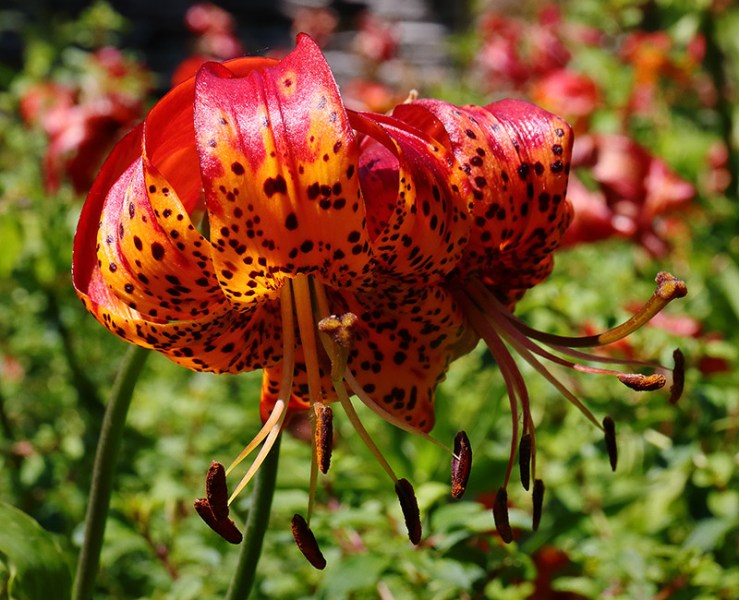
One of the first flowers I remember noticing as a small child was another brightly coloured Turk’s cap lily. That one was orange with dark spots – the tiger lily (Lilium lancifolium). We lived surrounded by moorland and low hills in Scotland’s northernmost county (Caithness), so to me this plant seemed improbably glamourous, and alien for such a place. (They are actually very cold-hardy and would have liked the moist, somewhat acid soil.) That lily grew in the shelter of a stone wall, protected from the blast of the wind and was tall enough for me to see the flowers at very close range. The sight of those exotic-looking orange flowers in that harsh and inhospitable landscape has stayed with me ever since.
Whether growing in a cold northerly garden or a warm southern one, I reckon these Turk’s cap lilies are amongst the most decorative flowers. Their curved petals (or ‘tepals’) and attractive spots seem designed to please, and gardeners can choose between flowers that are dainty and delicate or bright and bold. While they may not be suitable for my own garden and its feline company, I feel that they are well-worth the effort to see in other gardens. A real summer delight!







 Ann Mackay: Inspired by Nature