NB: A note for WordPress Reader users – you need to click on the title of the post again to come out of the reader and go to the post itself. This allows you to see the whole of the top photograph. (Otherwise you may see just a tiny section!)
I’m having a little holiday this week because we have visitors staying. So I’ll just leave you this pretty white gaura (Oenothera lindheimeri, AKA Lindheimer’s beeblossom). It’s a great plant for flowering profusely right up until the frosts start and a favourite of mine.
NB: A note for WordPress Reader users – you need to click on the title of the post again to come out of the reader and go to the post itself. This allows you to see the whole of the top photograph. (Otherwise you may see just a tiny section!)
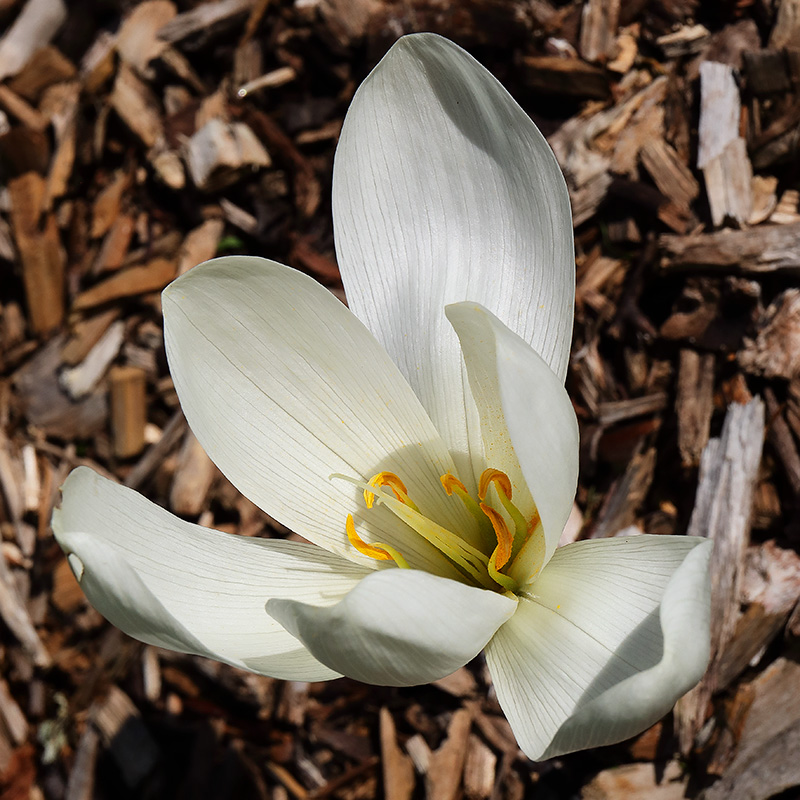
The colchicums (autumn crocuses) that I’m familiar with are those that are pink with a white throat. I’ve seen them here and there in other gardens and even tried growing them here. They’re not uncommon. But these white colchicums are something that I haven’t seen before.
These are part of the large collection of Colchicum autumnale growing in Fullers Mill Garden. (I posted photos of a pink and white variety that grows there a couple of weeks ago. You can see them here.)
Whilst the pink and white ones are very pretty, there’s a startling purity to these white flowers that feels unusual when surrounded by the glowing reds, oranges and yellows of many autumn flowers. The white, especially when combined with nearby green, gives a freshness and a feeling of cool and calm that is especially welcome after the blaze of summer heat.
Colchicum autumnale is sometimes called ‘meadow saffron’, but the whole plant is highly toxic and should not be mistaken for the source of the spice saffron. (Saffron actually comes from the saffron crocus, Crocus sativus, an entirely unrelated plant. Somewhat confusingly, this crocus also blooms in autumn.) It may be best to stick with calling these flowers either the commonly used ‘autumn crocuses’, or perhaps the more amusing ‘naked ladies’ (so-called because the flowers appear long before the leaves). It might get a few startled looks if you’re able to tell folk that your garden is full of naked ladies…
NB: A note for WordPress Reader users – you need to click on the title of the post again to come out of the reader and go to the post itself. This allows you to see the whole of the top photograph. (Otherwise you may see just a tiny section!)
The flowers of this bright red Hesperantha coccinea ‘Major’ (AKA crimson flag lily or river lily) are bright enough to rival the glow of other late summer flowers. They can easily compete with Crocosmia ‘Lucifer’, the heleniums, bright red kniphofia and ginger lilies from some of my recent posts.
While this hesperantha’s colour is rich and glowing, its flower has great elegance too. The simple curving shapes of the petals and the way the flowers are held on the long stems give the plant a graceful air. The detail that perfects it for me is the long style that divides into three and overlaps the petal edges. (The style is the female part of the flower’s anatomy that connects the pollen receptor to the ovary.)
I love the look of these flowers, but have found it difficult to keep this plant going in my own garden. The dry soil here isn’t suitable for them, as you’d guess from the ‘river lily’ name, and my attempts to keep them watered haven’t been enough. Hesperantha prefers damp soil, but the roots might rot if I tried planting it in the pond.
It would be good to find a suitable place to grow these…perhaps in their own little bog garden. (The bog garden I made a few years ago has now filled up with Siberian irises, so not much space there.) The beauty of these flowers, which can last until the first frosts, would make the extra effort to create a second bog garden worthwhile. It would have to be a very small bog garden though!
NB: A note for WordPress Reader users – you need to click on the title of the post again to come out of the reader and go to the post itself. This allows you to see the whole of the top photograph. (Otherwise you may see just a tiny section!)
At first glance these photographs look as if they may be of spring crocuses. But these are bigger and in flower right now. In fact, despite the common name of ‘autumn crocus’, these aren’t crocuses but colchicums. This plant looks as if it is probably Colchicum ‘The Giant’; it certainly had very big flowers.
(Before we go further, let me mention that there are true autumn-flowering crocuses. Crocus speciosus, AKA Bieberstein’s crocus, is a lovely soft lilac-blue and the saffron crocus, Crocus sativus, also blooms in autumn.)
There are a number of different colchicums available to gardeners, mostly in shades of pinky-lilac but there are others with pure white flowers too. (I saw some of those on this visit to Fullers Mill Garden, but will save those photos for a later post.) There were also different flower shapes amongst the colchicums I saw, some with double pink flowers (probably ‘Waterlily’) and others with long, spidery-looking petals. There was even a yellow-flowered variety, Colchicum luteum.
I have grown a few colchicum bulbs in pots in the past (they didn’t come back the next year). I don’t grow them now. That’s because this plant is a member of the lily family, and, like the lily, is toxic to cats. In fact, every part of the colchicum is highly toxic and the RHS recommend that gloves should be worn when handling or planting bulbs. So they’re not a good choice if you have young children or pets. Sometimes it’s best not to have a plant in your own garden, but to just admire it growing elsewhere!
The lavender-pink flowers of Colchicum (autumn crocus) open fully in sunshine.
NB: A note for WordPress Reader users – you need to click on the title of the post again to come out of the reader and go to the post itself. This allows you to see the whole of the top photograph. (Otherwise you may see just a tiny section!)
The flowers here look like lilies, and their common name is ‘swamp lily’, but they are not part of the Lilium family. They are Crinums – a different genus. This one looks as if it is probably Crinum x powellii (Powell’s swamp lily). It’s a beauty that I have often admired during visits to Fullers Mill Garden and this year I photographed it several times there, from early July ’til mid-September.
I can’t help feeling that this lovely flower deserves a more glamourous name than swamp lily, even if it is a fair description of where it may be found in its native habitat. (Though, from what I’ve read, it seems to be happy in soil that is just reasonably moist rather than soggy, and can tolerate some drought.)
The clumps of crinum that I saw at Fullers Mill were big – a few foot across – and about 4ft or more tall, so they’re too big for me to fit in to my modestly sized garden. In any case, I reckon my soil is not quite good enough for them because they prefer a soil that is rich, deep, and moist. (Maybe someday, when I’ve added enough compost and the humus has built up…)
These imposing flowers are large, but at the same time are elegant. They’re not a common sight here, in fact, I can only remember seeing them in a few gardens. Perhaps they’re more common in areas of the UK with a higher rainfall than Suffolk. That scarcity makes coming across a crinum all the more special and I’m very glad that they’re one of the pleasures of spending time in a favourite garden. Perhaps they will still have some flowers on my next visit.
NB: A note for WordPress Reader users – you need to click on the title of the post again to come out of the reader and go to the post itself. This allows you to see the whole of the top photograph. (Otherwise you may see just a tiny section!)
There was an end-of-summer feel to the day I took these photographs. We were visiting Bressingham Gardens in Norfolk at the end of August, on a day that was windy and rather cloudy. Our long, hot summer of blue skies and little rain has come to an end. Even so, there was plenty of colour still in these huge gardens, mainly from late-flowering perennials.
Some of the flowers we saw had strikingly vibrant colours, like the ginger lily above, which, according to the nearby label, is Hedychium ‘Tara’. (These gardens were originally created to display perennial plants grown by the Blooms of Bressingham Nursery, so, very conveniently for me, many of them are labelled.) This ginger lily is one of the hardier varieties, which tolerates temperatures down to around -10ºC and can be planted outside. Although there are a few frost-hardy varieties, ginger lilies can rot if they get very wet and some can be tender, so may be best planted in a pot and given protection from winter in a greenhouse or conservatory.
Other brightly glowing flowers included several different cultivars of red hot pokers (Kniphofia) in various shades of orange. The ones that stood out to me the most, though, were the daintier red flowers on the short-growing plant shown below. I prefer the look of these to the large bi-coloured kniphofia varieties, such as the familiar red and yellow ones that you often see.
The flower spike of the ginger lily suggested to me a trail of orange sparks flaring from a firework, and the little kniphofia flowers nearby made a burst of glowing mini-rockets that blazed against a dark background. Fanciful perhaps, but these warm and vivid colours made the flowers feel like an end of summer celebration as they gave a radiant performance to end the season. Floral fireworks are a joyful way to say goodbye to the summer and hello to autumn.
Several red flowers of Kniphofia (red-hot pokers) look like mini-rockets.
NB: A note for WordPress Reader users – you need to click on the title of the post again to come out of the reader and go to the post itself. This allows you to see the whole of the top photograph. (Otherwise you may see just a tiny section!)
Last month I saw these flower spikes of eucomis (pineapple lily) making an impressive show in a sunny garden border. The range of their colours, from white through pinks and peachy tones to the dark wine-red buds and stems, made them a most attractive sight. (And, of course, an irresistible subject for a photograph or two.)
My photographs don’t show the reason for the ‘pineapple lily’ name because the little cluster of leaves at the very top of the spike hadn’t yet grown to their full size. (You can just see the still-tiny leaves amongst the topmost flower buds.) Once they are fully-grown, these leaves sit in a little upright crown above the flowers, giving the appearance of a floral pineapple. (You can see what a green-flowered cultivar looks like when it has matured, and is creating its pineapple impersonation in this post.)
I wondered if eucomis might be drought-resistant enough for me to plant in my own garden, but it flowers best if it’s not allowed to dry out during growth. With our rainfall being so low, I feel that I should choose plants that can cope with little water. All the same, I’m tempted to try this plant, which appears to be Eucomis comosa ‘Sparkling Burgundy’. (Even the leaves can be spectacular – they’re a deep purplish-red in spring, before turning green in summer.) Perhaps it would be a good candidate for growing in a pot, which could then be taken into the protection of the conservatory in winter. It would certainly add a bit of excitement to the garden in late summer.
Eucomis in flower creates a beautiful array of colours.
NB: A note for WordPress Reader users – you need to click on the title of the post again to come out of the reader and go to the post itself. This allows you to see the whole of the top photograph. (Otherwise you may see just a tiny section!)
The summer heat has started to ebb away here but, oh, my, has this been a long, hot summer! Temperatures have frequently been up around 27°C and sometimes higher, so it has been too hot to work in the garden for long. (And I’m a Scot, so I’m not well-adapted to hot weather!) Happily, it’s now cool enough to catch up with some of the things that are waiting to be done.
To celebrate the return to more normal temperatures ( 🙂 ), here is a little bit of floral warmth. The tithonia (with its busy bumblebee) is actually from a few summers ago. I grew these brilliantly orange annual flowers just the once, but their memory lives on in a number of photographs. I’d be tempted to grow them again, but I now have fruit trees growing in that sunny spot. Maybe I’ll find another space for them in the future.
Heleniums (sneezeweed) in full flower create a blaze of bright colour in a summer garden.
The heleniums in the photo above are just as attention-demanding as the tithonia, but I’m less keen on the red and yellow colour combination. (So there’s no surprise that these aren’t in my own garden, but were in a garden I visited recently.) I do love the shape of heleniums though; the swirl of the petals suggests a dancing movement and there’s something delightful about the way the centre of the flower becomes almost spherical as it develops. I have tried growing a yellow cultivar and a dark red one in the past, but I haven’t been able to keep them going for more than a few years here.
I like the bold red of the crocosmia below. This plant had spread to make a very dramatic clump that drew me to it as soon as I caught sight of the colour. Brilliant as it is, I don’t have it in my own garden. (I did try it years ago, but it was never happy in our very dry conditions.) Nowadays I’m not sure I want to add many flowers with really ‘hot’ colours to my garden. Our summers are becoming so scorching that the last thing we need is to add to the suggestion of heat. With that in mind, I reckon I’ll have to stick with mostly cooler colours, such as blue and white, to try to bring a slightly cooler feel to the garden.🌼
Brilliant red crocosmia flowers stand out against a green background.
NB: A note for WordPress Reader users – you need to click on the title of the post again to come out of the reader and go to the post itself. This allows you to see the whole of the top photograph. (Otherwise you may see just a tiny section!)
It’s a quick post-and-run from me this week, with a couple of photos of clematis seen earlier in the summer. (I think it was June – I’m a bit shocked by how quickly this hot summer seems to be passing.) Instead of writing, I’m trying to catch up with some of the work in the garden, now that it’s cool enough to get out there. It won’t be easy because the dried-out soil is almost like concrete! So it may be a slow process…🥀
These dark blue clematis flowers have a slight blush of purple at the centre of their petals.
NB: A note for WordPress Reader users – you need to click on the title of the post again to come out of the reader and go to the post itself. This allows you to see the whole of the top photograph. (Otherwise you may see just a tiny section!)
Visiting gardens allows me to discover plants that I like the look of and frequently inspires ideas for what to grow here. Seeing them in growth, rather than just in a photograph, helps me to decide what plants I do and don’t like. Sometimes I’m surprised by how much I like a flower ‘in real life’ that seemed insignificant in pictures. This happens quite frequently with those that look lovely when planted in combination with something else.
Considering how much I rave on about plants, you might be surprised that there are some that I really don’t like. Yes, it’s true! I have become more and more aware of my preferences in plants as a result of garden visits, which is very helpful in planning my own garden.
One of the things that has become more apparent to me as I’ve been looking at the plants in other people’s gardens is that I very much prefer single flowers and semi-doubles to double-flowered varieties. The flowers you see here are all daylilies (Hemerocallis), but my reactions to them are very different. The cream-coloured flower in the top photo looks very like a lily (you might think it was, if not for the long, strap-like leaves that give its identity away). It looks elegant, exotic, but not overly fussy. I like it – it could easily fit into the planting here and would be a good addition for pollinators. (That particular daylily was attracting lots of hoverflies, as were the lilies in the same garden.)
An orange daylily (Hemerocallis) with double flowers gives a splash of bold colour to a garden border but doesn’t appeal to me.
My feelings towards the double orange daylily above (I think it is Hemerocallis fulva ‘Flore Pleno’) are entirely different. It provides a patch of vibrant colour, although I’d prefer a ‘clean’ orange without the reddish markings. But that’s a little irrelevant because I simply do not like the flowers. If you’ve been reading this blog for a while, you’ll know that I love most flowers. Not this one! I feel that the inner set of petals completely spoils the look of the flower. I prefer the simpler shape of the single flowers of the daylily below.
That preference for single flowers applies to other plants too, e.g. dahlias, where I’ve never much liked the very double forms such as cactus dahlias and ball/pom pom dahlias. I do, however, like the looks of both the single and semi-double dahlias. These also have the advantage of offering easily-accessible pollen and nectar to bees and other pollinators too, so would be much more suitable for my garden. Being able to see the differences in these flower forms when I visit gardens is an invaluable aid in forming my opinions of plants and choosing which ones to grow. So I am grateful for the opportunity to see plants I don’t like! (And those I do.)
An equally bright colour but a simpler shape – much more attractive to my eye!