NB: A note for WordPress Reader users – you need to click on the title of the post again to see the full photograph. (Otherwise you see just a tiny section!)
This year I’ve been making more of an effort to visit other people’s gardens. Now that Covid is less of a worry (although still around), we’ve been trying to get out and about to enjoy the things we used to do.
Visiting gardens gives the pleasure of looking at plants I don’t have in my own garden. If it’s one of the bigger gardens that regularly opens to the public, I’ll bring my camera. (I don’t take it to the smaller private gardens, that just feels a bit intrusive.) Amongst the plants I love to see are irises. I’d grow more of them in my own garden if I could, but seeing them elsewhere is a good substitute.
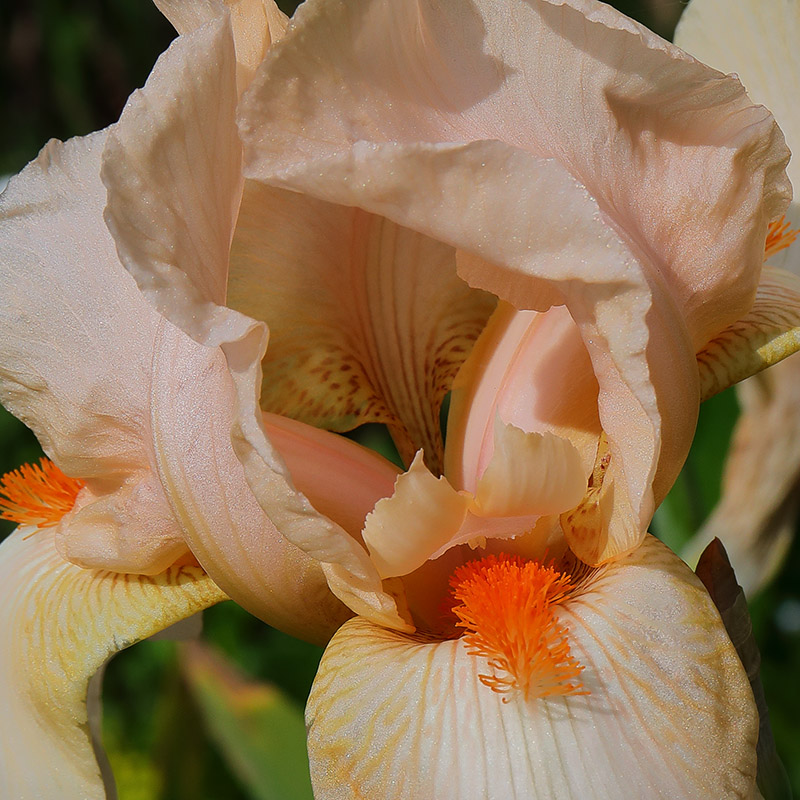
Photographing flowers in someone else’s garden can be a bit tricky. You can’t move anything or walk wherever you want to to change a distracting background. Here I’ve decided to get as close as I could to these bearded irises and then crop the images. This gets rid of the remains of flowers that had already gone over. (So much easier to have a quick tidy in your own garden!)
I was happy with the close-up of the white iris because I like the different colours of the flower’s markings. The pale orange iris doesn’t appeal to me quite so much because it’s a colour I’m less keen on. But the markings do help to make the photo a little more interesting. In my own garden I grow Siberian irises, which have beautiful markings. I photographed a couple of them last year for this post.
NB: A note for WordPress Reader users – you need to click on the title of the post again to see the full photograph. (Otherwise you see just a tiny section!)
I’m taking a short break this week and reposting an image from 2019. I’ve had very little time for photography because I’ve been too busy enjoying the company of friends who came to stay. (We did have the chance to sit out in the garden and enjoy the flowers though!)
NB: A note for WordPress Reader users – you need to click on the title of the post again to see the full photograph. (Otherwise you see just a tiny section!)
When I moved to England, one of the plants that made a big impression on me was wisteria. It can grow in Scotland if you have somewhere warm and sunny enough for it to flower, but I think I’d only seen it once or twice, if at all. Here in the east of England it is very popular and of course I wanted to grow it.
I chose Wisteria sinensis ‘Amethyst’ after falling in love with its scent when I came across a mature plant in flower. The colour is pretty too, but it was the scent that got to me most. (My sense of smell isn’t brilliant, so plants need a good scent for me to notice!)
The climber has been in the garden for quite a long time now and is busy growing over an old laurel that has become a fairly big tree. (I don’t like laurel, so I’m very happy that the wisteria makes it a bit more interesting to look at.) This year the wisteria has become a lot better established in the tree and there were lots of flowers, making it a very pleasing sight.
So far I haven’t really got to grips with pruning the wisteria properly, and obviously having it growing up a tree is going to make this difficult. However, I’m starting to see the effects of the pruning that I’ve done over the last few years and I feel a bit more confident about it than I did at the start. (There are some very clear instructions for pruning wisteria here and here – I wish I’d seen them a lot earlier!)
Right now the flowers are starting to fade and the leaves are beginning to take over. I can see that I will have a lot of pruning to do in July!
NB: A note for WordPress Reader users – you need to click on the title of the post again to see the full photograph. (Otherwise you see just a tiny section!)
Visiting gardens and looking at the plants other people grow has always been something I enjoy. It’s tremendously useful too, allowing me to look out for plants I might like to try growing in my own garden.
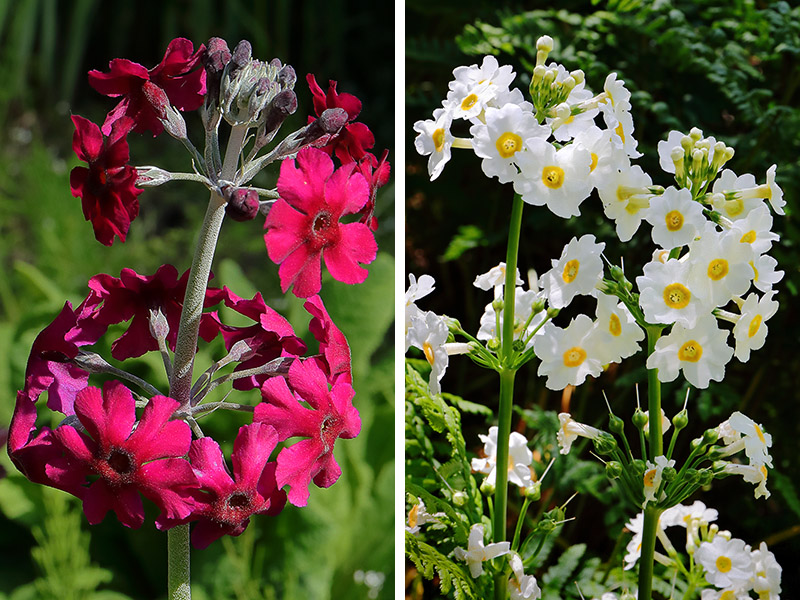
Candelabra primulas are amongst the plants that have caught my attention. They wouldn’t normally be happy in my garden conditions, but at the moment I’m building a small bog garden here. This will give damper conditions than I can provide elsewhere in the garden and should suit these and a range of plants that will look good near the pond.
These primulas have a very distinctive structure. The flowers are held in whorls around the stem. They make me think of an old-fashioned tiered cake-stand rather than a candelabra though! (The photos below give a good idea of the plant’s shape. As a new whorl comes into flower at the top, the lowest layer of flowers will be going over.)
There’s a lovely range of colours to choose from, with reds and pinks, oranges and yellows, and purples and mauves. I think the white ones (or perhaps yellow) would probably suit my planting best, but the glorious crimson flower really appealed to me.
As well as colours, there are a large number of species and hybrids. Some are bright and bold, while others are more delicate in appearance. The choice is wide, but space in my garden isn’t. So I will have to be restrained if I go shopping…
Candelabra primulas, with hostas, irises and astilbe.
NB: A note for WordPress Reader users – you need to click on the title of the post again to see the full photograph. (Otherwise you see just a tiny section!)
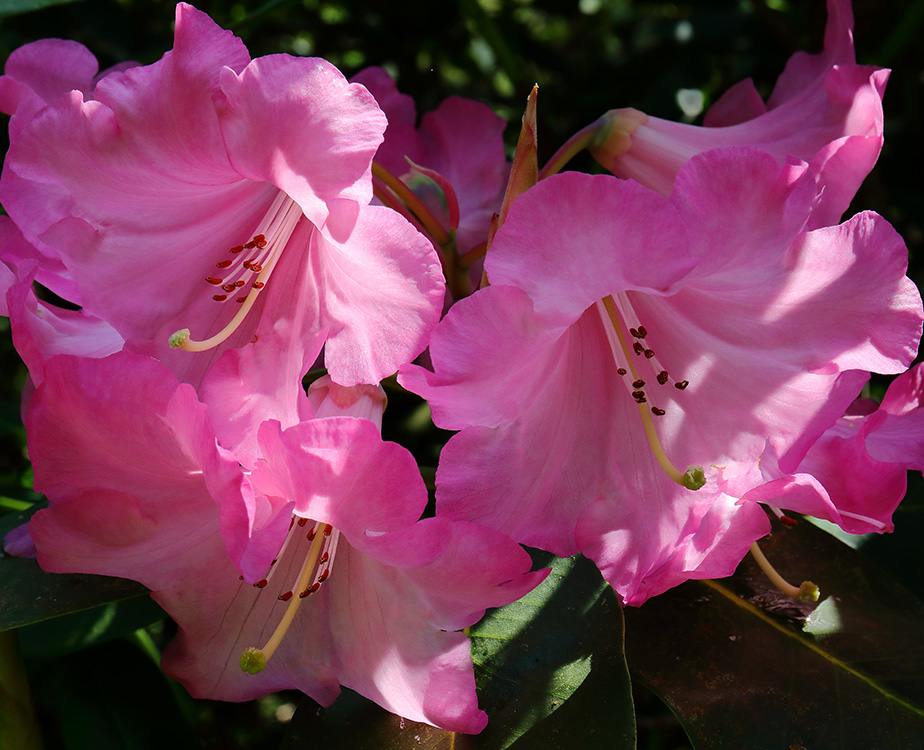
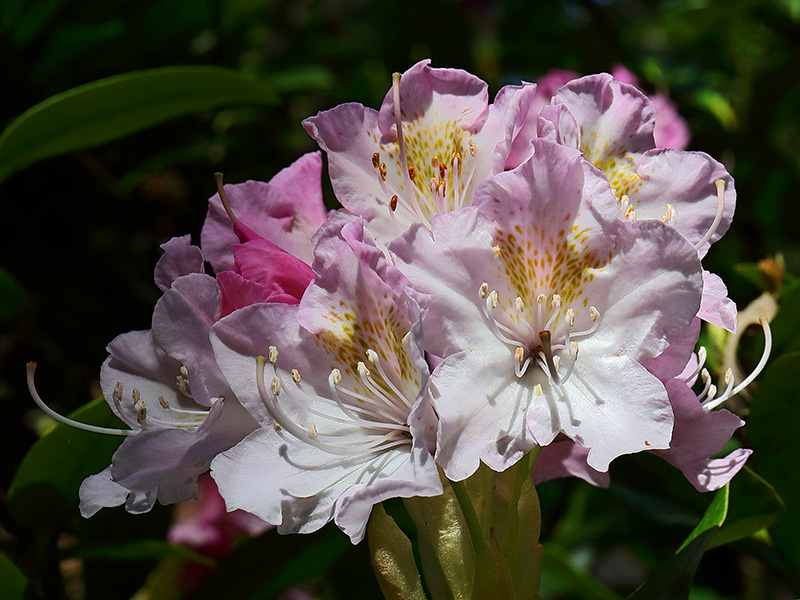
Our previous garden was near Edinburgh in Scotland, so it won’t be surprising that we had a few rhododendrons growing there. However, we have none here in our garden in Suffolk and I must admit that I do miss their beauty.
Although our garden wouldn’t be very suitable for growing rhododendrons (nor would it have the space), we do see them when we’re away from home. A couple of days away gave us the chance to see them in gardens that are rather cooler and moister than our own. It gave me the chance to photograph one or two of them too. So while I may never be likely to enjoy rhododendrons in this garden, I can still admire their loveliness when I’m out on a garden visit.
We’re back home after a mini-break, and now it’s time to get on with work here – there are plants calling for my attention. (And one or two new purchases… )
NB: A note for WordPress Reader users – you need to click on the title of the post again to see the full photograph. (Otherwise you see just a tiny section!)
Recently I treated myself to this pretty Dicentra formosa ‘Aurora’ at a local plant market. It’s not the most practical of plants to choose for a Suffolk garden, given our often hot and dry weather. I do however have a couple of shady spots in the garden, so I’m hoping that it will be happy enough in one of them.
I must admit that there was a lot of nostalgia involved in choosing this plant. When we lived in Scotland I used to grow the very similar Dicentra formosa ‘Langtrees’. That one had very silver-grey foliage and made a wonderful ferny-looking ground cover. (It did die back if the weather got hot though, so needed to be amongst other plants that would hide bald patches.)
Dicentra formosa isn’t as showy as the better-known ‘Bleeding Heart’, Dicentra spectabilis, which has had its name changed to ‘Lamprocapnos spectabilis’. (Why are plant names inevitably changed to something that would make a great tongue-twister?) But I reckon this is a lovely plant which should look good alongside the other plants in my garden…if I can help it survive!
NB: A note for WordPress Reader users – you need to click on the title of the post again to see the full photograph. (Otherwise you see just a tiny section!)
Spring brings the start of the garden-visiting season for us. This year, one of our first visits was to Columbine Hall, a timber-framed house built in about 1390. It was originally the gatehouse of a medieval manor-house and stands beside an even older defensive moat.
This attractive historic home had its gardens open to visitors as part of the ‘Great Garden Trail’ in aid of Suffolk’s St Elizabeth Hospice. The gardens here were begun by owner Hew Stevenson and his late wife, Leslie Geddes-Brown and developed with the aid of their head gardener, Kate Elliott.
Columbine Hall’s gardens have a dreamy air. The ancient house is surrounded by its moat and gardens (which are a mix of formal and very informal), with views to open fields and the Suffolk countryside.
Formal lawns within the area bounded by the moat. A parterre lies alongside these, and beside that is a much more informal area.
Traditional lawns surrounded by tall clipped hedges (above) provide calm, quiet spaces which contrast with the wilder, nature-inspired parts of the grounds. I particularly loved the area in the below, right-hand photo. Here white and ‘Spring Green’ tulips mingled their way through cow parsley, below rows of pleached limes.
Left: Part of the bog garden, where moisture-loving plants flourish along the edges of a narrow stream. Right: Beside the parterre is a wilder area where tulips grow through cow parsley – one of my favourite parts of the garden.
There are a number of different areas to the garden. A parterre provides a formally-structured area near the house, with rows of pleached trees, clipped cubes of box, and climbers on obelisks. In summer it will be full of flowers, including irises, alliums, hardy geraniums, lavender and Alchemilla mollis.
Nearby, the planting gradually becomes wilder and less formal as it gets closer to the edge of the moat. In a couple of weeks or so, the cow parsley in this area will have reached its full height and its mass of tiny white flowers will create a wild and romantic froth.
A bank with bluebells lies in front of the Mediterranean garden (to the right). Above and to the left is the edge of the orchard.
Outside the space encircled by the moat are other gardens. There is a bog garden, where moisture-loving plants grow, and a walled kitchen garden which, in summer, will be full of colourful vegetables, roses, dahlias and sweet peas. There is also an orchard – which was in full of blossom when we visited – and a Mediterranean garden. (You can see part of both in the photograph above.)
Some of the tulips at Columbine Hall
A few weeks earlier the garden’s collection of Engleheart daffodils would have been in flower. (Columbine Hall holds a part of the National Plant Collection of daffodils bred by Rev. G.H. Engleheart in Victorian times.) Now though, it’s the tulips that demand attention in this garden. (Thousands of tulips are planted every year by Kate Elliott and her assistants.)
There are tulips of a wide range of colours in the garden, even in the vegetable garden, where white tulips look very well with the bold silvery leaves of cardoons. My own favourites amongst the tulips were the dark, reddish-black ones, which you can see below. (I have ‘Black Parrot’ and ‘Queen of Night’ in my garden, as well as the white and green ‘Spring Green’.)
Tulips, irises and fennel in a border beside the house.
My visit to Columbine Hall was thoroughly enjoyable and it gave me both inspiration and food for thought. Seeing the gardens there has encouraged me to wonder how I can combine wild and cultivated plants in my own garden. It would surely make it more appealing to wildlife if I did. I wouldn’t have thought that tulips would look so at home with cow parsley, but it works and looks really lovely. At the same time it provides a better habitat for wildlife.
I hope I’ll get the chance to visit Columbine Hall again. It would be very interesting to see how it looks later in the year. I’m sure it will be beautiful in summertime. I’ll be keeping a lookout to see when their next garden-opening is!
White and ‘Spring Green’ tulips with cow parsley under the pleached limes give an informal, nature-inspired feel.
NB: A note for WordPress Reader users – you need to click on the title of the post again to see the full photograph. (Otherwise you see just a tiny section!)
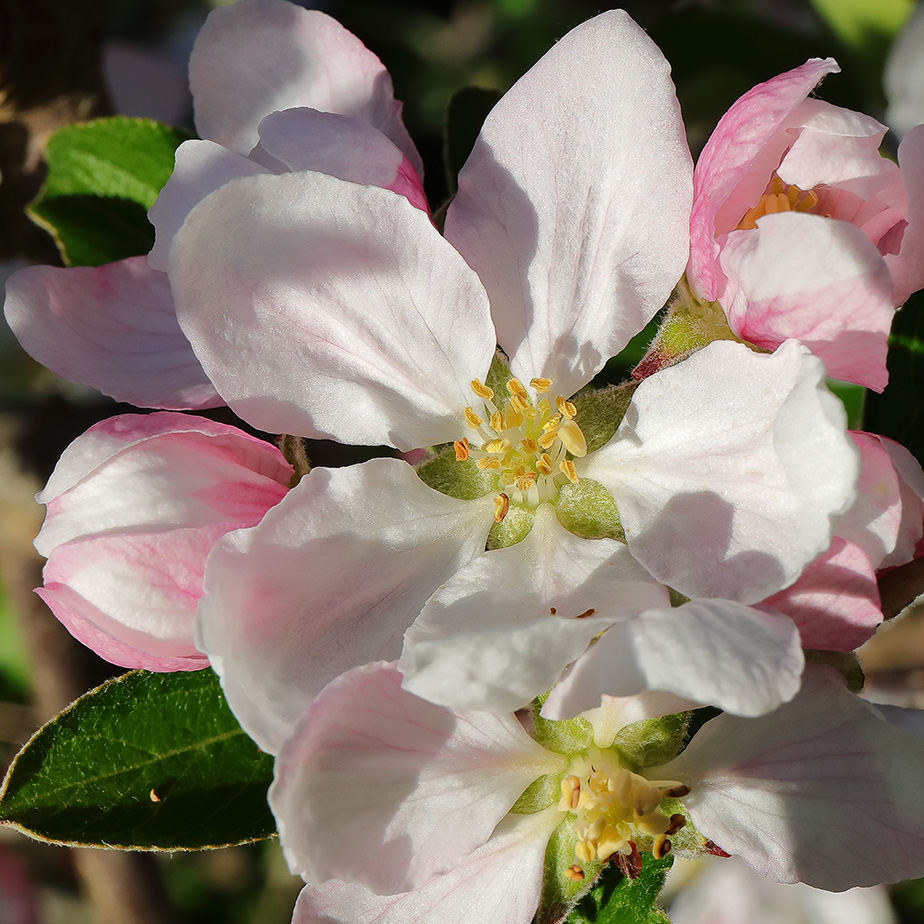
At last the spring blossom is here. Our apple trees (top) have begun to flower this week. They’re much later than last year. There has been less sunshine than usual, and more rainy days, so it’s not much wonder that the buds on the fruit trees haven’t been keen to open.
(In case you think I’m unhappy about the wet weather, I can assure you that I’m not. That’s because the extra rain will be a blessing if temperatures begin to rise the way they did last year. Excess heat and drought may become a problem here.)
It was still rather grey and breezy when I remembered to photograph the blossom on our very young pear tree. (It had it’s first fruit last year.) I was a bit worried that the blossom might get blown away if the winds persisted, but things calmed down and the blossom survived (photo below). It’s too early to expect more than one or two pears this year, but it was good to be at least able to enjoy the blossom.
Pear Blossom
Some stronger sun in recent days has now also brought the Morello cherry (bottom photo) into flower and I was even lucky enough to have a bright blue sky for a background. Whether I’ll be able to pick many of the eventual cherries before the blackbirds descend on them is another matter. I do hope they leave me some!
The flowering cherry in our front garden (‘Kanzan’ – a very pretty pink) is flowering surprisingly well this year, given that it has looked sickly for a couple of years. Eventually it may give up the ghost, so I really ought to go and pick a few twigs of flowers so that I can photograph them indoors. (They’re too difficult to get close to otherwise.) And then there’s the lovely deep pink crab apple out on the green in front of us. It is loaded with blossom this year. I think I need to go and get my camera…
NB: A note for WordPress Reader users – you need to click on the title of the post again to see the full photograph. (Otherwise you see just a tiny section!)
Tulips are wonderful subjects for photography. The flower shapes can vary hugely, some being a simple cup-shape but others being very like lilies or peonies. Their colourings and markings are even more varied and give unlimited opportunities for interesting photographs.
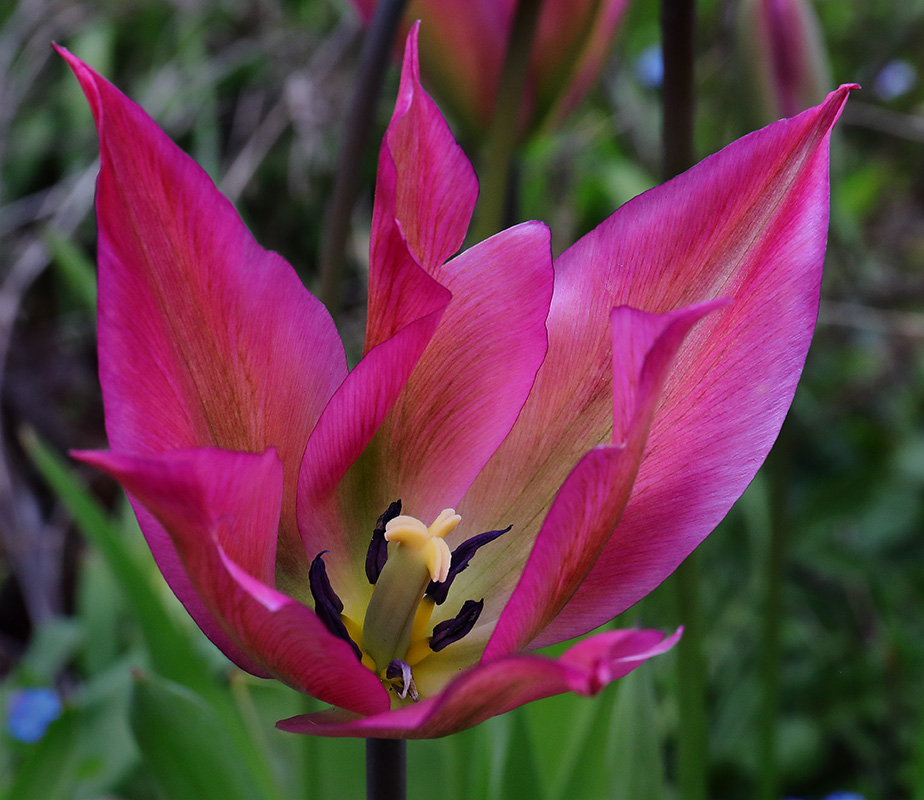
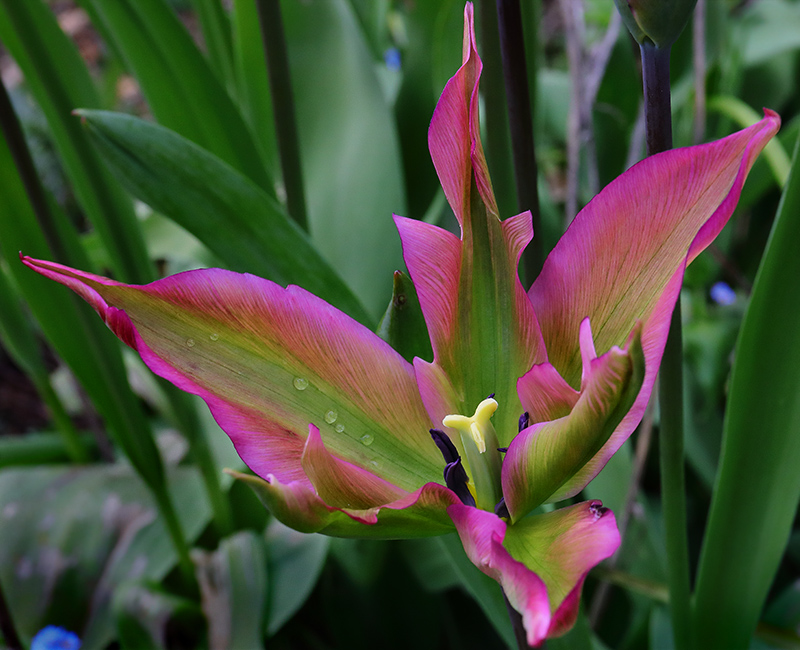
I photographed these tulips last year and again this year, and I was surprised to see how different the flowers look in the two sets of photos. They are a viridiflora tulip (my guess is that they are ‘Dolls Minuet’, but I can’t be sure). Viridiflora tulips all have a green feathered marking spreading from the base of the petals.
Last year’s photos (which you can see here) show these tulips as mainly magenta, with just a slight amount of green blush. The top photograph here is more like those from last year, with perhaps a little more green. But the photograph below shows a lot more green than I had expected.
I’ve just been out for a good look at these tulips again, a few days after the photos were taken. Now I can see that the tulip below has, in that short time, lost much of the green colouring. It has become more like the flower in the top photo. So that suggests to me that the flowers are greener when they first open and gradually change to become more pink.
This is something I hadn’t noticed before…or if I had, I’d forgotten. Spring is a very busy time in the garden, so it’s easy to let things pass by unnoticed. Hopefully next year I’ll remember the strong green markings when these tulips first open. Then I should have time to take some studio photographs of them too.
NB: A note for WordPress Reader users – you need to click on the title of the post again to see the full photograph. (Otherwise you see just a tiny section!)
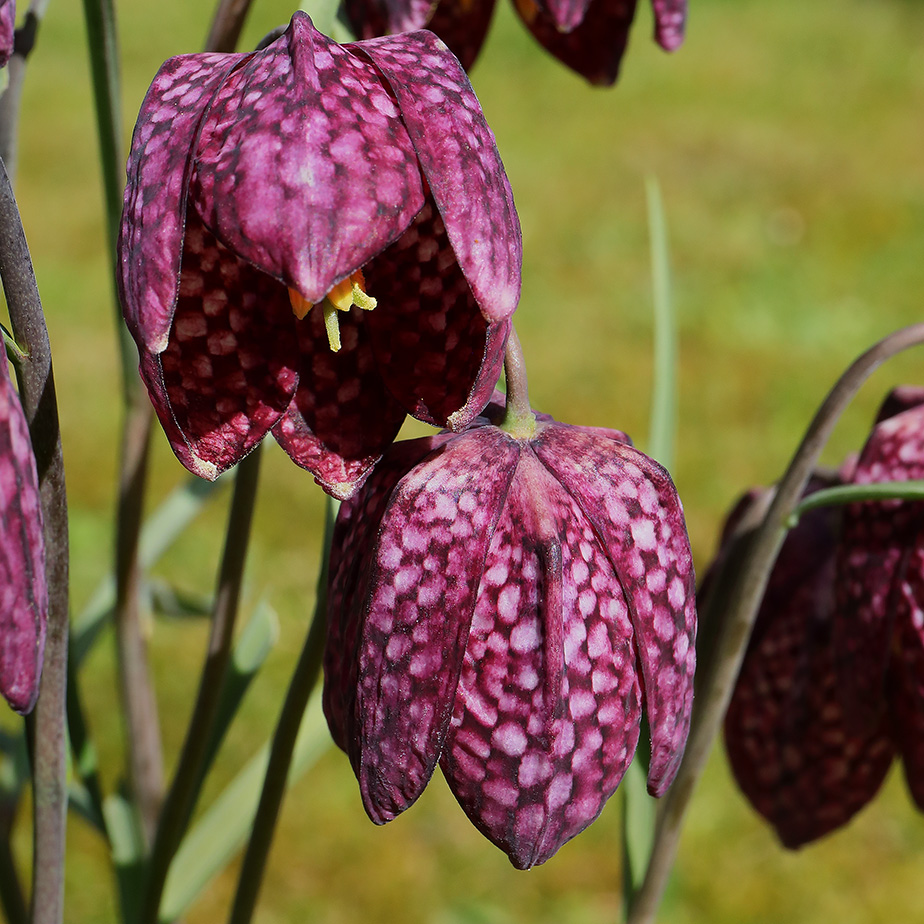
As a photographer I find the tiny checkered markings on the petals of Fritillaria meleagris irresistible. Also known as the ‘snake’s head fritillary’ (because of the shape of the unopened buds and the resemblance of the markings to a snake’s skin), it is a most unusual-looking flower.
The distinctive markings have given rise to other names for the plant. ‘Chess flower’ is a pretty obvious one, but ‘guinea hen flower or just ‘guinea flower’ come from the similarity of the checks to the spots on the bird’s feathers. (The Latin ‘meleagris’ has the same meaning.) Then there’s ‘checkered daffodil’ (it isn’t a daffodil) and ‘checkered lily’ (it is a member of the lily family).
Knowing that fritillaries are Liliaceae made me suspect that, like other lilies, they would be highly toxic to cats. I have two cats of my own and occasional feline visitors (or invaders as my two would reckon). So I have kept this plant in a pot that’s out of their way. Turns out that I was right to suspect the fritillary’s toxicity because I’ve just read that the plant contains elements that cause damage to both heart and kidneys. This is probably one to be wary of if you have a cat that likes to nibble plants.
If you’re in the UK or Europe you might be lucky enough to come across a damp meadow where these flowers are growing wild. They used to be much more common in water meadows, especially in the area around the Thames, but gradually disappeared as more land was cultivated. Happily for their survival, they’re a popular garden plant. It’s easy to see why!









 Ann Mackay: Inspired by Nature