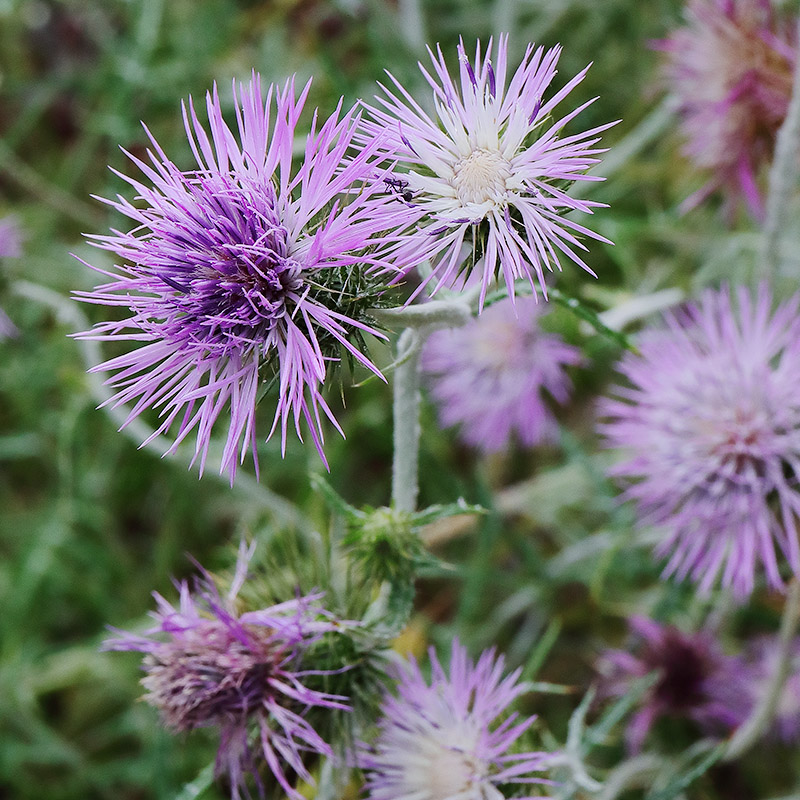
NB: A note for WordPress Reader users – you need to click on the title of the post again to come out of the reader and go to the post itself. This allows you to see the whole of the top photograph. (Otherwise you may see just a tiny section!)
Today I’m posting more photos of flowers that I’ve only ever seen at Fullers Mill. (There are lots of plants that I’ve seen for the first time there.) This plant is Galactites tomentosus, also known as purple milk thistle. The ‘purple’ in the common name is essential to avoid confusion with Silybum marianum, the plant more usually known by the name ‘milk thistle’.
Galactites tomentosus is an annual or biennial, depending on the growing conditions. It grows wild around the Mediterranean and, as you would expect, prefers sun and well-drained soil. Grown for the look of both its flowers and leaves, the seeds of this attractive thistle and a very striking white form (‘Alba’) are easily available online.
Like Silybum marianum, this thistle has green leaves that are strongly marked with white, giving it its common name. Last October I photographed the basal rosette of leaves of a young plant. These leaves persist through the winter, adding interest to gardens at a quiet time. (Although I have seen varying statements of its hardiness, some suggesting that it is fully hardy, and others saying that the leaves may die back in a severe winter.) The very prickly young plants that I saw last autumn will be amongst those that are in flower now.

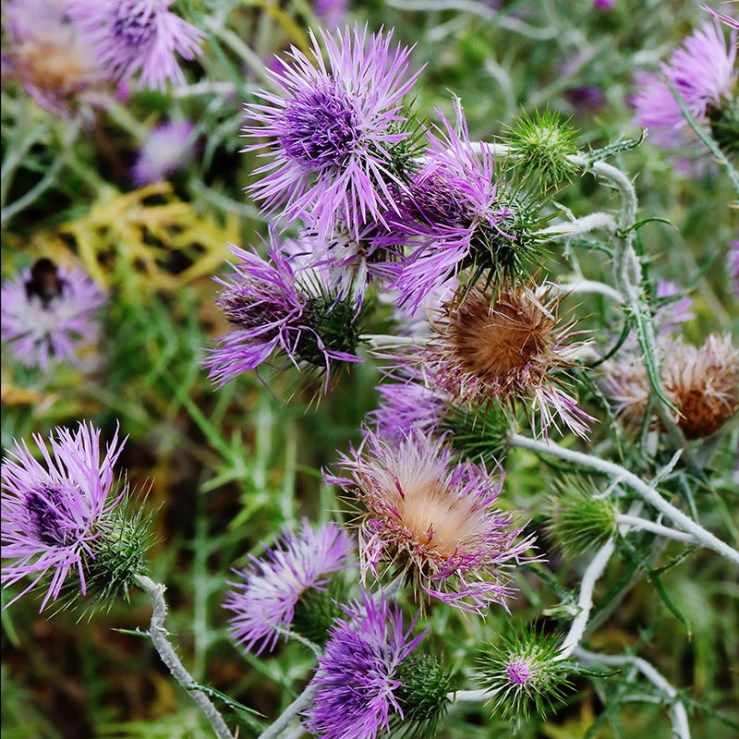
It’s not just the leaves that are prickly; the photo below shows the spines on the buds and the outer bracts that surround the flowers. What a contrast to the soft appearance of the pinky-purple flowers and the downy fluff of the seeds! The plant adds a touch of drama to a border…but I’d reckon on even more drama if a gardener happens to get spiked on it while weeding nearby. Ouch!
That slight risk will be worth it for wildlife gardeners though. When I photographed it, I noticed that the flowers were very busy with bumblebees. Galactites attracts other pollinators too, including hoverflies, butterflies and moths. Later in the year, the seeds are eaten by goldfinches. It’s not just pretty, or prickly, but very useful too.

 Ann Mackay: Inspired by Nature
The thistly nature of the flowers jumped out at me in the first picture. The Wikipedia article on the genus Galactites lists four species and notes that the one you showed is the best known.
LikeLiked by 1 person
I notice that the article mentions the different spelling ‘tomentosus’ and ‘tomentosa’, which bothered me when I was writing this…in the end I went for the one that Kew used on their website.
LikeLike
Sometimes we can tell the gender from the way a genus name ends, like Cirsium being of neuter gender, and Gaillardia being of female gender, but with Galactites there’s no obvious gender marker. I found on the Internet that “the German botanist Conrad Moench established the genus name Galactites in 1794.” Unfortunately he’s not around to ask what gender he intended his made-up name to have.
LikeLiked by 1 person
Not something I would have thought of! 🙂
LikeLike
The structure of the leaves is somewhat different, but the prickliness is the same as that belonging to our Cirsium horridulum, or “horrid thistle.” Like this plant, it also has soft, lovely flowers: perhaps an attempt to make up for all that horridness? I really like the white patterning on this one’s leaves; it appeals to me as much as the flowers.
LikeLiked by 1 person
When I first saw these flowers, I wondered if they were a species of Cirsium, but I don’t think any of those have ray florets. (The flowers are lovely…thistles are so much more than their prickles!) It was the leaves that helped me to identify the Galactites. They’re very decorative and one of the main reasons for growing this plant.
LikeLiked by 1 person
I avoid prickly plants in my garden as I am prone to getting scratched, spiked, jabbed! I wonder how invasive it is given the fluffy seed heads? Several wildflowers I grew from seed have proven a nightmare with their habit of self seeding.
LikeLiked by 1 person
I’m with you on that, Jude…I wear glasses, but have been scratched on the eye a couple of times by plants, so I’m careful now. I’m also aware that I need to make my garden easier to look after as I get older. There’s no point in creating problems for myself! Galactites does self seed but I’ve read that a lot of the seeds aren’t fertile. Even so, I don’t think I’ll chance it because I already have plenty of self-seeders! 🙂
LikeLike
The tender leaves are as beautiful as the lavender-coloured flowers of this wild plant!
LikeLiked by 1 person
They are, Indira. I think that it is often grown for these bold and lovely leaves which provide a striking focal point in winter.
LikeLike