NB: A note for WordPress Reader users – you need to click on the title of the post again to come out of the reader and go to the post itself. This allows you to see the whole of the top photograph. (Otherwise you may see just a tiny section!)
Winter has asserted itself forcefully over most of the UK. In the last week or so, heavy snow and a damaging storm caused problems over other areas of the country. Here we have been more fortunate and have pretty much escaped both. Our light sprinkling of snow has now melted away, to be replaced by heavy rain and the promise of sleet.
Even the frosts of the previous days had little impact here. Although the ground was completely frozen, the frost itself affected only the grass and low-lying leaves, with none appearing on the upper parts of plants. So there was little of interest to photograph, which is unusual for frosty mornings here. However, that did allow me to stay indoors and keep warm rather than trying to navigate the slippery paths and ground outside. The time wasn’t wasted because I spent it catching up with processing a few older winter photographs.
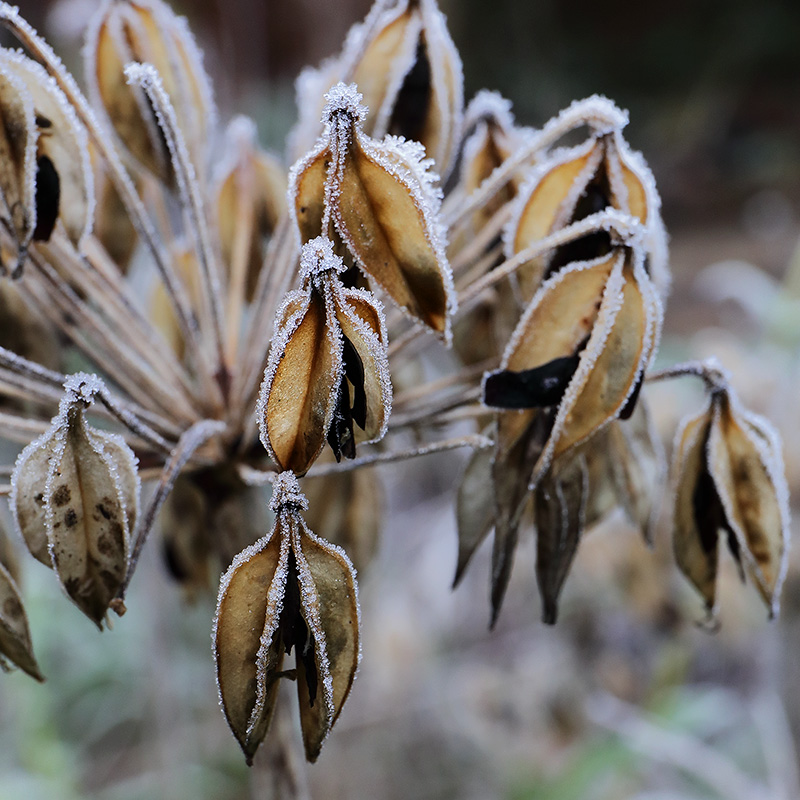
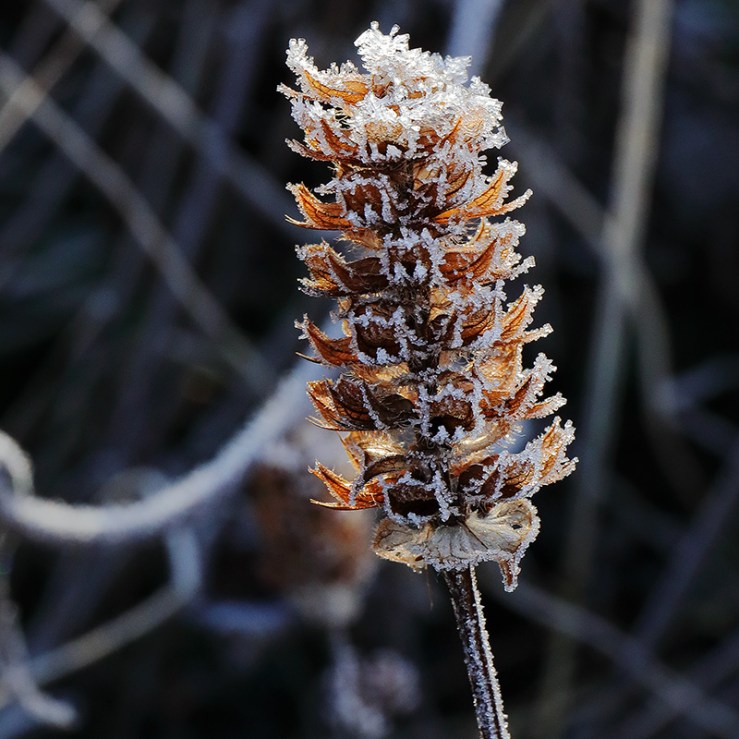
The pictures here show seed heads photographed in winters when we’ve had a bit more frost. I usually leave some seed heads standing, hoping that they will become covered in icy crystals and provide me with something to photograph. (I don’t tidy up much in the autumn anyway, because I know that there will be many ladybirds, and possibly other insects, hibernating in the undergrowth.)
The top photo shows the seed head of a hardy agapanthus which is able to survive outside in a garden border, rather than having to be kept in a pot and overwintered in a greenhouse. It is one of my favourite seed heads to photograph. The seed head below is betony (Betonica officinalis), which I was lucky enough to be able to photograph before it had completely dried out and lost its colour. (We must have had an early frost that year.)❄

 Ann Mackay: Inspired by Nature
Your betony looked familiar. It turns out that it’s very closely related to our Stachys: for example, Stachys drummondii, or Drummond’s hedgenettle. I remember that species having quite a nice scent, as well: not as prominent as the lemon flowers, but pleasant, and the structure’s very much the same.
I wondered if Betonica and Stachys still were considered synonyms, as the USDA suggests, but they’re not. I found this on Wikipedia: “Betonica was until recently usually included in the genus Stachys as a subgenus, but was separated at genus rank from Stachys when a detailed morphological examination showed clear consistent differences in both the foliage and flowers.”
Of course, for our purposes, both photograph wonderfully well — especially with a little frost around the edges!
LikeLiked by 1 person
You won’t be surprised that the RHS still lists Stachys officinalis as a synonym for betony, so they are very close. Other members of the mint family tend to run amok in my garden (if allowed), but betony seems well-behaved and has just formed a nice clump. It’s good for bees, so I’ll probably propagate it to give them some more.🐝
LikeLiked by 1 person
The frosted seed heads are beautiful!
LikeLiked by 1 person
Thank you Indira. I love to have an assortment of seed heads still in the garden in the hope of some frosty photos. Not much frost here yet, so I may be looking for some more pics from my old files.
LikeLiked by 1 person
Snow skipping your area left you free of the problems you say afflicted other regions. At the same time, are you sorry not to have had the chance to see your landscape and the plants and trees in it blanketed with snow?
LikeLiked by 1 person
Well, I’m grateful we didn’t have some of the awful problems of other areas (to put that in perspective, a coast north of us has a couple of areas where coastal erosion has meant that houses have been lost to the sea and they were expecting further damage), so that’s uppermost. But of course, a little more frost or snow would have given photographic opportunities – even so, I’ll stick with being grateful!
LikeLike
Love the frosted seed heads. No frost here though a sprinkling of snow earlier in the week. I’m glad it was milder when the 26 hour power cut happened. Another 5 hours today! So many trees down. Trelissick, Trebah, St Michael’s Mount, Tresco all reporting extensive damage in the gardens.
LikeLiked by 1 person
Oh, my, that was a long power cut! Hope it’s all fixed soon. It’s tragic to think of all the beautiful trees that are likely to have been lost and the damage to those gardens. I’m sure a lot of people – both those that work in them and those that love visiting them – will be heartbroken to see what has been destroyed.
LikeLiked by 1 person