
NB: A note for WordPress Reader users – you need to click on the title of the post again to come out of the reader and go to the post itself. This allows you to see the whole of the top photograph. (Otherwise you may see just a tiny section!)
As I’ve been working in the garden in recent days, I’ve noticed that there are still a few buff-tailed bumblebees around. They’ve been attracted to the yellow flowers of our mahonia, which is a great source of nectar and pollen during late autumn and winter.
While most bumblebee colonies die off for the winter, with just the mated queens hibernating and then starting new colonies in spring, the buff-tails (Bombus terrestris) can stay active. 30 years or so ago, buff-tailed queens would have hibernated too, but in more recent times both queens and workers may be seen flying in winter. It seems that this is the result of winters becoming milder, especially in southern areas of the UK.
There are not many sources of nectar for winter-active bumblebees, so the mahonia, which is a large shrub and well-covered with flowers, has become a valued feature of our garden. (By the time the mahonia has finished flowering, there will be some hellebores and later on there is the plum blossom. We do, however, want to increase the available food for bumblebees over winter.)
As you can see from the photographs, the mahonia flowers don’t mind a bit of frost or snow. Ours has the sunniest spot in the garden, so bees can enjoy the warmth of any sunshine right from early morning until sunset. The shrub was already here (and mature) when we came to this house, so I can’t be sure of the cultivar, but it does look like the very popular Mahonia x media ‘Charity’. I’m certainly very glad that a previous owner did plant it and I should think that the bumblebees are too! 🐝
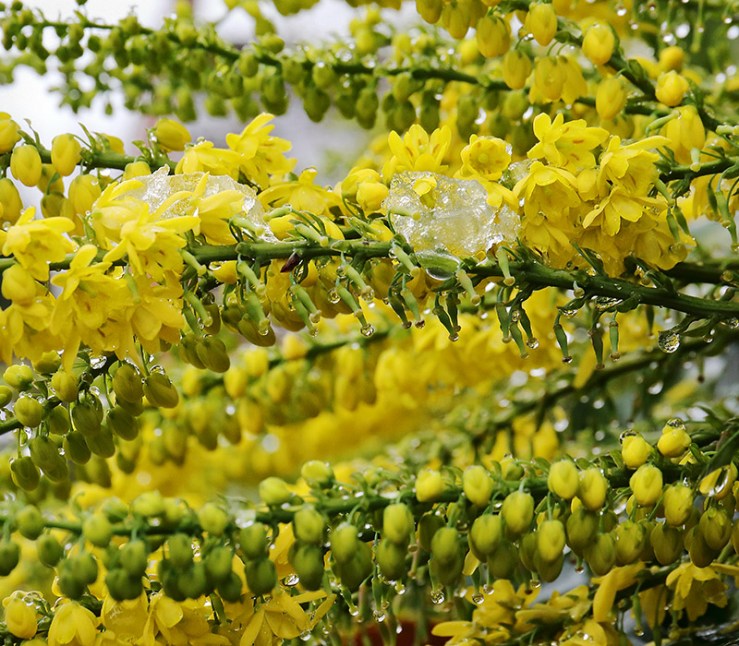
Snow melting from mahonia flowers doesn’t seem to cause them much damage.

 Ann Mackay: Inspired by Nature
I’m surprised to see so much flowering this late in the year where you are. As you noted, the bumblebees must be happy about that.
LikeLiked by 1 person
There are some winter-flowering plants in the UK, including shrubs. Another winter-flowering shrub that we have in the garden is Viburnum bodnantense ‘Dawn’, which is covered in small pink flowers right now. For some reason I haven’t seen bees on that one though. Maybe they prefer the mahonia!
LikeLike
I love Mahonia ‘ Charity’, it is a welcome sight in the gloomiest months of the year. Lovely photo.
LikeLiked by 1 person
It does really cheer up the garden (and me!) at this time of year. I’d like to grow more for bees that are around during winter and very early spring, but need to find things that don’t need a lot of space! 🙂
LikeLike
I think it is becoming more and more important to support garden insects as their habits change and what better way than planting a winter food bar? 😁I haven’t seen any buff-tails out and about for a while but they will certainly be the first bumble to emerge and as I was distraught at the lack of early forage in our first spring here, we have been very busy planting in recent weeks. A mahonia just like your beauty was top of the list along with winter-flowering honeysuckle, viburnum tinus, hellebores, forsythia, flowering currant and witch hazel and so many bulbs and corms, I’ve lost count! We also included a couple of stands of mixed willow in our tree planting, they are perfect for the boggy end of the meadow and will hopefully really boost the early pollen supply. Enjoy that mahonia, it really is a splash of sunshine at the darkest time of year! 💕
LikeLiked by 1 person
Your winter food-bar for insects sounds utterly wonderful, Lis! I have a long way to go with our garden, but I’m still moving things around and establishing new areas. It will take a while but I’m hoping to create a haven for insects, wildlife and humans too! 🙂 Your willow trees will be a wonderful source of early pollen…if I had a big garden I’d be tempted to plant one. I love the way so many gardeners are now planting to help wildlife – it gives hope for the future.
LikeLiked by 1 person
I wondered if any native Mahonia species exist in Texas. What a surprise! I not only know Mahonia trifoliolata, I’ve photographed it, and helped make jelly from its berries. Apparently its scientific name didn’t embed itself in my mind deeply enough that I remembered it without looking it up; its common name is agarita, and it’s equally beloved by bees and such. There are a couple of photos of the flowers in this post.
I wondered if any of our native Mahonia species were the source of your cultivar, but I read that yours is a cross between Mahonia japonica and M. lomariifolia. It certainly is pretty, and it’s great that it blooms for such a long time!
LikeLiked by 1 person
Wow, that mahonia looks spectacularly prickly! It really doesn’t want you to get the berries, LOL! It’s very elegant-looking too.
LikeLiked by 1 person
Spectacularly prickly is exactly right. One approved way of getting the fruit is to spread a sheet on the ground beneath the plants, then beat them with a broomstick until most of the fruit falls onto the ground!
LikeLiked by 1 person
A sensible approach…poor old plant though!
LikeLiked by 1 person