NB: A note for WordPress Reader users – you need to click on the title of the post again to come out of the reader and go to the post itself. This allows you to see the whole of the top photograph. (Otherwise you may see just a tiny section!)
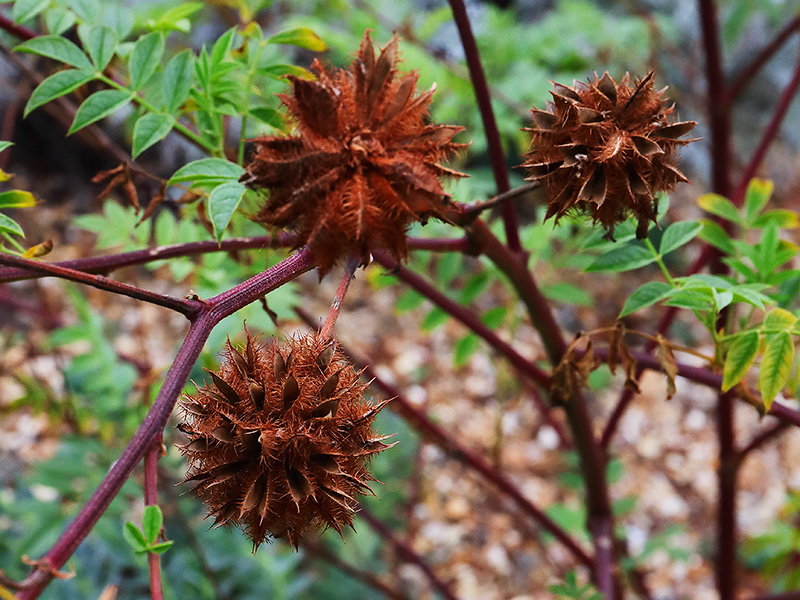
After the flowers have gone, then come a variety of interesting seed heads. Some are familiar and I come across them every year. Others are less common, like the liquorice plant (Glycyrrhiza) above, photographed on a recent visit to Fullers Mill.
Liquorice is a plant I’d never seen before and the spiky seed heads were what drew my attention. They would be lovely coated with tiny frost crystals, like little Christmas decorations. I didn’t touch one, but they look as if the tips of their individual pods could be sharp…not the most friendly thing to brush up against!
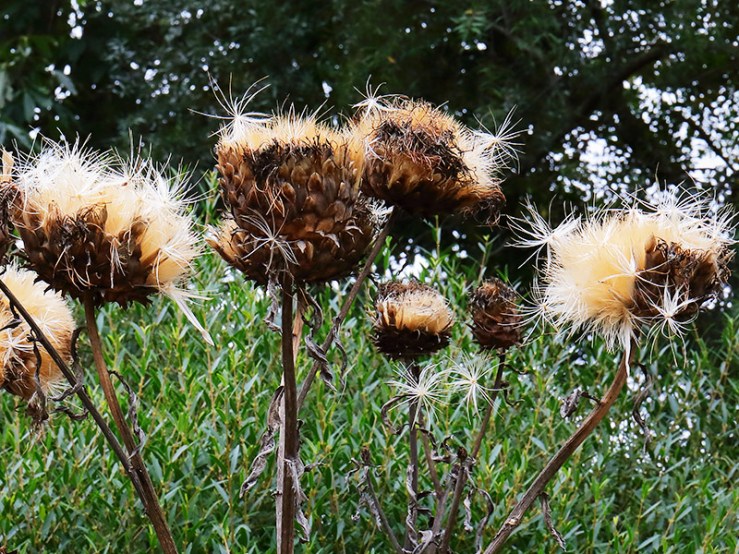
The seed heads of the cardoons (Cynara cardunculus), shown above, would be much nicer to get close to. These, however, were too tall for me to get near enough to reach the fluffy seeds. I would have liked to have been able to touch the hairs on the seeds, just to see if they’re as soft as they look. The first seeds were already making their escape last month, so I think that recent wind and rain will by now have carried many of them away.
Hairy seed heads are produced by other plants too, like the silvery plumes of Clematis tangutica (below, left). This plant was photographed at the end of summer and the single ‘tails’ attached to each individual seed were still smooth and shiny. Later, those tails become more feathery as they develop and the individual hairs on them grow and open out. That helps the attached seed to blow away in the wind. (It’s in a garden I visited, so I haven’t seen it recently, but I should think that those seed heads are very fluffy indeed by now, or perhaps have dispersed or become bedraggled in the autumn rain.)
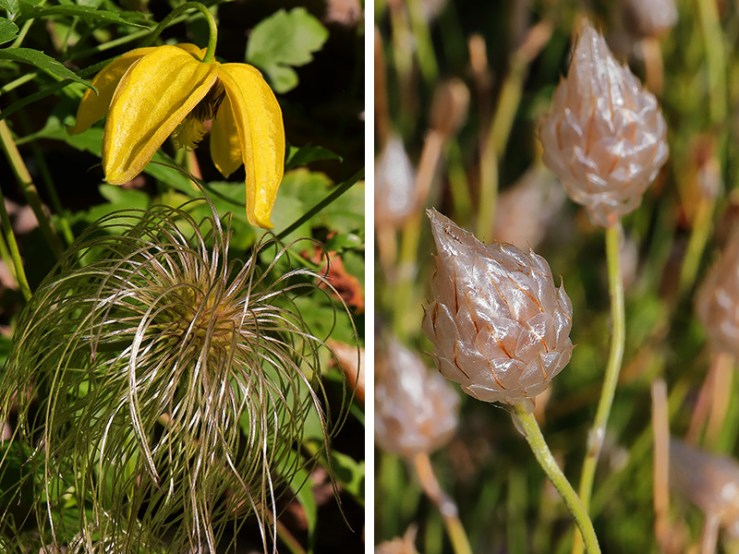
Right: Catananche seed heads have a subtle shine.
Another seed head with a slight shine is the Catananche caerulea (Cupid’s dart), shown above, on the right. The seeds are light and papery, clustered in airy heads that have a silvery look on a sunny day. This one is in my own garden and I love it for its long-lasting good looks, both in flower and seed.
Wild carrot (Daucus carota ‘Dara’) also grows in my garden. It’s allowed to seed itself around so that I have plenty of the nest-like seed heads to photograph. I’m having to be a bit stricter with it these days, because it can get everywhere. Now I just sprinkle the seeds in areas where there’s a bit of room for its waywardness. The lacy flower heads of wild carrot are pretty, but to my mind, this plant is at its best when in bud and later, when the seed heads appear. Both stages display the intricate architecture and grace of the plant at its most beautiful. When possible, I try to keep the seed heads, so that they (and the seed heads of other plants) will be here when the frost comes…not long to wait now!


 Ann Mackay: Inspired by Nature
You did a good job revealing the “architecture” of the wild carrot.
The genus of the cardoon, Cynara, immediately brought to mind a poem by Ernest Dowson.
LikeLiked by 1 person
The wild carrot is a great plant for photographers…lots of lovely possibilities! 🙂 I liked the poem, and the line, ‘Cynara! gone with the wind’, which seems quite appropriate to these little seeds starting out on their wind-blown journey.
LikeLike
Excellent pictures of these seed heads…sharp, literally!
LikeLiked by 1 person
Next time I see the seed heads on the liquorice plant I’m going to have to touch them, just to see if they really are! 🙂
LikeLiked by 1 person
The seed heads of the licorice plant reminded me of the spiky balls from the sweet gum tree. The cardoon seed heads look so much like those of our native basket-flower I had to look for more information about the plant. Sure enough, it’s in the thistle family, so I suspect that feathery business on top is just as soft as that of any thistle! I’ve never seen such color in wild carrot; is that because it’s a cultivar?
LikeLiked by 1 person
I was thinking about the sweet gum’s seed pods when I posted this – and wondering how they compare in spikiness, hehe! The wild carrot in my garden is a cultivar named ‘Dara’ and has mostly red flowers and I suppose that could account for the colour in the seed head too. (The leaves do turn red in autumn, so perhaps it’s just some autumn colouring in the seed heads if it gets cold enough.) There are some white ones in the mix of flowers too, and they’ve become more frequent over the last few years. I may have to buy more seed so that I have more of the coloured flowers again.
LikeLike
I love the seed heads of the wild carrot, but the foliage is a bit big for my garden. The Liquorice seeds remind me of star anise, but they are not related. I remember the woody liquorice sticks from when I was a child, I hated them, but I do love liquorice sweets and even herbal tea.
LikeLiked by 1 person
The wild carrot can get big, so it’s outgrown the area that I planted it in, especially since there are usually lots of seedlings from it. I’m going to try to get it established elsewhere. I hated all liquorice as a child! I probably still would, but haven’t tried it since then. I don’t think I’ll be planting it either, but that would be the preferred form for me.
LikeLike
I live in a region that’s leafless most of the year, so keeping an eye out for interesting seeds pods has become a habit. This is a great selection you’ve posted. On my walks along a nearby river, it’s mostly sycamore, beech and buttonbush, but the gardens and shrubs in my neighborhood have all sorts of varied designs.
LikeLiked by 1 person
With most flowers having disappeared for the winter, I’m grateful for anything I can find to post on the blog. I keep an eye open through summer and autumn for any interesting-looking seed heads to photograph, so that I can use them later in the year. In my own garden I leave the seed heads in the hope that I can photograph them when the frost comes – makes the garden look much more interesting too.
LikeLiked by 1 person
That last photo is a true revelation, Ann – the intricacy and detail is simply beautiful.
LikeLiked by 1 person
Thank you! These are amazingly intricate flowers and seed heads…wild carrot is a generous subject for photography! 🙂
LikeLiked by 1 person