
NB: A note for WordPress Reader users – you need to click on the title of the post again to come out of the reader and go to the post itself. This allows you to see the whole of the top photograph. (Otherwise you may see just a tiny section!)
Plants in the Asteraceae family bring charm and loveliness to late summer and autumn. Amongst those plants, asters (also known as Michaelmas daisies) are especially valued for their late flowering, as are other daisy-like flowers in this family. I like the thought that ‘aster’ means ‘star’ in both Latin and ancient Greek; for me the composite flowers of the Asteraceae are, indeed, stars of the garden.
The aster in the top photo appeals to me due to its dramatically dark purple, and I’ve looked around to see if I can buy something like it for my own garden. I haven’t found one yet, but last year I planted my favourite aster, the lavender-blue flowered ‘Monch’. (The photo below is not my own plant though, but one photographed at Fullers Mill, as the are the others here.)

There are a number of asters in my own garden now, mostly in purply-blue shades, but some pinks and white too. They keep the colour going when other flowers have finished and give a feeling of continuing life to the garden. Anything that helps to hold off the gathering greys of approaching winter is very welcome here!
I’d like to plant more late-flowering members of the Asteraceae, perhaps the dainty flower pictured below. I believe it’s probably Bidens heterophylla aurea. (Coreopsis verticillata ‘Moonbeam’ looks very similar, but appears to have slightly narrower petals. It is also a shorter and more compact plant.) This bidens (AKA Arizona beggarticks) has long, graceful stems that give the plant an airy feel, like gaura or Verbena bonariensis. This should make it easy to combine with other plants. I think it could be lovely with a delicate, wispy grass such as Stipa tenuissima (Mexican feather grass).

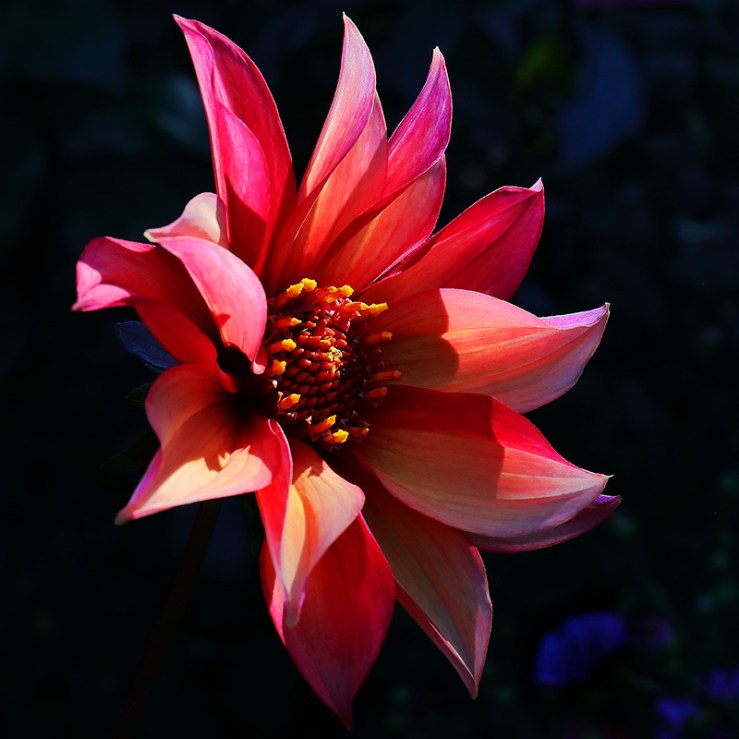
Some of the autumn-flowering Asteraceae are a bit less obviously daisy-like in appearance, like the dahlia below. However, you can easily see the family likeness in that centre made up of tiny individual ‘disc florets’, surrounded by the showier ‘ray florets’ (which we think of as petals). Rudbeckias, sunflowers, chrysanthemums, cosmos and zinnias are some of the varied members of this large family that can keep flowering when other plants have finished for the year. (You can see some of my previous photos of late-flowering Asteraceae in these posts: heleniums, cosmos, and zinnias. The Asteraceae bring beauty to our gardens in late summer and autumn and they’re all sparkling stars to me.

 Ann Mackay: Inspired by Nature
Your asteronomical post brings welcome attention to these late-in-the-year stars. The slender lavender rays and yellow disc florets in your second photograph are attractive indeed.
LikeLiked by 1 person
Thank you Steve! It is a lovely plant and and I’m delighted to see it starting to get established in my own garden too. 🙂
LikeLike
I do love our fall asters, and the lavender ones are a special favorite. I’m rather fond of Michaelmas as well as its flowers; like Christmas, the name’s a shortening. Just as ‘Christ’s mass’ became Christmas, ‘Michael’s mass’ became Michaelmas. It has quite a history. Because these asters are among the few flowers still blooming at this time of year, they gave rise to a little rhyme: “The Michaelmas daisies, among the dead weeds, bloom for St Michael’s valorous deeds.” In western traditions, the saint’s day is September 29; the eastern Orthodox celebrate it on November 8: practically bookending the season of these flowers.
LikeLiked by 1 person
I like the little rhyme! Asters really cheer up this time of year, although they’re fading away too now. Makes it feel like winter isn’t far off when they go.
LikeLiked by 1 person
I love your photo of Monch, so light and airy almost like they’re dancing. A couple of months have whizzed by and I haven’t been on WP but the weather’s been yuk much of that time (it’s just coming right now).
LikeLiked by 1 person
Our weather is just starting to get wet and grey. Luckily it’s still mild, so good for gardening. It’s good to see you back on WP! 🙂
LikeLiked by 1 person
So beautiful! Those colours are the perfect antidote to the gathering gloom, they are most definitely sparkling stars. 💕
LikeLiked by 1 person
Thanks Lis! I’ve been trying to increase the numbers of asters in my own garden and it does make a big difference for autumn. The bees love them too! 🙂
LikeLiked by 1 person