NB: A note for WordPress Reader users – you need to click on the title of the post again to come out of the reader and go to the post itself. This allows you to see the whole of the top photograph. (Otherwise you may see just a tiny section!)
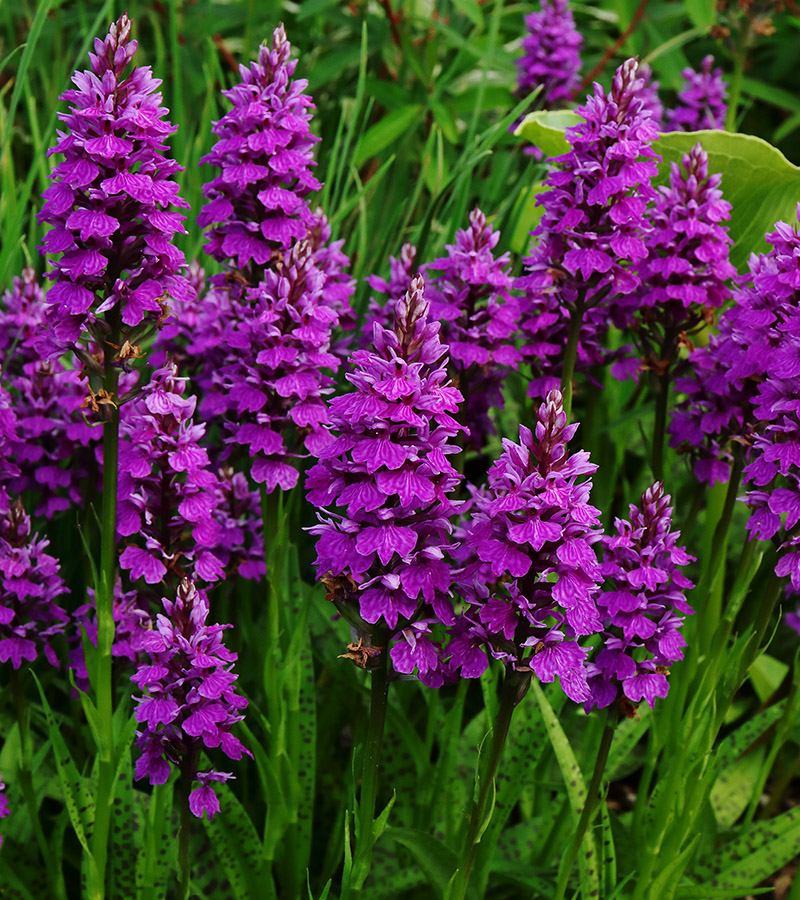
Visiting other people’s gardens is often an opportunity to see unfamiliar plants. Earlier in the summer I came across these orchids growing in the shade of some trees. They reminded me of the northern marsh orchid (Dactylorhiza purpurella), which I have seen growing in Scotland. As far as I remember, that one had a shorter flower spike with a flatter top than those you see here.
I’m fairly sure this is a Dactylorhiza of some kind, possibly a hybrid, since it was growing in a garden rather than in the wild. A Google image search showed that there are many marsh orchids and spotted orchids, both wild and hybridized, that have a similar appearance. I hoped to be able to identify this particular orchid, but, frustratingly, I didn’t see one with quite the same markings on the petals.
You may notice that there are also dark spotty markings on the leaves. Several species have these, including the heath spotted orchid and the common spotted orchid, the ‘spotted’ being a reference to the leaves. However, it seems that some species and hybrids can vary in whether they have these markings. So my attempt to identify these orchids is unsuccessful…too many possibilities and variations! But I have learned that there is a wide range of these beautiful orchids that are fairly easy to grow in the garden if you have reasonably moist soil.


 Ann Mackay: Inspired by Nature
This post prompted me to look up marsh orchids in Michigan (where I live), and there are quite a few orchids that are native to Michigan (lots of lakes/bogs). Thanks. I will keep my eye out when I am hiking.
LikeLiked by 2 people
I didn’t realise how many of these orchids there were until I Googled them. Sadly, where I live, the intensive use of land for agriculture has meant that many wild plants are becoming hard to find.
LikeLike
Rich purple and beautiful inflorescence of this orchid, Ann!
LikeLiked by 1 person
Thanks Indira – nature has many wonders! 🙂
LikeLiked by 1 person
The color of these certainly would appeal to you. It’s a genus I’d never heard of, and for good reason. When I consulted some range maps, I discovered only one species —Dactylorhiza praetermissa — and that was shown in Canada. Obviously, the “northern” part of these marsh orchids’ name is apt. I sympathize with your efforts to identify it. By the time the plant breeders get done with some of our native wildflowers, the result is more than puzzling, and any similarity to the species plant is almost invisible.
LikeLiked by 1 person
Yes, I love that colour! I don’t know that there would be many growing wild anywhere near here because it is so dry and hot. (We’re just starting another week of very hot weather – too hot to garden!) But it’s nice to have come across the northern marsh orchid in Scotland at least.
LikeLiked by 1 person
We already have small devices that aim a beam at an object to determine the temperature there. A fantasy of mine is that one day we’ll have a small device that we can point at a plant or touch a plant with to determine the species of the plant.
LikeLiked by 1 person
I think there would be many who would like one of those, including me! 🙂
LikeLike
Aren’t they stunning!
LikeLiked by 1 person
They certainly are! The colour was very rich and the markings so pretty. I’m not surprised that there are now hybrids offered for sale, because there must be lots of gardeners keen to grow them. I think my garden would be a bit too hot and dry though.
LikeLiked by 1 person
What a colour and those markings, too! They are truly beautiful, Ann! 💕
LikeLiked by 1 person
I couldn’t resist the colour, which made me come close enough to then be able to see the markings. I’ll be looking out for it again on my visits to the garden next year. (It was flowering in June, so I have a while to wait before I see it again… 🙂 )
LikeLiked by 1 person