
NB: A note for WordPress Reader users – you need to click on the title of the post again to come out of the reader and go to the post itself. This allows you to see the whole of the top photograph. (Otherwise you may see just a tiny section!)
There are more lilies here this week. This time it’s the turn of the ‘Turk’s cap’ lilies, with their distinctively-shaped upswept petals. (Like the others, these were photographed while visiting Fullers Mill Garden in Suffolk. This garden has a gorgeous collection of lilies.)
As I mentioned in my last post, I don’t grow lilies because of their toxicity to cats, but if I could, then the lily above would be one that I’d love to have here. This beauty is the Lankong lily (Lilium lankongense), with graceful pink flowers that are spotted with a deep burgundy-red. I prefer these to the showier, more gaudily-coloured varieties like the one below, but both are a pleasure to photograph.
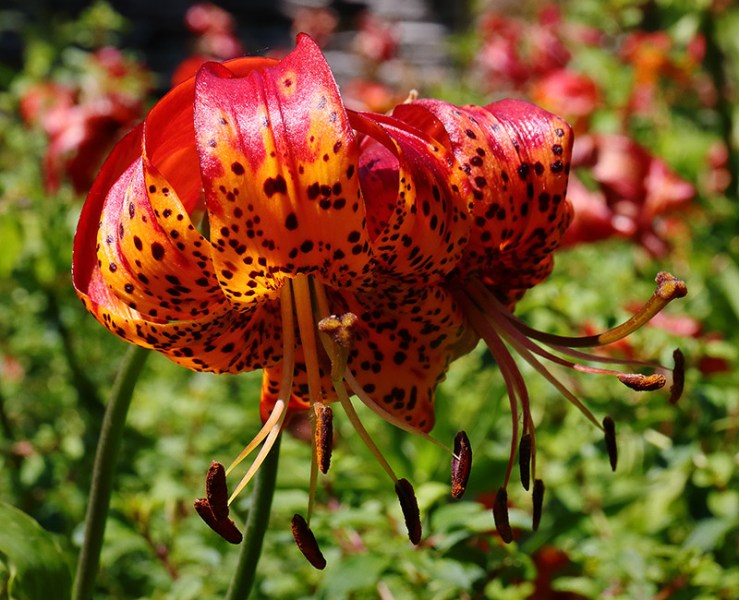
One of the first flowers I remember noticing as a small child was another brightly coloured Turk’s cap lily. That one was orange with dark spots – the tiger lily (Lilium lancifolium). We lived surrounded by moorland and low hills in Scotland’s northernmost county (Caithness), so to me this plant seemed improbably glamourous, and alien for such a place. (They are actually very cold-hardy and would have liked the moist, somewhat acid soil.) That lily grew in the shelter of a stone wall, protected from the blast of the wind and was tall enough for me to see the flowers at very close range. The sight of those exotic-looking orange flowers in that harsh and inhospitable landscape has stayed with me ever since.
Whether growing in a cold northerly garden or a warm southern one, I reckon these Turk’s cap lilies are amongst the most decorative flowers. Their curved petals (or ‘tepals’) and attractive spots seem designed to please, and gardeners can choose between flowers that are dainty and delicate or bright and bold. While they may not be suitable for my own garden and its feline company, I feel that they are well-worth the effort to see in other gardens. A real summer delight!


 Ann Mackay: Inspired by Nature
My first exposure to the phrase ‘tiger lily’ had nothing to do with flowers. Instead, I came to associate it with Woody Allen’s directorial debut with his film “What’s Up, Tiger Lily?” It’s still the first thing that comes to mind — although these flowers appeal far more than the film these days.
The first image of the pinkish-lavender lilies is charming, and my favorite. It’s interesting to see how the ones in the last photo are arranged around the stem; I’m not sure I’ve seen that before. I tend to think of lilies being limited to the tops of stems.
LikeLiked by 1 person
I think we may have similar tastes in flowers, Linda! That one is my favourite of all the ones I’ve seen. The Turk’s cap lilies all have their flowers arranged like that and it looks utterly delightful when you see some of the smaller and more delicate ones.
LikeLiked by 1 person
Lilium lankongense is stunning. I had Lilium pardalinum once but I couldn’t keep it. I saw some fabulous martagon lilies when I was last at Fuller’s Mill. They were quite unscathed by beetle. I would like to know how they do that.
LikeLiked by 1 person
I wonder if they are isolated enough from other gardens to have escaped the beetle so far. (Or to have had few enough that they were able to eradicate them?) Their lilies did look gorgeous on my most recent visit and were attracting lots of bees and hoverflies. (Lots and lots of hoverflies!) Incidentally, I’ve just ordered a copy of Bernard Tickner’s book, ‘A Scratch in the Soil’, so I’m looking forward to reading about the creation of the garden.
LikeLike
Bernard had a wonderful collection of fritillaries as well as lilies. He used to spray them with provado, which I never used because of the worry about its effect on bees. I don’t know how they deal with beetle now. At lily time he used to invite parties of people to look at them. It was always a great event. Jenny Robinson of Boxford was another lily enthusiast, one would get summoned to what she called her ‘lily sniffing parties.’
LikeLiked by 1 person
I don’t use chemicals here either and I imagine that there may be less likelihood of chemicals being used at Fullers Mill nowadays – at least, I hope so! I think we’re all becoming much more enlightened and more respectful towards nature. (But, sadly, that’s not true of everyone…) The thought of ‘lily sniffing parties’ makes me smile and imagine the guests emerging with noses covered in pollen, hehe!
LikeLike
Thanks for introducing me to these lilies Ann, I can see I’ll be online looking to buy some bulbs next year. As usual your pictures are gorgeous, and I love the image of the juxtaposition of that exotic flower growing in that muted wild moorland.
LikeLiked by 1 person
I hope the lilies grow well for you! I was fascinated by that lily as a child, and I guess that was the start of a lifelong interest. 🙂
LikeLike
I wondered about the spots. Here’s what AI said in reply to my query: “The pink Lilium lankongense lily has spots due to a combination of factors related to its genetics and the pigments within its petals. Specifically, a novel allele of the LhMYB12 gene, called LhMYB12-Lat, is responsible for the development of these ‘splatter’ spots on the tepals (petal-like structures). This gene is preferentially transcribed in the spotted areas, indicating that it plays a key role in the expression of the spotting phenotype.”
What AI didn’t tell me is whether the spots provide any benefit to the lily.
LikeLiked by 1 person
It would be interesting to know if the spots serve a purpose. Perhaps they help to guide pollinators, and there may be other markings that are not visible to us but that can be seen by bees (because they can see ultraviolet light).
LikeLike
I like those ‘painted’ petals!
LikeLiked by 1 person
So do I, Indira! 🙂
LikeLiked by 1 person
Lovely lilies. My attempt at growing martagon lilies was short lived. The S&S munched them before they had a chance to grow except for the one time when I covered the new shoots with a plastic bottle. The one and only time I saw the beautiful flowers.
LikeLiked by 1 person
The S&S must be responsible for a huge amount of disappointment amongst gardeners. The so often seem to target the flowers, rather than leaves too. They always chewed big holes in the lovely blue flowers of a clematis I used to grow in a big tub and they love my few irises too – very frustrating!
LikeLike
I have learned the hard way to grow plants they ignore. It’s hard to resist at times though. It’s a shame that they never seem to eat weeds!
LikeLiked by 1 person
S&S with a taste for ground elder etc. would be wonderful!
LikeLike
These are beautiful! I love the recurved lilies, I have several martagon types in my garden and their shapes fit so well with other perennials.
LikeLiked by 1 person
They are a beautiful shape and I love the variety that shape gives amongst other perennials. They can be very elegant, delicate or bold and showy – something for all tastes! 🙂
LikeLiked by 1 person