
NB: A note for WordPress Reader users – you need to click on the title of the post again to come out of the reader and go to the post itself. This allows you to see the whole of the top photograph. (Otherwise you may see just a tiny section!)
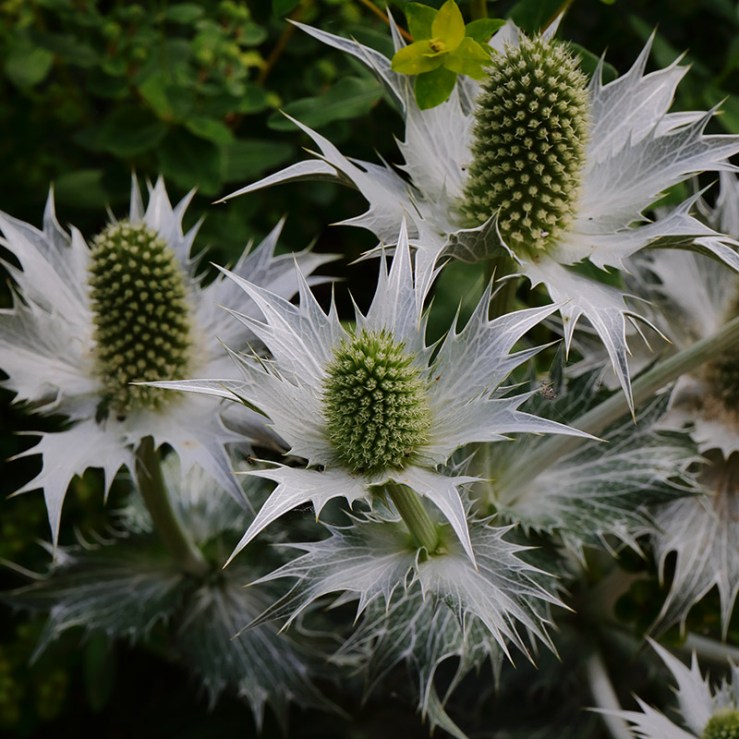
Amongst all the frill and froth of a summer garden, it’s interesting to see the more sculptural presence of a plant like eryngium. Its spiky leaves contrast with the delicate petals around it, while their silvery sheen is an attractive compliment to any flower colour.
I have the much smaller Eryngium planum (blue eryngo) in my own garden, but it doesn’t have the same impact as this Eryngium giganteum. It’s a plant that I would like to make room for here, and I’m having fun imagining what I might pair it with. Small flowers held on long, airy stems could look interesting. I’d like to see what it would look like with the ‘butterflies’ of gaura floating around it and with another, dark-coloured plant to contrast with both. Or perhaps with the small spires of a blue-flowered veronica for a variation in both shape and colour…the possibilities are many.
This particular plant looks like it may be either ‘Miss Wilmott’s Ghost’ or its improved version, ‘Silver Ghost’. For those who haven’t heard the story, Ellen Wilmott loved this eryngium so much that she used to sprinkle the seeds secretly in the gardens she visited – resulting in silvery surprise plants later on. Whether the story is true or not, it remains a popular myth (and possibly the earliest version of ‘guerrilla gardening’).
This handsome plant would be a very welcome surprise in my own garden, but, in the absence of ghostly seed-sprinklers, I think I’ll need to go and buy my own. It’s a short-lived perennial or biennial which self-seeds in areas that suit it, so if I do plant it, I will probably find plenty of seedlings to keep it going. Perhaps Miss Wilmott would have approved.

 Ann Mackay: Inspired by Nature
This is a lovely one. The genus is one of my favorites; as a matter of fact, I spent time in a friend’s pasture this afternoon marking the location of some Eryngium hookeri, or Hooker’s eryngo, so she could avoid it with the tractor. It’s one of three blue-to-purple species that are native here: Steve often sees E. leavenworthii (larger and more purple) and I’ve found E. prostratum, a light blue version with much smaller flower heads in east Texas.
Another interesting member of the genus is our rattlesnake-master (E. yuccifolium), which has white flowers. I’ve only seen photos of E. heterophyllum, which has rigid white bracts that look somewhat like these. It’s known as Mexican thistle, and is found primarily in the Big Bend region.
I like them all. This one apparently doesn’t grow here. I thought it interesting that one common name is sea holly. The Missouri Botanical Garden page for it mentions Miss Willmott’s seed-dropping proclivities, and the fact that her name is associated with the plant.
LikeLiked by 1 person
Very interesting, Linda. I’ve been looking up pictures of these…the E. leavenworthii is extraordinarily purple and the white of E. yuccifolium is very striking too. When I first saw eryngiums, it was in the larger gardens that I visited (back in Scotland) and they fascinated me. They seemed a bit unreal and very exotic at a time when I was still in the early stages of discovering the plant world.
LikeLiked by 1 person
In fact four days ago I found a good colony of E. Leavenworthii that’s just beginning to put on its first traces of color. I’ll try to go back in a couple of weeks to see if the plants have turned purple.
LikeLiked by 1 person
That will be interesting to see… 🙂
LikeLike
Yes, it will. I’m hoping to get some super purple pictures.
LikeLiked by 1 person
Very cool. And I really like the idea of a “more sculptural” component in the garden.
LikeLiked by 1 person
I like that idea too, Robert. It’s something that’s missing from my own garden, so I’ll need to put that right! 🙂
LikeLiked by 1 person
Great minds think alike, so you wrote about eryngiums this week too. I love them for the same reason as you. So architectural. I particularly love the electric blue ones.
LikeLiked by 1 person
Hehe, so it seems! I love these – I think the only reason I don’t already have it in the garden is that I simply haven’t come across one when I’ve been in nurseries or garden centres, which is rather surprising. (Although I do have ‘Blaukappe’.)
LikeLike
Great title, Ann. And a fascinating plant.
LikeLiked by 1 person
Thanks Liz! Coming up with a title frequently has me in a quandary, LOL! 🙂
LikeLiked by 1 person
Sharp shots of these floral heads…literally!😀
LikeLiked by 1 person
Hehe, very sharp I reckon – I certainly wouldn’t want to brush up against one unexpectedly!
LikeLiked by 1 person
I actually got rid of an eryngium I had in the garden as it smelled so bad! Sweaty feet doesn’t begin to come close! And only flies seemed interested in it. I must admit I did like the structural element and the blueness, but I am wary of buying another one. I do like this silver one though.
LikeLiked by 1 person
I hadn’t noticed the smell, but maybe that’s because my sense of smell isn’t great…next time I see one I must have a sniff to check!
LikeLike
The eryngium-ness came through in your pictures immediately. Unfamiliar with E. giganteum, I looked it up and found from Wikipedia that “Eryngium giganteum, with the common name Miss Willmott’s ghost, is a species of flowering plant in the family Apiaceae. The short-lived herbaceous perennial thistle is native to the Caucasus and Iran in Western Asia.” Wikipedia also offers information about Eryngium planum.
That’s an interesting anecdote about ‘Miss Wilmott’s Ghost’. Wikipedia also has plenty to say about her.
LikeLiked by 1 person
I have E. planum ‘Blaukappe’ here. It seeds itself around a bit, which is good, because I think the original plant is gone. The Wikipedia article was very interesting, thanks for the link!
LikeLike
Unlike Linda and Steve, we didn’t see any Eryngias in Texas this spring, it was probably too early for them. They are quite unusual, aren’t they? But the contrast between the different shapes and shades of leaves and flowers works really well, I think.
LikeLiked by 1 person
They are more of a summer thing here in the UK. They’re a very architectural plant and do demand attention! I love the variety of different colours and shapes amongst the different kinds of eryngium – something to suit all sorts of plantings.
LikeLiked by 1 person
They are very eye-catching!
LikeLiked by 1 person