
NB: A note for WordPress Reader users – you need to click on the title of the post again to come out of the reader and go to the post itself. This allows you to see the whole of the top photograph. (Otherwise you may see just a tiny section!)
On my visit to Fullers Mill earlier this week, I was surprised to see that their Siberian irises were still flowering. Not only that, but they had plenty of buds still too. Those in my own garden finished flowering a little while ago. (I’ve even had enough time to deadhead them all.)
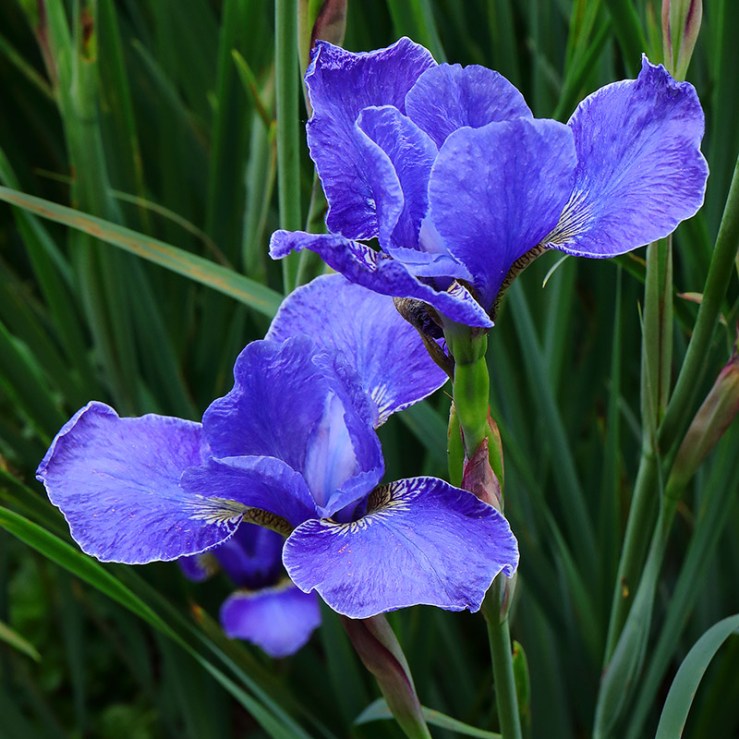
Perhaps the reason for the variation in flowering time is that my garden has been hotter and the soil more dried out. At Fullers Mill there are a lot of trees, which must help to give some shelter from the heat of the sun. There seems to be more moisture in the soil there too. Whatever the reason, it was a pleasure to be able to see these lovely plants still in flower.
The deep purple-blue tones of the iris in the top photo captivated me. The petals have a velvety look, enhancing the opulent effect of the flower. (I’d love to have enough space to grow this one – probably ‘Shirley Pope’ if anyone else has the same thought.) I recognise the second iris (photo above) because I have it in my own garden. It’s ‘Silver Edge’. Unfortunately, my plant is sulking a bit after having been moved, but hopefully it will recover and flower more prolifically in future.

Another guess, aided by a Google photo search, makes me think that the white and yellow iris above may be ‘White Swirl’. Although it’s the blue irises that capture my affections, the calm and elegance of white is often exactly what’s needed to create a quiet space away from the hurly-burly of bright colours.
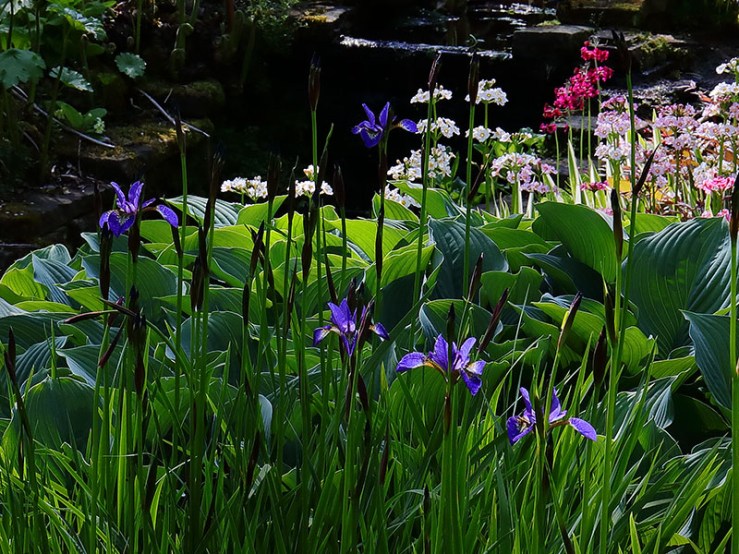
The photo below (from a different garden) shows a planting of blue Siberian irises, with perfect (unchewed by slugs and snails) hostas and pretty candelabra primulas. Oh, how I would love to be able to re-create this in my own garden! (Especially if I could have the stream that’s hiding behind it too) I can always dream!

 Ann Mackay: Inspired by Nature
That last photo of the combined flowers is utterly charming. The Siberian irises are especially nice. I’m coming to realize something odd. As much as I love white flowers, white irises just don’t do it for me. This blue is more attractive to my eye, even though I generally wouldn’t choose blue flowers, and that purple’s a knockout. I think both the texture and color add to that one’s beauty.
LikeLiked by 1 person
I loved that planting, Linda. It was in a garden I wrote about here: https://annmackay.blog/2024/02/11/looking-for-inspiration-the-bog-garden-at-east-bergholt-place/ Very different from my own garden, with quite q lot of shade from trees and very moist soil. I feel the same way about blue vs. white irises. The white ones just don’t have the same impact. (Though I often love other white flowers.)
LikeLiked by 1 person
Oh, “captivated” is the word… me too! Thank you, Ann!
LikeLike
It’s a gorgeous iris with a very deep and rich colouring…I might have to try to find a bit more space for irises here!
LikeLiked by 1 person
Regarding the first picture, do you know whether the curves on the white areas near the base of some petals are designed to guide pollinators inward?
I think this is the first time I’ve heard anyone refer to a plant as “sulking”.
LikeLiked by 1 person
I believe that they are guides – they’re in exactly the right place. There may also be markings that are not visible to us but that can be seen by insects. ‘Sulking’ is often used by gardeners – maybe more in the UK than elsewhere. It certainly feels as if that is what a plant is doing if it doesn’t flower much while it adjusts to where it has been planted. (Sadly, sulking can sometimes be terminal!)
LikeLike
I love the colour of those blue irises.
LikeLiked by 1 person
Me too! There is something special about a good blue in a flower and irises can be amongst the best blues. 🙂
LikeLiked by 1 person
Lovely pictures of Iris! I understand mythological stories and many symbolism are associated with Iris!
LikeLiked by 1 person
Iris was the name of the Greek godess of the rainbow. That seems particularly appropriate when there is such a wide range of colours in all the different types of iris. 🙂
LikeLiked by 1 person
I don’t think it ever occurred to me to deadhead my Siberian irises (and I have had them in my garden for more than 25 years). New thought. thanks. BTW, mine are still blooming–in stages (and not because I planned it that way). This year, I have Siberian irises where I did not last year, and they are blooming later. I don’t know how they migrated, but I will leave them because they are such happy flowers.
LikeLiked by 1 person
I do deadhead mine because they can suffer here if it’s too hot and dry – at least they’re not trying to put their energy into making seeds at the same time. But that does mean that I won’t get any seedlings, which I suspect you must have done if they seem to have moved. If they are young plants, that may be why they are blooming later. I think my plants went over quickly because they were getting too much heat and not enough moisture in the soil.
LikeLike
These are all beautiful, especially the composition in the last photo.
There are still many iris in bloom in our part of Colorado as well, but we have had a cooler-than-average May with above-average rainfall.
I have trouble deadheading our iris as the wilted blossoms seem to be firmly attached to the stem and I’m always worried I will pull out the entire plant. Do you have any suggestions about proper procedure?
LikeLiked by 1 person
Thank you Tanja! (Though credit for the composition in that photo really belongs with the gardener. I feel I learn a lot about laying out a garden from these visits.) I use secateurs when I’m deadheading the irises – it’s much easier than trying to pull them off – and quicker!
LikeLiked by 1 person
Thank you for letting me know about the iris. It’s nice to be able to visit other people’s gardens and “steal” their designs. 🙂
LikeLiked by 1 person
So elegant! They really are very special flowers and those colours . . . delicious! 😊
LikeLiked by 1 person
Thank you! The colours really drew me to the blue irises – I do love them!
LikeLike
Your photos are stunning—the last one really stands out with its beautiful composition! It’s wonderful to hear your irises are still blooming; the cooler, wetter weather must be a treat for them.
LikeLiked by 1 person
Thank you for the kind comment! It was lovely to see these irises still blooming. Now it has become sunny and hot – and the roses everywhere are enjoying it! 🙂
LikeLike
Lovely photos
LikeLiked by 1 person
Thank you Anthony, glad you like them! 🙂
LikeLiked by 1 person