NB: A note for WordPress Reader users – you need to click on the title of the post again to come out of the reader and go to the post itself. This allows you to see the whole of the top photograph. (Otherwise you may see just a tiny section!)
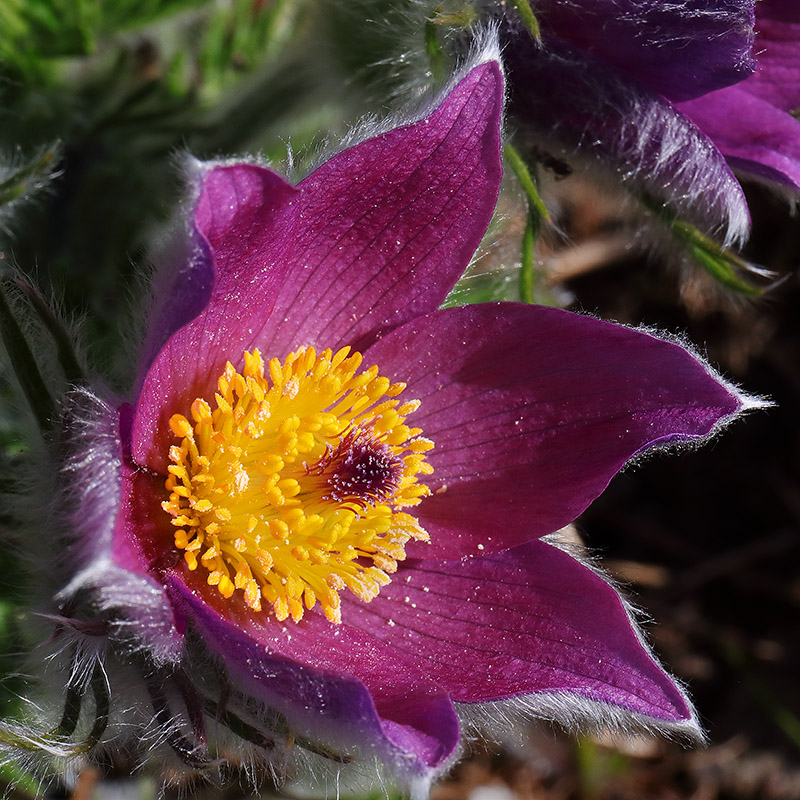
We may think of flowers as firstly a visual delight, but they can appeal to the sense of touch too. That’s very much the case with these pasqueflowers (Pulsatilla vulgaris) that have just started to open their fluffy blooms. The flowers themselves are a jewel-bright purple/pink, making them eye-catching, and their soft fluff makes them enticing to the fingers too.

The backs of the flower’s petals (actually sepals – pasqueflowers don’t have true petals) are covered in fine hairs that can become almost invisible against the flower’s rich colour. Bracts below the flower are more noticeably covered in a slightly longer fluff, which, no doubt, provides protection from cold for the developing buds. The stems and leaves are hairy too, as are the seed heads later. (The hairs on the seeds help them to disperse in the wind.)
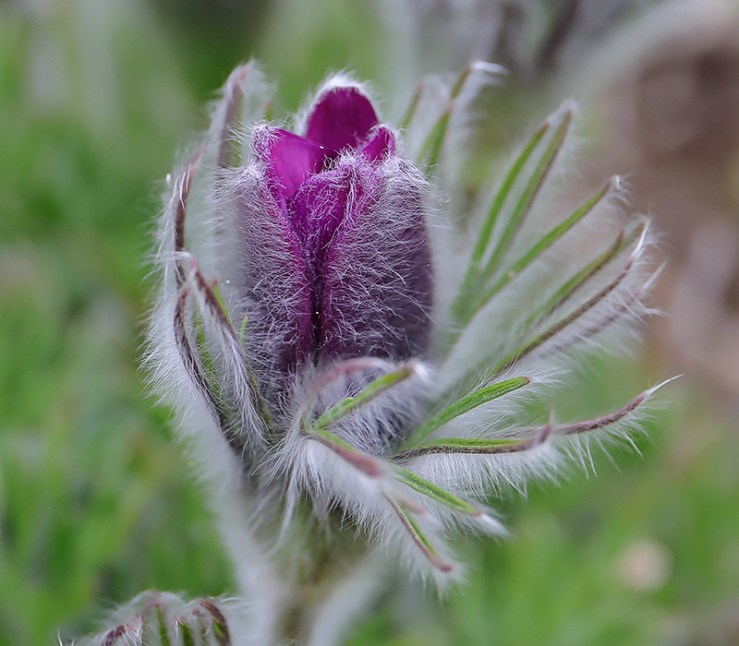
The silky hairs are a delightful invitation to stroke the plant, so I am planning to grow some right at the front of a border, where they will be easy to reach. It’s a simple pleasure, but one that brings a smile and the chance to have a closer look at this lovely plant. In fact, I’m smiling right now because I have discovered that my two original plants are surrounded by some tiny seedlings – happy (and fluffy) days!


 Ann Mackay: Inspired by Nature
Glorious photos! so happy to hear you’re getting seedlings from them! Bravo.
LikeLiked by 1 person
Thanks Liz! Finding the seedlings has made me very happy!
LikeLiked by 1 person
Oh, don’t you just want to reach out and touch them? Exquisitely beautiful flowers. too. 😊
LikeLiked by 1 person
They are silkily soft to the touch – like stroking a pet! And I do love the flowers too… 🙂
LikeLiked by 1 person
Beautiful photos Ann. I have two, a red and a purple but they don’t flower very well, in fact I don’t think either did last year and currently there are only leaves appearing. I think I need to move them out of the Belfast sink they are in. What do you grow yours in? And sunlight or shade?
LikeLiked by 1 person
Mine are growing in a very hot and dry patch in the garden that has fairly poor soil. I believe that they used to be seen growing wild on East Anglian grassland, so I hope that give you an idea of the conditions they like. I’ve never tried them in a container, but I imagine they would need good drainage. (I lost my white pasqueflowers because they were smothered by an evergreen shrub nearby…argh!)
LikeLiked by 1 person
Your pictures do justice to these appealing flowers. I was going to say it’s understandable that fluff on seeds would facilitate dispersion by the wind, and then ask what use the soft hairs are on other parts of the plant. Then I got to your statement: “Their fine furry coats protect pasqueflowers against cold weather, dehydrating winds, and hungry creatures.” That raises another question: if a furry coat aids pasqueflowers in those ways, why haven’t all wildflowers that grow in similar soils and climates developed a covering of soft hairs?
LikeLiked by 1 person
Thank you Steve! Your question is a good one and I don’t know the answer. Pasqueflowers are quite a bit bigger flowers than most of the wildflowers I can think of, so maybe that makes them more vulnerable to damage.
LikeLike
Awesome macro shots of these lovely flowers!
LikeLiked by 1 person
Thank you Indira – glad you liked them! 🙂
LikeLiked by 1 person
Is there a chance you played with the title of a song from the musical “Oliver” for your blog title? Of course I’m thinking of “Food, Glorious Food.”
Your flowers certainly are a feast for the eyes. I’ve read that some of our fuzzier plants, which often are found in drier areas, developed those hairs as a way of protecting themselves from moisture loss. It’s interesting that the same adaptation can serve multiple purposes.
I’ve seen photos of pasque flowers from places like the Nebraska prairies. When I looked up their species, there was no evidence of this genus being anywhere in the area. Mystery solved: the pasque flower in Nebraska and elsewhere is Anemone patens: the same common name applied to a different genus and species, although it seems all of the pasque flowers bloom at about the same time. Their emergence around Easter time no doubt’s the reason for their common name.
LikeLiked by 1 person
Yes, Linda – you spotted it! That song has been stuck in my head for a few days now…I hope it leaves soon, LOL! Anemone pulsatilla is an alternative name for Pulsatilla vulgaris, so they must be very closely related. (I’ve seen some gorgeous Pulsatilla cultivars, mostly on the web, but also in Edinburgh’s botanic garden. There’s a beautiful soft blue one – wonderful!)
LikeLiked by 1 person
Fantastic images, Ann. Makes me want to just gently touch each one with the tip of my finger.
LikeLiked by 1 person
Thank you! They are lovely to stroke… 😊
LikeLiked by 1 person
Happy fluffy Easter with beautiful pasqueflowers.
LikeLiked by 1 person
Hehe, thank you Jill! I hope that you and yours have a very happy Easter too! 🙂
LikeLike
Wishing you much more fluffy fuzziness–or fuzzy fluffiness.
LikeLiked by 1 person
Hehe! They’re now starting to develop their fluffy seed heads. (I had a cat that thought they were growing as toys, especially for her.)
LikeLiked by 1 person
I can see why your cat would think that! 😸
LikeLiked by 1 person
They had a lovely sway and bounce when she swatted at them!
LikeLiked by 1 person