
NB: A note for WordPress Reader users – you need to click on the title of the post again to come out of the reader and go to the post itself. This allows you to see the whole of the top photograph. (Otherwise you may see just a tiny section!)
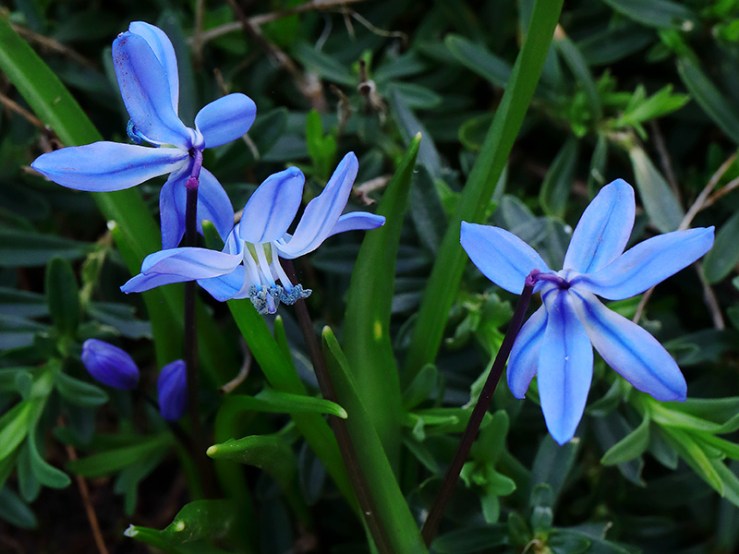
A few days ago I bought the little blue flowers that you see in the photo above as bulbs growing in a pot. They were from a local nursery that sells plants at very reasonable prices. Sometimes, however, they are not labelled with the particular cultivar.
These bulbs were labelled – as ‘Chionodoxa forbesii’. As it turns out, that’s not what they are. I had a quick look at the RHS site to check on the name change from Chionodoxa to Scilla. That showed me that my pot of flowers didn’t look like the RHS’s photo of Chionodoxa/Scilla forbesii. I don’t mind – they’re a Scilla of some sort and they’re pretty.
More importantly, they’ll be useful to any early bees that are around. Scillas are in flower now, at the same time as the crocuses, and provide lots of pollen and nectar.
I’d bought them as part of my planting project to provide more flowers to feed the first bees and butterflies to come out of hibernation. Bulbs will be one of the easiest things to use for this because they don’t take up much space. Conveniently, their very early flowering means they should suit an area area around our fruit trees, which will come into leaf after the bulbs have gone over.
What I minded most about the naming mistake was having to go back and change the name of my photo file…there’s enough confusion with plant names without me creating more! While it was probably just a mistake due to the wrong label being replaced in a pot, it can cause frustration when this happens. If you’re looking for a particular plant, you want to be sure of getting the right one. And if someone sees a plant they want in one of my photos, that plant needs to be correctly identified to allow them to find one. Ho-hum, what fun! Well, at least the bees won’t mind!
The Scilla below is a different variety to the one above, with only one flower on each stem instead of several. I don’t know the cultivar, but there’s only a few left of these. That’s because they’re growing beside a brick path and the bricks have been re-laid a couple of times. That has taught me a lesson…I won’t plant bulbs in a position that’s as likely to be disturbed in future. And maybe I’ll eventually have a carpet of blue flowers. (I can dream!)

 Ann Mackay: Inspired by Nature
Those are strikingly blue flowers, they’re gorgeous Ann!
LikeLiked by 1 person
Thank you Liz! They are tiny flowers but worth a close look! 🙂
LikeLiked by 1 person
I often get a kick out of using my plant ID app to try and pin a name on a flower a world away. This time, the app tells me that your new blue flower is Scilla siberica, or Siberian squill. When I looked at photos of that plant online, it sure does look like what you have. In any event, both the new and the old squills are lovely. I like this blue; it’s got a bit of a zing to it!
LikeLiked by 1 person
That’s very likely, Linda, because Siberian squill is one of the varieties that’s easy to buy as bulbs. I like the slight purple tinge to the blue here and there – like you see on Camassias too.
LikeLiked by 1 person
I left a comment that didn’t appear. So, I tried again, and was told that I was entering a duplicate comment. So…. You might look in spam or moderation to see if it’s there.
LikeLiked by 1 person
I have comments always on moderation so that spam can’t get through. It also means that I notice all the comments and can have a wee chat! (One of the best bits of blogging!) 🙂 But it does mean that there will be a delay before you see your comment, especially if it’s night-time here.
LikeLiked by 1 person
It confused me when Chionodoxia forbesii became scillas especially as it took me years to learn the difference. But chionodoxias face upwards and have whitish centres. These look like Scilla siberica to me. But whatever they are, they are so pretty, who can resist blue flowers? Where did you buy them?
LikeLiked by 1 person
I think you’re probably right about them being Scilla siberica, as it’s probably the commonest in garden centres etc. It was the dark stamens that made it clear that these aren’t C forbesii. I bought them at Chedburgh Plant Centre…I enjoy shopping there! (They’re on the Bury Rd./A143, between Chedburgh and Horringer. You turn off the A143 at Kiln Lane and it’s there.) Their selection of perennials has grown a lot over the last couple of years and they’re very reasonably-priced, as are their bedding plants. (They also have a lot of shrubs and trees, probably bought in rather than raised by them.)
LikeLike
I shall certainly go and check it out. I used to like Pauger’s for reasonably priced plants but they have gone now. They were somewhere round there. I was nearby at Ickworth just last week as I’m writing about stumperies for my column in the Box River News next month.
LikeLiked by 1 person
I miss Pauger’s, they had a good selection of plants – lots that I’d like to have bought and yes, their prices were good. (It’s easy to spend a fortune in garden centres!) The Box River News sounds interesting… 🙂
LikeLike
So instead of being between Scylla and Charybdis you found yourself between Scilla and Chionodoxa.
LikeLiked by 1 person
Hehe, Steve, luckily for me! I’d rather be between Scilla and Chionodoxa any day! 🙂
LikeLike
Those blues are exquisite! My humble little camera will never capture them properly, I’ve tried so many times with things like bluebells and alkanet but the colour is always washed out. Had another go at pulmonaria last week but the photo didn’t make it to my blog. Sigh. I’ve never grown scilla so I’ve added them to my list for spring colour next year, they are so beautiful (whatever they’re called!). 😊
LikeLiked by 1 person
Thank you Lis! Sensors on cameras and phones can saturate some colours more than others. I occasionally find that the greens can seem a bit too strong with mine and turn them down just a little bit. Shame about the blues – if you have an image-processing program you might be able to improve their saturation.
LikeLiked by 1 person
I too think this is Siberian squill, such a gorgeous colour and beautifully photographed. I have the older Scilla which were known as Chionodoxa forbesii or Glory in the Snow! They are almost impossible to photograph! I once had the white form but they have long disappeared.
LikeLiked by 1 person
The white ones would be lovely. There was a lone pinkish one at the back of the garden – a long forgotten remnant of a previous gardener’s bulb-planting or perhaps a stray that got into a packet of blue. (I’d planted Chionodoxa or Scilla years ago and there are still one or two about, but they were all blue.) They’re getting harder for me to photograph as I get older and less bendy – might have to grow more of the small bulbs in pots!
LikeLiked by 1 person
I love both shades of your blue flowers, Ann, and I hope your pollinators will, too.
LikeLiked by 1 person
Apparently bees are especially attracted to flowers in the blue-purple range, so these should be good for them. I have blue/mauve Anemone blanda coming into flower now too, so that gives them more choice. 🙂
LikeLiked by 1 person
I have noticed that many early bloomers are blue and/or purple. One of nature’s many wonderful strategies to help support those early insects?
LikeLiked by 1 person
I like that thought! Nature is entirely amazing, so it wouldn’t surprise me. 🙂
LikeLiked by 1 person