NB: A note for WordPress Reader users – you need to click on the title of the post again to come out of the reader and go to the post itself. This allows you to see the whole of the top photograph. (Otherwise you may see just a tiny section!)
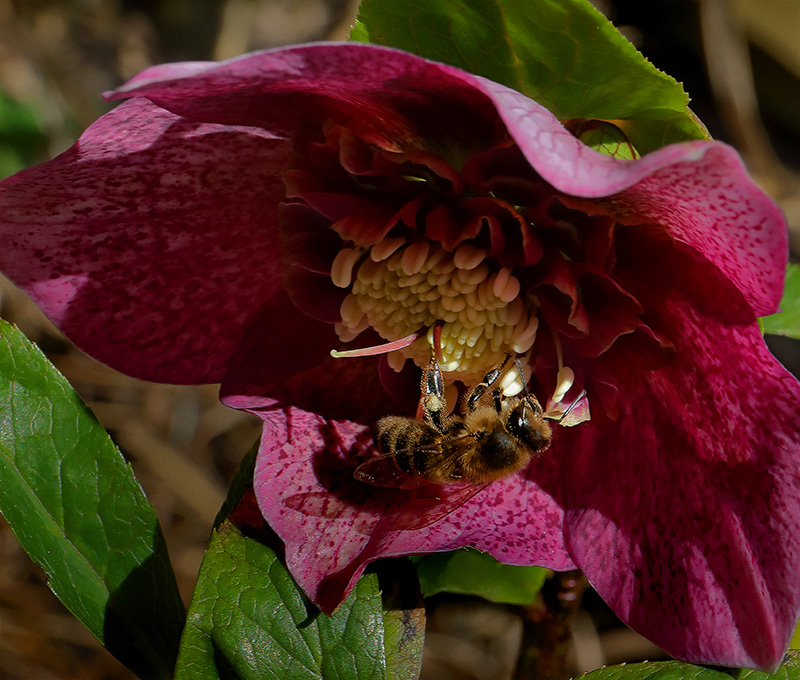
The sudden warmth in the sunshine over the last few days has brought more life to the garden. The birds have been singing and busily getting ready for spring for a little while. Now they’ve been joined by the first of the butterflies (peacock and brimstone so far) and both bumblebees and honey bees.
I hope the insects won’t be caught out by cooler temperatures next week and some sub-zero nights yet to come. Last year was a bad one for bees and butterflies here, so they really need better conditions this year to boost their numbers. While there’s not much that I can do to protect them from a change in the weather, I can at least try to provide early-flowering plants so that they have something to feed on.
Currently there aren’t very many plants that are in flower here. The viburnum bushes still have their pink flowers and there several hellebores and some snowdrops and crocuses. But there could be more. Yellow winter aconite for instance, or blue Siberian squill. Chionodoxa (‘glory of the snow’) is another that offers blue flowers. Both it and Cyclamen coum come in a range of other colours, including pinks and white. These would all flower very early and provide food for insects at a time when it can be hard for them to find enough.
There have been a lot of changes in the garden over the last couple of years and I’ve lost a lot of small bulbs (mainly crocuses) by accidentally digging them up while moving plants or changing the layout of borders. I’m hoping that I’ll now have areas settled enough for bulbs to be reasonably safe. One of these areas is where I’ve planted a number of fruit trees. Early spring bulbs should grow well there and enjoy the sun before the leaf canopy appears. I want it to work because our little insect friends need a bit of help. 🐝


 Ann Mackay: Inspired by Nature
The colours of your flowers are powerful and it’s nice to see some early insects out and about. I’m always amazed at how quickly some get active when the temperature climbs, even in winter, when it might be better for them to wait a little longer until there is a reduced risk of frost. But I guess that’s not how things work.
LikeLiked by 1 person
It may be a bit too early for them here still because we have a few cold nights with likely frost to come. It’s been so warm in the daytime that bees and butterflies have been tempted out but it’s going to be colder in a few days time. I don’t clear away all the dead vegetation from last year until the weather feels more reliably warm – I don’t want to evict anything that’s still hibernating!
LikeLiked by 1 person
Leaving leaves and other wilted vegetation during the winter is a proven intervention that helps insects. We do the same. One needs to develop some tolerance for “untidiness,” but it’s well worth it.
LikeLiked by 1 person
Gorgeous photos as always and so lovely to see the first insects emerge!
LikeLiked by 1 person
Thank you Lis! It is such a positive thing to see life returning to the garden – I just hope the weather is kind to them!
LikeLiked by 1 person
So far we’ve seen a few (very big) bumblebees, but only one butterfly – a Small Tortoiseshell. The woodpigeons are getting frisky (nothing new there!), while a female blackbird is gathering dried up leaves and grasses for her nest. Her mate looks on from the birdbath, where he’s busy primping himself. Glory be, spring’s here at last!
LikeLiked by 1 person
Hehe, the woodpigeons here are getting frisky too. It won’t be long before they’re eating the leaves from our lilacs and the plum tree, so I hope they’re not giving themselves extra-big appetites…!
LikeLiked by 1 person
I have seen bees about, but no butterflies as yet. I do hope there will be more butterflies this year, as last year they were very scarce.
LikeLiked by 1 person
Brimstones are one of the early ones here, but I’ve only ever seen a few of them. Peacocks were more numerous, but last year there were very few. Bee numbers weren’t good either, so I’m hoping for a better year too.
LikeLiked by 1 person
So you’re an acolyte of the aconite. It’s strange once again to find you ahead of central Texas in welcoming the insects that spring ushers in.
LikeLiked by 1 person
We’ve had much warmer weather than we’d normally expect over the last week and that has brought insects out of hibernation. There will be a dip back into cooler weather, so I hope that they can cope with it.
LikeLike
The crocus is such a beautiful flower: another of those that we don’t get to see, like daffodils. I’m seeing more butterflies in the past week. They’re still only occasional, like the bees, but small flies and spiders are out and about now; perhaps they sense that our forecasters are right, and the frosts are long gone.
LikeLiked by 1 person
There’s still a chance of frost here but the daytime has been very warm – a combination to possibly tempt the insects out too early! I’m hoping that the nights will be warmer than forecast. Some of our daffodils (we don’t have a lot) have just opened their flowers today – a cheery sight!
LikeLiked by 1 person
a couple of years ago I planted a winter honeysuckle and it’s been a favourite with the bees this last week, although it’s getting past it’s best, my Daphne Odora is fast becoming the next pit stop.
on my way home yesterday I did spot a lone brimstone, brings a joy to my heart .
(Live east Lincolnshire.)
LikeLiked by 1 person
I’d read about winter honeysuckle being good for bees, so it’s great to hear that confirmed – could be something I should have here. 🙂 Lets hope we see lots more butterflies this year!
LikeLiked by 1 person