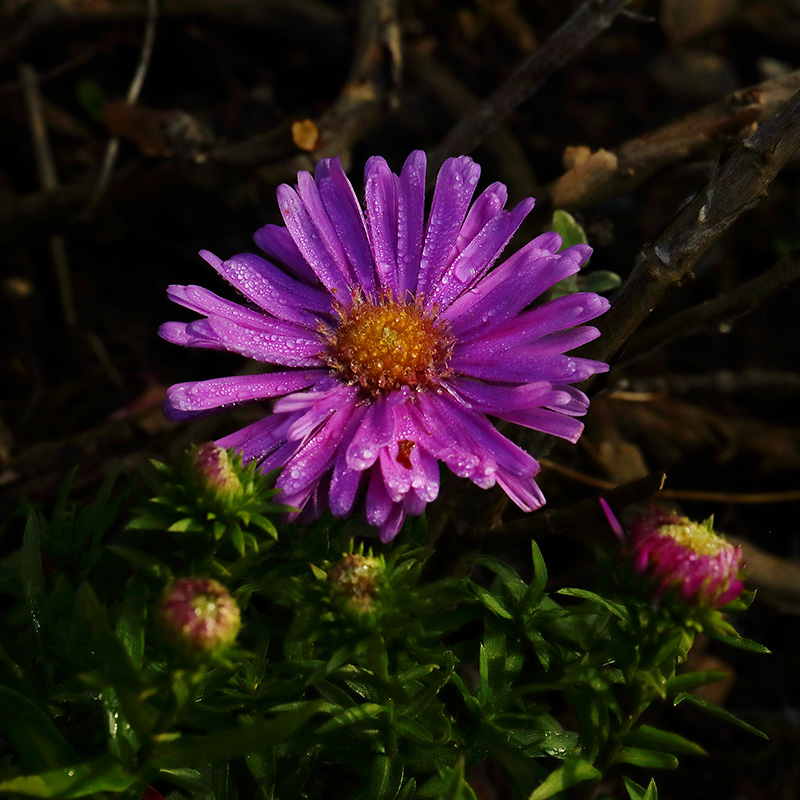
NB: A note for WordPress Reader users – you need to click on the title of the post again to come out of the reader and go to the post itself. This allows you to see the whole of the top photograph. (Otherwise you may see just a tiny section!)
After last week’s post, where I showed you the large-flowered aster I’d like to buy, I decided to show a couple of the asters already in my garden. To be honest, there’s not much other than asters (Michaelmas daisies) left in flower in the garden now. I have several and they’re all providing an uplifting display of colour that helps to combat the sometimes grey days of autumn.
These are two short-growing cultivars. The pink one at the top is ‘Alpha Light Pink’, but the identity of the blue one below is a mystery to me now. (I try to write down the names of the plants I buy, but don’t always remember.) We have a similar plant elsewhere, named ‘Audrey’, but I expect it to be a bit taller than this one. (This one is only about 30cm, Audrey can grow to 50cm.)
Trying to keep track of plant names isn’t easy, but is impossible when friends give you the generous gift of a name-unknown plant from their garden. There must be much-loved plants in gardens everywhere that have been passed around but their cultivar names either forgotten or mistaken for something else. (I have a couple of very pretty taller asters, both given to me by friends, but no idea of their names.)
However, it gets even more difficult when the powers that be decide to change a well-know name for something difficult to say, and usually all but impossible to spell. In this case, many Aster cultivars have become Symphyotrichum – yes, I had to look that one up for the spelling! But it’s more complicated than that. Checking on the RHS site, I read that the Aster genus is now divided into several: Aster, Callistephus, Eurybia, Kalimeris, and Symphyotrichum. Thankfully, they use the common name aster for all!
Does it really matter if the name of a plant is hard to pronounce, is overly complicated, or gets forgotten? Perhaps not so much in the garden, if it’s happy with where it’s growing and it looks good. It does matter when you want to enable someone else to buy the same plant, or to be able to check important details like the size of the plant or its preferred growing conditions. In future I’ll try to keep a better record of plant names, even if it’s just for labelling my photographs and writing this blog!


 Ann Mackay: Inspired by Nature
So beautiful and good for the soul at this time of year! I’d love to think a few late Red Admiral butterflies are visiting them but I know it hasn’t been a great year for them. Still, enjoy those gorgeous colours while they last, Ann! 😊
LikeLiked by 1 person
I do usually see bees on mine, though not so many this year. The colours are lovely and I may be adding to those I have over the next week or two. (We have a visitor coming to stay who likes visiting garden centres – what a great opportunity for a wee bit of plant-shopping! 🙂 )
LikeLiked by 1 person
Indeed, it would be rude to pass up on such a good opportunity! 😂
LikeLiked by 1 person
Indeed it would, hehe! 😁 (And my husband would be confused if I didn’t come home with something…!)
LikeLiked by 1 person
I need some of this cheerfulness in my own garden…
LikeLiked by 1 person
I can recommend it! Asters are amazing at this time of year – long-lasting flowers in a good range of colours. 🙂
LikeLike
In the top aster, the disc florets are similar enough in color to the ray florets that the two areas almost seem to merge. The bottom picture shows the more familiar case, where the center stands out in color against the rest.
LikeLiked by 1 person
I think that being so covered in tiny raindrops make it appear to merge even more. In some of these asters the centres darken as they age, turning from yellow to a reddish colour.
LikeLike
Lovely…lovely…Ann!! Beautiful colours!
LikeLiked by 1 person
Thank you Indira! There are lovely colours around from asters at the moment – I’m hoping to grow a few more in different colours to those I already have. 🙂
LikeLiked by 1 person
I’m happy to call them all asters, Ann, but we seem to have the need to know some beings by a more descriptive name (for me, that’s true with birds). And your point that gardeners want or need to know more details is well-taken.
Maybe you need to start a file with cards that contain the name of any new plant and when you planted it. You could also glue the little labels on the card that come with the plant when you buy it (I assume that’s the same in the UK). I hope it will be fun! 😊
LikeLiked by 1 person
The card index with the plant labels is a good idea, Tanja! For now, I’m keeping a notebook with new plant details. There are a couple of small nurseries here that sell plants for very reasonable prices, but unfortunately don’t always provide precise details of the cultivar. I find that frustrating, but their plants are very healthy, so I’m often tempted by them!
LikeLiked by 1 person
It would definitely be easier to know about the cultivars right from the beginning.
LikeLiked by 1 person
We have a tiny white aster whose center turns from yellow to red, and it’s quite striking when a large stand of them develop those ‘multicolored’ centers. I was absolutely delighted to find a purple aster this weekend, even though it’s also quite small — just about a half-inch in diameter. I’ve not identified it yet, but you know what it’s like trying to ID asters. I think of these beautiful ones of yours as Michaelmas daisies.
I have a silly way of remembering Symphotrichum. It’s a mental question and answer: “Are you going to the “sympho’ny?” “I’ll “tri,” “chum.” It’s a trick I first learned as a kid, when I learned how to spell chrysanthemum; I turned it into the anwer to “Who’s coming to dinner?” “Chrys an the mum.” Silly, but it’s stuck with me!
LikeLiked by 1 person
It must be lovely to find a large stand of asters growing in the wild. The white ones with their coloured centres sound beautiful and purple is always beautiful to me. Your spelling trick makes me smile!
LikeLike
If T S Elliott were still with us do you think he’d do a sequel to the Naming of Cats? Although I guess the Naming of Asters doesn’t have quite the same appeal! 🙂 The colours of the specimens you feature are gorgeous.
LikeLiked by 1 person
Hehehe! I love that idea…or maybe it could be ‘The Re-naming of Plants’. it would probably strike a chord with a lot of gardeners! 😁
LikeLiked by 1 person