
NB: A note for WordPress Reader users – you need to click on the title of the post again to come out of the reader and go to the post itself. This allows you to see the whole of the top photograph. (Otherwise you may see just a tiny section!)
Back in August I posted about taking part in the annual ‘Big Butterfly Count’ which is held by UK charity Butterfly Conservation. The results of the nationwide count have now been published and they confirm that the UK has indeed had a very bad summer for butterflies. So much so, that the charity has labelled it a ‘butterfly emergency’.
This year’s count recorded the lowest number of butterflies in the 14-year history of its existence. A total of just over 935,000 butterflies and day-flying moths for 2024 was a drop of over a third in comparison to the figure of over 1.5 million for 2023. The average number of butterflies seen per count fell from last year’s 12 to seven for each count this year and there was also the highest ever number of counts where no butterflies were seen (9,000).
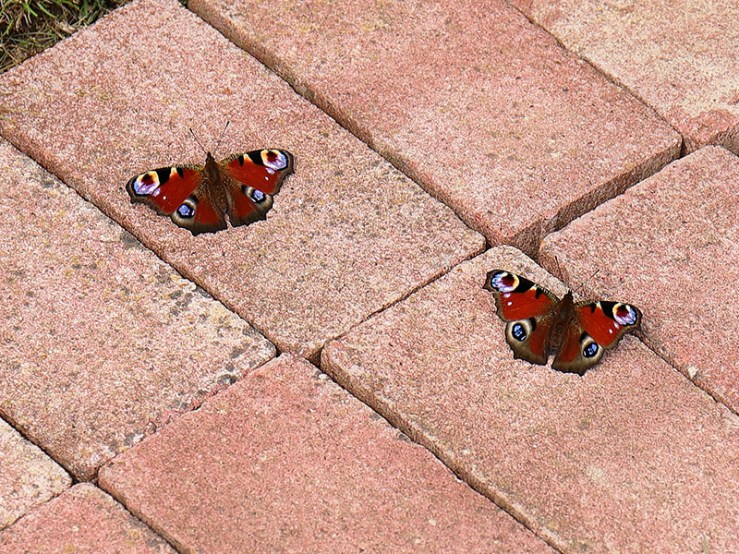
While habitat loss and this year’s wet and initially cool summer must both be at least partly to blame for the dramatic drop in butterfly numbers, Butterfly Conservation is seriously concerned about the effects of pesticides. Head of Science at Butterfly Conservation, Dr Richard Fox, said that neonicotinoid pesticides used on farmland can contaminate the wild plants growing around the edges of fields, killing the butterflies and moths and their caterpillars that feed on them.
In an effort to protect future generations of butterflies (and of course, other insects), Butterfly Conservation is calling for a complete ban on neonicotinoid pesticides in the UK. (They were banned in 2018, but an exception was made for their use on sugar beet.) The request for the ban is being made in an open letter to the Secretary of State and they are asking UK residents to support that request by signing their letter. You can find the letter here. (And you can see the full report on butterfly numbers here.)
The photographs in this post weren’t taken this year, but in 2020 and 2021. This year there were very few butterflies in my garden, so I had very little chance to photograph any. Like many people this year, I noticed that my garden was unusually empty of butterflies, bees, and the other insects that I normally expect to see here. (The small tortoiseshell in my top photo was one of England’s worst-affected species with a drop of 72% from the numbers in last year’s count. Holly blue numbers fell in England by 80% and red admirals by 82%.)
I hope that those who can sign this letter will do so – it’s a small chance to do something that may help preserve all of our insects, not only the beautiful butterflies.


 Ann Mackay: Inspired by Nature
Thank you Ann for sharing the worrying news about the Big Butterfly Count. Let’s hope the letters to the Secretary of State have some effect on stopping the use of neonicotinoids. I too published a blog about the same issue a few days ago.
Thank you for your weekly posts- I always enjoy reading them on Sunday mornings.
LikeLiked by 1 person
I’m glad you enjoy the posts! It’s somewhat disheartening when you garden for wildlife but are (as I am) close to farmland where neonics are used on sugar beet. But at least our gardens can be little oases of safety for insects and will hopefully help. I read your excellent post – it was very interesting to learn that caterpillars need a cold winter to maintain dormancy. I imagine that may become a big problem if our winters are becoming milder. (I tried to leave a reply but it failed, so I’ll try through the WP reader this time…)
LikeLike
We too here in Birmingham have noticed this. We are surrounded by gardens, green spaces, and many trees [Birmingham although managing to bankrupt itself is very good at tree planting] but the numbers of butterflies and various hoverflies in particular are so low this year. Basically it can only be described as a total collapse in numbers. Our giant self seeded hebe was a success, feeding a good amount and variety of bees, but really that was the only good news. Thanks for posting this Ann, lovely images as usual!
LikeLiked by 1 person
Thanks Stephanie, glad you enjoyed the pics! Yes, there has been a massive drop in all insects here and like you, I especially noticed the lack of hoverflies. Our spring had started off fairly well with lots of bees on a very spreading ajuga (bugle), whose spikes of blue/purple were thronging with bees. Then the bees seemed to just disappear…it’s very worrying.
LikeLike
Sorry to hear about the huge drop in the count from 2023 to 2024. Aside from gradual warming, did some specific event precipitate the steep decline?
LikeLiked by 1 person
I think it’s a combination of things, Steve. Habitat loss is going on all the time, so will always be a factor. We had a very wet early summer, which was also very cool in many places and this made a big difference this year. Pesticides are, of course, a factor and is one of the few things that we have some control over. East Anglia, which includes Suffolk, is an area that produces a lot of sugar beet (we have a local factory that processes it into sugar) and it is for this crop that the exception allowing the use of neonicotinoids has been made.
LikeLike
A point to ponder…. Beautiful butterfly pics though.
LikeLiked by 1 person
Thanks Indira! It is indeed a point that needs thought – and action too, if we are to help our fellow creatures survive!
LikeLiked by 1 person
Beautiful photos as always, Ann, but a very worrying story. Since returning to Shropshire at the beginning of the month after living in France and northern Spain for several years, I have been stunned at the apparent lack of insects in general. One of the reasons for coming back, though, is that I feel in a much stronger position to stand up for nature in my own language and culture, something I think is essential now if there is any chance of halting these serious declines. Thankyou for an illuminating post and naturally I’ve added my voice to the open letter!
LikeLiked by 1 person
Thank you Lis…and as you say, it is very worrying. I’m struck by how many people have said that they have seen very few insects around this year. It’s been easy to see that we have far fewer butterflies and bees this year, but everything else seems to have been scarce too. Usually we’d see lots of hoverflies and beetles on the plants here but I’ve seen hardly any this year, and I haven’t noticed any bats out hunting in the evening either. It does, however, hearten me to see that many others, like ourselves, care about this issue and want to do whatever we can to help these creatures. I hope other will join us in acting for nature!
LikeLiked by 1 person
That’s a sorry and shocking state of affairs, Ann. We know about our destructive ways yet don’t seem able or willing to do anything about it, at least not on a large scale.
I agree that we have influence over our own little gardens, but what good does it do when our neighbors, on a small and large scale, kill every insect in sight. I’m very discouraged and don’t think we are doing enough. 😢
LikeLiked by 1 person
I think you’re absolutely right, Tanja. I feel particularly frustrated by knowing that while I try to garden for insects, at the same time they are dying on the farms around here that grow sugar beet and use neonicotinoids on them. Hence the need to write about it and hope that it makes more people aware of the risks to nature.
LikeLiked by 1 person
I hope so too, Ann.
LikeLiked by 1 person
When it comes to neonicotinoid use, even best-intentioned people here get led astray. I can’t remember if I mentioned this to you or to someone else, but many of the growers supplying plants to our big chain stores use them. People buy their impatiens or whatever, take them home, and plunk brand new, pesticide laden plants into the ground. They know enough to want to help the pollinators, but haven’t yet learned that not every commercial grower has the same concerns.
LikeLiked by 1 person
Yes, that’s something that worries me too. There’s no way of telling if they’ve been used on the plants you buy – even if you ask, will that person actually know or be truthful? It’s a gamble! I realise that I may need to start growing more things from seed.
LikeLiked by 1 person