
NB: A note for WordPress Reader users – you need to click on the title of the post again to come out of the reader and go to the post itself. This allows you to see the whole of the top photograph. (Otherwise you may see just a tiny section!)
‘Where are the butterflies this year?’ I’ve heard that question from many folk here in the UK this year. The rain and lack of warmth earlier in the summer have been blamed, especially after the previous very wet and windy weather in the spring.
It has become warmer and more summery recently but there still aren’t many butterflies around. At this time of year I take part in the ‘Big Butterfly Count’, run by the UK charity, Butterfly Conservation. Butterfly Conservation has reported that the numbers of butterflies recorded this year are the lowest ever in the 14 years of holding it. Although the poor weather has made it hard for butterflies to fly and to mate this year, their numbers have already been in decline in recent decades. Much of this is attributed to the loss of habitats, pesticides, and now a changing climate.
My photographs here were not taken this summer, but in previous years. There simply haven’t been enough times when I’ve seen butterflies in the garden to be able to photograph them. For my count here, it was noticeable that there was a huge drop in the numbers of those that are usually the commonest. There was only one peacock butterfly and no red admirals at all. (I have in the past seen a dozen peacock butterflies sunning themselves on our brick path and around the same number of red admirals feasting on a buddleia.)
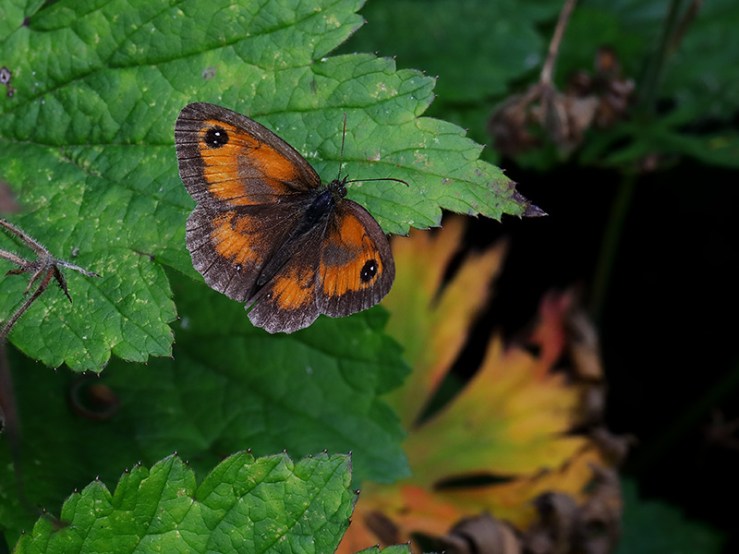
For one particular butterfly – the gatekeeper (below) – there was actually a slight rise in numbers. This year I saw five of them during the 15-minute count. Last year I think it was three. (We are probably seeing more of these because we now have both blackberries and thyme in the garden for the adults to feed on.) Other butterflies – large white, small white, and comma (top photo) were sighted but, again, in fewer numbers. There was a single brimstone, which I’ve only seen once during a count, but no small tortoiseshell this year.
It’s not just a poor year for butterflies here, but for bees too. Normally there would be lots in the garden, but now there are very few. (Spring was good at one point, and I noticed that the ajuga was absolutely buzzing while it was in flower.) I hope that the insect numbers will be able to recover in warmer years, but I feel that I may need to do more to provide both habitat and food to encourage these visitors. In particular, I’d like to grow food plants that will be available over a longer period, especially for any late-arriving butterflies and bees. 🦋

 Ann Mackay: Inspired by Nature
Sorry to hear about the 14-year low in your butterfly count. Let’s hope it’s a fluctuation rather than part of a trend. Your plan “to provide both habitat and food to encourage these visitors” sounds like a good measure.
LikeLiked by 1 person
Butterfly numbers are said to have been going down since the 1970s, so it’s worrying to think that the decline may be accelerating. I’m hoping that this year’s low is mostly due to the weather.
LikeLike
Sadly, it’s the same here in Derbyshire. I’ve never know such a bleak summer for butterflies. I don’t think I’ve seen a single comma, peacock or red admiral in our garden, although like you I’ve seen a few more gatekeepers than in other years. Just one small tortie has shown up so far. And moths are notable by their absence. In other summers I’m always rescuing moths that fly into our bathroom in the late evening, when the light’s on and the window’s open. Last night was the first time in 2024 that I’ve had to perform that duty. Bumblebees have been around in reasonable numbers, but other bees, hoverflies etc have been almost completely absent. The buddleia is flowering profusely, but for most of the time is an insect-free zone. It’s heart-breaking.
LikeLiked by 3 people
It really is heart-breaking. It feels like insect numbers are becoming so low that a bad year like this may be very hard for them to recover from. They’ve become so vulnerable now! Like you, I have seen very few moths. I haven’t seen the bats that usually fly over our garden in the evening to catch insects. It must be affecting birds badly too.
LikeLiked by 2 people
Your Gatekeeper is beautiful. I saw one a week ago but didn’t have a camera.
LikeLiked by 1 person
Thanks Jude! Usually the butterflies are too quick to move away, so I’m lucky if I manage to catch them in a photo! 🙂
LikeLiked by 1 person
Ooh…climatic changes may be affecting the butterflies. The ones in the pictures are so lovely!!
LikeLiked by 1 person
I think you’re right, Indira. The weather here has been very different this summer – much more rain and cooler than usual. It makes life very difficult for butterflies and bees!
LikeLiked by 1 person
I’m sorry to hear about the absence of pollinators from your garden. I haven’t been out and about for a while, but I had quite the opposite experience the last time I visited the refuges; there were so many butterflies of various sorts I couldn’t have counted them. Thinking back, I do remember times in the past decade when they seemed remarkably absent; I suppose that weather does affect them, particularly as it either encourages or discourages the plants they rely on. From that perspective, your thought of planting specifically for pollinators seems the best approach.
Pollinator gardens are quite the thing here, and various organizations are funding them as well as offering other kinds of encouragement. Many schools now have them, and it’s a great way to educate the kids on the value of pollinators and the threats to them.
LikeLiked by 1 person
That sounds amazing, Linda – how lovely to see lots of butterflies. I think our agriculture means that there are few wild areas as habitats with food plants. But there is a growing awareness of the problem. For the past couple of years our local council has been allowing many open areas to become mini-meadows, including the green outside the houses on this road. Eventually it should help a little.
LikeLiked by 1 person
How sad! I hope they return and are able to recover their numbers. Kudos for your motivation to offer more host plants, especially during thin times of the year. I’m glad there are people like you caring about the butterflies and the bees and other pollinators. -lisa
LikeLiked by 1 person
I hope they do, Lisa. This has been an odd year with some very wet and windy spells which will have affected their ability to breed, so they really need a good year next year. I think that many gardeners are now thinking about how they can provide for wildlife in their gardens and I hope that we can make a difference. 🐝
LikeLiked by 1 person
These long-term declines of butterflies and bees (and birds) is very concerning. Each of us needs to do what we can in our little gardens, but if pesticides are applied across huge areas and habitat is destroyed on a vast scale, our little efforts likely won’t be enough.
LikeLiked by 1 person
I agree, Tanja. We need to see pesticide use cut back everywhere. The lack of butterflies is an indicator of what is happening to wildlife generally and it looks bad for the future.
LikeLiked by 1 person
😢
LikeLiked by 1 person
[…] in August I posted about taking part in the annual ‘Big Butterfly Count’ which is held by UK charity […]
LikeLike
Your top photo on this post (butterfly on blackberry fruit) is stunning. Do they actually feed on the fruit?
LikeLiked by 1 person
Thanks Liz! Yes, butterflies do feed on blackberries, so I made sure to leave plenty for them. It feels good to be able to share our crop with them. 🙂
LikeLiked by 1 person
Very generous of you!!!!!!
LikeLiked by 1 person