NB: A note for WordPress Reader users – you need to click on the title of the post again to come out of the reader and go to the post itself. This allows you to see the whole of the top photograph. (Otherwise you may see just a tiny section!)
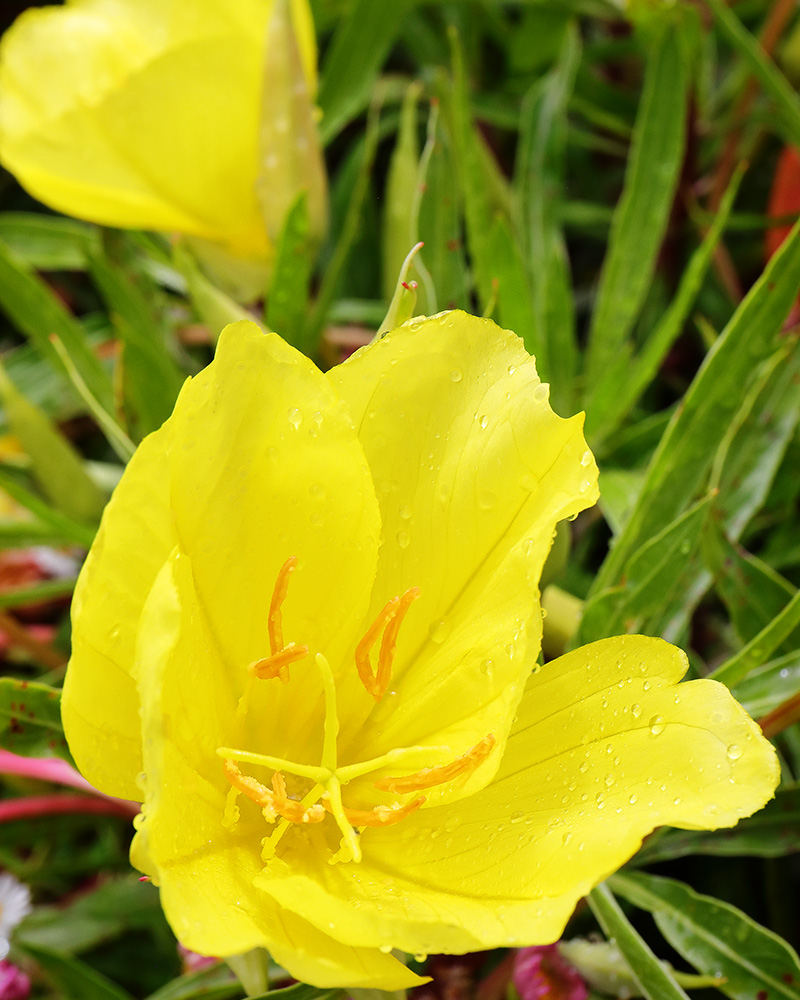
During a recent break between rain showers, I went into the garden to take as many photos as I could of the raindrop-adorned plants. These evening primroses stood out as looking particularly sunny after a grey day. This one is Oenothera macrocarpa (Missouri evening primrose), which is quite different to the tall evening primroses that also grow here.
The biggest difference between this and the other evening primrose in our garden (which I believe is Oenothera stricta ‘Sulphurea’) is the growth habit. The Missouri evening primrose is an easy neighbour for the other plants in the border, spreading slowly on low, lax stems. It causes no problems for the other plants around it. ‘Sulphurea’, on the other hand, can be a bit of a thug because it can self-seed in such great numbers that it blocks light from the other plants beside it.
I made the mistake of letting many of Sulphurea’s seedlings remain in an area where they have now created a screen that hides the neighbouring shorter plants. Oops! They’ll have to be removed and I’ll spread the seed from them in a semi-wild area where the other plants are tall enough to compete.
Meanwhile, the Missouri evening primrose that you see here is behaving beautifully, so I’m likely to plant more of this one. Then there will be plenty of zingy yellow flowers to brighten the days when the sun is sulking behind clouds.


 Ann Mackay: Inspired by Nature
Despite the common name Missouri evening primrose, Oenothera macrocarpa is native in central Texas as well, including my county. Another vernacular name for it is fluttermill, based on the seed capsules, I believe. It’s hard to beat the flowers’ blast of bright yellow.
LikeLiked by 1 person
I’m intrigued by the ‘fluttermill’ name, Steve. It makes me think of a butterfly. The strong yellow really brings the border to life!
LikeLike
Here’s what Ellen D. Schulz wrote in her 1928 book Texas Wild Flowers: “children use the larger, 4-winged seed pods for water-wheels, by running a wire through the axis and placing them in running water.” She agreed with you: “The gorgeous, golden blossoms make an effective addition to any rock garden.”
LikeLiked by 1 person
Sounds like fun – I used to love playing in water as a kid! 🙂
LikeLike
Oenothera macrocarpa is native here, although it’s limited to the central part of the state. It is beautiful, and you’re right that its sunny appearance (like so many of these primroses) makes it a wonderful addition to the garden or landscape. I smiled at the little ant in the center of this one; it’s lagniappe!
LikeLiked by 1 person
It would be a lovely sight in the wild and it makes a great garden plant too. I was amused to see that the ant had found itself somewhere dry , right in the centre of the flower.
LikeLiked by 1 person
Brilliant! Love the yellow … and the raindrops ☺️
Thanks for the info, we have wild Peruvian primroses here, but I don’t know how they are related to other primroses.
LikeLiked by 1 person
I hadn’t heard of Peruvian primroses before so had to satisfy my curiosity by Googling the plant. Apparently it’s in the Onagraceae (evening primrose) family, so they must be pretty closely related. However, our common primrose (Primula vulgaris) is in a different family, the Primulaceae. 🙂
LikeLiked by 1 person
So interesting,Ann. Thanks!
LikeLiked by 1 person
I love yellow, and these flowers are delicate, and strong. I paint flowers when I have the time.
LikeLiked by 1 person
They’re a lovely subject to paint. I sometimes do printmaking using flowers as the subject – haven’t had time for it for a while though!
LikeLike
I didn’t see the rain drops until just now. Wow.
LikeLiked by 1 person
The raindrops have been an added extra this summer – love it when they sparkle in the sun.
LikeLike
I love these flowers. Yellow is a favorite color for me.
LikeLiked by 1 person
These are a great yellow – it stands out and looks good with the other colours around it. 🙂
LikeLike
They are so bright I need my sunglasses. 😎
LikeLiked by 1 person
They really are bright – even more so today while the sun is shining!
LikeLiked by 1 person
I love all evening primroses, including the fact that they come in so many different colors.
LikeLiked by 1 person
Warm and cheerful yellow! Lovely pictures, Ann!
LikeLiked by 1 person
Thank you Indira! This plant has done well this year and produced lots of flowers. 🙂
LikeLiked by 1 person
These are beautiful.
LikeLiked by 1 person
Thank you! The colour brightens everything up! 🙂
LikeLike