
NB: A note for WordPress Reader users – you need to click on the title of the post again to come out of the reader and go to the post itself. This allows you to see the whole of the top photograph. (Otherwise you may see just a tiny section!)
After last week’s post about blue/purple aquilegias, I decided that the pink ones deserved a little attention too. Like the blues and purples, pinks also vary in colouring and add to the interest and diversity of the garden at this time of year. The darkest flowers (above) are my favourites, but the other aquilegias range from those that are just the palest of pinks, like the one below, to medium pinks and others that are closer to red.

Amongst the aquilegia flowers, I was intrigued to see that some of the pale pink flowers had random patches of a darker pink on their petals. Strange! It’s something I’ve seen elsewhere too, but I can’t remember seeing it on other flowers. I wonder if it’s just aquilegias that do this? (Hmm, there must be other flowers that do…) Perhaps it shows how mixed their colour genes are.

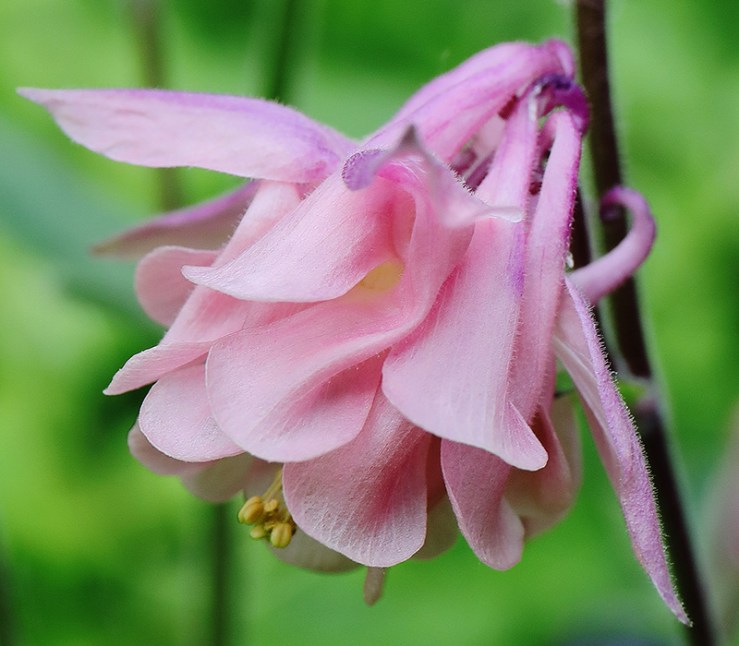
Not only do the colours vary in their flowers, the shape can too. You can see how aquilegias got one of their common names from the shape of the double flower below. It does indeed look like an old-fashioned ‘Granny’s Bonnet’. I hope that there will be plenty of seedlings from this year’s aquilegias – I’d love to have a great mix of colours and flower forms again.

 Ann Mackay: Inspired by Nature
Beautiful.
LikeLiked by 2 people
Thank you! 🙂
LikeLike
You certainly have a lovely selection of aquilegias, no wonder you get so many great seedlings. Are you going to Lavenham Open Gardens today?
LikeLiked by 2 people
Yes, Chloris – I’m looking forward to going round the open gardens there today. (Not taking my camera though – it feels a bit intrusive in smaller private gardens.) We went round the Lavenham gardens a few years ago and they were beautiful.
LikeLiked by 1 person
I just got back. I specially loved 21 and 25, both friends of mine and great gardeners. And 6 was amazing too, quirky and fun.
LikeLiked by 1 person
We just got home too – after a marvellous day and a lot of walking. Both 21 and 25 were lovely – I notice that I put a reminder on my gardens map to tell me to note 21 for the future… 🙂 I especially loved visiting 6 because a keen gardener friend who lives on the other side of the road brought me there a few years ago, when it was fairly newly-planted. It was great to see it again as a mature garden – I really enjoyed that one!
LikeLike
The last one is particularly beautiful. I hadn’t realised until recently how many shapes and sizes these plants came in.
LikeLiked by 2 people
We ended up with a lot more of them when we were in Scotland because I made a point of scattering the seeds all over the place and they grew very easily there. I even got a bicolour that was white and a very dark purple, a bit like the variety ‘Magpie’. I have a long way to go here before we have as many!
LikeLiked by 2 people
Your inclusion of the double flower prompted me to find out more about that phenomenon. According to the relevant Wikipedia article (https://en.wikipedia.org/wiki/Double-flowered#), “Double flowers are the earliest documented form of floral abnormality, first recognized more than two thousand years ago.”
LikeLiked by 2 people
That’s interesting, Steve. And of course, plant breeders have been encouraging it for a long time. (Though I usually go for the single flowers when I buy a plant, so that the bees can get at them…🐝)
LikeLiked by 1 person
My favorite color is that very subtle combination of yellow and pink in the second photo, but I must say the texture of the petals in the last photo appeals as well. That one’s petals seem differently shaped than the others. Perhaps it’s at a different stage of development, or perhaps it’s just a natural variation.
LikeLiked by 1 person
I think that last one would change a bit as it opens out more, but the shape is different – as you suggest, a natural variation. I was happy to find an aquilegia with very pale blue flowers yesterday. The flowers on that one are very small though – maybe because it’s having to compete so much with surrounding plants. I’ll have to hope that the plant is bigger and better established next year and may have bigger flowers. 🙂
LikeLiked by 1 person
Another colour mystery with regard to these flowers, Ann! We will need to try to learn about how those colour genes are passed down.
LikeLiked by 1 person
I love the way they produce variations so easily…and without any effort from me! (But lots of work from the bees.) 🙂
LikeLike