
NB: A note for WordPress Reader users – you need to click on the title of the post again to come out of the reader and go to the post itself. This allows you to see the whole of the top photograph. (Otherwise you may see just a tiny section!)
Late spring is the time when Aquilegia vulgaris flowers in my garden. It self-seeds in great numbers, so I never know where it’ll pop up next. (Although I do try to give it a helping hand by scattering the seeds where I’d like them to come up.)
Their enthusiasm for self-seeding and the ability to cross-pollinate easily with other aquilegias means that new flower colours appear frequently. In my previous garden, in Scotland, I ended up with quite an array of pinks, blues and purples in many shades, as well as white. Sometimes the flower shape varied too, with double flowers appearing.
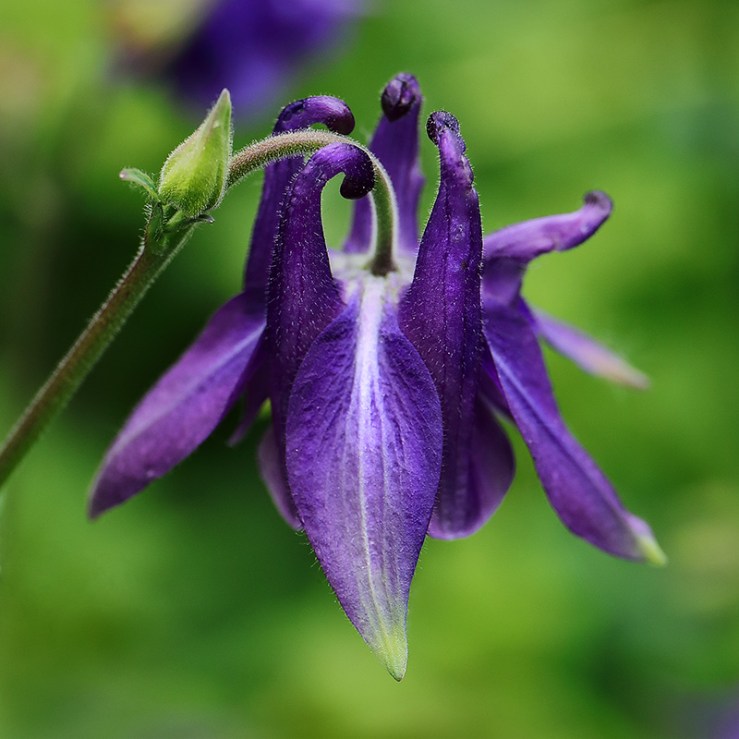
The conditions here in Suffolk are a bit on the dry side for aquilegias, which prefer a moist soil. However, too much moisture in a wet spring or summer can lead to ‘Aquilegia downy mildew’, which can kill the plants. (RHS info is here.) So I’m a bit worried about all the rain we’re having right now! I lost a number of aquilegias to this disease around five years ago and it has taken a long time to start to build up the collection of colours again. Currently there are several plants in the purple/blue range and a number of pink-flowered plants.
You can see how the colours here vary between the pinkish-purple at the top, through to a darker flower above, which has more deep blue in it. The lighter-coloured flower below (photographed a few years ago) was one of the closest to blue so far. It will be interesting to see whether we ever get a stronger blue. Meanwhile, I need to go out and photograph the pink aquilegias…let’s see what I can find!


 Ann Mackay: Inspired by Nature
I love purple flowers! These are beautiful.
LikeLiked by 1 person
Thank you! Purples and blues are my favourite flowers in the garden, so I love to have lots in those colours. 🙂
LikeLike
In a post 5 years ago you discussed the origin of the name columbine. The American Heritage Dictionary says it’s “from the resemblance of the inverted flower to a cluster of doves.” Somebody had a good imagination.
LikeLiked by 1 person
Indeed they did, Steve! Though some see an eagle’s talons in the shape of the hooked petals, hence the name ‘Aquilegia’. 🙂
LikeLike
I’d never heard of this one, and I was quite surprised to see that one common name is Columbine. Even though it’s native there, the Missouri Botanical Garden says that it’s naturalized in the eastern U.S. because of ‘escapees’ from gardens. They also mentioned the self-seeding, and the cross-pollination that creates color variations. It will be interesting to see if you begin to get some of those new colors!
LikeLiked by 1 person
I discovered a very blue one while weeding yesterday…didn’t even know it was there amongst some taller plants. So I’m hopeful for more blues in future! 🙂
LikeLiked by 1 person
I have a few of those popping up, strangely often in pots.
LikeLiked by 1 person
Hehe, they get themselves everywhere!
LikeLiked by 1 person
Lovely flowers with rich colours!
LikeLiked by 1 person
Thank you Indira! It’s fun to see what colours come up each year. 🙂
LikeLiked by 1 person
Your columbines are beautiful, Ann. I hope they won’t be adversely affected by too much rain.
Colorado’s state flower is the Colorado Blue Columbine and it’s lovely to come across one during a hike in the mountains. It’s also a popular addition to a wildflower garden and we have a number of them along our driveway. Interestingly, the flowers have a tendency to turn yellow with time, even if they started out blue. Do you know how that happens?
LikeLiked by 1 person
Thank you Tanja! Everything’s growing like mad here after the rain. 🙂 The Colorado Blue Columbine is especially beautiful and the colour change is intriguing. I’ve no idea why but would suspect it’s just the aging process. Maybe it takes energy from a plant to maintain flower colour? It would be very interesting to know!
LikeLiked by 1 person
Thanks for sharing your thoughts, Ann. I was outside weeding among the columbines this morning and thought about that intriguing question of their color. If I learn the explanation, I will let you know!
Enjoy what sounds like a thriving garden.
LikeLiked by 1 person
Wonderful! Yes you are right best blue it was! Well shared
LikeLiked by 1 person
Thank you Priti! I’m hoping for more purples and blues next year. 🙂
LikeLiked by 1 person
💐
LikeLiked by 1 person
[…] last week’s post about blue/purple aquilegias, I decided that the pink ones deserved a little attention too. Like […]
LikeLike