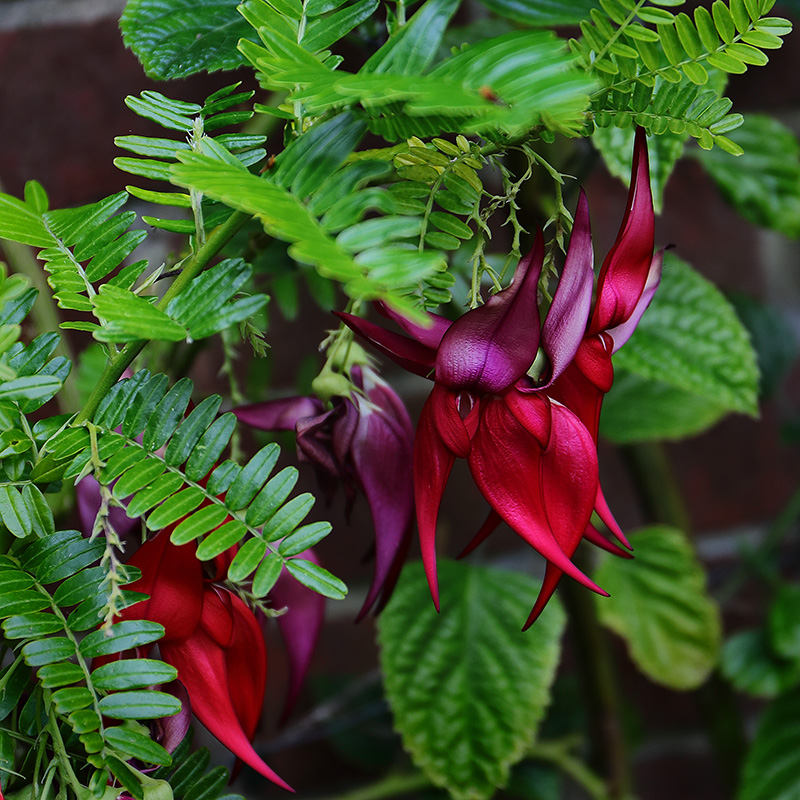
NB: A note for WordPress Reader users – you need to click on the title of the post again to come out of the reader and go to the post itself. This allows you to see the whole of the top photograph. (Otherwise you may see just a tiny section!)
The sight of unfamiliar flowers and plants is one of the perks of visiting other people’s gardens. You never know what you may see. The plant shown here was one of the more surprising encounters I had when I saw it for the first time in a Norfolk garden four years ago. I had absolutely no idea what it was, but it looked strange and exotic to me.
This plant, with its weird flowers, felt like something that belonged in a botanic garden glasshouse, rather than outside in a British garden. It seemed too exotic to be hardy. Much later I found out that it was a Clianthus and will grow in a sunny position in mild areas. (The RHS says it can tolerate down to -5°C and suggest a cool greenhouse or conservatory for colder areas.)
Clianthus has several common names: glory pea, lobster claw and, from its native New Zealand, ‘kaka beak’. (Named after an NZ parrot, this colourful name is my favourite!) Growing against a wall, the plant looked like a climber, but is in fact a scrambling shrub. It’s a member of the pea family and has two species and a number of cultivars. (I don’t know what this one may be, possibly a cultivar, because it seems to develop more pink/purple in the fading flowers than I’ve seen in photographs of the species.)
I’m always pleased to get the opportunity to photograph a plant that I’m unlikely to be able to grow at home. I wonder what this year’s garden visits may allow me to photograph…🌿


 Ann Mackay: Inspired by Nature
The color is wonderful. To me, the shapes resemble a ristra: a traditional string of drying chile peppers, but all of the names are fun and descriptive. When I looked up the genus on the USDA site, although it noted that this one isn’t part of the U.S. plant world, they did provide ‘glory pea’ as the common name.
LikeLiked by 2 people
Oh, yes, Linda, I agree! I’ve seen those strings of drying chili peppers and that’s just what these flowers look like. And I reckon they are probably able to make a good claim to be the glory of the pea family. 🙂
LikeLiked by 1 person
exquisite and unusual…
LikeLiked by 2 people
It certainly is! 🙂
LikeLike
What a lovely photo Ann. I often find New Zealand plants in Cornwall, the climate here seems to suit them. Can’t say that I have come across this one though.
LikeLiked by 2 people
It was something new for me at the time (2020) and seen in a garden that does have a lot of exciting plants: https://eastrustonoldvicarage.co.uk/home It’s a garden I love to visit, just wish it was a bit closer!
LikeLiked by 1 person
I have seen that garden on the TV and would love to visit in person. Didn’t have enough time when we holidayed in Norfolk, maybe another visit to East Anglia is due.
LikeLiked by 1 person
I highly recommend it Jude – one of my favourite gardens.
LikeLiked by 1 person
Never a dull floral moment, Ann. Wishing you many more weird and wonderful discoveries!
LikeLiked by 2 people
Thanks Tanja! I’m hoping for more intriguing encounters in this year’s garden visits… 🙂
LikeLiked by 1 person
I’m sure you will have them!
LikeLiked by 1 person
Fabulous! I have tried this but it did’nt survive the winter in my Suffolk garden.
LikeLiked by 2 people
It must have been great to see, but sad that it didn’t survive. I live in Suffolk too, so I wouldn’t expect it to survive here.
LikeLike
I live in Melbourne, Australia and it’s the 1st time I’ve seen this plant. I’m surprised cause we’re very close to New Zealand. I just bought one from Bunnings (Australian hardware store) with Scarlet flowers. At first I thought the picture of the flowers was chillies 😅
I think this one’s gonna be a standout specimen in my garden
LikeLiked by 1 person
They do look like chillies at first glance! I was surprised to see such an exotic-looking flower here. Hope yours thrives and looks amazing! 🙂
LikeLike
That’s different. Not familiar with that one. It’s nice to encounter a plant you don’t know.
LikeLiked by 2 people
It really made an impression on me to see it for the first time…so different from what you usually see in UK gardens! 🙂
LikeLiked by 1 person
We have a beauty in our garden! It’s in a sheltered spot amongst other trees, and right up against a corrugated iron boundary fence. We get hard frosts and sometimes snow, so they’re reasonably hardy as long as they don’t get too wet. I went looking for an article for you and found a blog-post which is very informative and a good read. I’ll put the link at the end. Despite the reported opinion of one person near the end of that post, I wouldn’t put a kakabeak where it’s *too* exposed to strong wind. I tend to look for a spot that’s reasonably sheltered, with light shade and some sun. If right out in hot sun you’d need to take care it doesn’t get too dry in summer. At our last property we inherited a good kakabeak that was growing against a wooden (low) wall. It got loads of sun, but we have a cool climate. You could also consider growing one in a pot. It’s good advice to prune it after flowering – we didn’t and it’s shot up and become very unruly! I rather hope you give one a try, they’re magnificent plants. Here’s the link: https://sandrasgardenblog.wordpress.com/2019/01/03/our-native-plants-kaka-beak/
LikeLiked by 2 people
Thanks for the link, Liz! I grinned at the thought of going up in a helicopter to fire shotgun cartridges full of seed – that’s a very different way of seed-sowing! 🙂
LikeLiked by 1 person