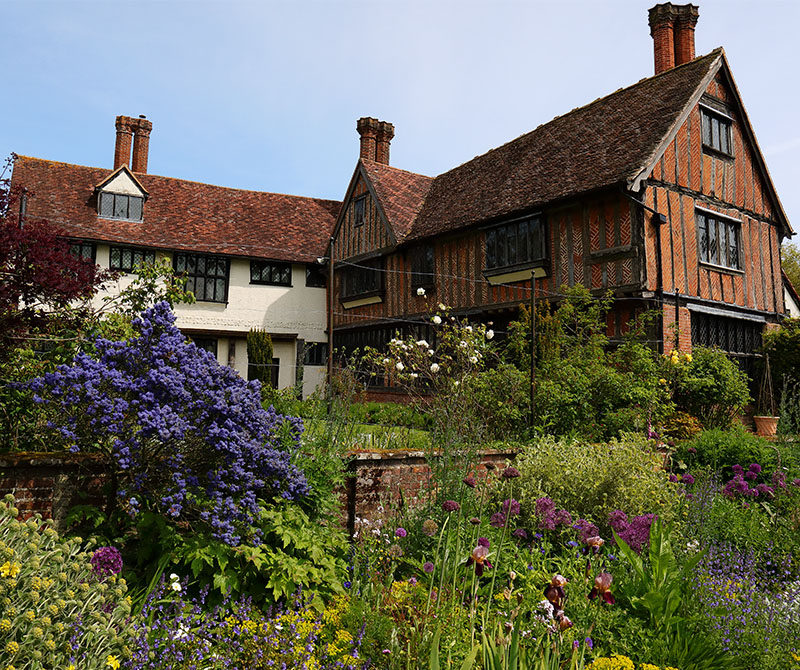
NB: A note for WordPress Reader users – you need to click on the title of the post again to come out of the reader and go to the post itself. This allows you to see the whole of the top photograph. (Otherwise you may see just a tiny section!)
Last year my husband and I joined other visitors on ‘The Great Garden Trail’. This is a summer-long event for which volunteers open their gardens to raise money for the St Elizabeth Hospice in Ipswich, Suffolk. Gardens of all sorts take part in the scheme, big and small, filled with exciting plants, or more modestly planted. Some of the gardens are the setting for interesting historic houses and occasionally there may be a village with many of its gardens open to explore.
Otley Hall turned out to be in the ‘modestly planted’ category. I would have been disappointed if I’d gone there just to see the gardens, but I also love Suffolk’s quaint medieval houses, so the visit was worthwhile.

Built in the early sixteenth century, Otley Hall is said to be the oldest house in Suffolk to have remained ‘largely intact’, with some parts of the building added later in the same century. Timber-framed buildings from medieval times are a feature of Suffolk’s countryside and many of its towns and villages. They make you feel as if you could step back in history by just walking inside them. (But we didn’t go inside this one – it was only the garden that was open on our visit.)

In the garden itself, my attention was captured by the beautiful irises which were in full flower, especially the white iris above, with the little hints of colour, and the blue one below. (Our visit was at the end of May, a little too early for the many roses there to be in bloom.)
The main flower borders edged a croquet lawn, one of several lawns throughout the gardens. Other grassy areas featured a labyrinth, ‘The Mount’ – an artificial mound which allows views of the surrounding countryside, and an H-shaped canal. (The house still has a moat on one side too.)

Otley’s ten acres have a mix of both formal gardens and informal, more natural grounds. For example, near the house there is a small ‘knot garden’ with box hedging and herbs planted up in a classic Tudor-style design. Elsewhere there are woodlands and hedgerows, maintained to encourage wildlife and areas planted up with wildflowers.
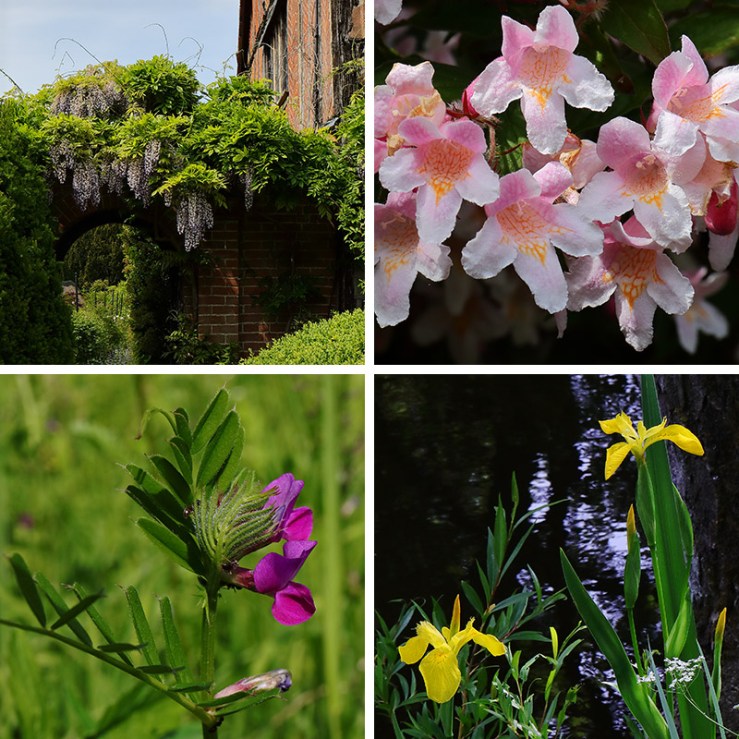
The combination of traditional and wilder areas gives an easy-going feel to a stroll around the gardens of Otley Hall. It’s not the best garden for a plantaholic to visit, but it does offer a pleasant afternoon with the opportunity to see a fine example of a medieval timber-framed house. (It has an excellent cafe too…coffee and cake is an important part of our garden visits!)


 Ann Mackay: Inspired by Nature
Motley Hall seems one of “The Stately Homes of England” that Noel Coward wrote about in his song of that name [https://www.youtube.com/watch?v=8PU2ZDDGzY4]. What a stalwart brick chimney. The house is attractive even when viewed from the back.
Those hints of color in the white iris are particularly nice.
LikeLiked by 2 people
Hehe, first time I’ve heard that song, Steve. Thanks for the link! The white iris is one that I’d be very happy to grow – it is lovely.
LikeLike
Now that’s what I call a chimney!
LikeLiked by 1 person
Yes, it really is massive…a status-symbol of that time I suspect! 🙂
LikeLiked by 1 person
Awesome vintage architecture! Gorgeous flowers!!
LikeLiked by 1 person
Thank you Indira! Photographing a building made a change for me! 🙂
LikeLiked by 1 person
There are neighborhoods — or individual homes — here and there that are very much like Otley Hall: except for the chimneys. I’ve always thought of them as faux Tudor; whether that’s the time period I don’t know, but the half-timbered look was quite popular here in the mid-1900s.
I especially enjoyed seeing the wisteria and the vetch. I like that there are different sorts of areas planted around the house — not to mention the cake and coffee!
LikeLiked by 1 person
Faux-Tudor is a good description for modern houses in that half-timbered style and they were popular in some areas here too. I liked the mix of wild and formal, which means they see quite a lot of wildlife there. (It gives a relaxed and comfortable feel to the grounds too.)
LikeLiked by 1 person
I absolutely love ornate chimneys and old buildings like that one. It looks like a wonderful place to visit. A decent tea room is always a bonus.
LikeLiked by 1 person
It is a lovely place. Like you, I love these quirky old buildings so it was good to be able to see it. (They do events, especially weddings, there – it must be a wonderful venue for those!)
LikeLiked by 1 person
Any day spent strolling in a lovely garden like this one that culminates in coffee and cake is a day well spent. 😊☕🍰
LikeLiked by 1 person
It certainly is – and hoping for more days like it this year! 🙂
LikeLiked by 1 person
I just love to visit with people who lived in a home at that time. Very lovely photos! the irises are incredible. The purple one literally jumps off the screen.
LikeLiked by 1 person
Can you imagine what it would be like to live in a house this age? I reckon it would be quite amazing… 🙂 Glad you like the photos, thank you!
LikeLiked by 1 person
Haha!! I just realized that I had a typo in my comment. Instead of “I love to visit with people”, I meant to say, “I love to envision” the people who used to live in such a house!😉
LikeLiked by 1 person
Aha! That does work better, hehe! 🙂
LikeLiked by 1 person